
Moving to a state without personal income tax sounds like an instant raise for your retirement nest egg, but state governments always collect their revenue somewhere. Zero-income-tax states frequently offset their missing revenue through staggering property levies, elevated sales tax rates, exorbitant home insurance premiums, or inflated healthcare expenses. When you evaluate a potential relocation solely on tax codes, you risk walking directly into a financial trap that erodes your fixed income. By examining the true cost of living across popular retirement destinations, you can protect your purchasing power and build a resilient financial blueprint.

The Mirage of Income-Tax-Free Retirement
Every state requires revenue to construct roads, maintain public safety, finance municipal infrastructure, and fund emergency services. When a state legislature decides not to tax earned wages or retirement distributions, it shifts the financial obligation onto other income streams. According to financial spending data from the U.S. Bureau of Labor Statistics, housing and healthcare consume a significantly larger share of a retiree’s budget than personal income taxes ever do; therefore, a high property tax rate or inflated health service cost quickly wipes out any initial savings on income tax.
Certified Financial Planner™ professional Elena Rostova notes that retirees often hyper-focus on headline tax rates while ignoring localized line items. “You cannot spend income tax savings if those dollars immediately flow into homeowner insurance, local sales levies, or prescription co-pays,” Rostova explains. “True tax friendliness depends entirely on how your specific income sources intersect with a state’s entire tax and pricing architecture.” Evaluating a location requires looking past marketing claims and auditing the full ledger of daily living.
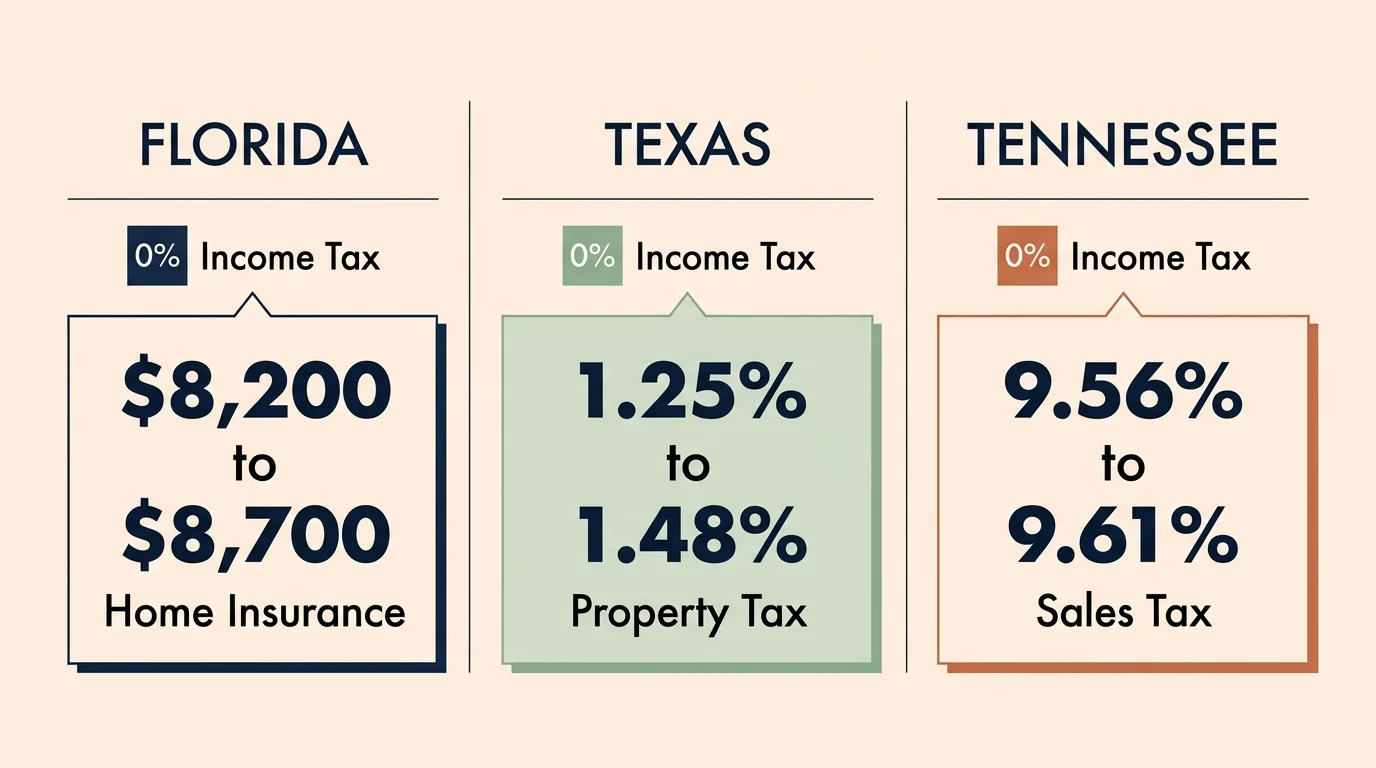
“This infographic shows how states with no income tax offset savings with other high costs.” (16 words)
1. This
2. infographic
3. shows
4. how
5. st
7 “Tax-Friendly” States With Expensive Hidden Costs
1. Florida: Exorbitant Homeowner Insurance Premiums
Florida remains a premier destination for retirees due to its complete absence of state personal income tax and moderate combined sales tax rate of approximately 7%. However, severe weather risks and volatile reinsurance markets have caused catastrophic property insurance increases across the peninsula. Florida homeowners pay average annual home insurance premiums of $8,200 to $8,700—a figure soaring over 180% above the national average. For retirees living on fixed pensions or structured withdrawals, paying $700 or more every month just to insure a home completely neutralizes zero state income tax benefits.
2. Texas: Punishing Effective Property Taxes
Texas boasts no individual state income tax, making it attractive on paper for retirees withdrawing money from traditional IRAs or 401(k) accounts. To fund school districts and county services, Texas relies heavily on municipal real estate taxes, holding the 9th highest effective property tax rate in the nation at roughly 1.25% to 1.48%. The median annual property tax bill in Texas exceeds $4,100, with urban centers like Austin, Dallas, and Houston charging far higher sums. Combined with an average state and local sales tax rate of 8.19%, Texas extracts substantial revenue directly from your equity and transactions.
3. Tennessee: Nation-Leading Sales Tax Burdens
Tennessee fully phased out its Hall Income Tax on interest and dividends in 2021, meaning the state levies zero personal income tax on residents. To offset this, Tennessee imposes an aggressive average combined state and local sales tax rate of 9.56% to 9.61%, which includes a 7% state base tax and local additions up to 2.75%. In Davidson County (Nashville), local authorities elevated the combined sales tax rate to 9.75% effective February 2025. Because sales taxes hit groceries and daily goods directly, fixed-income seniors pay a disproportionately high percentage of their spending to state tax collectors.
4. Washington State: Fuel Taxes and High Sales Levies
Washington State charges no personal income tax on wages or retirement income, appealing to seniors relocating within the Pacific Northwest. However, the state levies a 6.5% base sales tax, pushing average combined state and local sales tax rates to 9.51%, with specific municipal transit districts reaching up to 10.6%. Driving expenses compound this burden; as of July 1, 2026, Washington’s state gasoline tax rose to 56.5 cents per gallon due to an automatic 2% annual inflation adjustment enacted under 2025 state legislation. That rate ranks as the third-highest state gas tax in the nation, steadily driving up transport costs.
5. New Hampshire: High Property Taxes on Rising Home Values
New Hampshire advertises a zero-tax environment for earned wages and retail purchases, having fully repealed its interest and dividends tax effective January 1, 2025. The state relies almost exclusively on local real estate levies to fund public operations, giving New Hampshire the nation’s 4th highest effective property tax rate between 1.50% and 1.77%. With a median single-family home price hovering around $535,000, retirees regularly face annual local property tax bills between $10,000 and $15,000. These steep carrying costs can force retirees to downsize or drain cash reserves unexpectedly early.
6. Nevada: Regressive Sales Tax and Daily Consumption Costs
Nevada attracts thousands of relocating retirees each year with its zero state income tax and vibrant lifestyle. The state funds its balance sheet through tourism fees and heavy consumption levies, charging a 6.85% base state sales tax. Average combined state and local sales tax rates reach 8.24% statewide, climbing to 8.375% in heavily populated Clark County, which encompasses Las Vegas. High municipal sales taxes combine with elevated local utility bills and premium pricing on medical services, steadily raising monthly spending for resident retirees who do not benefit from tourist-driven offsets.
7. South Dakota: Service Taxes and Nation-Highest Healthcare Expenses
South Dakota levies no personal or corporate income tax, presenting an appealing environment for retirees focused on preserving investment capital. However, the state applies its 4.2% base sales tax broadly to many personal services, adding extra costs to everyday professional assistance and maintenance. More critically, national health spending statistics rank South Dakota as having the most expensive healthcare costs per capita in the United States, averaging over $11,700 per person annually for hospital, physician, and care services. These exorbitant healthcare overheads present a serious financial threat to older adults with chronic conditions.

Three Strategy Pillars for Accurate Retirement Budgeting
Income Planning and Revenue Balancing
Proper tax planning requires analyzing where your retirement distributions originate. If your income stems primarily from Roth accounts or pre-tax Social Security, state income tax exemptions offer minimal actual savings. Review guidance from the Internal Revenue Service to calculate your federal tax obligations before choosing a location. Model your projected income against local property tax rates, sales taxes, and home insurance rates to uncover whether a zero-income-tax state truly lowers your annual expenses.
Lifestyle Design and Localized Overhead
Build a comprehensive cost-of-living model that extends beyond basic state tax brackets. Evaluate local transportation requirements, climate control costs, home insurance trends, and annual auto registration fees before making a move. Transitioning to a location with extreme weather patterns can dramatically raise cooling or heating bills while pushing home insurance premiums beyond reasonable limits. Compare neighborhood-level real estate taxes rather than relying on statewide averages, as municipal mill rates vary widely across adjacent counties.
Health and Wellness Infrastructure
Prioritize healthcare access and out-of-pocket medical pricing when choosing a destination. Research published by aging experts at AARP emphasizes that medical expenses routinely represent one of the largest budget variables during advanced age. Evaluate local hospital network density, specialist availability, and regional Medicare Advantage coverage options. Review data provided by the Centers for Medicare & Medicaid Services to confirm that your prospective community provides affordable, high-quality healthcare facilities without excessive local out-of-pocket pricing.

Hidden Risks, Benefit Cliffs, and Financial Safeguards
Relocating across state lines introduces subtle financial risks that can quietly undermine your long-term security. Many states offer generous homestead exemptions or property tax freezes for seniors, but these programs frequently feature strict income caps or multi-year residency requirements. Purchasing a new primary residence often triggers an immediate property tax reassessment based on recent purchase prices rather than historical tax valuations, resulting in unexpected tax hikes during your second year of residency. Furthermore, predatory relocation scams and unaccredited financial advisers frequently target newly arrived retirees. Always verify property tax histories with local county assessors and consult certified fiduciaries before completing an out-of-state purchase.
Frequently Asked Questions
Should you move to a zero-income-tax state if your income consists mostly of Social Security?
If your retirement income relies predominantly on Social Security benefits, moving to a zero-income-tax state rarely yields significant financial savings. The Social Security Administration notes that federal taxation rules apply regardless of state residence, and the vast majority of U.S. states already exempt Social Security benefits from local income taxes. Consequently, moving to a zero-income-tax state with high sales or property taxes could increase your overall cost of living.
How do local homestead exemptions alter your real estate tax burden?
Homestead exemptions reduce the assessed taxable value of your primary residence, which directly lowers your annual property tax bill. Some states offer enhanced exemptions or valuation caps for homeowners aged 65 and older. However, qualifications vary significantly by county, and some jurisdictions enforce income thresholds that exclude retirees taking large traditional IRA distributions.
Why are home insurance premiums escalating rapidly across the Sunbelt?
Insurance carriers in Sunbelt states like Florida and Texas face escalating financial losses from severe weather events, severe storms, and elevated litigation costs. These factors force global reinsurance companies to raise capital rates for regional insurers. Local insurance companies then pass those expanded operational costs directly onto homeowners in the form of higher annual premiums.
What is the most effective way to test-drive a new state before moving?
Rent a property in your target neighborhood for 6 to 12 months before selling your current home. Renting enables you to experience seasonal weather shifts, sample local medical systems, buy everyday goods at local sales tax rates, and interact with the community without committing capital to home buying or paying closing fees.
Take Action on Your Retirement Plan Today
Navigating retirement finances requires making decisions grounded in facts rather than alluring tax headlines. Take charge of your financial future today by auditing your current spending against prospective retirement locations. In the next 48 hours, calculate your true annual tax burden—combining income tax, property tax, sales tax, and property insurance—for your top retirement destination. Comparing these real figures against your present residence will empower you to make a confident, secure move that preserves your wealth and protects your lifestyle.