
Carrying insurance policies you no longer need can drain thousands of dollars from your retirement nest egg every year. While protecting your financial security remains essential, many retirees quietly over-pay for coverage designed for their working years—such as disability insurance, hefty term life policies, or duplicate health add-ons. By conducting a systematic insurance review, you can identify obsolete coverage, eliminate redundant premiums, and redirect those funds toward your actual lifestyle goals. Realigning your risk management strategy ensures your money works for your present reality rather than your past liabilities, leaving you with greater liquidity and peace of mind throughout your golden years.

The High Cost of Outdated Coverage in Retirement
When you transition from building wealth to preserving it, your risk profile changes radically. During your working career, insurance protects your future earning power, covers large household debts, and provides for dependents. Once you enter retirement, those primary risks naturally diminish or disappear entirely. Data from the Bureau of Labor Statistics highlights that housing and medical care consume the largest shares of a retiree’s budget; allocating scarce dollars toward unnecessary insurance premiums undermines your long-term financial stability and reduces your disposable income for active daily living and personal fulfillment.
Unfortunately, many retirees fall into the trap of auto-renewing policies year after year without evaluating whether those contracts still serve a purpose. Insurance companies rarely reach out to tell you that you no longer require a specific rider or policy type. Over a decade of retirement, maintaining redundant policies can cost you $10,000 to $30,000 in wasted premiums—money that could otherwise support travel, family gifts, or healthcare emergencies. Recognizing where your coverage overlaps with your actual needs is the first step toward financial liberation.
8 Signs You’re Over-Insured in Retirement
1. You Still Pay for Disability Insurance Past Retirement
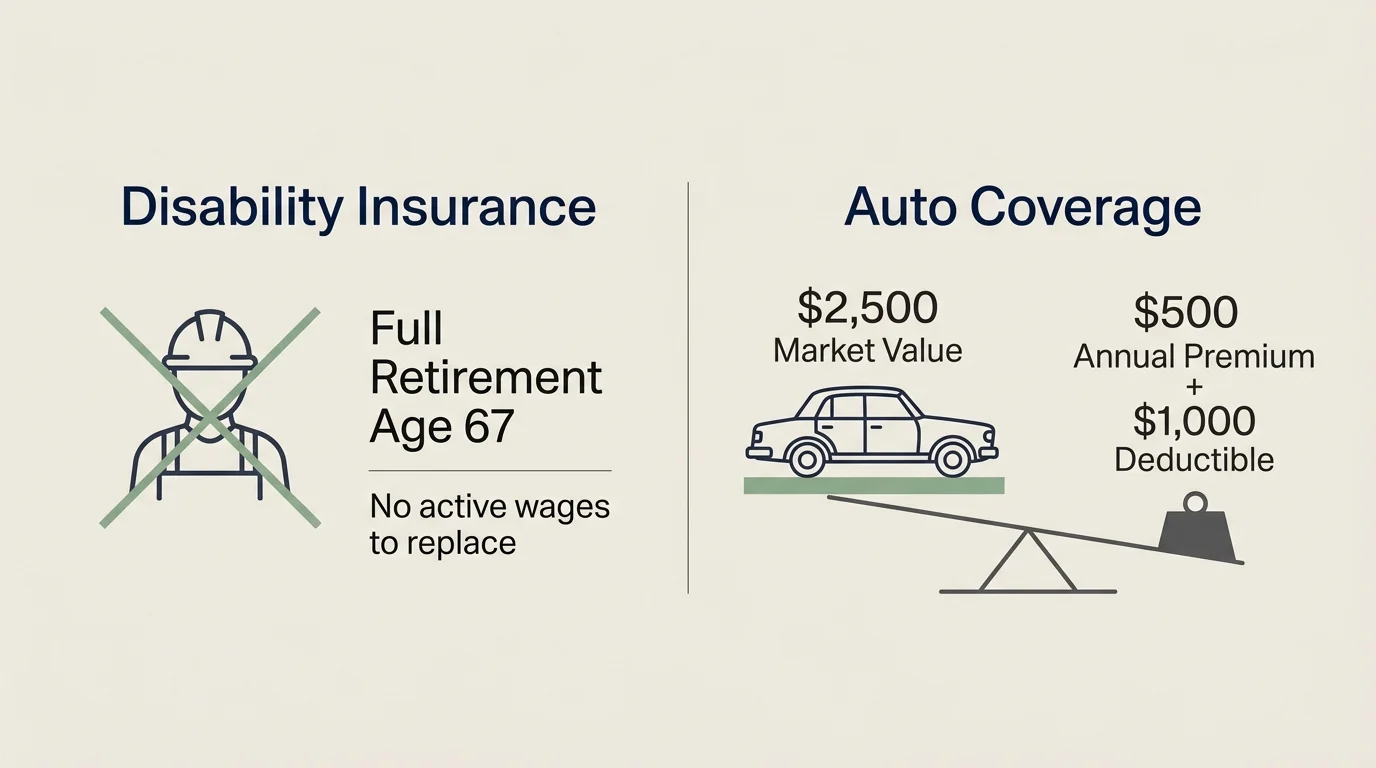
Disability insurance serves one main goal: replacing lost workplace wages if an illness or injury prevents you from working. Once you stop working or reach Full Retirement Age—which is age 67 for individuals born in 1960 or later according to the Social Security Administration—your income originates from pensions, retirement accounts, and Social Security rather than active labor. Paying premiums for a wage-replacement policy when you no longer earn wages represents an absolute financial loss because you cannot claim benefits without active employment.
2. You Carry Substantial Life Insurance Without Dependents or Outstanding Debt
In your early career, life insurance protects your family against the loss of your income, pays off mortgage balances, and guarantees funds for college tuition. However, if your children live independently, your home mortgage is paid off, and your surviving spouse has sufficient retirement assets to maintain their lifestyle, large life insurance policies become redundant. Continuing to pay high monthly premiums for term or permanent life insurance out of force of habit drains your current retirement cash flow without delivering a necessary safety net.
3. You Maintain Collision and Comprehensive Auto Coverage on Low-Value Vehicles
Auto insurance rates continue to climb, yet many retirees continue paying for full collision and comprehensive coverage on older cars. Financial planners often recommend dropping collision coverage when annual insurance premiums plus your deductible exceed the total market value of the vehicle. For instance, if your 12-year-old car holds a market value of $2,500 and you pay $500 annually for comprehensive coverage with a $1,000 deductible, a total-loss claim nets you at most $1,500. Self-insuring that risk saves substantial money every year.
4. You Have Duplicate Medical or Dread-Disease Add-On Policies
Navigating healthcare costs requires efficiency rather than piling on overlapping insurance plans. The 2026 Medicare Part B standard monthly premium is $202.90 per month according to Medicare.gov. When you combine Original Medicare with a high-quality Medigap policy or choose a robust Medicare Advantage plan, specialized add-on policies—such as standalone cancer, heart attack, or hospital indemnity cash plans—are usually unnecessary. These niche policies feature strict payout triggers and largely duplicate the comprehensive coverage provided by your primary health carrier.
5. Your Long-Term Care Policy Exceeds Your Net Worth Risk
Long-term care represents a major retirement expense, but over-insuring against it can prove unnecessarily costly. Data from the American Association for Long-Term Care Insurance indicates that average annual premiums for a 65-year-old individual seeking $165,000 in initial coverage with 3% inflation growth average $3,280 for single males, $5,290 for single females, and $7,150 for couples. Meanwhile, the national median cost of nursing home care ranges from $112,000 to $115,000 per year for a semi-private room. If your liquid portfolio already generates substantial passive income without touching principal, paying steep long-term care premiums may be redundant, as you can comfortably self-insure a portion of potential care costs or utilize hybrid life-LTC contracts that guarantee cash value preservation.
6. You Buy Extended Warranties and Redundant Travel Insurance
Retailers and travel providers frequently pressure retirees into purchasing add-on warranties and travel insurance policies. In reality, modern financial infrastructure offers built-in protections that make these extra policies wasteful. Most premium credit cards already provide complimentary primary or secondary auto rental protection, lost luggage insurance, and trip cancellation coverage. Furthermore, keeping a dedicated emergency fund gives you far more flexibility than purchasing restrictive home warranty plans that frequently deny valid service claims through complex policy exclusions.
7. Your Homeowners Deductible Is Too Low while Insuring Land Value
When you purchased your home decades ago, a $250 or $500 homeowners insurance deductible made sense. Maintaining an artificially low deductible today inflates your annual premium significantly without adding proportional value. Additionally, verify that your policy structure calculates insurance coverage based solely on the replacement cost of the physical structure rather than the total real estate market value. Because land does not suffer structural destruction from fire or storms, insuring land value inflates your annual premiums unnecessarily.
8. You Maintain Umbrella Liability Insurance Unmatched to Exposed Assets
Umbrella liability insurance offers valuable protection against catastrophic legal judgments, but the coverage level must match your exposed net worth. Retirement alters your personal liability profile because you generally commute less and host fewer large gatherings. Carrying a $5 million umbrella policy when your total exposed, non-qualified liquid net worth equals $400,000 creates an expensive mismatch. Aligning your umbrella limit directly with your actual vulnerable assets keeps your liability protection effective while reducing annual premiums.
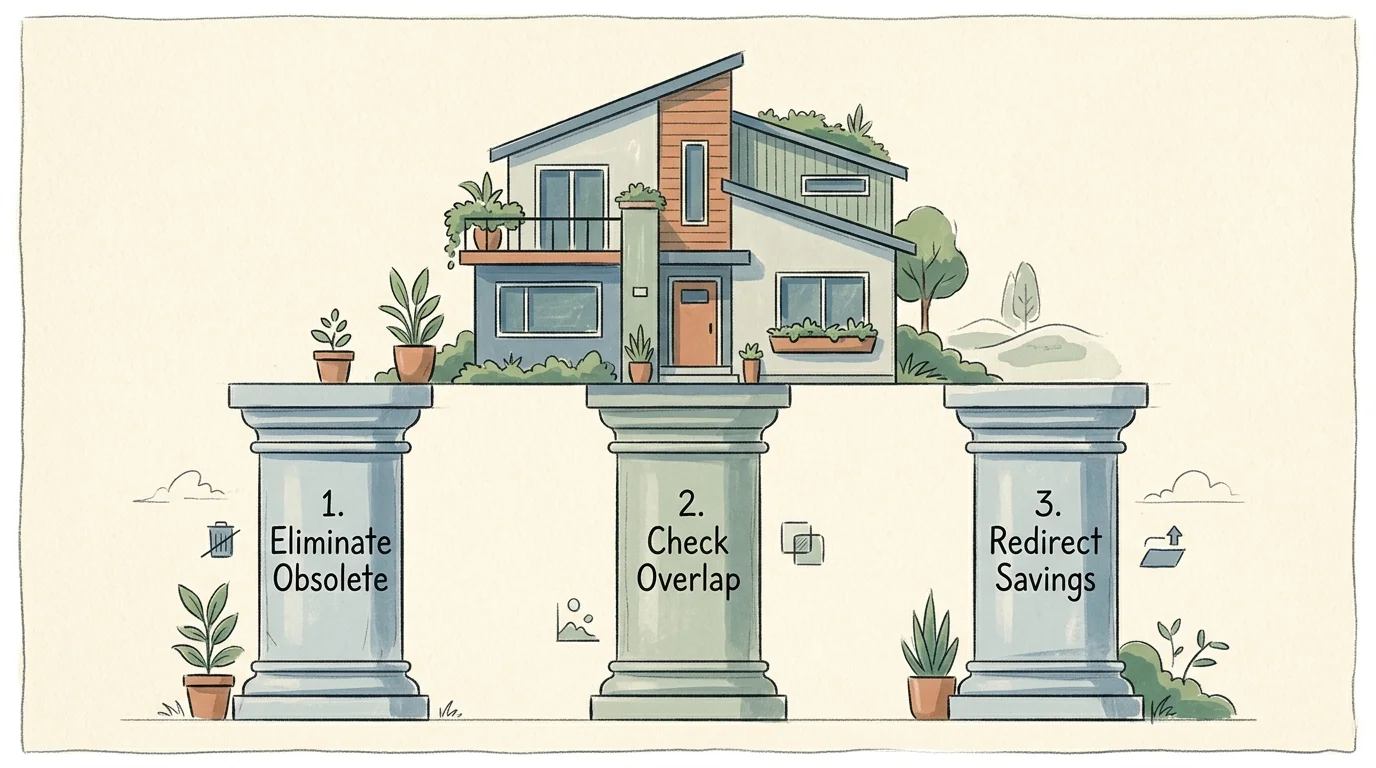
Three Strategic Pillars to Right-Size Your Insurance Portfolio
Pillar 1: Income Planning and Cash-Flow Optimization
Eliminating unnecessary policy payments directly increases your monthly spendable income. Diverting $300 to $600 each month from redundant premiums into high-yield cash accounts or income-generating funds enhances your real purchasing power. By conducting a systematic review of your automatic monthly insurance drafts, you ensure that every dollar in your budget serves your current active retirement lifestyle rather than padding insurance carrier reserves.
Pillar 2: Lifestyle Design and Asset Realignment
Your insurance framework should reflect your current living arrangements, vehicle usage, and family dynamic. If you have downsized your living space, sold an extra vehicle, or spent less time driving, your risk profile has dropped. Updating your garage locations, lowering estimated annual auto mileage, and removing unneeded property riders align your policy structures with how you actually live today, safeguarding your wealth without overspending.
Pillar 3: Health, Wellness, and Smart Medical Coverage
Managing medical expenses requires a balanced approach that combines strong core health coverage with personal wellness initiatives. Combining primary Medicare with appropriate supplemental coverage delivers comprehensive health protection without purchasing redundant dread-disease indemnity plans. Utilizing community health resources and active lifestyle benefits supported by non-profit organizations like AARP helps lower long-term health risks while keeping healthcare expenditures predictable and lean.

Expert Perspectives and Financial Safeguards
Financial planners and gerontologists emphasize that right-sizing your insurance portfolio requires careful execution to avoid creating dangerous gaps in coverage. While eliminating redundant insurance releases valuable cash flow, you must avoid dropping core liability or primary health policies. Additionally, liquidating permanent life insurance policies with substantial cash value can trigger sudden tax consequences or impact your income calculations. A structured approach ensures you remove excess weight without sacrificing your ultimate financial defense.
For example, realizing significant cash gains from a surrendered policy could push your income above the 2026 Medicare IRMAA threshold, which starts at $106,000 Modified Adjusted Gross Income for single filers and $212,000 for joint filers (based on 2024 tax returns). Exceeding these limits triggers mandatory surcharges on your Medicare Part B and Part D premiums. Consulting guidelines from the Internal Revenue Service or working with a fee-only fiduciary planner ensures that policy cancellations do not trigger unexpected tax penalties or higher healthcare surcharges.
Frequently Asked Questions
How often should I review my insurance policies in retirement?
You should perform a comprehensive insurance audit once every year, or immediately following any major life change such as selling a property, paying off a loan, or experiencing changes in health status. Annual reviews help you catch premium increases, adjust deductibles, and eliminate riders that no longer match your current financial situation.
Will surrendering a permanent life insurance policy trigger unexpected taxes?
Yes, if the cash surrendering value exceeds the total amount of premiums you paid into the contract (your cost basis), the excess growth is taxable as ordinary income. To prevent taxable events, you can explore tax-free 1035 exchanges into hybrid long-term care products or annuities if those better align with your financial strategy.
How do I know if I can safely self-insure for long-term care?
You can consider self-insuring if your reliable pension income and liquid investment portfolio generate sufficient cash flow to cover a potential $112,000 to $115,000 annual nursing home expense for two to three years without depleting assets required for your surviving spouse’s baseline living needs.
Can dropping unwanted insurance lower my Medicare costs?
Dropping insurance itself does not directly lower Medicare premiums, but stopping expensive monthly premiums preserves your liquidity. More importantly, carefully managing taxable distributions when surrendering cash-value insurance policies prevents unexpected spikes in your MAGI, keeping you below the Medicare IRMAA surcharge thresholds.
Take Action: Your 48-Hour Insurance Audit Strategy
Take control of your retirement cash flow by committing to one simple step in the next 48 hours. Gather the declaration pages for all your current auto, home, life, and health insurance policies and place them in one folder. Identify one policy that appears redundant—such as an active disability policy or an extended auto warranty—and call your agent to evaluate cancellation or deductible adjustments. Taking this single action initiates momentum toward a leaner, more efficient financial future.