
Navigating your Social Security retirement strategy requires staying ahead of key legislative milestones, and 2027 represents a pivotal shift for millions of Americans. As the final phase of a decades-long federal transition takes full effect, your age, earnings, and claiming timeline will directly determine your monthly cash flow.
Understanding these upcoming adjustments empowers you to optimize your benefit checks, protect your spending power against persistent inflation, and avoid costly tax traps. By reviewing the top regulatory updates taking effect in 2027, you can make informed decisions today that safeguard your financial independence for decades to come.

Strategic Overview: Why 2027 Marks a Historic Social Security Turning Point
The year 2027 serves as a watershed moment in the modern history of American retirement policy. Over four decades ago, Congress passed the landmark Social Security Amendments of 1983 to preserve the long-term solvency of the trust funds. That legislation instituted a gradual, step-by-step increase in the age at which workers qualify for unreduced retirement benefits. In 2027, that multi-decade phase-in officially reaches its ultimate destination. Beyond this structural age shift, macroeconomic conditions continue to reshape payroll tax revenue, cost-of-living adjustments, and work-penalty formulas across the federal government.
Understanding how these moving parts interact allows you to build a resilient income engine. Whether you are currently receiving benefits, planning to retire in 2027, or working part-time while collecting monthly checks, regulatory changes will alter your cash flow math. By grounding your planning in updated rules rather than outdated assumptions, you maintain total control over your financial freedom during your golden years.

1. Full Retirement Age Reaches Its Permanent Ceiling of 67
The most consequential Social Security update in 2027 affects anyone born in 1960. When individuals born in 1960 celebrate their 67th birthdays in 2027, they reach their official Full Retirement Age (FRA). This marks the absolute completion of the 1983 legislative phase-in, which slowly raised the retirement threshold from age 65 up to 67 over several generations. You can review official age threshold tables directly through the Social Security Administration.
Reaching FRA at 67 alters the lifelong math for early and delayed claimers. If you were born in 1960 or later and choose to start collecting benefits at the earliest possible age of 62, your monthly check will suffer a full 30% permanent reduction. For example, if your baseline monthly benefit at age 67 equals $2,000, filing at age 62 shrinks your monthly payment down to $1,400 for the rest of your life. Conversely, waiting past age 67 allows your monthly payout to grow by 8% per year in delayed retirement credits until you turn age 70, capping your maximum potential check at 124% of your baseline amount.

2. Projected COLA Adjustments Reflect Shifting Inflation Trends
Your monthly benefit check receives an annual cost-of-living adjustment (COLA) designed to preserve your purchasing power against inflation. The federal government measures inflation using the Consumer Price Index for Urban Wage Earners and Clerical Workers (CPI-W) during the third quarter of each year. The official 2027 COLA announcement will occur in mid-October 2026, and beneficiaries will see these adjusted dollar amounts arrive in their bank accounts starting in January 2027.
While the baseline COLA implemented in January 2026 stood at 2.8%, economic forecasting models from The Senior Citizens League project the 2027 adjustment to range between 3.7% and 3.8%. persistent pressure in key retiree spending categories—such as housing, medical services, and prescription medications—drives these higher projections. A 3.8% boost on a $1,900 average monthly retirement check adds approximately $72.20 per month, or nearly $866 per year, providing vital relief against elevated everyday expenses.

3. High Earners Face an Increased Taxable Wage Base
Social Security programs rely primarily on payroll taxes collected under the Federal Insurance Contributions Act (FICA). Workers pay a 6.2% tax rate on their earnings up to an annual ceiling, which employers match dollar for dollar. Self-employed individuals cover both sides of the contribution, paying a combined 12.4% rate up to that same wage limit. In 2026, the maximum taxable earnings limit was set at $176,100, meaning any income earned above that amount was exempt from Social Security payroll taxes.
Because the national average wage index continues to rise, the federal government will increase the maximum taxable wage base for 2027. Officials will announce the exact dollar threshold in mid-October 2026 alongside the annual COLA adjustment. High-income earners and small business owners must prepare for higher payroll tax contributions in 2027. You can check current tax guidelines and payroll withholding rules through the Internal Revenue Service to ensure accurate estimated tax calculations throughout the calendar year.

4. Earnings Test Limits Increase for Working Beneficiaries
If you choose to claim Social Security benefits before reaching your Full Retirement Age while continuing to work, the Social Security Administration applies the Retirement Earnings Test (RET). This mechanism temporarily withholds a portion of your monthly check if your job earnings exceed annual thresholds. In 2026, the standard earnings threshold was $23,400 per year. For every $2 you earned above that limit, the agency withheld $1 in benefits.
In 2027, the RET limits will rise in step with national wage growth. The higher limit allows working beneficiaries to earn more income from employment before triggering benefit withholding. Furthermore, during the calendar year you reach your FRA, a far higher earnings threshold applies, and the agency only withholds $1 for every $3 earned over the limit. Once you hit your exact 67th birthday in 2027, the earnings test disappears entirely; you can earn an unlimited income without losing a single dollar of your benefit checks.

5. Permanent Claiming Penalties Shift Spousal and Survivor Dynamics
The permanent stabilization of Full Retirement Age at 67 creates downstream effects on spousal and survivor benefits. A lower-earning spouse is eligible to claim up to 50% of the primary worker’s full retirement amount. However, if the spouse claims prior to reaching age 67, their spousal benefit undergoes a permanent reduction. Under the 2027 rules, claiming spousal benefits at age 62 yields only 32.5% of the primary worker’s full amount, compared to the maximum 50% available at age 67.
Survivor benefits follow equally strict rules. A surviving spouse can claim unreduced survivor benefits at their own FRA of 67. If a widow or widower claims survivor benefits early at age 60, the monthly payout drops permanently to 71.5% of the deceased worker’s primary insurance amount. Understanding these permanent reductions allows married couples to coordinate their claiming strategies, ensuring that the higher earner delays benefits whenever possible to lock in maximum survivor protection.
Actionable Strategy Pillars for Your 2027 Retirement Plan
Pillar 1: Tax-Smart Income Planning
An increased COLA check brings welcome spending power, but it can also push your income into higher tax brackets. Up to 85% of your Social Security benefits become subject to federal income tax if your combined income—defined as adjusted gross income plus non-taxable interest plus half of your Social Security benefit—exceeds $34,000 for individual filers or $44,000 for married couples filing jointly. To minimize tax drag, consider pulling income strategically from Roth IRAs, which do not count toward your combined income calculation, rather than relying solely on traditional taxable accounts.
Pillar 2: Healthcare and Medicare Integration
Your Social Security benefit strategy directly connects with your healthcare budget. Medicare Part B premiums are automatically deducted from monthly Social Security payments for most retirees. When COLA boosts your monthly gross check, rising Medicare Part B premiums can consume a portion of that gain. You should monitor Medicare standard premium rates and Income-Related Monthly Adjustment Amount (IRMAA) thresholds through Medicare to prevent unexpected healthcare surcharges from eroding your net monthly income.
Pillar 3: Purposeful Lifestyle and Work Transitions
With the Retirement Earnings Test limit increasing in 2027, flexible part-time work or consulting becomes an even more attractive option for early retirees. Working part-time allows you to bridge financial gaps without drawing down retirement portfolios prematurely. Moreover, because the Social Security Administration recalculates your lifetime average earnings every year, continuing to earn a solid income in your 60s can replace lower-earning years from early in your career, permanently lifting your baseline monthly benefit check.

Expert Perspectives on the 2027 Shifts
Financial professionals emphasize that the jump to a age-67 FRA requires a mindset shift for pre-retirees. Certified Financial Planners point out that treating age 62 as the default claiming choice now costs retirees nearly a third of their earned income. Delaying even one or two years past age 62 significantly reduces that early penalty curve and strengthens lifetime cash flow against longevity risk.
Gerontologists and longevity researchers stress the value of aligning health expectations with financial milestones. Studies show that maintaining phased, part-time work late into your 60s supports mental sharpness and physical wellbeing. The 2027 updates reward this balanced approach by raising earnings limits, allowing you to combine active work with partial retirement income without facing immediate benefit cuts.

Risks and Safeguards: Protecting Your Financial House
Whenever major legislative updates take effect, scam activity increases dramatically. Fraudsters often target seniors by posing as official agency representatives, alleging that individuals must pay fees or update private bank details to receive their 2027 COLA adjustments. Remember that the federal government never charges fees to process annual updates, nor will agency staff call or email demanding personal details. You can track consumer fraud warnings and official economic data through the Bureau of Labor Statistics and Federal Trade Commission portals.
A second major pitfall involves ignoring the interaction between early benefit claims and temporary withholding rules. If you claim benefits at age 63 in 2027 while working a full-time executive job, the Retirement Earnings Test may result in the agency withholding 100% of your monthly checks for the year. While the Social Security Administration recalculates your check at age 67 to give back those withheld amounts over time, unexpected temporary withholding can cause severe short-term cash flow distress if you fail to plan ahead.
Frequently Asked Questions About 2027 Social Security Changes
When will the official 2027 Social Security COLA be announced?
The Social Security Administration will officially announce the 2027 COLA in mid-October 2026. This calculation uses third-quarter inflation data from July, August, and September 2026. The new benefit amounts take effect with the January 2027 payout cycle.
How does reaching Full Retirement Age at 67 impact my spousal benefits?
Reaching FRA at age 67 allows you to receive up to 50% of your spouse’s full benefit amount, provided your spouse has already filed for their own retirement benefits. If you claim spousal benefits prior to turning 67, your monthly payout suffers a permanent reduction down to a minimum of 32.5% at age 62.
If Social Security withholds benefits due to the earnings test, is that money lost forever?
No, withheld benefits are not lost permanently. When you reach your Full Retirement Age of 67, the Social Security Administration recalculates your monthly benefit amount to credit you for the months during which benefits were withheld due to your employment income. This adjustment permanently increases your monthly check going forward.
Will the increase in the wage cap affect my future retirement benefit calculation?
Yes, if you earn income at or above the maximum taxable wage limit, paying payroll taxes on a higher earnings cap increases the income figures used in your lifetime average monthly earnings calculation. Over time, paying taxes on higher capped earnings elevates your ultimate Primary Insurance Amount upon retirement.
Take Control Today: Your 48-Hour Action Plan
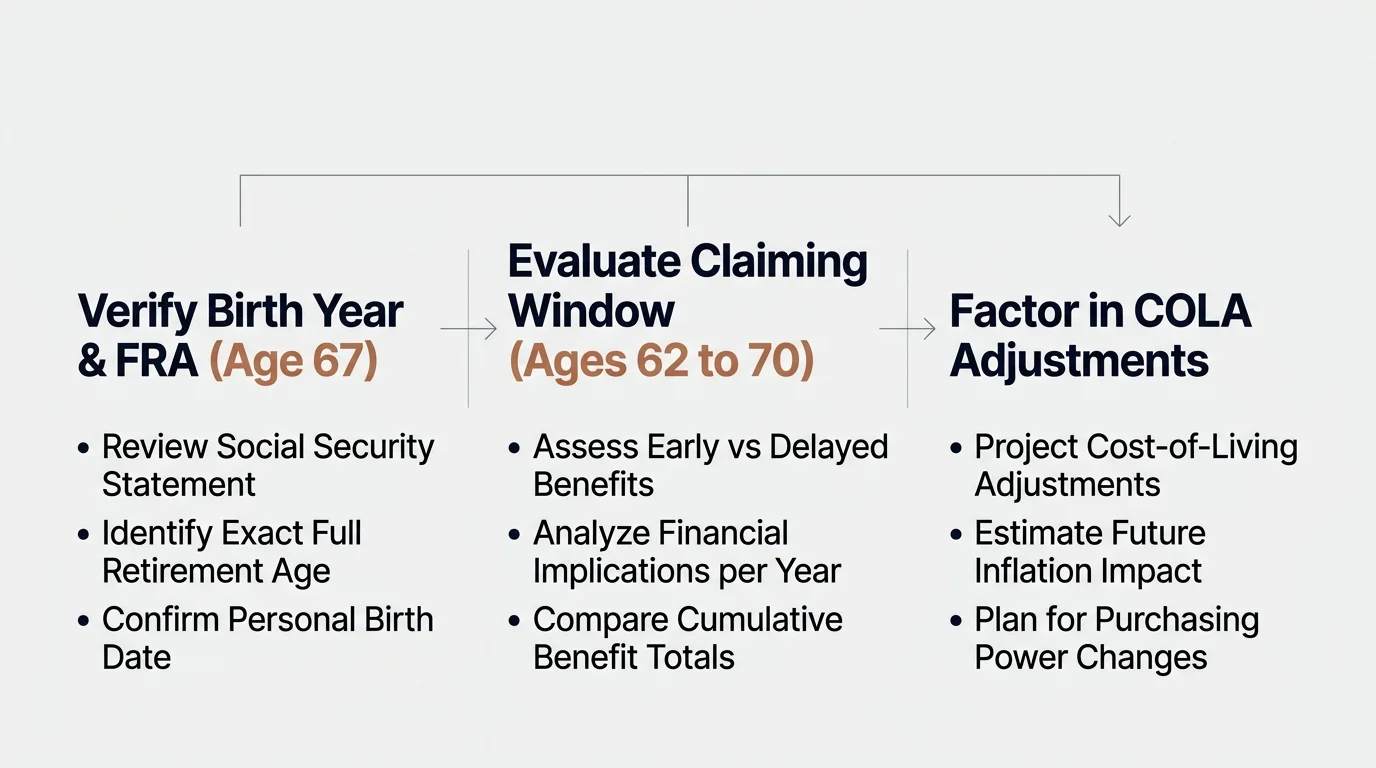
Mastering your Social Security future does not require overwhelming effort; simple, decisive steps today yield massive dividends tomorrow. Take charge of your retirement trajectory by completing one practical task over the next 48 hours. Log into your personal portal on the official federal Social Security website to download your complete earnings statement. Verify that your past wage history is reported accurately, locate your projected benefit amounts at age 62, 67, and 70, and share those figures with your financial advisor or spouse. Taking this immediate step equips you with exact data, enabling you to build a confident, bulletproof income strategy for 2027 and beyond.






Im 83 years old and have been working for Public Partnerships LLC as agent for employer I get paid twice a month. My ssa deduction was $88.04 or $176.08 a month. Do I get an increase in mt check because of these deductions. Please respond.
how come retiree military don’t get reimbursed on their Medicare garbage men get reimbursed and fireman but military doesn’t can that be explained when we were promised free medical for life
I get a widowed money and one a month will this hurt me.
Cleverly disguised ads interspersed throughout this article might prompt unsuspecting readers to click on same, thinking they’re part of its content. Sure, they rake in cash for staff, editors, etc., but it reality they’re annoying, bothersome & detract from overall reading experience.
But hey, don’t break from the crowd – continue to obfuscate & confuse readers. Some suckers will fall for your slight of hand & be taken in…not me, but feed the machine – anything for a buck, right?
Cleverly disguised ads interspersed throughout this article might prompt unsuspecting readers to click on same, thinking they’re part of its content. Sure, they rake in cash for staff, editors, etc., but it reality they’re annoying, bothersome & detract from overall reading experience.
But hey, don’t break from the crowd – continue to obfuscate & confuse readers. Some suckers will fall for your slight of hand & be taken in…not me, but feed the machine – anything for a buck, right?
I have worked hard for my ss. Why are they sending my money to the illegals, etc? other countries they have been giving money to, excuse me, i am a tax payer, an american citizen. Im 72 and i deserve my ss.
Both my wife and i are 80. We worked through COVID as we were ruled essential. Our income level does not require us to file state or federal income tax returns. This stinks we get screwed out of the money the Feds and New York State are currently giving out!!!!
you do get free medical through VA or us to be called
Champus has a new name now . Medicare is a seperate thing.
When SSA and SSI increases my EBT or CalFresh decreases so there is no gain. This is totally wrong. Illegals get so much more free assistance, and this is wrong too! Stop the Wars!
How does this affect disability social security?
How does this affect disability benefits
I totally agree with this statement, I worked from age 19 and paid into SS until age 67
the SS program has given me the freedom to enjoy my retired years.
The SS program should not support the poor in this country it was ment for the workers
who spent 52 + years working 52+ years to support their families.
Those who didn t work fall into a different cadigory and should never get SS assitance !
The whole problem lay with the value of the Dollar do to the amount of federal dept !
Our Laizy ass politisans who voted to continue to borrow money because they could not work to a budget!
This is why Judges should be neutral!!! Also, register & vote as a Republican. Let the attacks begin … they won’t bother me simply because I won’t be reading them. This is my opinion & not 1 of you will change it.
Have a beautiful day! Bye 👋
What about married 1984 women whom stayed at home while husband worked and didnt pay into SS and her marriage ends before 10 yrs, then works on her own doing minimum wage jobs to support herself until she remarried in 2009 divorced after 3 yrs, then back at it again to find out she hasn’t gotten near enough paid in to live on, im now 60 will be 61 in Dec, to retire early is 840.00 that would cover my house payment, and 1240.00 at 67 , then again not enough to pay house payment, electricity, gas, water, much else anything else.
Why are women penalized because of 10 yr mark.
I only get $904 a month in SS. I worked sone part time jobs then I worked full time for over 25 years straight at Kmart. Lost all their matching money when they went bankrupt, only have what I was able to save. Even worse, I only get $110 a month pension from Kmart! What a slap in the face. I’m basically living off my husband, when he dies I’m screwed. I don’t get any of his pension , only his SS which is about $1600, but then I give up my Ss. I had a 100,000 life insurance policy on him, paid about $20,000 in premiums , then was told the account was generating enough income to pay the premiums. Well guess what, they never told me the account was losing money, until there was only $100 left! Now I’m screwed. I’d have to pay another $40,000 in premiums to build it back up. I’m not working, I’m 71, and have health issues, I can’t afford that! These big corporations really know how to screw you over. It’s devastating to me. I don’t know how I’ll survive when my husbands gone. Unless I get a job at Walmart which is 40 miles away! Then how do I afford the gas?
Why penalized when we always make less don’t have ins. raise kids, take them to the Dr, , school and no one cares nor is the sytem fair we have always made less money!