
Planning an international adventure should bring pure excitement, not unexpected hospital bills. Crossing the American border instantly alters your healthcare coverage and exposes your retirement budget to massive medical liabilities.
Original Medicare pays zero dollars for healthcare in almost every foreign country. You must understand your policy limits before booking international flights or boarding cruise ships.
Discovering these seven crucial Medicare rules protects your physical health and preserves your life savings abroad. Smart preparation ensures you explore the globe with genuine peace of mind.
1. Original Medicare Stops at the Border With Three Rare Exceptions
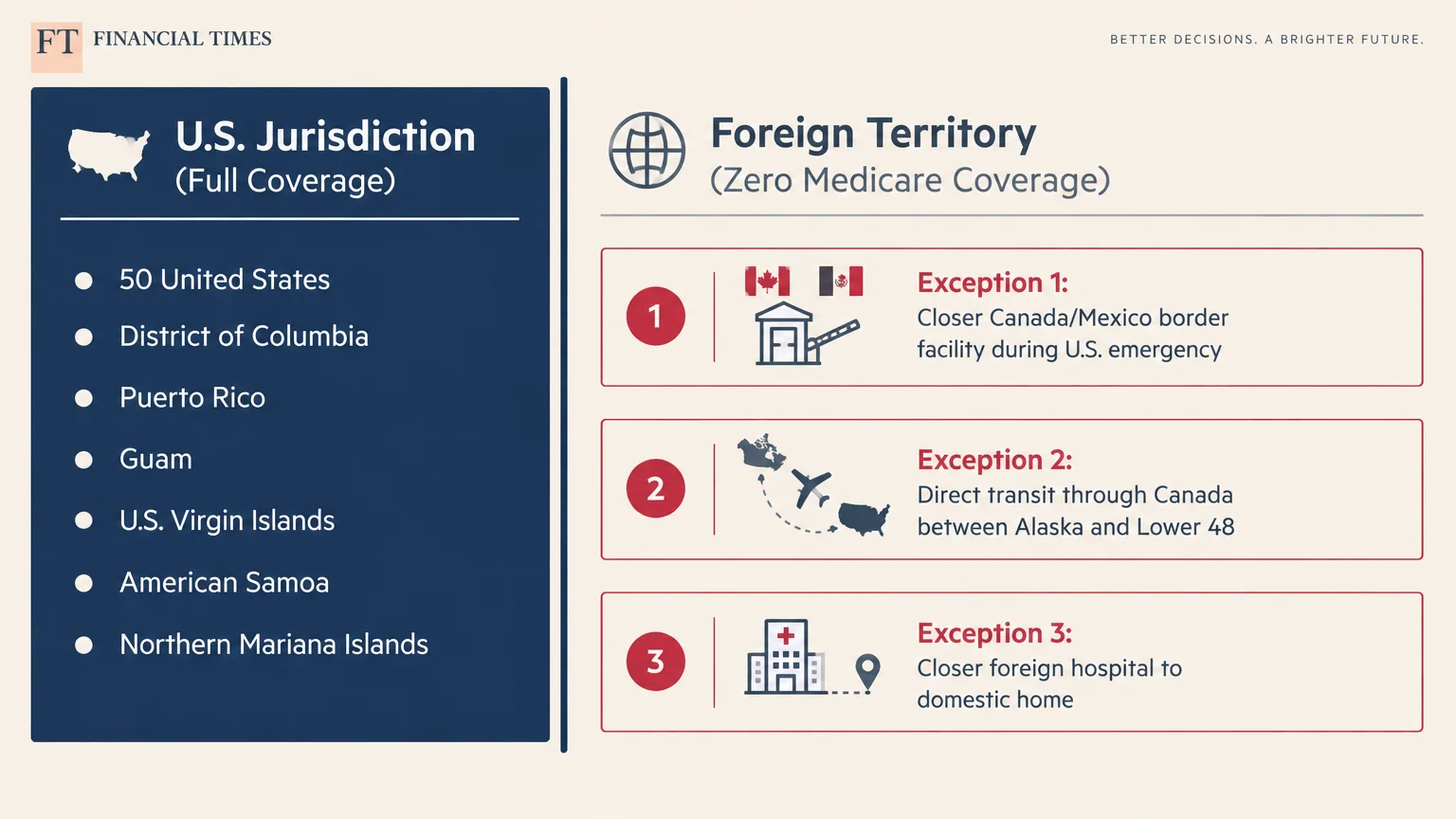
Original Medicare defines domestic coverage strictly within the fifty United States and the District of Columbia. Your benefits also apply throughout Puerto Rico, Guam, the U.S. Virgin Islands, American Samoa, and the Northern Mariana Islands.
Once you step outside these specific jurisdictions, you enter foreign territory where traditional Medicare coverage essentially vanishes.
According to Medicare program guidelines, Original Medicare pays for overseas care in only three narrow statutory situations.
First, Medicare covers treatment if an acute medical emergency occurs inside the United States, but a foreign hospital in Canada or Mexico is geographically closer.
Second, coverage applies if an emergency occurs while you travel directly through Canada between Alaska and the lower forty-eight states without unreasonable delay.
Third, Medicare pays if you live in the United States and an accessible foreign hospital is closer to your home than any domestic facility.
This third exception applies regardless of whether your medical condition represents an urgent emergency. Outside of these three legal provisions, Medicare pays nothing for foreign healthcare.

2. The Six-Hour Rule Dictates Cruise Ship Medical Coverage
Many retirees assume that setting sail on an ocean cruise keeps them under domestic healthcare protections. However, maritime healthcare rules follow precise maritime boundaries and strict time limits.
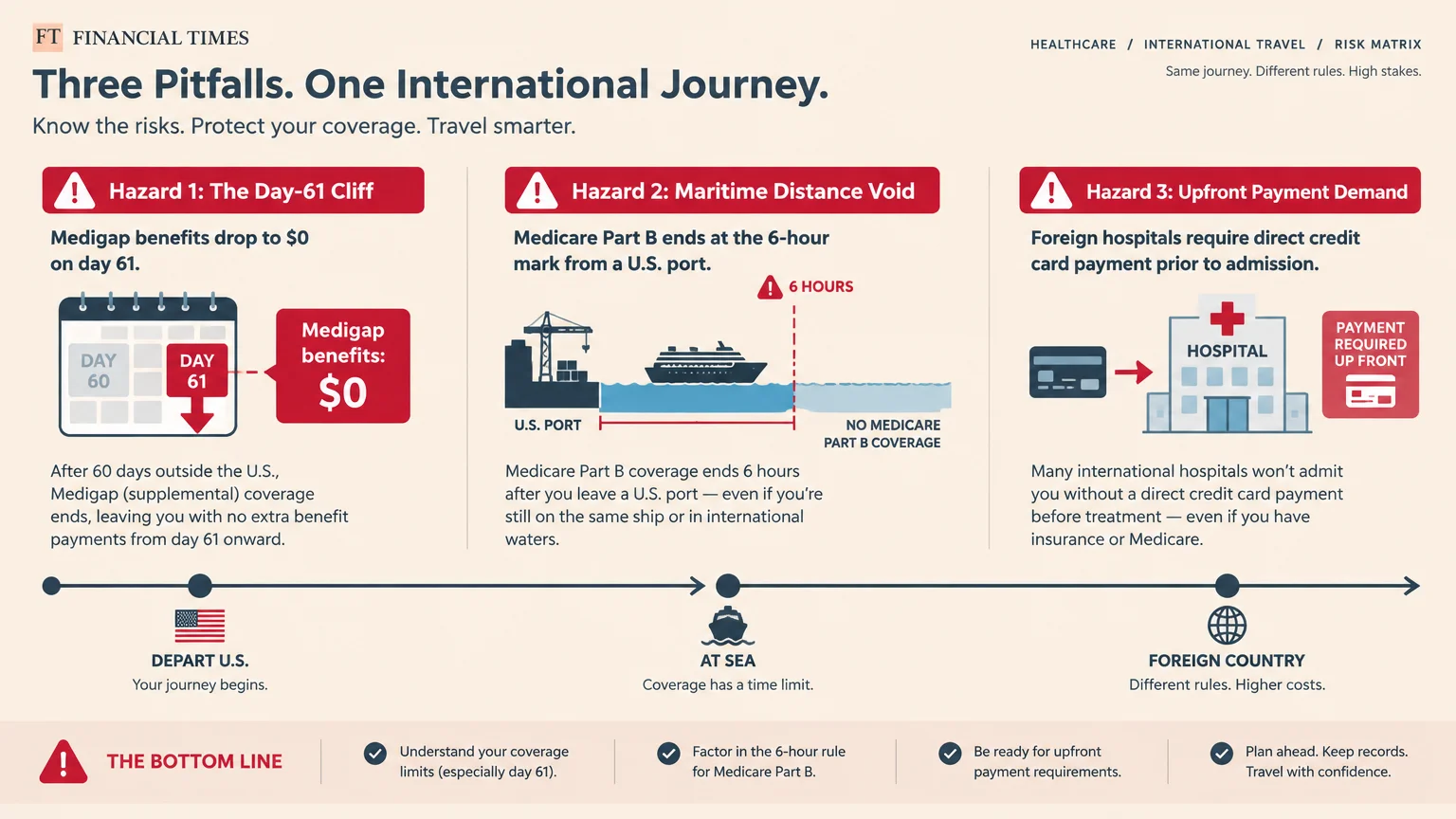
Medicare Part B covers medically necessary services onboard only while the ship rests in an American port.
Coverage also continues if the vessel travels within territorial waters no more than six hours away from an American port.
The shipboard physician must hold a valid legal license to practice medicine under federal regulations.
The moment your ship sails beyond that six-hour threshold, all Medicare coverage instantly terminates.
If you slip on a deck in international waters, the onboard infirmary will bill you directly. These private shipboard medical bills often reach thousands of dollars before the ship returns to shore.
3. Medigap Plans Offer Foreign Emergency Benefits With Strict Caps
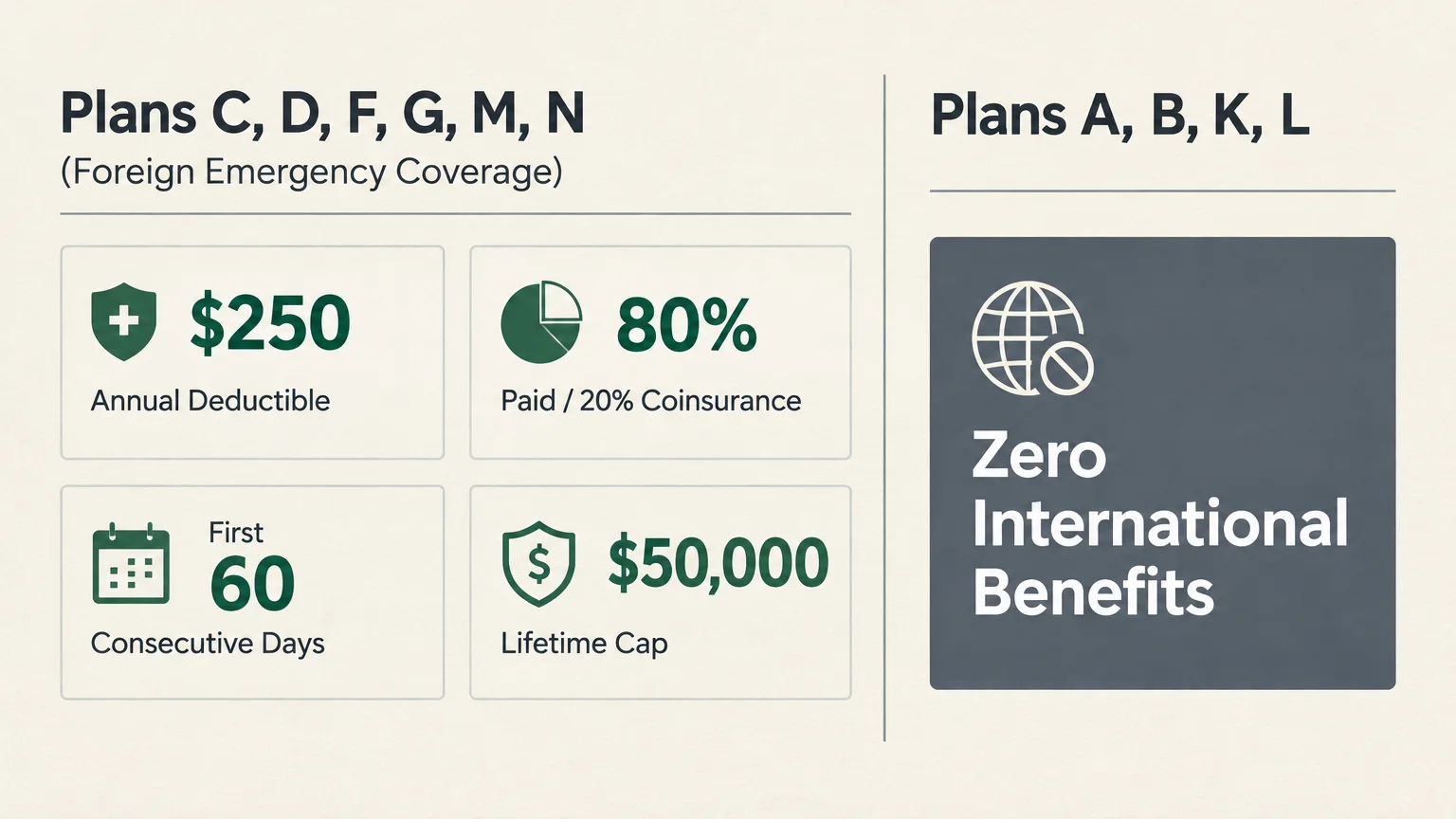
If you carry a supplemental Medigap policy, you may hold valuable emergency protection for foreign travel. Standardized Medigap Plans C, D, F, G, M, and N provide specific foreign travel emergency benefits.
In contrast, popular Medigap Plans A, B, K, and L provide zero international healthcare coverage.
Eligible plans require you to satisfy a modest $250 annual deductible before benefits begin.
After meeting that deductible, the policy pays eighty percent of billed charges for medically necessary emergency care. You remain responsible for the remaining twenty percent coinsurance out of your own pocket.
Crucially, this benefit applies only to emergencies that begin during the first sixty consecutive days of your international trip.
If an emergency arises on day sixty-one, your Medigap policy pays zero dollars. Furthermore, Medigap policies impose a lifetime limit of $50,000 for foreign travel emergency care.

4. Medical Evacuation Is Never Covered by Traditional Policies
Medigap helps stabilize acute medical conditions in foreign hospitals, but it never pays for emergency repatriation. Neither Original Medicare nor standard Medigap policies cover the cost of flying you back to the United States.
An emergency medical evacuation from an overseas destination routinely costs between $50,000 and $100,000 out of pocket.
Complex air ambulance transports across continents can easily exceed $150,000 depending on specialized medical staff requirements.
“Retirees often assume their supplemental insurance will fly them home after a stroke or fracture,” notes certified financial planner David Sterling. “In reality, families must scramble for liquid cash without dedicated evacuation coverage.”
Purchasing a specialized medical evacuation membership guarantees transport to your preferred home hospital without catastrophic financial losses.
5. Part D Excludes Foreign Prescriptions but Funds Pre-Trip Vaccines
Prescription drug management requires careful advance planning before traveling abroad. Medicare Part D plans do not pay for outpatient medications purchased at pharmacies outside the United States.
If you run out of essential blood pressure or diabetes medication overseas, you must pay full local retail prices.
Fortunately, your domestic Part D coverage provides significant financial relief before you leave American soil.
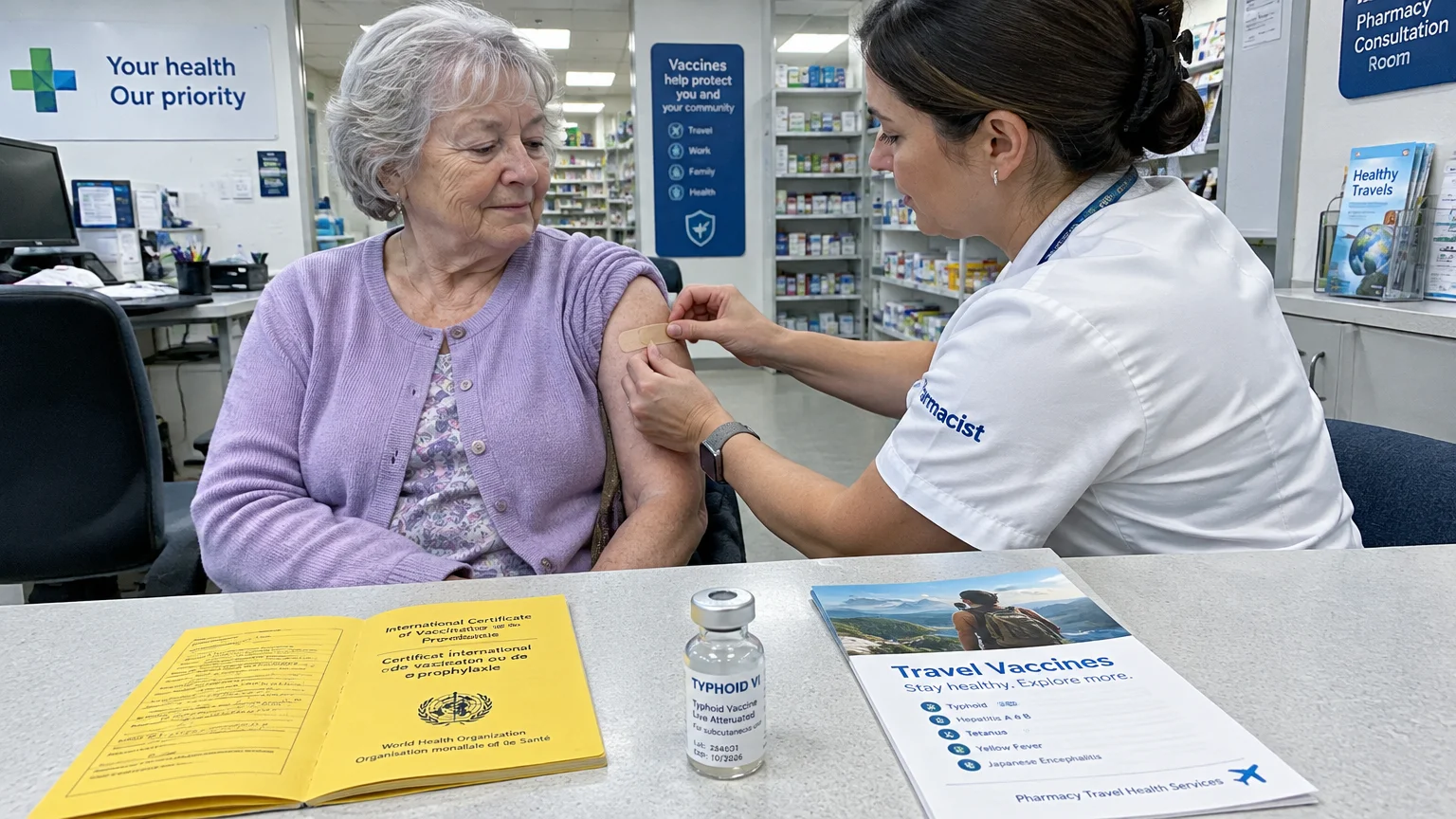
Under federal rules, Part D covers all travel vaccines recommended by the Advisory Committee on Immunization Practices at zero out-of-pocket cost.
You can receive preventative immunizations for yellow fever, typhoid, hepatitis, and shingles with no deductible or copay.
Speak with your primary physician at least eight weeks before departure to coordinate your recommended travel vaccines.
You should also request ninety-day medication refills to guarantee an uninterrupted pharmaceutical supply abroad.
6. Medicare Advantage Plans Vary Wildly in Global Protection
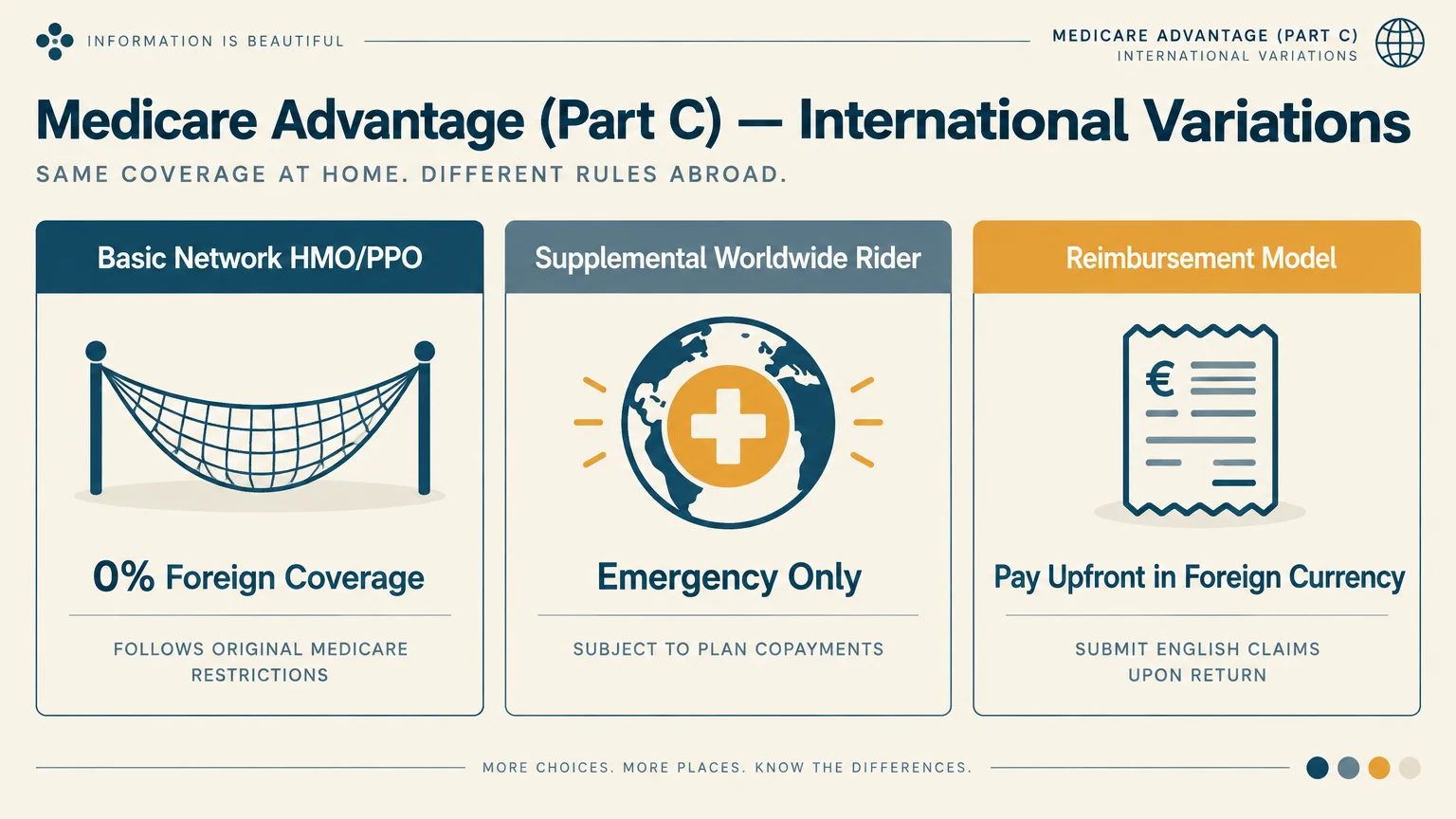
Private Medicare Advantage plans, also known as Part C, operate under different international guidelines than Original Medicare.
Many Advantage insurers choose to include supplemental benefits for worldwide emergency and urgent care.
However, cost-sharing amounts, deductibles, and annual benefit caps vary dramatically between individual private carriers.
Almost no foreign healthcare providers bill American Medicare Advantage plans directly for services rendered.
You must pay foreign hospitals directly using personal credit cards or local currency upon discharge.
To secure reimbursement, you must request fully itemized medical records and coded invoices written in English.
You will submit these documents alongside formal claim paperwork once you return to the United States.

7. Dedicated Travel Medical Insurance Bridges Dangerous Financial Gaps
A comprehensive travel medical insurance policy serves as an indispensable safety shield for globetrotting retirees.
Standard trip cancellation insurance merely reimburses lost airfare and hotel bookings if you cancel your vacation.
Dedicated travel medical insurance pays directly for overseas hospitalizations, emergency surgeries, and diagnostic imaging.
Look for policies that offer primary medical coverage so you avoid bureaucratic battles between competing insurers.
Ensure your chosen policy includes a pre-existing medical condition waiver by purchasing coverage promptly after your initial trip deposit.
Without that waiver, insurers can legally deny claims linked to chronic conditions treated in recent months.

Strategic Retirement Pillars for Global Explorers
Traveling during retirement requires balanced coordination across your personal finances, physical health, and daily routines.
Pillar One: Income Planning and Currency Reserves
International travel demands reliable access to liquid funds for unexpected medical contingencies. Foreign medical clinics frequently demand immediate credit card deposits before initiating diagnostic tests or treatment.
Contact your financial institutions to increase your international credit limits prior to boarding foreign flights.
Maintain an accessible emergency checking reserve so foreign currency conversions do not disrupt your core retirement portfolio.
According to financial guidelines from AARP, keeping separate emergency cards prevents disruptions if a primary account gets frozen.
Pillar Two: Health and Mobility Logistics
Managing personal wellness across international borders requires proactive logistical coordination.
Gerontologist Dr. Elena Ramirez emphasizes that sudden climate shifts and long flights often exacerbate underlying chronic conditions.
“Carry translated physical copies of your essential health history, electrocardiograms, and drug regimens,” advises Dr. Ramirez.
Research the physical accessibility of your destinations, especially when visiting ancient cities with uneven cobblestone streets.
Pack vital mobility aids, extra prescription glasses, and orthopedic supports directly inside your airline carry-on luggage.
Never place daily life-sustaining medications in checked baggage that could become delayed or lost in transit.
Pillar Three: Intentional Lifestyle Design
Meaningful retirement travel balances active cultural exploration with sensible physical pacing.
Avoid exhausting itineraries that cram multiple countries into brief, stressful timeframes.
Build dedicated rest days into your travel schedule to allow your immune system adequate recovery.
Register your travel itinerary with the Smart Traveler Enrollment Program through the U.S. Department of State.
This free governmental service helps local embassies contact you or your family during severe international crises.
Healthcare Pitfalls, Benefit Cliffs, and International Scams
Unsuspecting American retirees frequently encounter aggressive financial traps when seeking healthcare in foreign resort areas.
Some predatory private clinics collude with taxi drivers and hotel concierges to divert tourists away from accredited facilities.
These private clinics frequently inflate treatment charges, knowing foreign travelers possess vulnerable credit balances.
Always ask your hotel or local embassy for accredited hospital recommendations rather than accepting unsolicited driver advice.
Another critical risk involves the sixty-day Medigap benefit cliff that threatens extended international journeys.
If your overseas adventure lasts sixty-one days, Medigap completely excludes any emergency occurring on that sixty-first day.
You must reset the sixty-day window by re-entering American soil before embarking on another journey.
Never drop your domestic Medicare Part B coverage simply because you plan to live abroad temporarily.
The Social Security Administration imposes permanent late enrollment penalties when you attempt to re-enroll later.
Furthermore, dropping Part B forfeits your guaranteed right to retain or reacquire standardized Medigap supplemental coverage.
Frequently Asked Questions About Medicare Abroad
Does Medicare pay for emergency care if I get sick in Mexico or Canada?
Original Medicare pays for emergency care in Canada or Mexico only under exceptionally narrow statutory circumstances.
The emergency must occur either inside the United States or during direct transit between Alaska and the lower forty-eight states.
If you vacation inside Mexico or Canada and fall ill, Original Medicare pays absolutely nothing toward your treatment.
Can I use my Medicare card at pharmacies overseas?
No international pharmacy accepts domestic Medicare cards or Part D prescription drug plans.
You must purchase required medications out of pocket using local currency or personal credit cards.
Consult your prescribing physician beforehand to secure adequate ninety-day supplies for the full duration of your trip.
What happens if I move abroad permanently as a U.S. retiree?
You will retain your monthly Social Security retirement benefits in most foreign countries across the globe.
However, your Medicare benefits will not accompany you to your new foreign country of residence.
Many expatriate retirees maintain Part A premium-free while dropping Part B to eliminate monthly premium expenses.
However, dropping Part B triggers lifetime financial penalties if you ever decide to return to the United States.
How do I submit an international claim to my Medigap or Advantage plan?
Collect fully itemized invoices, doctor notes, and receipt proofs from every foreign medical provider.
Request that the overseas hospital provide documentation in English, or hire a certified translation service upon returning home.
Complete CMS Form 1490S alongside your private insurer claim documentation and submit all itemized foreign receipts promptly.
Take Action in the Next 48 Hours
Exploring international destinations remains one of the greatest pleasures of modern retirement.
Protecting your travel dreams requires sensible preparation rather than fear of unexpected medical scenarios.
Review your existing Medicare Advantage or Medigap policy documents within the next forty-eight hours.
Identify your specific foreign coverage limits and verify whether your policy includes emergency out-of-country benefits.
If gaps exist, research independent travel medical insurance quotes before you finalize your next international booking.
Taking this simple protective step ensures that your future journeys remain joyful, secure, and financially sound.