
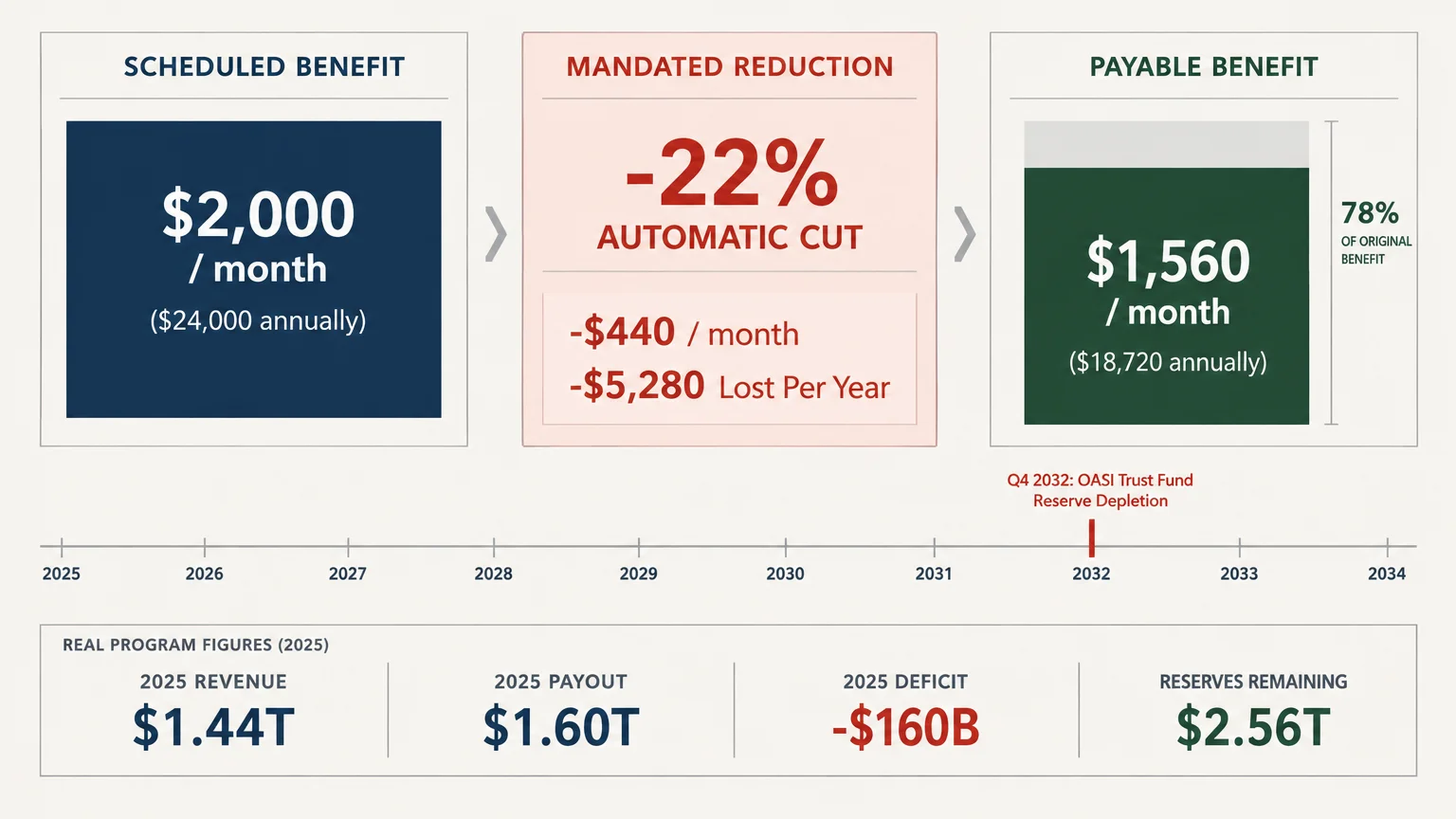
If you receive a monthly Social Security benefit of $2,000, an automatic 22% reduction will strip $440 straight off your check. That sudden loss eliminates $5,280 of predictable income every single year.
Official government projections show trust fund reserves running out in late 2032 without congressional action. While you cannot control Washington lawmakers, you can build a resilient personal financial defense today.
Understanding the exact math behind this shortfall allows you to restructure your portfolio, cut unnecessary taxes, and protect your retirement lifestyle.
The Math Behind the 22% Cut and Trust Fund Insolvency
The 2026 Social Security Trustees Report delivered a sobering reality check for current and future retirees. The report confirmed that the Old-Age and Survivors Insurance Trust Fund will deplete its reserves in the fourth quarter of 2032.
Depletion does not mean that the entire Social Security program goes completely broke. Millions of working Americans will continue paying payroll taxes into the system each month.
Those incoming tax revenues, however, will only cover 78% of scheduled retirement benefits. Federal law mandates an automatic across-the-board cut of 22% once reserves run dry, unless Congress alters the governing statutes.
Official data from the Social Security Office of the Chief Actuary reveals why this shortfall is accelerating. During 2025, the program gathered $1.44 trillion in revenue while paying out $1.60 trillion in benefits.
That single-year deficit of $160 billion drained total trust fund reserves down to $2.56 trillion by the end of 2025. Over the full 75-year projection window, the system faces an unfunded obligation of $29.3 trillion.
That long-term actuarial deficit stands at 4.42% of taxable payroll. If Congress hypothetically combines the retirement fund with the Disability Insurance Trust Fund, depletion shifts to the third quarter of 2034 with an automatic 17% cut.
The disability fund remains fully solvent through 2100 on its own merits. Without explicit congressional authorization to combine these funds, retirees face the earlier 2032 depletion date and the steeper 22% benefit reduction.
Consider the practical impact of this statutory reduction on a baseline benefit check of $2,000 per month. A 22% cut subtracts $440 each month, leaving you with an income of just $1,560.
That loss equates to $5,280 in vanished purchasing power every single year. For households relying on Social Security to cover essential living costs, that reduction presents a substantial financial hurdle.
In late 2026, the average monthly Social Security benefit for retired workers reached approximately $2,095. A 22% reduction on that average benefit strips away roughly $461 each month.
The 3.6% cost-of-living adjustment announced in October 2026 raises that average benefit by $75 to $2,170 per month starting January 2027. In 2026, the annual adjustment was 2.8%.
Applying a 22% cut to the 2027 average benefit of $2,170 eliminates approximately $477 every month. That loss leaves the typical retired worker with only $1,693 per month to pay necessary expenses.
Couples face an even more significant drop in cumulative household income. Research from the Committee for a Responsible Federal Budget highlights the severe consequences for dual-earner households.
A typical newly retired dual-income couple stands to lose $16,900 per year, or about $1,408 every month. Low-income dual-earner couples will lose about $10,200 annually from their collective budget.
High-income couples face an annual reduction of roughly $22,300 under an across-the-board cut. These projections demonstrate why every retiree must prepare for potential cash flow disruptions.
Recent federal legislation contributed directly to the earlier depletion timeline. The Social Security Fairness Act signed in January 2025 repealed the Windfall Elimination Provision and the Government Pension Offset, increasing outgoing benefit payments.
Additionally, the One Big Beautiful Bill Act enacted in 2025 lowered tax liabilities for seniors. That tax relief inadvertently reduced the volume of income tax revenue returning to the Social Security trust funds.
Demographic trends compound these legislative factors. The ratio of taxpaying workers to beneficiaries has dropped from over 5-to-1 in 1960 down to 2.9-to-1 today.
Actuaries project that this ratio will sink further to 2.2-to-1 by the 2070s. Approximately 71 to 72 million Americans collect Social Security benefits today, supported by roughly 185 million covered workers.
The dedicated payroll tax rate remains at 12.4%, split evenly between employees and employers. The maximum taxable wage cap sits at $184,500 in 2026 and increases to $192,300 in 2027.
Currently, only 83% of covered wages are subject to the payroll tax, down from 90% in 1983. Because legislative solutions remain uncertain, you must build an independent defense across your wider financial portfolio.
Aligning Your Income Streams Against Benefit Cuts
Protecting your retirement lifestyle requires coordinating all available income sources into an integrated distribution plan. You cannot treat Social Security as an isolated payment independent of your private savings.
Social Security Claiming Timing and Delay Strategies
Claiming benefits at age 62 locks in a permanent 30% reduction compared to your Full Retirement Age amount. If an across-the-board cut takes effect later, that early claiming reduction deepens your financial strain.
Delaying your claim past your Full Retirement Age earns you delayed retirement credits of 8% per year until age 70. This guaranteed expansion increases your foundational income floor substantially.
A larger baseline payment provides superior defense against any percentage reduction. Even after a 22% haircut, an enhanced benefit claimed at age 70 delivers considerably more cash flow than an early filing.
You can fund this delay by drawing down taxable investment assets during your early sixties. That bridge strategy turns your personal savings into a tool for securing higher permanent, inflation-adjusted income.
Evaluating claiming timing requires analyzing your health history, marital status, and family longevity expectations. A personalized claiming analysis helps you capture the maximum lifetime benefit available from the system.
Pensions, Annuities, and Guaranteed Income Floors
Defined-benefit pensions provide reliable monthly income that remains completely immune to Social Security policy changes. If you hold a pension, verify its funding health and examine whether it includes annual cost-of-living adjustments.
Retirees without traditional pensions can construct their own guaranteed income floor using commercial annuities. A Single Premium Immediate Annuity converts a lump-sum payment into a contractually guaranteed lifetime income stream.
Purchasing an annuity can replace the specific $440 monthly gap created by a potential benefit cut. This contractual structure transfers longevity risk and market volatility away from your household.
Fixed index annuities offer another vehicle for income generation while protecting your principal balance from market drops. These contracts credit interest tied to index performance while guaranteeing that your principal never declines.
Always evaluate the financial strength ratings of the insurance company before purchasing an annuity contract. Diversifying your holdings across several top-rated carriers provides essential protection against institutional insolvency risks.
Dynamic Portfolio Withdrawal Frameworks
Relying on a static 4% annual withdrawal rate can place your investment portfolio at risk during prolonged bear markets. Modern retirement planning favors dynamic withdrawal frameworks that adjust distributions according to portfolio performance.
Implementing Guyton-Klinger withdrawal guardrails gives you clear rules for adjusting distributions each year. When your portfolio grows, the guardrails allow you to take larger distributions to support your lifestyle.
During market declines, the guardrails call for modest distribution trims to preserve underlying capital. This dynamic adjustment prevents you from liquidating depressed assets to maintain an arbitrary spending level.
You should pair dynamic withdrawals with a dedicated liquidity buffer holding two to three years of living expenses. Keeping that capital in high-yield cash and short-term Treasuries shields you from sequence-of-returns risk.
When stock markets experience sharp corrections, you draw your monthly income from this liquid reserve. That buffer grants your equity investments sufficient time to recover before you need to sell shares.
Systematic rebalancing allows you to replenish your cash reserves whenever market rallies expand your equity holdings. This disciplined process turns market volatility into an advantage rather than an existential threat.
Tax Efficiency and Healthcare Cost Containment
Taxes and healthcare costs represent two of the largest recurring expenses you face during retirement. Minimizing these outlays frees up immediate cash flow to offset potential Social Security reductions.
Proactive Roth Conversions Before 2032
Executing strategic Roth conversions today allows you to prepay income taxes at current rates. Moving assets from traditional IRAs into Roth IRAs eliminates future income tax obligations on that capital.
Every dollar inside a Roth account grows tax-free and distributes tax-free throughout your retirement. Furthermore, qualified Roth distributions do not trigger taxation on your Social Security benefits.
Official guidelines from the Internal Revenue Service explain how provisional income dictates benefit taxation. Keeping taxable income below federal thresholds shields up to 85% of your benefits from tax.
Convert funds gradually each year up to the ceiling of your current marginal income tax bracket. Spreading conversions across multiple tax years before 2032 optimizes your lifetime tax efficiency.
A lower pre-tax balance also reduces future Required Minimum Distributions, keeping your taxable income permanently lower. That proactive tax management preserves discretionary cash when benefit cuts threaten your income.
Managing Required Minimum Distributions
The government requires you to take Required Minimum Distributions from traditional retirement accounts once you reach your seventies. Unmanaged distributions can push your household into higher tax brackets without warning.
Higher mandatory distributions increase your adjusted gross income, pulling more Social Security income into the taxable net. Conducting Roth conversions during your sixties softens this mandatory distribution wave.
If you support charitable causes, you can utilize Qualified Charitable Distributions to satisfy mandatory distribution amounts. You can transfer funds directly from an IRA to a qualified charity starting at age 70 and a half.
A Qualified Charitable Distribution bypasses your tax return entirely and does not increase your adjusted gross income. This technique fulfills your distribution obligations while preserving your lower tax bracket.
Navigating Medicare IRMAA and Healthcare Surcharges
Income-Related Monthly Adjustment Amounts impose steep premium surcharges on Medicare Part B and Part D coverage. The government determines these surcharges using your modified adjusted gross income from two years prior.
Crossing an income threshold by a single dollar triggers higher monthly healthcare costs for the entire year. Those unexpected surcharges can easily exceed the $440 monthly loss from a Social Security cut.
Published schedules from the Centers for Medicare & Medicaid Services define these income tiers clearly. Structuring your distributions carefully ensures that you do not inadvertently trigger these expensive surcharges.
Health Savings Accounts offer an exceptional mechanism for funding healthcare expenses tax-free during retirement. Contributions enter pre-tax, investments grow without tax drag, and qualified distributions for medical care remain completely tax-free.
You can use accumulated HSA assets to pay Medicare premiums and qualified out-of-pocket medical bills. Utilizing this dedicated medical fund preserves your standard retirement income for general living expenses.

Asset Protection and Wealth Preservation
Protecting your retirement security requires shielding your assets from catastrophic health events, fraud, and legal complications. A strong defense ensures that unexpected emergencies do not derail your lifestyle.
Hedging Against Long-Term Care Exposure
Long-term custodial care represents a major financial risk that can quickly drain retirement portfolios. Traditional Medicare does not cover ongoing non-skilled custodial assistance with activities of daily living.
Paying out-of-pocket for private memory care or nursing facilities can cost tens of thousands of dollars each year. That capital depletion directly threatens your ability to generate ongoing retirement income.
Hybrid life insurance policies with long-term care riders provide an effective method for managing this risk. If you need care, the contract provides tax-free payouts to cover qualifying healthcare expenses.
If you never require custodial care, the policy pays an income-tax-free death benefit to your chosen beneficiaries. This feature eliminates the fear of paying premiums for coverage that goes unused.
Retirees who choose to self-insure should establish a separate, dedicated reserve fund exclusively for healthcare needs. Segregating these assets ensures that medical bills never force you to sell your income-generating investments.
Guarding Assets Against Fraud and Scams
Financial fraud targeting seniors continues to rise across the country through deceptive digital schemes and impersonation calls. Scammers frequently pretend to represent federal agencies, claiming your Social Security number has been suspended.
Federal agencies will never call you unannounced to demand immediate payments through gift cards or cryptocurrency. Hanging up immediately and calling official customer service lines protects your accounts from exploitation.
Designating a trusted contact on your brokerage accounts adds an important layer of institutional protection. Resources from FINRA BrokerCheck also let you confirm that your financial advisors hold spotless records.
A trusted contact allows your brokerage firm to reach a designated family member if they suspect fraudulent account activity. This connection helps stop unauthorized transactions before significant financial harm occurs.
Placing a security freeze on your credit files with the major credit bureaus stops identity thieves from opening new credit lines. You can lift these freezes easily whenever you choose to apply for credit.
Estate Planning Basics and Beneficiary Audits
Failing to maintain updated estate planning documents can cause delays, expenses, and conflicts for your loved ones. A comprehensive estate plan ensures your assets pass smoothly to your intended heirs.
Review your beneficiary designations on IRAs, 401(k) accounts, and insurance policies every two years. Direct beneficiary designations legally override instructions written in your will, making accuracy essential.
Establishing a revocable living trust allows your assets to transfer to your beneficiaries without going through probate court. Avoiding probate preserves privacy, minimizes legal costs, and speeds up asset distribution.
Execute durable financial powers of attorney and healthcare directives to prepare for potential incapacity. These legal documents ensure that trusted individuals can manage your financial affairs and medical decisions seamlessly.
Frequently Asked Questions About Benefit Cuts and Retirement Strategy
Can part-time work in retirement offset a benefit reduction without penalty?
Working part-time can replace lost income, but you must monitor federal earnings limits if you claim early. If you claim before your Full Retirement Age, earnings exceeding annual thresholds trigger temporary benefit withholding.
Once you reach your Full Retirement Age, these earnings restrictions vanish completely. You can earn unlimited income from wages without forfeiting any portion of your monthly Social Security check.
Part-time earnings can easily bridge the $440 monthly gap created by a 22% benefit cut. Working a few hours each week also reduces the withdrawals required from your investment portfolio.
Which investment assets offer the most reliable inflation protection?
Inflation degrades your purchasing power over time, making raw cash a hazardous long-term holding for retirees. Treasury Inflation-Protected Securities provide a direct federal guarantee by adjusting your principal based on consumer price changes.
Dividend-growth equities offer another essential pillar of inflation defense. Established companies with long track records of increasing cash dividends deliver income streams that regularly outpace rising consumer prices.
Short-duration bond funds offer portfolio stability while allowing you to reinvest proceeds into higher-yielding debt. Blending these asset classes ensures your income keeps pace with escalating living expenses.
How can I verify that my financial advisor operates under a fiduciary standard?
A fiduciary advisor holds a continuous legal duty to put your financial interests ahead of their own. Non-fiduciary sales representatives, by contrast, only need to ensure their recommendations meet basic suitability standards.
Ask prospective advisors to sign a written fiduciary pledge confirming their status across all accounts. Fee-only advisors accept compensation solely from client fees, eliminating commissions and hidden product incentives.
Review an advisor’s regulatory history and Form ADV filings on public government databases before signing an agreement. Confirming clean regulatory records protects your capital from questionable financial practices.
What happens to survivor benefits if Social Security implements an across-the-board cut?
Survivor benefits derive directly from the primary earner’s underlying benefit record. If scheduled benefits decline by 22%, the baseline calculation for survivor benefits experiences that same 22% reduction.
When one spouse passes away, the surviving partner retains the larger of the two monthly checks while the smaller benefit disappears. That loss of a second check creates an immediate household cash flow gap.
Couples must build their retirement distribution plans to survive both an automatic cut and the loss of a spouse’s benefit. Preparing for that transition early prevents severe financial distress during widowhood.
Taking Decisive Action for Your Financial Future
Begin your defense by logging into your personal Social Security account to verify your recorded earnings history. Confirming that your work history is accurate ensures your baseline benefit calculation is correct.
Stress-test your monthly household budget against an automatic 22% reduction in your Social Security checks. If your benefit is $2,000, model your living expenses around receiving $1,560 each month.
Identify discretionary spending categories that you can trim without diminishing your overall quality of life. Eliminating high-cost consumer debt and reviewing recurring bills creates immediate financial flexibility.
Examine your asset allocation to ensure you maintain adequate liquidity outside the equity markets. Holding a multi-year cash reserve prevents forced asset sales during broader market corrections.
Schedule a planning session with a fee-only fiduciary advisor and a licensed tax professional to assess your strategy. Professional guidance ensures your tax planning, withdrawal rates, and asset protections function harmoniously.
Because individual financial circumstances vary significantly, generalized information cannot replace an individualized financial plan. Working with licensed fiduciaries allows you to design a personalized strategy tailored to your needs.
You cannot dictate how lawmakers address the trust fund shortfall, but you control your own financial preparation. Taking decisive action today guarantees that your retirement security remains firmly in your hands.