
You can lose thousands of dollars in surprise healthcare fees simply by earning one dollar of excess retirement income. A sharp spike in your earnings triggers the Income-Related Monthly Adjustment Amount, which increases your standard Medicare premiums.
This hidden surcharge penalizes retirees who take large capital gains, execute portfolio conversions, or collect lump-sum pensions. Learning how the government calculates this surcharge helps you shield your nest egg from excessive deductions.
You can eliminate these Medicare penalties through disciplined withdrawal coordination and strategic tax planning. Proper distribution sequencing preserves your accumulated wealth and keeps your ongoing medical expenses predictable.
Understanding the Mechanics of the Medicare Surcharge
The Regulatory Framework of Part B and Part D
The Income-Related Monthly Adjustment Amount represents a mandatory surcharge added to standard Medicare Part B and Part D premiums. Federal legislation created this tiered fee structure to shift higher proportions of healthcare costs onto higher-income retirees.
Part B covers physician visits, outpatient therapies, and durable medical equipment. Part D provides prescription drug insurance through private plan sponsors regulated by the federal government.
When your income exceeds statutory thresholds, the government attaches a separate dollar penalty to both coverages. Official rules from the Centers for Medicare & Medicaid Services require each spouse to pay individual surcharges on their respective coverage.
The Two-Year Lookback Calendar
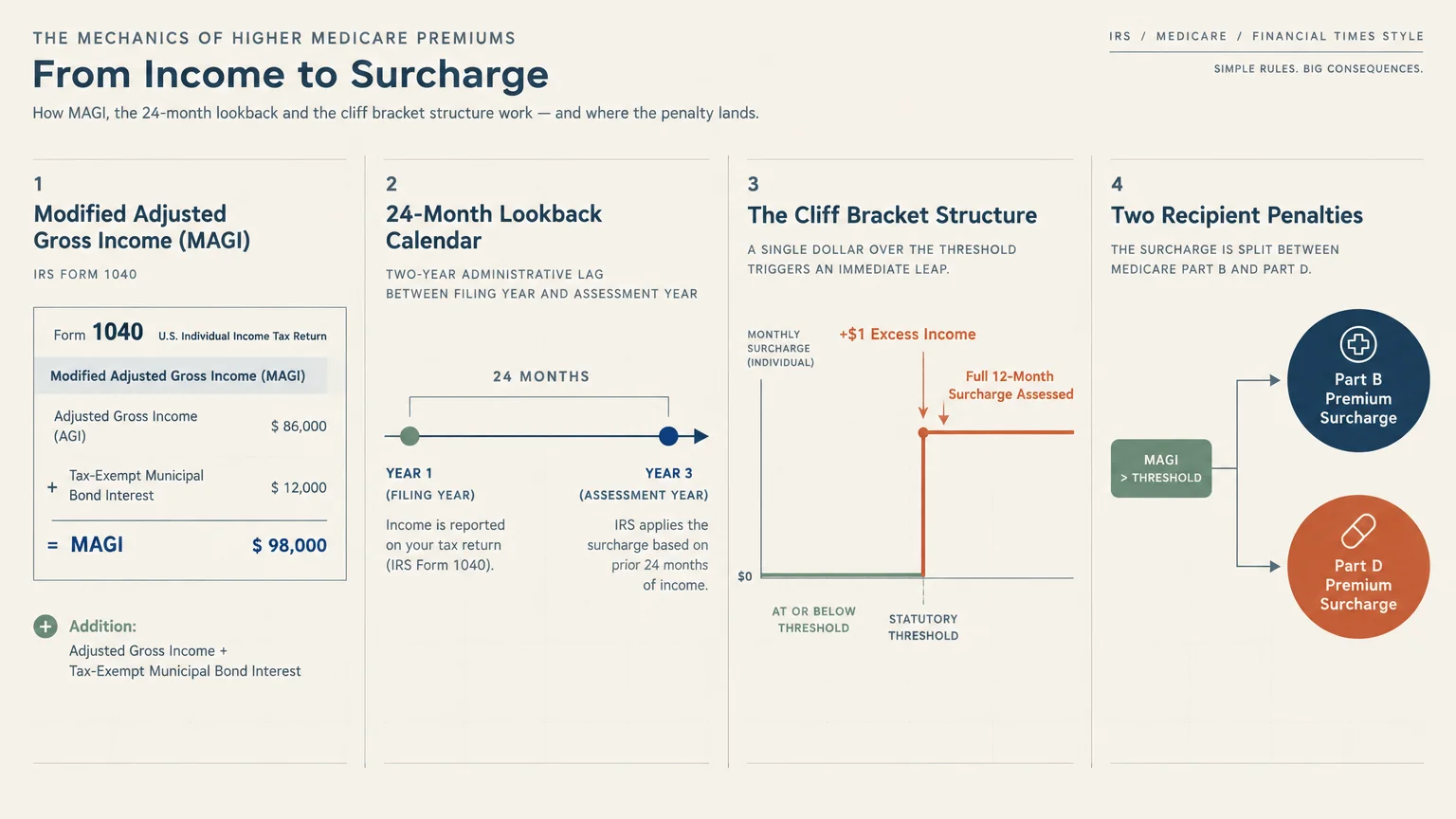
The federal government determines your current healthcare surcharge using your federal tax return filed two years prior. Your premium schedule relies on data from two years ago rather than your current spending or bank balance.
This two-year administrative lag creates unexpected consequences for newly retired individuals who recently left high-paying executive or professional careers. Your early retirement premiums reflect your prior peak earnings years unless you formally appeal the determination.
Retirees must anticipate this lookback schedule whenever they contemplate taxable portfolio events or property sales. Every realized capital gain or retirement account distribution produces a delayed healthcare surcharge exactly twenty-four months later.
The Cliff Bracket Structure
Standard federal income tax brackets follow a progressive marginal system where higher rates apply solely to income inside that specific band. Medicare premium surcharges function in a fundamentally different manner by employing non-marginal cliffs.
Crossing a single statutory bracket by one dollar triggers the full surcharge assessment across all twelve months. A single dollar of excess income can cause thousands of dollars in cumulative annual premium increases.
This harsh mechanism penalizes uncoordinated financial distributions that slightly breach an established threshold. Vigilant income monitoring prevents an accidental distribution from generating outsized healthcare surcharges.
Calculating Modified Adjusted Gross Income
Medicare calculates your assessment using a unique definition known as Modified Adjusted Gross Income. This specific figure begins with your adjusted gross income taken directly from your IRS Form 1040.
The calculation then adds back all tax-exempt interest income earned from municipal bonds and municipal bond funds. Any interest income excluded from regular federal taxation becomes fully visible for Medicare surcharge computations.
Many conservative investors accumulate municipal bonds under the assumption that tax-exempt earnings remain completely invisible to federal programs. Discovering that municipal bond coupons trigger healthcare surcharges often comes as an expensive shock.
Cost of Living Adjustments and Premium Inflation
The Social Security Administration indexes surcharge income tiers annually to account for broader consumer price inflation. However, rapid increases in overall healthcare costs often outpace baseline inflation measures.
If your pension or portfolio distributions increase alongside inflation, your earnings might drift into a higher surcharge bracket. Maintaining cash buffers beneath bracket boundaries insulates your plan from unexpected inflationary drift.
Financial Triggers That Inflate Retirement Earnings
Real Estate Transactions and Capital Gains
Selling an appreciated primary residence, vacation home, or rental real estate generates substantial capital gains. While homeowners can exclude specific gain amounts on primary homes, profits exceeding statutory allowances flow directly onto tax returns.
Investment properties carry no primary residence capital gains exclusion and often involve significant depreciation recapture taxes. This accumulated taxable gain produces a dramatic one-year spike in modified adjusted gross income.
You should structure significant property sales before enrolling in Medicare whenever feasible. Alternatively, evaluating structured financing or 1031 exchanges for investment real estate preserves capital while deferring taxable gain recognition.
Pension Buyouts and Deferred Compensation
Corporate restructuring often prompts employers to offer lump-sum buyouts to participants in defined-benefit pension plans. Accepting a cash settlement without executing a direct rollover generates immediate ordinary income on the entire sum.
Similarly, executive deferred compensation distributions frequently pay out in substantial installments during your initial years outside the workforce. These non-qualified distributions cannot roll into individual retirement accounts and remain fully taxable ordinary earnings.
You must coordinate the receipt of deferred compensation packages alongside other liquidations to avoid compounding surcharge brackets. Staggering discretionary distributions around mandatory corporate payouts mitigates your overall exposure.
Mutual Fund Capital Gain Distributions
Active mutual funds held within taxable brokerage accounts must distribute realized internal trading profits to shareholders annually. These mandatory year-end capital gain distributions occur even if the broader financial market declines.
Reinvesting these distributions directly back into additional mutual fund shares does not defer your current tax obligations. The Internal Revenue Service treats these reinvested figures as current taxable capital gains on your return.
Transitioning taxable portfolios toward tax-efficient exchange-traded funds minimizes capital gain distributions. Exchange-traded funds utilize in-kind creation and redemption mechanisms that virtually eliminate unexpected pass-through capital gains.
Business Liquidations and Partnership Exits
Selling an interest in an operating business or professional partnership often culminates decades of personal labor. The resulting gain typically combines ordinary income from inventory liquidation with long-term capital gains on enterprise value.
Failing to structure the purchase agreement carefully can push your retirement earnings into the highest Medicare surcharge tier. Engaging experienced transactional attorneys and tax professionals ensures favorable sale installment treatment.
Coordinating Core Retirement Income Streams
Optimizing Social Security Timing
Claiming Social Security benefits before reaching full retirement age locks in permanently reduced monthly payments. Conversely, delaying benefit claims until age 70 guarantees an eight percent annual delayed retirement credit growth.
Up to 85 percent of your Social Security benefits become subject to ordinary income tax depending on your combined income. You can verify your earnings history and projected benefit calculations through the Social Security Administration.
Delaying Social Security allows you to draw down taxable assets during early retirement without stacking on top of benefits. This strategic sequence lowers lifetime taxable income and prevents forced Medicare premium escalations.
Evaluating Defined Benefit Pension Elections
Retirees with traditional defined-benefit pensions must choose between single-life payouts and joint-and-survivor annuities. Single-life annuities offer larger checks but terminate entirely when the primary beneficiary dies.
Joint-and-survivor options provide reduced ongoing monthly payments to ensure continuous financial support for a surviving partner. Choosing the survivor structure suppresses your immediate household income while safeguarding your spouse against future poverty.
Assess whether fixed pension payments push your household baseline dangerously close to Medicare surcharge thresholds. If your pension consumes most of your lower bracket space, discretionary distributions must stay tightly controlled.
Structuring Commercial Annuity Income
Commercial fixed and variable annuities purchased with after-tax money provide guaranteed income with distinct tax properties. Each payment represents a combination of tax-free principal return and taxable accumulated investment growth.
The Internal Revenue Service determines this taxable ratio using a standard actuarial calculation known as the exclusion ratio. Only the earnings portion enters your modified adjusted gross income for healthcare surcharge determinations.
Once you outlive your actuarial life expectancy, the entire annuity payment becomes taxable as ordinary income. You must incorporate this eventual tax shift into your long-term healthcare premium projections.
Multi-Bucket Withdrawal Sequencing
A balanced retirement distribution plan organizes your assets into taxable, tax-deferred, and tax-free buckets. Strategic sequencing dictates which bucket you tap each year to manage your reported taxable income.
Withdrawing funds exclusively from tax-deferred accounts increases your adjusted gross income rapidly. Combining distributions from taxable brokerage accounts with tax-exempt Roth withdrawals produces flexible cash flow without generating excessive reported earnings.
You should partner with a fiduciary advisor registered with the Securities and Exchange Commission to model withdrawal order. Fiduciary professionals evaluate tax implications across your total net worth.
Non-Taxable Cash Reserves and Liquidity Buffers
Maintaining a dedicated cash buffer in high-yield bank accounts provides essential spending flexibility during volatile market cycles. Drawing on cash reserves during major expense years prevents you from realizing taxable capital gains.
Short-term emergency reserves protect you from liquidating appreciated investments during market downturns. This liquidity discipline preserves your assets while preventing unnecessary jumps across Medicare surcharge thresholds.

Tactical Tax Planning to Avoid Surcharges
Strategic Multi-Year Roth Conversions
Roth individual retirement account conversions transfer assets from traditional pre-tax accounts into accounts that grow and distribute tax-free. You pay ordinary income taxes on the converted balance in the tax year of execution.
The prime conversion window occurs between your retirement date and age 63. Because Medicare examines income with a two-year lag, conversions completed prior to age 63 never trigger healthcare premium adjustments.
When converting after age 63, you must calculate the exact remaining capacity within your current surcharge bracket. Converting up to the dollar boundary line optimizes tax rates while completely avoiding higher healthcare premiums.
Systematic partial conversions reduce the future account balance subject to mandatory government distributions. Lower future distributions permanently reduce your long-term risk of incurring mandatory Medicare surcharges.
Deploying Qualified Charitable Distributions
Retirees who attain age 70½ can execute Qualified Charitable Distributions directly from their individual retirement accounts. The Internal Revenue Service allows individuals to donate substantial pre-tax sums directly to qualifying charities.
These direct charitable gifts satisfy your annual Required Minimum Distribution mandate without counting as taxable income. By avoiding adjusted gross income entirely, you protect your Medicare surcharge brackets.
Standard charitable itemizations reduce taxable income but leave your initial adjusted gross income intact. Utilizing qualified distributions bypasses your tax return entirely, shielding your Medicare calculations from unnecessary inflation.
Donors should coordinate distributions directly through their individual retirement account custodians before taking year-end distributions. Once funds land in your personal checking account, they count as taxable distributions permanently.
Leveraging Health Savings Accounts for Medical Expenses
Health Savings Accounts offer unprecedented triple tax advantages for individuals enrolled in qualifying high-deductible health plans. Assets grow completely free of federal taxes and distribute tax-free for qualified healthcare services.
You can utilize accumulated Health Savings Account balances to pay Medicare Part B, Part D, and Medicare Advantage premiums. These tax-free distributions cover your healthcare obligations without adding a single dollar to your modified adjusted gross income.
Federal law mandates that you cease all Health Savings Account contributions upon enrolling in Medicare. Maximizing contributions in the years preceding your enrollment establishes an insulated healthcare reserve for retirement.
Tax-Loss Harvesting and Asset Location Discipline
Tax-loss harvesting involves selling underperforming assets in taxable accounts to offset realized capital gains dollar for dollar. You can also use net realized investment losses to offset up to three thousand dollars of ordinary income annually.
Proper asset location places income-generating assets, such as high-yield bonds and real estate investment trusts, within tax-deferred wrappers. Equities with low dividend yields remain inside taxable accounts to minimize annual reported earnings.
Coordinating asset location and disciplined loss harvesting keeps your annual baseline taxable income remarkably low. This deliberate investment design protects you from crossing critical Medicare income thresholds.
Installment Sales for Concentrated Gains
Selling high-value assets through an installment sale structure spreads taxable capital gain recognition over multiple tax years. Instead of receiving a single lump-sum payment, you receive contractual payments over an agreed timeline.
Spreading capital gains across five or ten years prevents sudden income spikes that trigger peak Medicare surcharges. Each annual installment carries a proportional share of taxable gain alongside a return of principal.
Navigating the SSA-44 Appeal Process
Recognized Life-Changing Event Categories
The Social Security Administration recognizes that significant life disruptions can abruptly diminish your annual household income. In such situations, federal rules permit you to file Form SSA-44 to request a premium recalculation.
Qualifying life-changing events include the death of a spouse, marriage, divorce, or complete work retirement. Significant reductions in work hours, loss of income-producing property, or loss of pension income also qualify for formal relief.
Voluntary capital gains realizations, high mutual fund distributions, and routine market downturns do not qualify as life-changing events. You cannot file a successful appeal based solely on fluctuating investment portfolio returns.
Compiling Verifiable Documentation
Every appeal submission requires rigorous documentary proof verifying the specific life-changing event and your projected earnings reduction. For retirement or work reductions, you must submit signed employer letters detailing your retirement date and reduced hours.
For marital disruptions or deaths, you must present original or certified copies of marriage, divorce, or death certificates. The agency rejects appeals that fail to provide official certified corroborating evidence.
You must also provide verifiable income documentation, such as filed tax returns or signed federal tax estimates. Ensuring documentation accuracy accelerates processing and minimizes administrative rejections.
Correcting Inaccurate Tax Lookback Data
Occasionally, the Internal Revenue Service transmits outdated or erroneous tax transcript data to the Social Security Administration. Amended tax returns or corrected filing statuses can take months to update across federal agency databases.
If an amended tax return lowered your modified adjusted gross income, you can request an immediate administrative correction. Providing certified copies of your amended return alongside IRS acceptance notices corrects your surcharge tier promptly.
Administrative Timelines and Retroactive Reimbursements
Processing Form SSA-44 requests generally takes anywhere from thirty to ninety days depending on regional office workload. Beneficiaries must continue paying the initially assessed Medicare premiums while their appeal remains under official review.
Once the Social Security Administration approves your petition, they adjust your premium rate retroactively to the effective date. Excess premiums deducted from previous Social Security checks are refunded directly to your bank account.

Protection, Long-Term Care, and Estate Planning
Funding Long-Term Care Without Income Spikes
Long-term care represents one of the largest unpredictable financial risks facing aging retirees today. Liquidating retirement accounts to pay hundreds of thousands of dollars in nursing care costs triggers immediate top-tier Medicare surcharges.
Asset-based hybrid life insurance policies with long-term care riders provide non-taxable reimbursement pools for qualified care. These insurance benefits pay nursing expenses directly without inflating your taxable income or triggering healthcare penalties.
Establishing an irrevocable healthcare trust or securing dedicated long-term care insurance provides critical liquidity insulation. Shielding your assets prevents catastrophic medical costs from triggering compounding tax and surcharge liabilities.
Mitigating the Surviving Spouse Tax Cliff
The passing of a spouse forces the surviving partner to transition from married filing jointly to single filing status. This transition cuts income tax brackets and Medicare surcharge thresholds roughly in half starting the following year.
While income may decline slightly, recurring pensions and mandatory retirement distributions often remain largely unchanged. The surviving spouse is abruptly propelled into higher Medicare surcharge brackets despite experiencing higher overall living burdens.
Proactively drawing down traditional retirement accounts while both spouses live creates lasting protection against this single-filing trap. Lowering future required minimum distributions softens the surcharge impact on your surviving partner.
Preserving Capital Asset Step-Up in Basis
Selling highly appreciated securities or physical property during retirement generates substantial capital gains subject to Medicare surcharges. Conversely, retaining appreciated assets within your estate confers a complete step-up in basis upon death.
Heirs receive inherited assets valued at fair market value on your date of death, completely wiping out built-in capital gains. This strategy avoids lifetime Medicare surcharges while preserving maximum intergenerational wealth for your beneficiaries.
Fiduciary Protections Against Elder Financial Fraud
Elder financial exploitation can destabilize retirement plans and trigger devastating tax and healthcare consequences. Fraudulent withdrawals or forced asset liquidations inflate reported gross income and generate severe Medicare surcharges.
Retirees should review fraud advisories from FINRA to identify deceptive schemes and predatory investment sales. Establishing trusted secondary contacts across all custodian accounts enables institutions to flag suspicious activity before liquidations occur.
Executing comprehensive durable powers of attorney grants trusted fiduciaries authority to manage accounts if incapacity occurs. Proactive legal designations prevent predatory individuals from accessing your assets and destroying your financial structure.
Trust Distribution Taxation and Pass-Through Considerations
Many retirees utilize revocable living trusts and irrevocable family trusts to manage their estate transfers. Trust assets distributed to beneficiaries carry taxable income through Schedule K-1 forms that impact recipient tax returns.
If a trust retains income rather than distributing it, that earnings face highly compressed trust tax brackets. Coordinating trust distribution timing ensures that neither the trust nor the individual beneficiary incurs punitive Medicare surcharges.
Frequently Asked Questions About Medicare Surcharges
How does part-time consulting affect my Medicare premiums?
Consulting income increases your net business earnings and raises your overall modified adjusted gross income. If those consulting earnings elevate your total income past a surcharge threshold, your Medicare premiums will rise accordingly.
You can counteract this exposure by establishing a tax-deductible retirement structure, such as a simplified employee pension or solo 401(k). Contributing pre-tax consulting revenue directly lowers your adjusted gross income back beneath critical thresholds.
How can I protect against inflation without triggering higher surcharges?
Holding inflation-indexed instruments inside tax-deferred accounts shields your purchasing power without generating current taxable income. Treasury Inflation-Protected Securities held in taxable accounts generate phantom taxable income that increases your reported earnings.
Investing in dividend-growth companies inside tax-advantaged accounts provides vital inflation protection without affecting current tax returns. This asset allocation balances purchasing power expansion with strict Medicare threshold defense.
Are financial advisor fees tax-deductible to help lower my income?
Federal tax reform eliminated miscellaneous itemized deductions for personal investment advisory and wealth management fees. You cannot deduct financial advisory fees to reduce your modified adjusted gross income for Medicare purposes.
However, paying management fees directly from your traditional individual retirement accounts pays advisory costs with pre-tax capital. This practice effectively reduces future required distributions without creating taxable transactions on your tax return.
How does the death of a spouse affect future surcharge thresholds?
You file taxes using married filing jointly rates for the full calendar year in which your spouse dies. Beginning the following tax year, you must file using single taxpayer status unless you qualify as a surviving spouse with dependent children.
Single thresholds are roughly half the married joint limits, exposing smaller income streams to substantial surcharges. Surviving spouses must immediately reevaluate their portfolio withdrawal rates and charitable strategies to navigate this compressed landscape.
Implementation Blueprint and Fiduciary Review
Managing Medicare surcharges requires continuous attention across every stage of your retirement journey. Waiting until you receive an elevated premium notice limits your options to reactive administrative appeals.
Conduct an annual income review every autumn with your tax professional to examine your year-to-date earnings. Projecting your final adjusted gross income gives you time to harvest losses or execute charitable distributions before year-end.
Coordinate closely with credentialed financial planners and tax specialists before executing significant property transactions or portfolio rebalancing. Professional modeling ensures that necessary asset sales do not trigger avoidable multi-tier Medicare surcharges.
Review your most recent tax filings and Social Security statements to assess your current surcharge tier position. Taking proactive command of your taxable distributions guarantees financial independence and protects your hard-earned retirement assets.