
The Social Security benefit formula does not treat every career equally. Understanding how the government calculates your Primary Insurance Amount allows you to capture thousands of extra dollars before you file.
While the system offers progressive replacement rates, specific structural rules quietly penalize two-earner couples and short careers. You can counter these baked-in biases by timing your filing date alongside your broader investment portfolio.
Navigating these complex calculations requires a clear look at how monthly earnings turn into lifetime income. Here is how the formula truly works and how you can position your household for maximum benefits.
Deconstructing the Social Security Benefit Formula
The Thirty-Five-Year Calculation Baseline
The Social Security Administration bases your baseline benefit on your thirty-five highest-earning years. Officials index your past wages to reflect national wage growth across your working life.
Wage indexing adjusts your historical earnings up to age sixty so that earlier compensation reflects modern economic realities. After age sixty, earnings enter the formula at their actual face value without further wage-growth indexing.
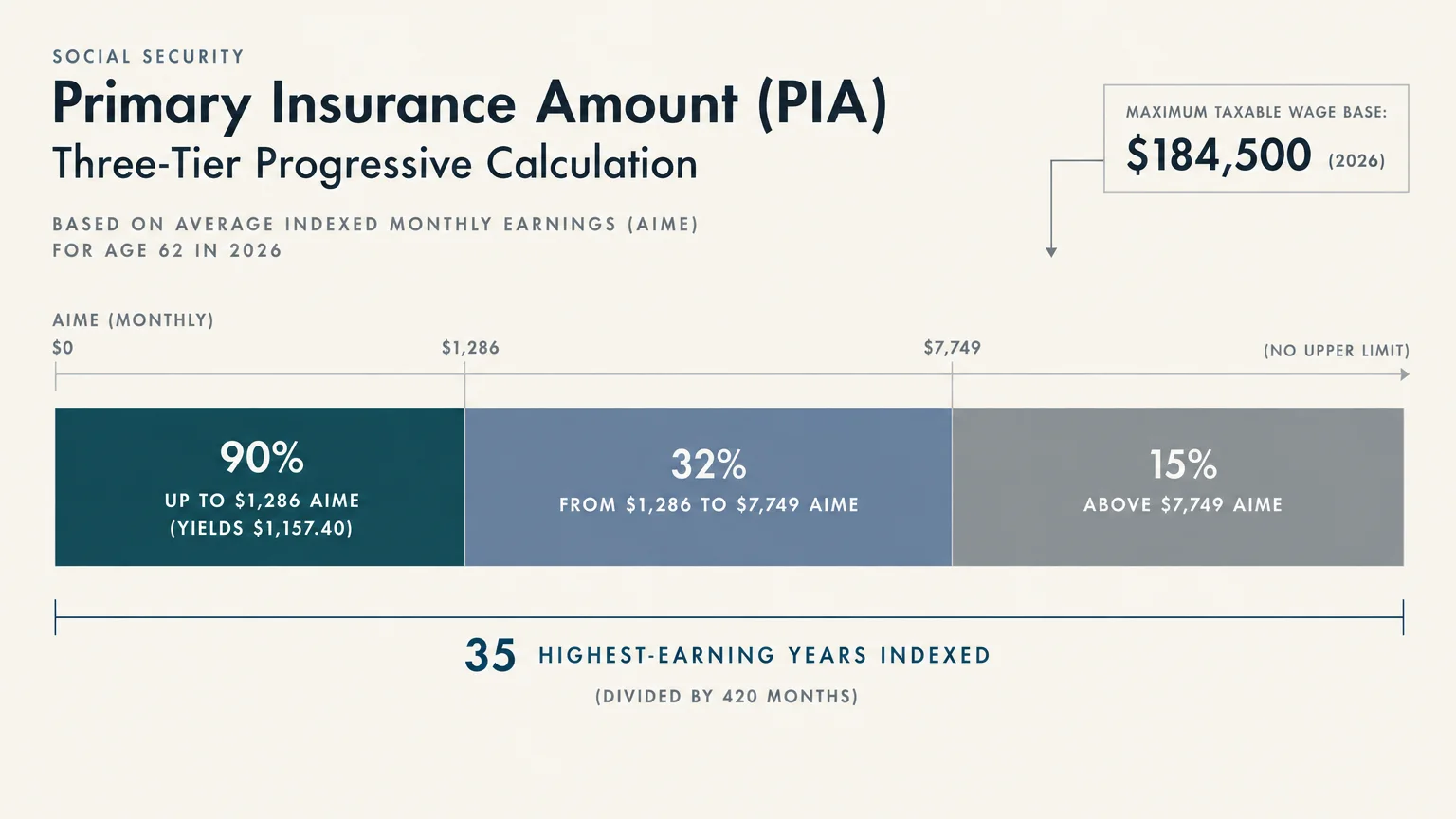
The system sums these thirty-five indexed years and divides the total by 420 months. This calculation establishes your Average Indexed Monthly Earnings, universally known as your AIME.
If you work fewer than thirty-five years in covered employment, the formula inputs zero earnings for every missing year. These zero-earning years drag down your monthly average and permanently diminish your baseline payment.
To achieve basic eligibility for retirement benefits, you must accumulate forty work credits over your career. In 2026, you earn one credit for every $1,890 in covered wages, requiring $7,560 for the annual four-credit maximum.
That threshold rises in 2027 to $1,970 per credit, which equals $7,880 for all four credits. Accumulating these credits guarantees access, but your thirty-five-year average dictates the size of your checks.
Progressive Bend Points in Action
Once the government establishes your AIME, it applies a three-tiered progressive formula to establish your Primary Insurance Amount. This formula uses specific dollar thresholds known as bend points.
For workers reaching age sixty-two in 2026, the formula awards 90% of the first $1,286 of your AIME. It then replaces 32% of earnings between $1,286 and $7,749.
Any average earnings above $7,749 yield a modest 15% replacement rate. This tiered system replaces a substantially larger percentage of pre-retirement earnings for lower-wage workers than for high earners.
For individuals who reach age sixty-two in 2027, the bend points increase to $1,340 and $8,077. This annual upward adjustment tracks national average wage increases to preserve purchasing power across successive generations.
A lower earner with an AIME of $1,286 in 2026 receives a primary insurance amount of $1,157.40; this equals a 90% replacement rate. That favorable replacement structure softens income drops for vulnerable workers.
In contrast, a high earner sees the top slice of their earnings replaced at only 15%. This mathematical tapering means high earners receive a much lower percentage of their pre-retirement pay from Social Security.
Indexed Earnings and the Wage Base Cap
The formula does not consider all compensation when calculating your thirty-five-year average. The federal government caps the amount of annual earnings subject to Social Security payroll taxes.
In 2026, the maximum taxable wage base sits at $184,500. This cap rises to $192,300 in 2027, reflecting ongoing national wage inflation.
Employees pay a 6.2% payroll tax on income up to this cap, matched by their employers. Self-employed professionals pay the combined 12.4% tax rate across all net earnings up to the annual statutory threshold.
Earnings beyond these statutory thresholds face no Social Security payroll taxes; however, they also add nothing to your eventual benefit. High earners who make far above the cap contribute the maximum tax without expanding their credits.
For maximum earners retiring at full retirement age, the monthly benefit reaches $4,152 in 2026 and rises to $4,188 in 2027. If you claim at age seventy, those maximum monthly checks climb to $5,181 and $5,358.
Why the Formula Favors Specific Retiree Profiles
Single-Earner Couples Versus Dual-Income Households
The Social Security benefit formula provides a generous advantage to single-earner married couples over dual-income households. A non-working spouse can claim a spousal benefit equal to 50% of the primary earner’s Primary Insurance Amount.
Consider a household where one spouse earns the maximum taxable limit while the other spouse stays home. That non-working spouse receives up to half the worker’s benefit without ever paying a dollar in payroll taxes.
In contrast, a dual-income couple where both spouses earn moderate wages pays twice as much into the system over thirty-five years. Yet their combined household benefit often matches or falls below the single-earner couple’s total payout.
The disparity deepens when the first spouse passes away. In a single-earner household, the surviving spouse steps into 100% of the primary earner’s benefit, preserving the bulk of their household income.
In a dual-income marriage, the smaller benefit disappears entirely, leaving the surviving spouse with only the larger payment. This dynamic produces a sharp, unexpected collapse in household cash flow for two-earner families.
Family Maximum Limitations
The government also limits total payments to a single family record through the family maximum benefit formula. This calculation establishes its own progressive bend points to prevent excessive household payouts.
For 2026, the family maximum bend points are $1,643, $2,371, and $3,093. In 2027, those thresholds rise to $1,712, $2,471, and $3,223 across four progressive replacement tiers.
These tiers apply strictly when dependent children or multiple eligible family members draw on one worker’s record. Understanding these limits prevents households from overestimating the total monthly cash flow they can extract.
Short Careers Versus Sustained Tenures
The strict thirty-five-year averaging window creates structural disparities for workers who take mid-career breaks. Caregivers, parents, and late entrants to the workforce carry zero-earning years that drag down their lifetime average.
A professional working thirty intense years at high wages will still have five zero-income years entered into their formula. Those five zeros dilute the Average Indexed Monthly Earnings substantially.
Conversely, an individual who maintains forty consecutive years of moderate earnings fills every slot in the calculation. The formula replaces their income at higher marginal rates without the drag of blank years.
You can overwrite zero-earning years by working additional years later in life. Any current year with higher earnings displaces a lower or zero-earning year from your thirty-five-year record.
The Historic Repeal of WEP and GPO for Public Servants
For decades, public-sector workers faced harsh formula penalties known as the Windfall Elimination Provision and the Government Pension Offset. These rules severely slashed benefits for educators, police officers, and firefighters receiving non-covered pensions.
The Windfall Elimination Provision dropped the first bend point replacement rate from 90% down to as low as 40%. Meanwhile, the Government Pension Offset wiped out spousal and survivor benefits for millions of public employees.
On January 5, 2025, the President signed the historic Social Security Fairness Act into law, retroactively effective to January 2024. This landmark legislation completely repealed both the Windfall Elimination Provision and the Government Pension Offset.
Over three million affected public retirees now enjoy the standard 90%, 32%, and 15% replacement formula. Their spousal benefits now operate under the exact same progressive rules that govern private-sector workers.
If this regulatory change applies to you, verify that the administration has updated your monthly payment records. Affected retirees should confirm that their benefits reflect the full 90% first-tier formula without arbitrary public-pension reductions.

Aligning Guaranteed Income and Investment Assets
The True Math Behind Early Filing
Filing for Social Security before your Full Retirement Age results in a permanent reduction of your monthly check. For workers born in 1959, Full Retirement Age is sixty-six and ten months; for those born in 1960 or later, it is sixty-seven.
Claiming at age sixty-two locks in a permanent 30% reduction from your baseline Primary Insurance Amount. In 2026, the maximum monthly payout at age sixty-two is $2,969, increasing to $3,094 in 2027.
The formula reduces your benefit by 5/9 of 1% for each of the first thirty-six months of early filing. For each additional early month beyond thirty-six, the benefit decreases by another 5/12 of 1%.
If you claim early, you sacrifice compounding benefits that protect against longevity risk. Before locking in a reduced check, verify your household cash flow needs with a qualified fiduciary financial planner.
Delaying Benefits for Longevity Protection
Every year you delay claiming Social Security past your Full Retirement Age boosts your benefit by 8% per year. This guaranteed annual increase accrues monthly until you reach age seventy.
For someone with a Full Retirement Age of sixty-seven, delaying until age seventy creates a permanent 24% benefit increase. That guaranteed return outpaces most conservative fixed-income instruments in the current economic environment.
Delaying past age seventy provides no additional financial credit whatsoever. You should always begin claiming your retirement benefits no later than the month you reach age seventy.
Beneficiaries also receive annual Cost-of-Living Adjustments on their higher baseline amounts. The Social Security Administration enacted a 2.8% adjustment in 2026 and announced a 3.6% boost for January 2027.
Those percentage increases generate substantially larger nominal dollar increases when applied to a delayed, elevated monthly payment. Over a twenty-year retirement, that higher baseline provides an exceptional hedge against stubborn inflation.
Coordinating Defined-Benefit Pensions and Commercial Annuities
Integrating private pensions with your Social Security claiming strategy stabilizes your retirement income floor. A reliable pension allows you to tap non-guaranteed assets early while delaying Social Security to age seventy.
Fixed and variable annuities can also serve as bridge income while you postpone your benefit application. This strategic approach prevents premature liquidation of equities during cyclical market downturns.
Always evaluate fee structures, surrender charges, and insurer credit ratings before purchasing commercial annuities. High internal costs can easily counteract the longevity advantages annuities provide.
The Retirement Earnings Test Rules
If you claim Social Security before your Full Retirement Age while continuing to work, the earnings test applies. The government temporarily withholds benefits if your earned wages surpass annual statutory limits.
In 2026, the earnings limit for workers under Full Retirement Age all year is $24,480. The government withholds $1 of benefits for every $2 earned above that cap.
In 2027, that threshold rises to $25,560, giving working retirees slightly more room before penalties begin. In the calendar year you reach Full Retirement Age, the limit expands significantly.
For 2026, that higher limit is $65,160, with $1 withheld for every $3 earned above the limit. That threshold increases to $67,920 for individuals reaching Full Retirement Age in 2027.
The earnings test only counts earned wages and net business earnings; it ignores pension payouts, dividends, capital gains, and interest. This distinction allows retirees with substantial investment income to claim early without earnings test withholdings.
Withheld benefits are not permanently lost; the administration recalculates your monthly check at Full Retirement Age to credit those amounts back. However, the temporary cash disruption catches many working retirees off guard.
Tax Optimization and Healthcare Expense Management
Mitigating the Social Security Tax Torpedo
Up to 85% of your Social Security benefits may be subject to federal income taxation. The Internal Revenue Service uses a calculation called provisional income to determine benefit taxation.
Provisional income equals your adjusted gross income, plus tax-exempt municipal interest, plus half of your annual Social Security payment. The threshold dollar amounts have never been adjusted for inflation since their introduction in 1983.
Single filers face taxation on up to 50% of benefits above $25,000 and up to 85% above $34,000. For married couples filing jointly, those thresholds sit at $32,000 and $44,000 respectively.
Crossing these static thresholds triggers the infamous tax torpedo, causing your marginal tax rate to surge unexpectedly. Strategic withdrawals from cash reserves or taxable brokerage accounts can keep your provisional income below key triggers.
Navigating Medicare IRMAA Surcharges
Your taxable income directly impacts your monthly healthcare premiums under Medicare rules. High-income retirees face the Income-Related Monthly Adjustment Amount, commonly known as IRMAA.
IRMAA adds mandatory surcharges to Medicare Part B and Part D premiums for higher earners. The government calculates these surcharges using your tax returns from two years prior.
A large taxable withdrawal to fund home renovations or portfolio rebalancing can push you into a higher IRMAA bracket. Careful multi-year planning prevents single-year income spikes from inflating your healthcare costs two years later.
If your income drops sharply due to retirement, marriage, or loss of income-producing property, you can appeal your surcharge. Submitting Form SSA-44 alerts the administration to your life-changing event and can eliminate unnecessary surcharges.
Strategic Roth Conversions and Required Distributions
Traditional individual retirement accounts and 401(k) plans require minimum distributions once you reach your statutory age. These mandatory withdrawals increase taxable income and can trigger both Social Security taxes and IRMAA surcharges.
Executing partial Roth conversions between retirement and the onset of required distributions mitigates this tax liability. Converting assets at lower ordinary income brackets permanently reduces the size of future mandatory withdrawals.
Qualified distributions from Roth accounts do not count toward your provisional income formula. They provide tax-free spending flexibility that shields your Social Security check from aggressive taxation.
Utilizing Health Savings Accounts Effectively
Health Savings Accounts offer triple tax advantages that make them premier tools for pre-retirees. Contributions are tax-deductible, investments grow tax-free, and withdrawals for qualified medical expenses incur no income tax.
You must stop contributing to a Health Savings Account six months before enrolling in Medicare. Failing to halt contributions creates tax penalties due to retroactive Medicare coverage provisions.
Once enrolled in Medicare, you can spend accumulated HSA funds on out-of-pocket medical expenses, dental care, and vision treatments tax-free. These distributions do not raise your provisional income or affect your Medicare premium tiers.

Protecting Your Wealth and Securing Family Longevity
Shielding Assets Against Long-Term Care Costs
Extended healthcare needs present one of the greatest threats to household retirement solvency. Traditional Medicare does not cover custodial long-term care services like assisted living or nursing home stays.
A catastrophic medical event can rapidly drain portfolio assets, leaving a surviving spouse dependent solely on a reduced Social Security check. Hybrid life and long-term care insurance policies can protect your core capital from depletion.
Purchasing coverage in your late fifties or early sixties secures lower premium rates and ensures medical underwriting approval. Evaluating asset-based policies guarantees that unused benefits pass cleanly to your heirs.
Defending Your Identity and Retirement Accounts
Financial fraud targeting seniors has escalated dramatically with sophisticated digital impersonation schemes. Criminals frequently attempt to redirect direct-deposit benefit payments by hijacking online Social Security accounts.
You must establish your personal account on the official administration portal before identity thieves do it for you. Adding multi-factor authentication creates a vital security barrier around your monthly benefit checks.
You should also verify the credentials of any financial professional offering benefit claiming advice through the FINRA BrokerCheck database. Ensuring your planner operates under a strict fiduciary standard protects your hard-earned wealth.
Freezing your credit reports across the three major bureaus—Equifax, Experian, and TransUnion—provides another essential layer of defense. This simple, free step stops unauthorized individuals from opening fraudulent accounts in your name.
Updating Estate Basics and Beneficiary Designations
Sound retirement planning requires regular reviews of your core estate documents. Wills, revocable living trusts, durable powers of attorney, and healthcare directives require periodic updates as family circumstances evolve.
Beneficiary designations on retirement accounts and insurance policies override instructions left inside a traditional will. Failing to update these forms can unintentionally transfer wealth to ex-spouses or estranged family members.
Coordinate your estate plan with qualified legal counsel licensed in your state of residence. Ensuring consistency across all accounts guarantees seamless wealth transfer without lengthy probate proceedings.
Securing Protection for Surviving Spouses
Survivor planning is one of the most critical aspects of Social Security income optimization. When a married spouse passes away, the smaller of the household’s two monthly benefit checks terminates permanently.
The surviving spouse retains the larger check, making the primary earner’s delayed claiming decision vital. By delaying to age seventy, the higher-earning spouse locks in the maximum possible survivor protection.
This guaranteed monthly cash flow protects the surviving spouse against poverty late in life. Fiduciaries consistently recommend prioritizing the higher earner’s delay over the lower earner’s claim date.
Frequently Asked Questions About the Social Security Formula
How does part-time work affect my Social Security payments?
If you have already reached Full Retirement Age, part-time earnings never reduce your monthly Social Security benefit. You can earn an unlimited amount from employment without penalty.
If you claim early, earnings exceeding $24,480 in 2026 trigger a temporary withholding of $1 for every $2 earned. In 2027, that earnings limit increases to $25,560.
Any new earnings that rank among your thirty-five highest-earning years will cause the administration to recalculate your benefit upward permanently. That annual recalculation occurs automatically each autumn.
What is the most reliable inflation hedge for fixed benefits?
Delaying your claim until age seventy provides the most powerful structural defense against inflation. Annual Cost-of-Living Adjustments yield larger dollar increases when applied to an elevated baseline benefit.
Pairing delayed Social Security benefits with Treasury Inflation-Protected Securities provides additional guaranteed purchasing power. These government-backed bonds adjust their principal value directly with the Consumer Price Index.
Maintaining a diversified equity allocation in your portfolio also delivers critical long-term growth. Equities historically generate returns that outpace inflation over extended multi-decade horizons.
How should I evaluate advisor fees for retirement planning?
Seek fee-only fiduciary advisors who charge flat fees or hourly rates rather than commission-based brokers. Fiduciary planners are legally bound to prioritize your financial interests over company incentives.
You can verify advisor registration and disciplinary records through the Securities and Exchange Commission investment adviser public disclosure database. Checking credentials verifies whether your advisor maintains an unblemished professional track record.
Avoid advisors who promote opaque products carrying steep surrender periods or hidden commissions. Transparent fee structures preserve your capital and guarantee unbiased financial recommendations.
Can a surviving spouse switch between benefits later?
Yes, a surviving spouse can claim a survivor benefit as early as age sixty and switch to their own retirement benefit at age seventy. Alternatively, they can claim their own benefit early and switch to an unreduced survivor benefit at Full Retirement Age.
This strategic flexibility allows surviving spouses to optimize lifetime payouts based on personal earnings and age differences. Careful coordination between both benefit types prevents leaving guaranteed money on the table.
Consult a qualified financial planner to model both claiming paths before submitting an application. The right sequence can add tens of thousands of dollars to your lifetime income.
Take Control of Your Retirement Trajectory
Reviewing Your Social Security Statement
Log into your personal account on the government portal annually to inspect your earnings history. Correcting reporting errors before you claim ensures the administration calculates your thirty-five-year average with total precision.
Compare your estimated payments across ages sixty-two, sixty-seven, and seventy to assess the lifetime payoff of delayed filing. Those figures illustrate the substantial financial return that patience provides.
Partnering with Fiduciary Professionals
The Social Security formula interacts directly with your tax bracket, healthcare premiums, and investment portfolio drawdowns. Navigating these overlapping rules requires comprehensive modeling tailored to your unique financial footprint.
Schedule a planning session with a fee-only fiduciary advisor and a certified public accountant. Taking proactive steps today ensures you maximize every dollar the federal benefit formula offers.
Keep your financial plan flexible as policy changes and market conditions evolve over time. Proactive oversight empowers you to build a resilient, enduring retirement income strategy.