State pension tax rules are shifting rapidly as you prepare your 2026 return in early 2027 and map out your 2027 retirement budget. Knowing whether your state shields defined-benefit payouts can keep thousands of dollars in your pocket each year.
While fifteen states leave traditional pensions largely untaxed, others apply steep income cliffs or treat private plans differently than government benefits. Recent state rate cuts and federal deduction updates make proactive coordination essential.
You can use these 2027 strategies to verify your state exemptions, coordinate withdrawals, and safeguard your retirement income.
How Your State Taxes Pensions Heading Into 2027
Where you live in retirement dictates how much of your monthly pension check actually reaches your bank account. State legislatures have enacted sweeping rate cuts and targeted retirement exemptions affecting both 2026 tax returns and the 2027 tax year.
Before you adjust your tax withholding or consider relocating, you need to separate states that skip personal income taxes entirely from those that carve out selective pension shields. Reviewing how your state classifies each retirement account prevents costly April surprises.
The 15 States That Leave Traditional Pensions Untaxed
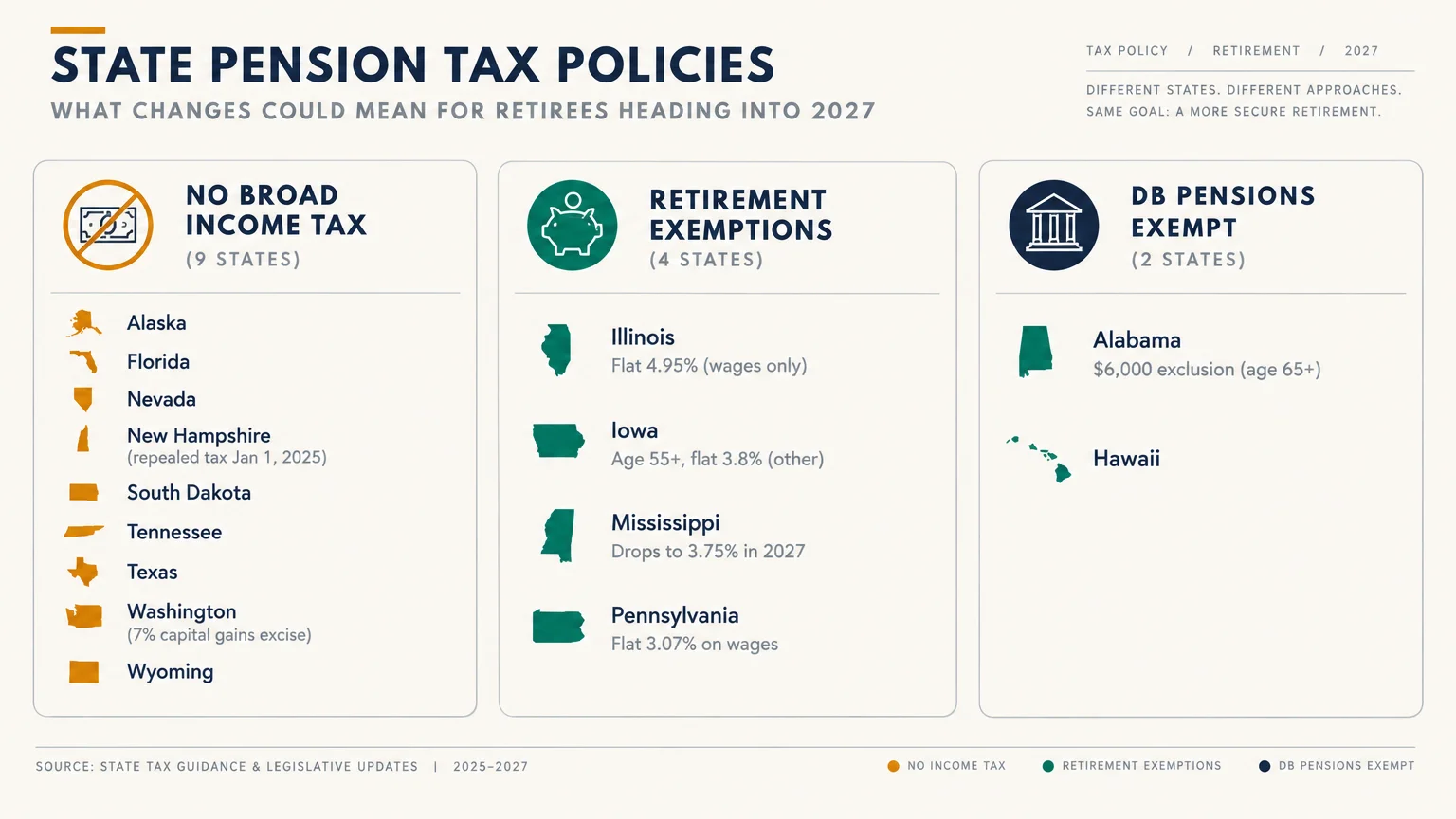
Nine states impose no broad-based individual income tax at all, leaving your traditional pensions, 401(k) distributions, IRA withdrawals, and Social Security benefits completely untouched at the state level. Those states are Alaska, Florida, Nevada, New Hampshire, South Dakota, Tennessee, Texas, Washington, and Wyoming.
New Hampshire joined the ranks of completely income-tax-free states when it repealed its Interest and Dividends Tax effective January 1, 2025. Retirees living there now keep pension payouts and investment interest free of state income tax.
Washington also charges zero personal income tax on your pensions, 401(k) withdrawals, IRA distributions, and real estate sales. However, the Washington Department of Revenue enforces a 7% capital gains excise tax—rising to 9.9% above $1 million—on non-retirement long-term capital gains exceeding roughly $270,000 to $278,000 annually.
Four additional states levy a broad individual income tax on wages yet exempt most retirement income across the board. Illinois, Iowa, Mississippi, and Pennsylvania let you keep qualified pension payouts and retirement plan distributions free of state income tax.
In Illinois, the Illinois Department of Revenue exempts Social Security, qualified pensions, and IRA or 401(k) withdrawals while taxing wages and non-retirement investment income at a flat 4.95%. If you work part-time in Illinois, only your paycheck faces that state tax.
Iowa exempts Social Security at any age and shields retirement plan and pension income once you reach age 55 or older. Other taxable income in Iowa faces a flat 3.8% rate.
Mississippi exempts Social Security, pensions, and IRA or 401(k) distributions from state tax. Non-retirement income above $10,000 faces a 4% rate in 2026, which drops to 3.75% in 2027.
Pennsylvania leaves Social Security, qualifying pensions, and 401(k) or IRA distributions untaxed while applying a flat 3.07% rate to wages and investment earnings. Remember to check local rules, because some Pennsylvania municipalities still collect local earned income taxes on part-time wages.
Two more states—Alabama and Hawaii—round out the fifteen states highlighted by AARP for exempting traditional defined-benefit pension payouts. Both states draw sharp lines between traditional employer pensions and personal retirement savings accounts.
Alabama shields traditional defined-benefit pension income from state tax, yet it generally taxes withdrawals from IRAs and 401(k) plans. Once you reach age 65 or older in Alabama, you can exclude up to $6,000 per qualifying spouse of otherwise taxable retirement income.
Hawaii exempts payouts from traditional pension plans when you made no employee contributions, and it also shields employer-contributed 401(k) portions. Employee-contributed IRA and 401(k) distributions in Hawaii face graduated tax rates ranging from 1.4% to 11%.
Major State Tax Shifts for 2026 Returns and 2027
Retirees filing 2026 returns in early 2027 will see major relief in Michigan following the completion of a four-year phase-in under PA 4 of 2023 and PA 24 of 2025. Per Michigan Department of Treasury Revenue Administrative Bulletin 2026-1, birth-year restrictions on pension exemptions are gone.
Beginning with tax year 2026, Michigan retirees of any birth year can subtract qualifying retirement and pension benefits up to $67,610 for single filers or $135,220 for married couples filing jointly. Alternatively, taxpayers born after 1945 who are 67 or older can claim a $20,000 single or $40,000 joint deduction against all income.
Consider a married couple in Michigan collecting $110,000 in combined private and public pensions on their 2026 return. Because $110,000 sits below the $135,220 joint cap, they wipe out their state tax on that pension income—though they should confirm eligibility rules with a licensed tax professional.
Georgia is also expanding retirement relief heading into tax year 2027, particularly for younger military veterans. Beginning in 2027, Georgia raises its under-65 military retirement income exclusion to a flat $65,000 for retirees of any age.
For general retirement income, the Georgia Department of Revenue maintains exclusions of $35,000 per person for ages 62 through 64 and $65,000 per person at age 65 and older. Any taxable retirement income above those thresholds faces Georgia’s flat 4.99% rate.
Across the country, broader rate cuts documented in the Tax Foundation’s 2027 State Tax Competitiveness Index will lower the bite on pensions that exceed state exclusion limits. You can track these evolving brackets through Tax Foundation state tax research before finalizing your 2027 withholding elections.
Ohio shifted from a graduated income tax to a flat 2.75% individual rate, simplifying estimates for retirees with large IRA withdrawals or private pensions. Meanwhile, Oklahoma consolidated six income tax brackets into three and lowered its top rate from 4.75% to 4.5%.
Georgia, Kentucky, Nebraska, Oklahoma, and Utah each trimmed their flat or top marginal income tax rates heading into 2027. Even modest rate reductions compound meaningfully when applied to decades of pension payouts.
Social Security taxation is also shrinking across state lines. West Virginia completed its three-year phase-out, making Social Security benefits 100% exempt on 2026 returns filed in 2027.
Rhode Island plans to eliminate state taxes on Social Security benefits for eligible retirees in 2027, a move projected to benefit roughly 9,200 residents. If you live in Rhode Island, review your 2027 state withholding so you do not overpay throughout the year.
Aligning Pensions, Social Security, and Portfolio Withdrawals
Maximizing your after-tax cash flow requires matching each income stream to your state’s specific tax treatment. A withdrawal strategy that works seamlessly in Illinois can trigger steep state taxes in California or Oregon.
When you coordinate defined-benefit pensions, Social Security timing, commercial annuities, and portfolio drawdowns together, you gain control over which dollars hit your state tax return first.
Public vs. Private Pensions and State Exclusion Caps
A 2026 QuantCalc study found that eleven states tax identical dollar amounts differently depending on whether your check comes from a government pension, a private employer pension, or an IRA. Understanding your pension’s legal origin is critical before you forecast state liabilities.
Massachusetts and New York fully exempt many government pensions while taxing or strictly capping private retirement income. By contrast, California, Minnesota, Oregon, and Vermont tax most private pension payouts as ordinary income, and Connecticut exempts pensions only below adjusted gross income limits.
Many states soften the blow on partial pension taxes through dollar-capped exclusions that reward careful income layering. Knowing your exact cap helps you decide whether to draw from taxable pensions or Roth accounts first.
Colorado allows a $24,000 exclusion at age 65 and older—or $20,000 between ages 55 and 64—and fully exempts Social Security at age 65. Delaware offers a $12,500 exclusion starting at age 60, dropping to $2,000 if you are under 60.
Maine provides a partial pension exclusion of $49,824 in 2026, while Maryland offers up to $40,600 for qualifying residents age 65 and older. In New York, government pensions stay exempt while private pensions and qualified retirement distributions receive a $20,000 annual exclusion starting at age 59½.
Smaller deductions still offer targeted relief in other states. Oklahoma grants up to a $10,000 retirement income exclusion, South Carolina provides a $10,000 deduction at age 65 and older, and Virginia allows up to a $12,000 age-based deduction at age 65.
New Jersey requires extra caution because of a strict income cliff published by the NJ Division of Taxation. Residents age 62 or older can exclude up to $75,000 single or $100,000 joint in pension, annuity, and IRA withdrawals if total New Jersey income stays at $100,000 or less.
If a joint couple in New Jersey reports total income between $100,001 and $125,000, the exclusion shrinks to 50%; between $125,001 and $150,000, it drops to 25%. Once your New Jersey income crosses $150,000 by even a single dollar, the exclusion plunges to $0.
Military retirees enjoy far broader protection nationwide. Across the nine no-income-tax states and twenty-eight states with full exemptions, thirty-seven states did not tax military retirement pay in 2026.
Even California added partial relief starting in tax year 2025, exempting up to $20,000 of military retired pay for single filers with adjusted gross income of $125,000 or less. Additionally, VA disability compensation remains exempt from both federal and state income taxes in every state.
Coordinating Social Security Timing, Annuities, and Federal Source Rules
Following West Virginia’s phase-out, forty-two states and Washington, D.C. impose zero tax on your Social Security benefits. Only eight states—Colorado, Connecticut, Minnesota, Montana, New Mexico, Rhode Island, Utah, and Vermont—tax Social Security for at least some residents in 2026.
Even within those eight states, income thresholds shield most middle-income retirees. Connecticut exempts benefits below adjusted gross income limits of $75,000 single or $100,000 joint, while New Mexico exempts up to $100,000 single or $150,000 joint.
With the 2027 Social Security cost-of-living adjustment set at 3.6%, your federal benefit will climb noticeably next year. If you live in one of the eight states that tax benefits, check whether that 3.6% bump pushes your total income above your state’s exemption cap.
You should also track how earned wages interact with Social Security before full retirement age. In 2027, the Social Security earnings test threshold rises from $24,480 to $25,560, though your pension payouts never count toward that earnings limit.
Before locking in a claiming age, review your projected benefit estimates on the Social Security Administration retirement portal. Delaying Social Security while drawing down taxable IRAs or pensions in a low-tax state can permanently boost your inflation-adjusted income floor.
Commercial annuities add another layer to your state tax puzzle. Some states, like New Jersey, bundle commercial annuities with pensions and IRAs under the same exclusion umbrella, while states like Alabama favor employer-sponsored defined-benefit plans over private retirement contracts.
If you earned your pension in a high-tax state and plan to move to a tax-free state, federal law stands firmly on your side. Under the federal Pension Income Tax Limits Act, codified at 4 U.S.C. § 114, your former work state cannot tax qualified retirement payouts once you move.
That federal source-tax ban covers defined-benefit pensions, 401(k) plans, 403(a) plans, and SEPs. Only your current state of legal residence may tax those distributions, so verify your plan administrator updates your residency address immediately after moving.
Tax, RMD, and Healthcare Strategies for 2027
Moving to a tax-free pension state eliminates state withholding, yet federal income taxes and healthcare surcharges still apply to every dollar of taxable retirement income. Viewing your federal tax bracket, state rules, and Medicare premiums as one unified system prevents accidental tax spikes.
A single poorly timed IRA withdrawal can trigger federal taxes, erase a state pension exclusion, and inflate your future healthcare costs all at once.
Navigating Federal Deductions, Contribution Limits, and RMDs
Even if your state leaves your pension untouched, you must plan around rising federal standard deductions for 2026 and 2027. For tax year 2026 returns filed in early 2027, the federal standard deduction stands at $16,100 for single filers and $32,200 for married couples filing jointly.
Taxpayers age 65 and older also receive an extra federal standard deduction of $2,050 for single filers or $1,650 per spouse on joint returns in 2026. On top of that, the July 2025 One Big Beautiful Bill Act added a $6,000 per-person senior deduction—up to $12,000 for joint filers both age 65 or older.
For tax year 2027, IRS Revenue Procedure 2026-35 and Notice 2026-66 increase the base federal standard deduction by 3.2%. Single filers receive $16,600, joint filers receive $33,200, and heads of household receive $24,925.
If you are still working part-time or full-time in 2027, higher retirement plan limits allow you to shelter more income from federal and state taxes. The 2027 deferral limit for 401(k), 403(b), and 457 plans increases from $24,500 to $25,500.
Older workers gain generous catch-up room in 2027 as well. Catch-up contribution limits rise to $8,500 for savers ages 50 through 59 or 64 and older, and reach $11,750 for savers ages 60 through 63.
Executives and high earners participating in defined-benefit plans also see a higher ceiling in 2027. The annual IRS limit under IRC Section 415(b) climbs from $290,000 to $300,000, and you can verify official plan rules on IRS retirement plan resources.
Once required minimum distributions begin, mandatory withdrawals from traditional IRAs and 401(k) accounts stack directly on top of your monthly pension checks. In states with strict income cliffs, those combined distributions can wipe out your state pension exclusion.
Imagine a New Jersey married couple age 65 receiving $90,000 in pension income and $45,000 in other taxable income, putting total income at $135,000. Because they sit in the $125,001 to $150,000 tier, they still keep 25% of their $100,000 exclusion, shielding $25,000.
If a $20,000 required minimum distribution pushes their total New Jersey income to $155,000, they breach the $150,000 cliff and lose the entire $25,000 exclusion overnight. Before executing Roth conversions or delaying withdrawals to manage cliffs like this, consult a licensed tax advisor for personalized projections.
Managing Medicare IRMAA and HSAs Alongside Pension Income
Your taxable pension payouts, traditional 401(k) withdrawals, and required minimum distributions feed directly into your modified adjusted gross income. Medicare uses that figure to determine whether you owe Income-Related Monthly Adjustment Amounts on Part B and Part D premiums.
Because Medicare typically evaluates tax returns from two years prior, the pension elections and portfolio withdrawals you make in 2026 and 2027 dictate your future healthcare premiums. You can review current surcharge brackets and enrollment rules through official Medicare cost guidelines.
Blending tax-free income sources helps keep your modified adjusted gross income below Medicare surcharge triggers and state income cliffs. Drawing from Roth IRAs or after-tax cash reserves during high-expense years lets you pay bills without inflating taxable income.
Health Savings Accounts provide another powerful buffer if you built balances before enrolling in Medicare. Qualified HSA withdrawals for medical, dental, or vision bills remain completely tax-free at the federal level and stay invisible to Medicare surcharge formulas.
If you are still working, covered by a qualifying high-deductible health plan, and have not yet enrolled in Medicare, contributing to an HSA lowers both your federal and state taxable income today. Lowering your adjusted gross income now can help you qualify for income-tested state exclusions like Connecticut’s Social Security exemption.

Protecting Your Retirement Paycheck and Legacy
Focusing exclusively on state pension income tax can blindside you with steep sales, property, or estate bills after you settle into a new home. True retirement readiness requires evaluating your total tax burden alongside residency rules, estate paperwork, and scam defenses.
Protecting what you have built means checking every local levy and legal document before your circumstances change.
Looking Beyond Income Taxes to Sales, Property, and Estate Taxes
Skipping state income tax on your pension does not mean living tax-free. States without personal income taxes frequently offset lost revenue through higher sales taxes, steeper property assessments, or state-level estate levies.
Five states—Alaska, Delaware, Montana, New Hampshire, and Oregon—charge zero statewide sales tax. By contrast, no-income-tax states like Tennessee at 9.61% and Washington at 9.51% carry among the highest average combined state-and-local sales tax rates, well above the 7.53% national weighted average.
Property taxes can also erode the savings from a tax-free pension. New Hampshire and Texas carry notably high property tax rates, which can strain fixed pension budgets as home values climb.
Washington adds another wrinkle for affluent retirees by imposing a state estate tax alongside its capital gains excise tax. Before relocating to save on pension taxes, compare annual property tax bills, local sales tax rates, and state estate exemptions side by side.
Long-term care expenses present a hidden tax trap in retirement as well. Paying large assisted-living or home-care bills out of pocket often forces retirees to liquidate large sums from pre-tax IRAs in a single year.
Those sudden IRA withdrawals can push you above state exclusion cliffs in states like New Jersey or raise your Medicare premiums for an entire year. Evaluate long-term care insurance, hybrid policies, or dedicated health savings early so care costs do not derail your tax bracket.
Domicile Rules, Beneficiary Updates, and Fraud Prevention
If you move across state lines to benefit from the federal source-tax ban under 4 U.S.C. § 114, you must establish clear legal domicile in your new state. Simply renting an apartment or changing a mailing address is not enough if your former state audits your residency.
Update your driver’s license, vehicle registrations, voter registration, and primary home records promptly, and track the number of days you spend in each state. Clean documentation proves to aggressive state revenue departments that your former state can no longer tax your pension.
Reviewing beneficiary designations is just as vital as establishing domicile. Beneficiary forms on your pension survivor election, 401(k) accounts, IRAs, and life insurance policies legally override whatever instructions sit inside your will.
Audit your primary and contingent beneficiaries every year, especially after marriage, divorce, or the birth of grandchildren. Confirming how your pension pays out to a surviving spouse prevents administrative delays and unintended tax burdens during an already difficult transition.
Retirees managing lump-sum pension rollovers or relocation proceeds remain prime targets for financial fraud. Be skeptical of promoters pitching pension advance loans, aggressive tax-shelter trusts, or high-commission annuities disguised as state tax solutions.
Before rolling over a pension lump sum or trusting an advisor with your retirement move, verify their background and disciplinary history using the FINRA BrokerCheck tool or SEC registration databases. Checking credentials takes two minutes and protects your lifetime savings from unregulated pitches.
Frequently Asked Questions About State Pension Taxes
State tax rules touch every corner of retirement life, from part-time paychecks to survivor benefits. These four answers address the most common questions retirees raise when planning for 2027.
How Does Part-Time Work Affect My Pension Taxes and Social Security?
Taking a part-time job does not eliminate traditional pension exclusions in states like Illinois or Pennsylvania, though your wages will face regular state income tax and potential Pennsylvania municipal earned income taxes. However, extra earned income can push your total adjusted gross income over strict thresholds in states like New Jersey or Connecticut.
For Social Security, watch the earnings test if you work before reaching full retirement age. In 2027, the Social Security earnings test threshold rises to $25,560—up from $24,480 in 2026—and while your earned wages count toward that limit, your pension payouts do not.
What Are the Best Inflation Hedges When Your Pension Is Fixed?
Unlike Social Security, which delivers a 3.6% cost-of-living adjustment in 2027, many private defined-benefit pensions pay a flat monthly check forever. Over a twenty-year retirement, inflation steadily shrinks the purchasing power of that fixed pension payment.
You can offset a flat pension by keeping a balanced allocation of dividend-paying equities, Treasury Inflation-Protected Securities, or flexible part-time work. Just keep non-retirement investment gains aligned with state rules, especially in places like Washington where large non-retirement capital gains trigger a separate excise tax.
How Should I Evaluate Advisor Fees When Planning a Tax Move?
Compare an advisor’s ongoing fees directly against your projected annual tax savings rather than focusing solely on upfront promises. Avoid locking large pension rollovers into steep surrender-charge products just to chase modest state tax deferrals.
Ask prospective advisors whether they operate as fiduciaries and evaluate your entire tax picture—income, property, sales, and estate levies—rather than looking at pension taxes in isolation. Always confirm their licensing status with SEC or FINRA records before signing an agreement.
How Does State Tax Planning Change for a Surviving Spouse?
Moving from married filing jointly to single filing status often triggers a sharp tax increase even when household income drops. Federally, your 2027 standard deduction cuts in half from $33,200 to $16,600, pushing remaining pension and IRA payouts into higher brackets sooner.
State exclusions shrink dramatically for single survivors as well. In Michigan, your pension subtraction drops from $135,220 to $67,610, while New Jersey’s maximum exclusion drops from $100,000 to $75,000—making joint survivor pension elections and early Roth conversions worth discussing while both spouses are living.
Your Next Steps for 2027 Retirement Tax Readiness
Gathering your latest pension statements, Form 1099-R documents, Social Security benefit letters, and local property tax bills gives you an immediate baseline for 2027. Compare your combined income against your state’s specific 2026 filing rules and upcoming 2027 rate changes before adjusting withholding.
If your income sits near a state cliff like New Jersey’s $150,000 cutoff, or if you plan to relocate for tax relief, schedule a dedicated check-in with a licensed CPA or fiduciary financial planner. A short planning session today can protect your pension paycheck and your peace of mind for years ahead.