
You do not need a multi-million-dollar portfolio to enjoy a secure and fulfilling retirement. Shifting your focus from asset size to steady cash flow allows you to build sustainable monthly income today.
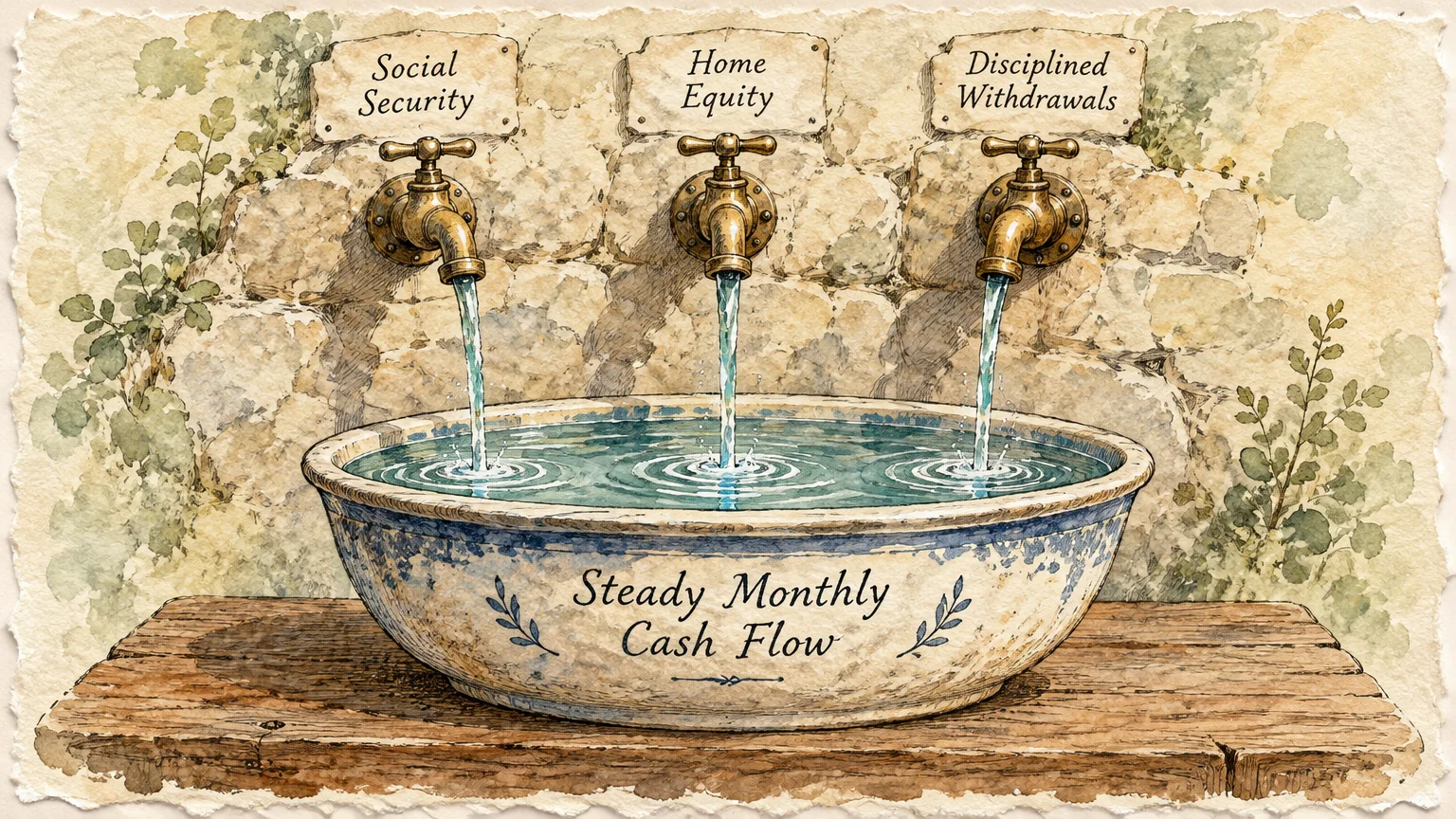
National survey data proves that real-world retirees survive and thrive with far less than conventional wisdom suggests. By coordinating Social Security, home equity, and disciplined withdrawals, you can eliminate structural shortfalls.
Strategic income distribution turns modest savings into lifelong financial stability. Small operational adjustments will protect your standard of living through every stage of your retirement.
The Million-Dollar Myth Versus Real Retirement Numbers
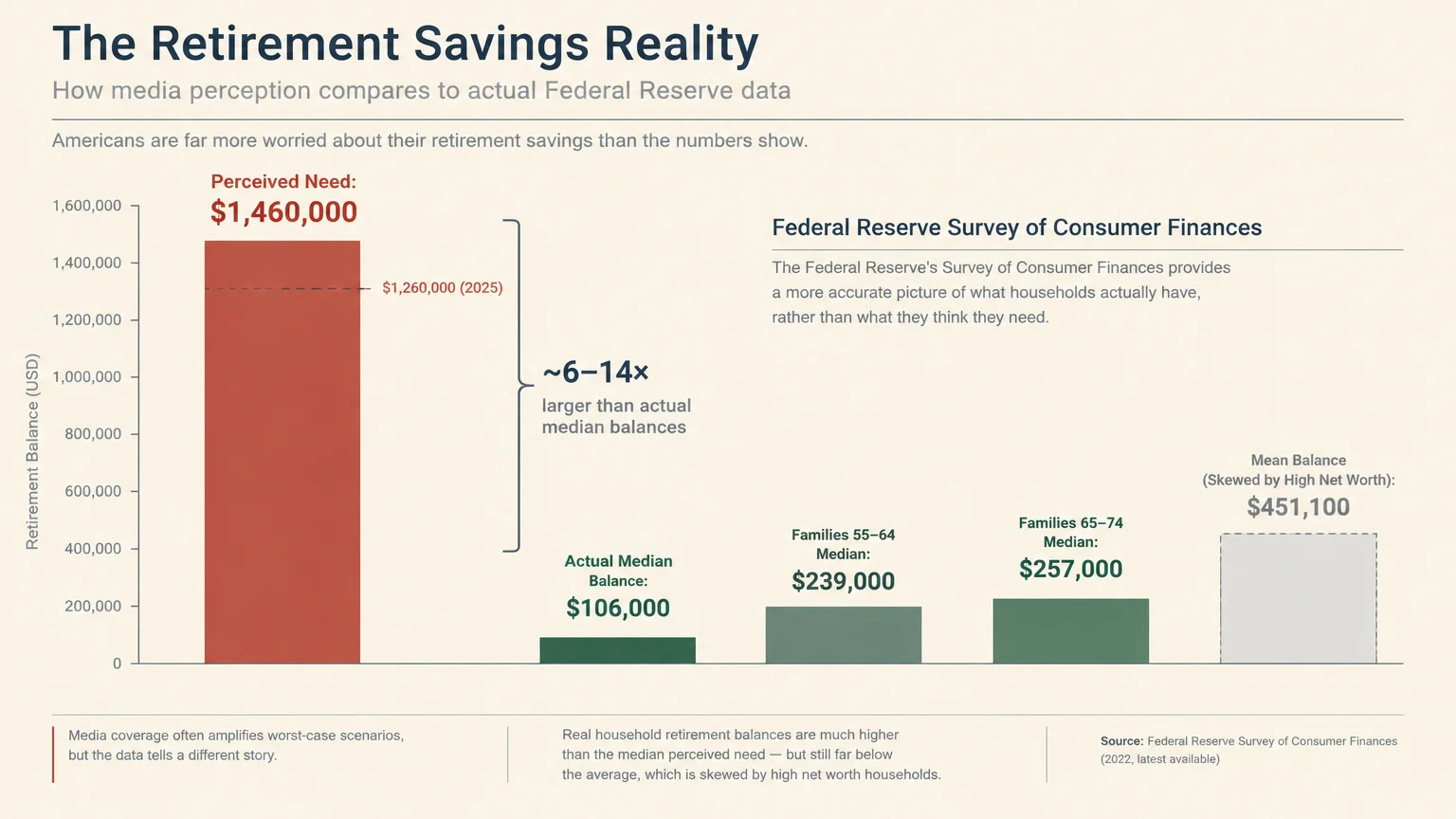
Financial headlines routinely convince workers that a comfortable retirement requires an unattainable fortune. The 2026 Northwestern Mutual Planning & Progress Study revealed that the average adult believes they need $1.46 million to retire comfortably.
That target climbed by $200,000 from the $1.26 million figure reported in 2025. Similarly, workplace plan participants in the 2026 Schroders US Retirement Survey estimated that they require $1.2 million to stop working.
These inflated expectations generate pervasive financial anxiety across the country. The Northwestern Mutual study discovered that 46% of Americans do not expect to be financially prepared, while 48% fear outliving their accumulated savings.
Actual household balance sheets present a drastically different picture. According to the Federal Reserve’s 2025 Survey of Consumer Finances, released in October 2026, the median retirement account balance among all participating families sits at $106,000.
High-net-worth households heavily skew the overall mean balance upward to $451,100. Evaluating the median provides a far more accurate representation of what typical American families have saved.
For families aged 55 to 64, the Federal Reserve recorded a median balance of $239,000 against a mean of $670,200. These figures show that real-world savers accumulate far less than published survey benchmarks suggest.
For households aged 65 to 74, the median balance stands at $257,000. This reality confirms that a seven-figure portfolio is neither standard nor necessary for leaving full-time employment.
The Federal Reserve also reported that only 54.9% of American families hold dedicated retirement accounts like 401(k) plans or IRAs. When factoring in traditional defined-benefit pensions, overall plan participation reaches roughly 65%.
A substantial 36.9% of families aged 55 to 64 possess no retirement accounts whatsoever. Millions of older adults still navigate their post-career years successfully by organizing diverse financial resources.
Comparing your balance against hyper-inflated media benchmarks will only paralyze your planning efforts. Shifting your focus toward cash flow management restores clarity and control to your financial life.
The Real Retirement Age and the Housing Safety Net
You may have stepped away from your career earlier than you originally envisioned. A May 2026 Gallup poll revealed that while non-retired workers expect to retire at age 66, the actual average retirement age is roughly 61.
Corporate downsizings, industry reorganizations, or sudden health emergencies frequently force an unplanned departure from the workforce. Leaving early reduces your accumulation years and forces your existing assets to stretch over a longer horizon.
Despite an abrupt transition, your primary home can serve as an indispensable asset anchor. The Federal Reserve reports that 66% of American families own their primary residence.
Among homeowners, the median net housing value—calculated as total home value minus outstanding mortgage balances—stands at $230,000. This equity provides vital financial flexibility when liquid savings fall below your expectations.
You can unlock this stored wealth by downsizing to a smaller residence or moving to a more affordable geographic area. Selling a home with substantial equity frees up cash while reducing ongoing maintenance costs, utilities, and property taxes.
Moving from a high-tax jurisdiction to an area with lower tax burdens produces permanent monthly savings. Those freed-up dollars directly offset portfolio withdrawal demands.
If you prefer staying in your home, lines of credit or reverse mortgages can supply reliable standby liquidity. Treating your residential equity as a strategic reserve transforms a dormant balance sheet asset into practical retirement income.
Redefining “Enough” Through Cash Flow Replacement
Professional planners evaluate retirement readiness through practical cash flow replacement rather than arbitrary lump sums. Leading institutions like Fidelity and Northwestern Mutual recommend replacing 70% to 80% of your pre-retirement income to preserve your lifestyle.
You do not need to replace 100% of your working earnings because several major expenses vanish in retirement. You no longer pay payroll taxes, fund workplace retirement plans, or spend money commuting to an office.
Professional wardrobe costs, outside dining during the workweek, and convenience spending decline naturally. Furthermore, retirees who extinguish their mortgage balances can reduce their income needs by an additional 20% to 30%.
To establish your personal spending target, divide your recurring expenses into essential baseline needs and discretionary desires. Essential expenses cover your basic shelter, groceries, utilities, insurance premiums, and medical copays.
Discretionary expenses include vacation travel, gifts, hobby equipment, and entertainment subscriptions. Isolating essential costs reveals the minimum guaranteed income required to keep your household fully secure.
When guaranteed income covers your essential bills, you never have to worry about market downturns causing eviction or hunger. Your remaining investment portfolio only needs to fund your flexible lifestyle choices.
Reviewing bank statements from the previous twelve months will reveal your true spending habits. Eliminating unused memberships and renegotiating home and auto insurance coverage instantly narrows any perceived income gap.
Maximizing Guaranteed Income and Social Security Timing
Social Security provides the foundation of guaranteed, inflation-protected income for the vast majority of American retirees. The federal program shields you against longevity risk by continuing uninterrupted payments for your entire life.
The federal government adjusts these benefits annually to protect your purchasing power from general price inflation. Beneficiaries received a 2.8% Cost-of-Living Adjustment in 2026, and the government announced a 3.6% COLA for 2027.
Before the 2027 adjustment takes effect, the average monthly benefit for a retired worker is $2,094, while an aged couple averages $3,237. These payouts create an immediate baseline that reduces pressure on your personal savings.
Starting in January 2027, the 3.6% boost raises the average retired worker’s benefit to $2,170 per month. That adjustment delivers roughly $26,040 each year in guaranteed, predictable income.
For a retired couple, the 2027 adjustment lifts average monthly payments to $3,354, producing approximately $40,248 annually. Coordinated spousal claims can lock in substantial guaranteed revenue without taking portfolio risk.
You should review your personalized benefit projections directly through the Social Security Administration website. Establishing an online account allows you to inspect your earnings history and compare claiming scenarios.
Delaying your benefit claim beyond your Full Retirement Age increases your check by 8% per year until age 70. If you possess bridging capital, delaying claiming yields a significantly higher lifetime payout.
Married couples should consider delaying the higher earner’s benefit as long as possible. That strategy maximizes the ultimate survivor benefit for whichever spouse outlives the other.
If your former employer provides a defined-benefit pension, evaluate distribution options carefully before signing paperwork. Choosing between a single-life annuity and a joint-and-survivor option requires balancing monthly cash flow against spousal protection.
You can also construct your own personal pension by purchasing a single-premium immediate annuity from a top-rated insurer. Committing a portion of your savings to an annuity permanently fills any shortfall between Social Security and essential expenses.
Dynamic Portfolio Withdrawal Strategies
Relying on a rigid withdrawal rule can lead to unnecessarily austere spending or premature portfolio exhaustion. Morningstar’s State of Retirement Income research sets the 2026 base safe withdrawal rate at 3.9% for a 30-year retirement.
That base calculation assumes an equity allocation between 20% and 50% and delivers a 90% probability of portfolio survival. However, strict static withdrawals assume you never adjust your spending in response to changing markets.
Real-world retirees do not spend identical dollar amounts adjusted strictly for inflation every single year. Morningstar researchers highlight that dynamic spending models permit retirees to start with initial withdrawal rates between 5% and 6%.
Flexible spending allows you to enjoy higher distributions during your active early retirement years. You simply agree to adopt modest guardrails that moderate spending when investments encounter prolonged market downturns.
Under a guardrails approach, you skip inflation raises or trim your distributions by a few percentage points following down years. Conversely, you award yourself bonus spending raises after periods of exceptional market expansion.
This dynamic adjustments model prevents sequence-of-returns risk from decimating your principal early in your retirement journey. Liquidating equities during severe market declines forces you to realize temporary losses permanently.
To insulate your lifestyle from market swings, establish a dedicated cash reserve. Holding 12 to 24 months of essential expenses in high-yield savings accounts or short-term Treasury bills prevents panic selling.
When market prices fall, you draw living expenses from your cash buffer until equities recover. When markets rally, you replenish your cash reserve by harvesting capital gains from appreciated assets.
Tax-Efficient Distribution and Healthcare Coordination
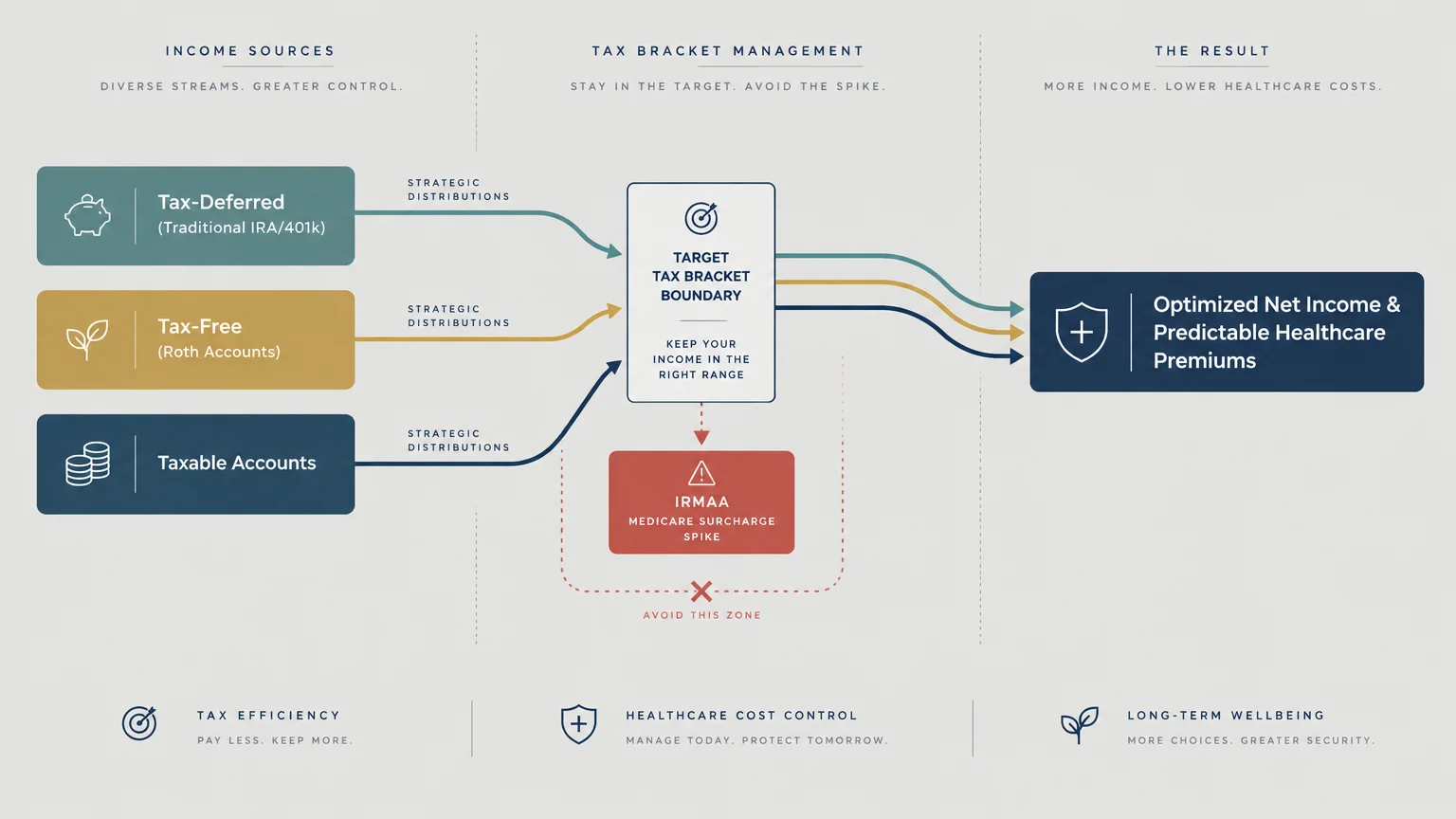
Minimizing taxes across different retirement accounts can extend the life of your nest egg by multiple years. Coordinating withdrawals across taxable brokerage accounts, traditional pre-tax IRAs, and Roth accounts requires ongoing annual oversight.
You must pay close attention to the tax calculation governing your Social Security benefits. The statutory provisional income thresholds established by the Internal Revenue Service remain unindexed for inflation.
Benefits become up to 50% taxable when provisional income exceeds $25,000 for single filers or $32,000 for married joint filers. Up to 85% of your benefits become taxable above $34,000 for single filers or $44,000 for married couples.
Provisional income equals your modified adjusted gross income plus nontaxable interest and half of your annual Social Security benefits. Large, uncoordinated distributions from traditional IRAs can inadvertently push your benefits into these taxable brackets.
Executing deliberate Roth conversions during low-income years between career exit and age 73 reduces future tax liabilities. Shrinking your pre-tax IRA balance diminishes future Required Minimum Distributions that might trigger higher tax rates later.
Healthcare represents another critical budget consideration that demands structured coordination. Research enrollment windows and evaluate coverage choices directly through Medicare to avoid permanent late-enrollment premium penalties.
Income-Related Monthly Adjustment Amount surcharges increase Part B and Part D premiums for retirees reporting higher incomes. Keeping your modified adjusted gross income below these surcharge cliffs preserves predictable monthly cash flow.
If you possess an accumulated Health Savings Account, treat those assets as dedicated medical funds. Distributions from HSAs remain 100% tax-free when applied to qualified medical, dental, vision, and hearing expenses.
Working in Retirement and Late-Stage Contributions
Working part-time during your initial retirement years creates immense financial flexibility while keeping you mentally engaged. The 2026 Northwestern Mutual study found that 41% of Americans currently work or plan to work during retirement.
Generating even $1,500 to $2,000 each month sharply reduces your reliance on portfolio distributions. Earning modest income allows your remaining investments to continue compounding undisturbed through changing market conditions.
If you claim Social Security before your Full Retirement Age, you must monitor the annual earnings test limits. The earnings limit is $24,480 in 2026 and rises to $25,560 in 2027.
The government withholds $1 in benefits for every $2 you earn above these established thresholds. The restriction relaxes significantly during the specific calendar year in which you attain Full Retirement Age.
In the year you reach full retirement age, the earnings limit rises to $65,160 in 2026 and jumps to $67,920 in 2027. The government withholds $1 for every $3 earned above the limit until your birthday month.
Once you attain Full Retirement Age, the earnings test vanishes completely. Furthermore, the Social Security Administration recalculates your monthly benefit upward at full retirement age to restore any previously withheld funds.
Working seniors can also continue accumulating tax-advantaged savings through employer plans or individual accounts. For 2026, the standard contribution limit for 401(k), 403(b), and 457 accounts is $24,500.
Workers aged 50 and older can make an additional catch-up contribution of $8,000, bringing their total potential contribution to $32,500. Under SECURE 2.0 rules, employees aged 60 to 63 qualify for a super catch-up limit of $11,250.
That special provision raises the total potential workplace plan contribution for workers aged 60 to 63 to $35,750 in 2026. For traditional and Roth IRAs, the 2026 limit is $7,500, plus an $1,100 catch-up for savers 50 and older.
Contributing earned income to a Roth IRA creates tax-free growth and completely eliminates future distribution mandates. That flexibility makes Roth accounts an exceptional estate planning and income management tool.

Asset Protection, Estate Basics, and Fraud Defense
Safeguarding your existing assets from unnecessary erosion is just as important as generating monthly yield. A comprehensive protection strategy addresses long-term care exposures, legal estate documents, and consumer fraud risks.
Traditional long-term care insurance policies often impose unpredictable premium increases that threaten fixed retirement budgets. Asset-based hybrid life insurance policies with long-term care riders provide guaranteed benefits alongside level annual premiums.
If commercial insurance does not fit your budget, you can establish an emergency healthcare reserve within your home equity. State Medicaid programs provide nursing home coverage, but accessing benefits requires navigating complex asset limits.
Sound estate documentation ensures your assets transfer directly to your chosen heirs without court interference. Review your primary and contingent beneficiary designations on all bank accounts, brokerage accounts, and insurance policies today.
Formal beneficiary forms supersede any instructions written inside your last will and testament. Update these designations whenever major family milestones occur, including marriages, divorces, or the death of a named heir.
Draft a durable financial power of attorney and an advance healthcare directive with an estate planning attorney. These essential documents empower trusted family members to manage your bills and healthcare if cognitive decline occurs.
Protecting your accounts from financial exploitation requires ongoing vigilance against sophisticated scams. You can verify the regulatory standing and disciplinary record of any financial professional using tools provided by FINRA.
Avoid complex investment vehicles that promise high guaranteed yields while downplaying real liquidity constraints. The Securities and Exchange Commission provides comprehensive guidance to help seniors identify and report fraudulent financial offerings.
Frequently Asked Questions
Can I work part-time without hurting my Social Security benefit?
You can work while collecting Social Security, but your age determines whether earnings limit your monthly checks. If you have reached Full Retirement Age, you can earn unlimited wages without any benefit reductions.
If you claim benefits before Full Retirement Age, earnings exceeding the annual limit trigger temporary payment withholdings. That limit is $24,480 in 2026 and increases to $25,560 for 2027.
The government withholds $1 for every $2 earned above the cap until you reach Full Retirement Age. The withheld amounts return to you as permanently higher monthly checks once you reach that milestone.
How can I protect a modest nest egg against inflation?
Social Security provides your first line of defense through statutory annual adjustments like the 3.6% boost taking effect in 2027. This guaranteed COLA protects your baseline purchasing power regardless of prevailing economic inflation.
For your personal savings, maintain a diversified allocation to low-cost equity index funds to outpace rising prices. Over multi-decade retirement horizons, broad equities reliably deliver returns above the rate of inflation.
Holding too much money in low-yielding checking accounts guarantees steady erosion of your real wealth. Deploying cash into Treasury Inflation-Protected Securities or short-term certificates of deposit helps preserve purchasing power.
How do advisor fees impact a smaller retirement portfolio?
Asset-based advisory fees exert a substantial drag on small investment portfolios over long periods. Paying a standard 1% annual fee on a 4% portfolio withdrawal consumes a full quarter of your spendable income.
High mutual fund expense ratios and hidden trading fees further reduce your portfolio longevity. Seek out independent, fee-only fiduciary financial planners who charge transparent hourly or flat project-based consulting fees.
Fee-only fiduciaries do not sell commission-generating products or accept marketing incentives from investment firms. This structure guarantees that your advisor provides objective recommendations tailored entirely to your financial well-being.
What happens to our income plan if one spouse passes away?
When a spouse passes away, household income declines abruptly while fixed overhead costs frequently remain unchanged. The surviving spouse retains the larger of the two Social Security benefits, while the smaller check ceases.
Losing that second monthly check creates an immediate cash flow contraction for the surviving partner. Furthermore, the surviving spouse must eventually file taxes as a single individual rather than married filing jointly.
Single tax brackets feature narrower income thresholds, which can push smaller incomes into higher marginal tax brackets. Maintaining modest term life insurance or selecting joint-and-survivor pension options provides vital cash flow protection for the survivor.
Building Your Sustainable Action Plan
Thriving in retirement with a modest portfolio requires systematic cash flow management rather than anxiety. By organizing your income streams and trimming avoidable costs, you can construct an enduring financial future.
Begin by recording all recurring monthly expenses to identify your exact baseline living costs. Compare that total against your guaranteed monthly income from Social Security and any available pensions.
If an income gap appears, calculate whether a dynamic portfolio withdrawal rate safely covers the remaining difference. Adopting flexible spending guardrails allows you to begin distributions near 5% or 6% with confidence.
Explore supplemental part-time employment or consider unlocking primary home equity to eliminate persistent deficits. Even small amounts of earned income significantly reduce withdrawal pressure on your invested nest egg.
Individual circumstances vary widely based on tax status, health considerations, and specific investment portfolios. Consult a certified financial planner and an experienced tax professional to design an individualized financial strategy.
Gather your latest account statements and spending records this week to map your personal retirement balance sheet. Taking prompt, informed action today empowers you to retire with lasting dignity, confidence, and peace of mind.