
You can boost your monthly retirement income by claiming benefits tied to your former spouse’s work record. Millions of divorced women leave substantial cash on the table because they mistakenly believe divorce severed their rights.
If your marriage lasted at least ten years, federal law guarantees access to spousal benefits without reducing your ex-husband’s check. You do not need his consent, contact information, or direct involvement to file your claim.
Recent regulatory changes and expanding inflation adjustments make understanding these entitlements vital for your financial security. Uncovering these rules allows you to optimize your retirement cash flow immediately.
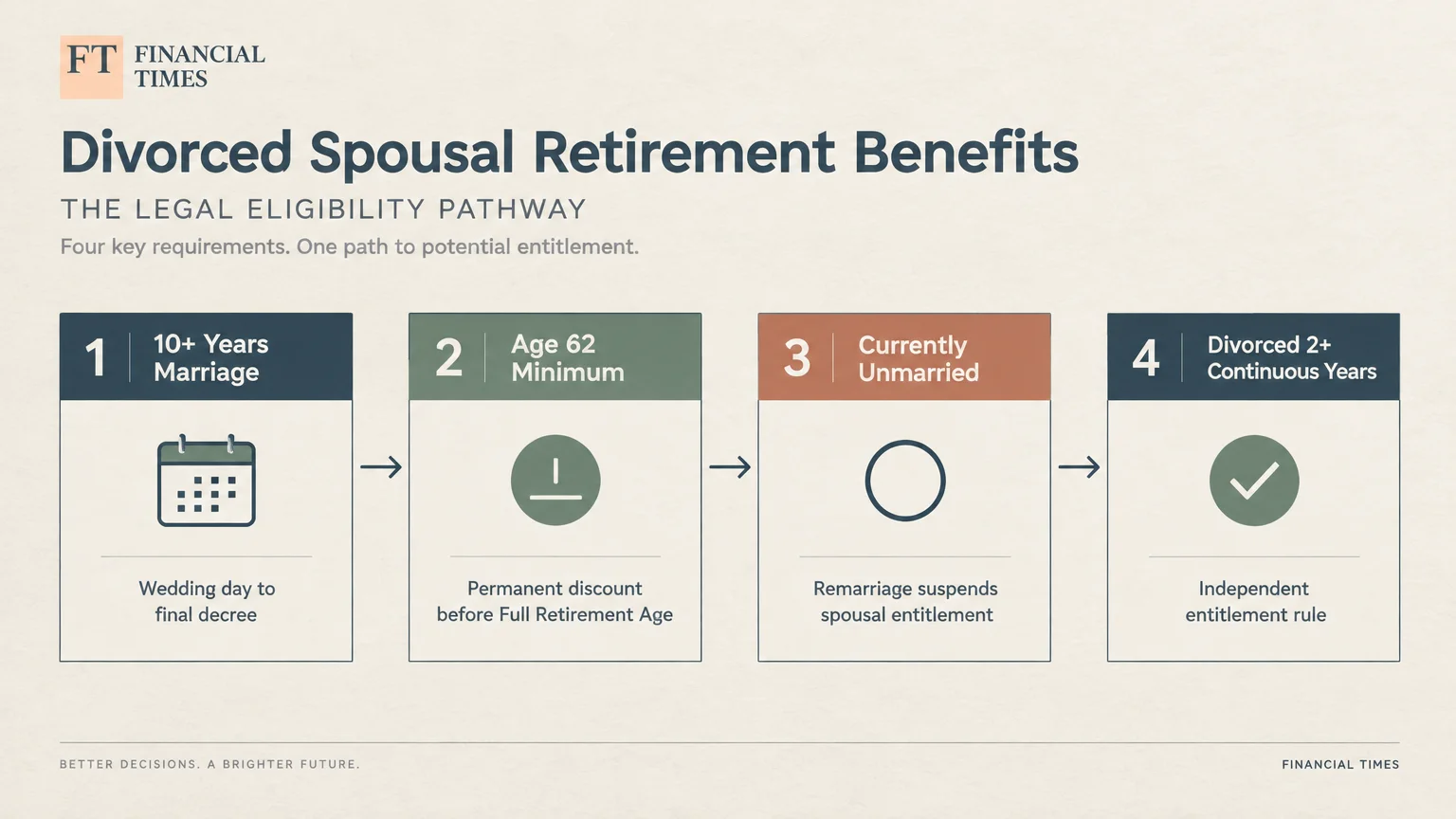
Core Qualification Criteria for Divorced Spousal Benefits
The Ten-Year Marriage Requirement
To qualify for spousal benefits on an ex-spouse’s earnings record, your marriage must have lasted at least ten consecutive years. The Social Security Administration measures this duration strictly from your wedding day to the date your final divorce decree took legal effect.
If you divorced and later remarried the same person, you can still meet this benchmark under specific conditions. You may combine both marriage periods if you remarried no later than the calendar year immediately following your divorce.
Many women assume that an acrimonious split or a long physical separation prior to legal dissolution disqualifies them. Fortunately, the law focuses entirely on legal marriage dates rather than your living arrangements during those years.
Locating your legal marriage certificate and divorce decree represents the first practical step toward proving this timeline. Keeping these original or certified documents on hand eliminates bureaucratic friction when you submit your application.
Age Thresholds and Claiming Timelines
You must reach at least age 62 before you can claim divorced spousal payments on a living ex-partner’s record. Filing at age 62 permanently discounts your benefit amount compared to waiting until your Full Retirement Age.
Your Full Retirement Age depends entirely on the calendar year you were born. For individuals born in 1959, Full Retirement Age sits at 66 years and ten months; for those born in 1960 or later, it reaches 67.
Claiming before your Full Retirement Age locks in a permanent monthly reduction for the rest of your life. Evaluating your cash reserves and overall health helps determine whether early filing fits your broader financial plan.
Consulting licensed financial professionals ensures your timing aligns with other assets rather than reacting to short-term cash crunches.
The Independently Entitled Ex-Spouse Rule
Under standard spousal rules, a current spouse cannot collect benefits until the primary worker files an application. Divorced women, however, enjoy a powerful legal carveout known as the independently entitled ex-spouse provision.
If your former partner is at least age 62 and qualifies for benefits, you can claim your share even if he delays filing. You only need to ensure that your divorce has been legally finalized for at least two continuous years.
This critical rule prevents an uncooperative or wealthy former spouse from holding your retirement funds hostage. You control your filing schedule regardless of when he decides to leave the workforce.
You can run payment estimates on the Social Security Administration benefit tools portal to see your baseline entitlement.
Current Marital Status and Privacy Protections
To receive living ex-spouse benefits, you must remain currently unmarried when you submit your paperwork. If you remarry, your eligibility on your former husband’s record ceases immediately, unless that subsequent marriage ends through death or divorce.
Conversely, your ex-husband’s current marital status has zero bearing on your legal eligibility. He can remarry multiple times, and his subsequent marriages will never dilute or eliminate your lawful claim.
Filing on your ex’s record remains completely confidential between you and the federal government. The agency will never notify your ex-spouse, and your payments will never reduce his monthly deposit.
His current wife’s spousal payments also remain completely untouched by your claim. You are simply drawing from the federal trust fund based on earnings history recognized by law.
Calculating Your Monthly Divorced Spousal Payout
The Fifty Percent Maximum Benefit Cap
The maximum benefit for a divorced spouse tops out at 50% of the ex-spouse’s Primary Insurance Amount. This figure reflects the monthly amount your former partner is entitled to receive at his Full Retirement Age.
Your benefit calculations never include any delayed retirement credits your former spouse might earn by waiting until age 70. The 50% cap anchors strictly to his baseline Full Retirement Age payout.
If his Primary Insurance Amount equals $2,400 per month, your maximum unreduced spousal payment would equal $1,200. This guaranteed sum arrives every month, backed by federal cost-of-living adjustments throughout your retirement.
Understanding this mathematical limit enables you to build realistic cash flow forecasts for your post-career lifestyle.
Early Claiming Reductions and Full Retirement Age
Claiming spousal benefits before reaching your Full Retirement Age triggers a severe, lifelong actuarial penalty. If you file at age 62, your payment drops to as little as 32.5% of your ex-spouse’s Primary Insurance Amount.
This sharp reduction occurs because the Social Security Administration expects to pay you benefits over a significantly longer lifespan. That discount remains permanent, depressing your monthly baseline for decades to come.
Waiting until your Full Retirement Age secures the entire 50% spousal allotment without any ongoing penalty deductions. Assessing your current portfolio balances and personal longevity expectations helps clarify whether patience makes financial sense.
Personalized modeling helps you weigh the immediate utility of smaller checks against the compounding value of a higher baseline.
Why Delaying Past Full Retirement Age Yields No Extra Return
When you delay claiming your own worker benefits past Full Retirement Age, your payout grows by roughly 8% annually until age 70. However, divorced spousal benefits do not accumulate delayed retirement credits under any circumstances.
A divorced spousal payment reaches its absolute ceiling the moment you attain your statutory Full Retirement Age. Waiting until age 68, 69, or 70 to claim an ex-spouse benefit simply surrenders monthly income without increasing your check.
Once you reach age 67, you should claim your spousal entitlement immediately if you have not already done so. Leaving money with the government past that date provides no financial advantage whatsoever.
Checking your birth year ensures you pinpoint your exact Full Retirement Age and avoid leaving monthly funds unclaimed.
Navigating Deemed Filing Regulations
The Bipartisan Budget Act of 2015 permanently altered filing strategies for anyone born on or after January 2, 1954. Under these deemed filing rules, submitting an application automatically triggers a claim for both your personal and spousal benefits.
The government evaluates both benefit records simultaneously and pays your own earned retirement benefit first. If your spousal entitlement provides a higher dollar amount, the agency tops off your check with an auxiliary payment.
You cannot claim only the spousal benefit while leaving your own worker benefit to grow until age 70. The system automatically awards you the larger of the two amounts, eliminating legacy switching loopholes for living ex-spouses.
Understanding this rule prevents costly miscalculations when designing an integrated, multi-year retirement draw schedule.

Legislative Relief: The Social Security Fairness Act
Repeal of the Government Pension Offset
On January 5, 2025, federal legislation fundamentally expanded retirement options by passing the Social Security Fairness Act. This historic measure repealed both the Government Pension Offset and the Windfall Elimination Provision retroactive to January 2024.
For decades, the Government Pension Offset reduced or wiped out spousal benefits for individuals collecting non-covered public pensions. Women who dedicated careers to civil service routinely saw their legitimate spousal entitlements reduced to zero.
With this punitive offset eliminated, public servants can now access the full spousal income they lawfully earned through marriage. This reform restores substantial monthly liquidity to millions of deserving female retirees nationwide.
This policy change highlights the importance of staying informed about federal statutes that directly impact retirement asset rights.
New Opportunities for Public Sector Workers
Retired teachers, municipal clerks, public hospital nurses, and state employees benefit most from this sweeping legislative reversal. If you receive a government pension from non-covered work, your divorced spousal benefit is now shielded from automatic penalties.
You can collect your full state or local pension alongside the complete divorced spousal benefit provided by your ex-partner’s record. This dual-stream cash flow substantially enhances your monthly purchasing power and reduces portfolio withdrawal pressures.
Public service retirees must recalculate their lifetime income projections to incorporate these newly liberated federal benefits. The resulting cash infusion can easily translate into hundreds of additional dollars every month.
Fiduciary advisors can help public workers integrate these newly accessible funds into an updated, tax-efficient retirement plan.
Revisiting Previously Denied Applications
If the Social Security Administration previously denied your spousal application due to the Government Pension Offset, you should act. The retroactive nature of the 2025 legislation allows affected individuals to reapply and secure their rightful payments.
Filing a fresh claim enables the agency to recalculate your monthly entitlement under the updated statutory rules. In many instances, claimants qualify for retroactive lump-sum adjustments extending back to the legislation’s effective date in 2024.
Do not assume the government will automatically update your file and send corrected payments without your intervention. Contacting your local field office guarantees your paperwork receives prompt attention under the revised framework.
Reclaiming these lost benefits provides immediate capital you can allocate toward emergency reserves, debt reduction, or discretionary spending.
Divorced Survivor Benefits: Maximizing Protection After Loss
Accessing Up to One Hundred Percent of Former Earnings
If your former spouse passes away, your financial relationship to his earnings record shifts dramatically under survivor benefit rules. Divorced survivor benefits allow you to collect up to 100% of your deceased ex-spouse’s monthly payment.
To qualify for this elevated benefit, your marriage must have met the baseline ten-year duration rule prior to divorce. If you reach your Full Retirement Age before claiming survivor benefits, you receive his full Primary Insurance Amount.
This survivor boost provides crucial financial defense against the loss of household purchasing power during your later retirement years. The resulting payment often doubles or triples the spousal amount you collected while he was still alive.
You should review these rules early so you can respond decisively if your former spouse passes away.
Remarriage Exceptions at Age Sixty
While remarrying normally disqualifies you from living ex-spouse benefits, survivor rules offer a remarkably generous statutory exception. If you remarry at or after age 60, you retain full legal eligibility to claim deceased ex-spouse survivor benefits.
Disabled divorced surviving spouses enjoy an even earlier threshold, maintaining claiming rights if remarriage occurs at or after age 50. Entering a new marriage later in life will not compromise this valuable stream of federal survivor cash.
This provision grants mature women marital freedom without imposing devastating financial penalties on their retirement income. You can build a new life with a partner while preserving the safety net earned over your prior marriage.
Knowing this age milestone prevents costly assumptions that might otherwise lead you to forfeit thousands of dollars annually.
Strategic Switching Between Benefit Streams
Unlike living spousal rules, deemed filing does not apply to divorced survivor benefits under current federal guidelines. This crucial legal distinction creates powerful opportunities for strategic benefit coordination across your sixties.
A divorced widow can claim a reduced survivor benefit as early as age 60 while letting her own benefit grow. At age 70, she can switch to her personal worker benefit, which has maximized through delayed retirement credits.
Alternatively, you could claim your own retirement benefit early at age 62 and switch to a full survivor benefit at Full Retirement Age. This flexibility allows you to customize your income trajectory based on health, investment returns, and lifestyle goals.
Partnering with a fiduciary retirement planner helps you map the optimal claiming sequence for your specific income needs.
Coordinating Social Security with Total Retirement Income
Synchronizing Defined Benefit Pensions
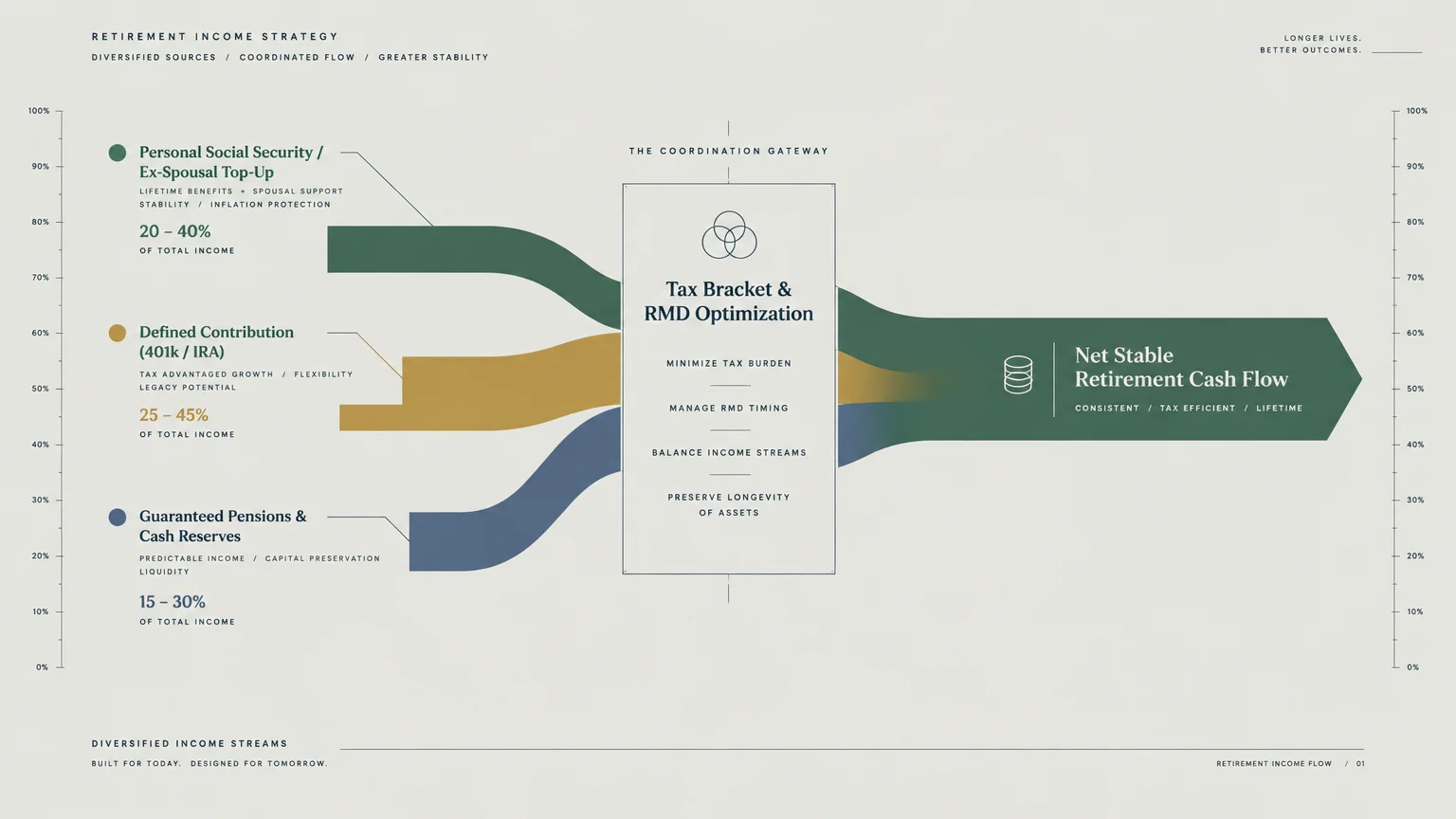
A secure retirement requires careful alignment between Social Security benefits and any personal defined benefit pension plans you hold. Spousal payments provide a reliable, inflation-adjusted foundation that works alongside fixed monthly pension disbursements.
Because most corporate pensions lack robust annual cost-of-living adjustments, their real purchasing power steadily declines over time. Social Security’s annual inflation adjustments offset this erosion, preserving your real standard of living as you age.
Reviewing pension survivorship options during retirement planning prevents unexpected income drops if you outlive an income stream. Balancing private pensions with ex-spousal benefits establishes a dependable floor for your essential living expenses.
This balanced foundation shields you from having to liquidate market securities during severe economic downturns.
Aligning Portfolio Withdrawals with Fixed Income Floors
Integrating ex-spousal benefits directly reduces the annual withdrawal pressure on your personal 401(k) and IRA portfolios. A higher guaranteed monthly check means you can adopt a more conservative withdrawal rate across your liquid accounts.
Limiting portfolio liquidations early in retirement protects your investments against damaging sequence of returns risk. Your capital enjoys extended runway to compound in diversified market index funds throughout market cycles.
Financial planners frequently recommend maintaining three to five years of liquid cash reserves alongside stable Social Security cash flows. This protective buffer prevents panic-selling when market volatility depresses equity prices.
Structuring withdrawals methodically ensures your portfolio survives a retirement that could easily span three decades or more.
Evaluating Guaranteed Lifetime Annuities
If your combined spousal benefit and personal savings fall short of essential expenses, fixed income annuities warrant consideration. A single premium immediate annuity converts a portion of your liquid savings into an additional guaranteed income stream.
Combining annuity payouts with divorced spousal benefits creates a personal pension floor that eliminates baseline longevity anxiety. You gain peace of mind knowing your housing, healthcare, and food costs remain covered regardless of market fluctuations.
However, you should avoid high-fee, overly complex indexed products pushed by commission-driven insurance salesmen. Always examine internal fees, surrender charges, and counterparty credit ratings before allocating assets to any insurance contract.
Reviewing regulatory materials on the SEC investment adviser public disclosure database helps you vet any professional recommending insurance products.
Tax Strategy and Healthcare Cost Mitigation
Managing Provisional Income and Benefit Taxation
Social Security benefits are not entirely tax-free; up to 85% of your payout can face federal income taxation. The Internal Revenue Service measures your exposure using provisional income, which includes adjusted gross income, tax-exempt interest, and half your benefit.
If your combined provisional income surpasses $34,000 as an unmarried filer, up to 85% of your benefits become taxable. Keeping provisional income beneath this threshold requires intentional withdrawal coordination across traditional, Roth, and brokerage accounts.
Executing partial Roth conversions before claiming benefits can permanently reduce future taxable distributions from traditional individual retirement accounts. Lower required minimum distributions in your seventies directly limits taxable exposure on your monthly Social Security deposits.
You can reference official publications through Internal Revenue Service guidelines to measure your specific provisional income exposure.
Controlling Medicare IRMAA Surcharges
Surging taxable income does not just increase your tax liability; it can also inflate your monthly Medicare premiums. The Income-Related Monthly Adjustment Amount imposes heavy surcharges on Medicare Parts B and D if your earnings exceed statutory limits.
These surcharges utilize a two-year lookback period, meaning your current income dictates your healthcare costs two years later. An ill-timed traditional IRA distribution can trigger unexpected healthcare fee hikes that persist for an entire year.
Coordinating divorced spousal benefits with targeted capital gains harvesting prevents accidental crossings into higher Medicare premium tiers. Preserving cash in taxable brokerage accounts grants you flexibility to fund big purchases without inflating reportable income.
Checking the official Medicare threshold calculations helps you sidestep unexpected premium spikes throughout retirement.
Health Savings Accounts and Medical Reserve Planning
Health Savings Accounts offer triple tax advantages that make them premier tools for funding out-of-pocket medical expenses. Contributions enter tax-free, compound without annual tax drag, and withdraw tax-free when applied toward qualified medical care.
However, you must cease all HSA contributions at least six months before applying for Social Security after age 65. The government automatically backdates Medicare Part A enrollment by six months, triggering tax penalties if you fund an HSA concurrently.
Deploying existing HSA funds during retirement protects your fixed spousal benefits from being consumed by unexpected healthcare emergencies. Utilizing dedicated health reserves prevents you from pulling taxable cash from tax-deferred accounts during high-expense years.
Strategic medical cash allocations safeguard your overall portfolio while shielding your baseline income from compounding tax rates.

Risk Management, Fraud Prevention, and Legacy Planning
Protecting Against Identity Theft and Benefit Fraud
Retirees remain primary targets for sophisticated identity thieves and impersonation scams aimed at diverting federal deposits. Criminals routinely attempt to open fraudulent online profiles to hijack monthly Social Security payments into unauthorized accounts.
You should establish your personal digital profile with the federal agency immediately, even if you plan to delay claiming. Claiming your online account locks your Social Security number behind multi-factor authentication, shutting out prospective fraudsters.
Never disclose your Social Security number, banking credentials, or personal information over the telephone to unsolicited callers. The federal government never initiates aggressive phone demands or threatens arrest over routine verification questions.
Vigilant identity monitoring safeguards your guaranteed income stream from disruptions that can take months of administrative appeals to correct.
Addressing Long-Term Care Vulnerabilities
A comprehensive retirement plan must account for potential cognitive decline and the staggering costs of extended eldercare. Standard Medicare coverage excludes custodial nursing home stays, leaving personal assets vulnerable to rapid depletion.
While your divorced spousal benefit continues paying regardless of where you reside, it rarely covers comprehensive memory care facilities. Evaluating asset-based long-term care policies or dedicated hybrid annuities helps protect your remaining estate from catastrophic eldercare bills.
Establishing these protective structures during your early sixties ensures affordable underwriting before chronic health conditions emerge. Proactive risk management keeps your wealth intact and prevents emotional strain on adult children.
Integrating care financing into your income plan preserves your personal autonomy as you navigate advanced aging.
Updating Estate Plans and Beneficiary Designations
A finalized divorce decree does not automatically overwrite beneficiary forms on private retirement plans, life insurance, and bank accounts. If you neglect to update these forms, your former husband could legally inherit assets you intended for your children.
Direct beneficiary designations supersede whatever instructions you write into a standard last will and testament. You must audit every individual retirement account, brokerage account, and insurance contract to establish your preferred transfer-on-death beneficiaries.
Additionally, you must execute updated durable powers of attorney and healthcare proxies reflecting trusted relatives or professional fiduciaries. These essential legal directives empower authorized representatives to manage your affairs if incapacitation strikes.
Updating your estate documents ensures your legacy transfers smoothly to the next generation without protracted probate fights.
Frequently Asked Questions About Divorced Spousal Benefits
How Does Working Part-Time Impact Spousal Benefits Before Full Retirement Age?
If you claim spousal benefits before Full Retirement Age and continue working, you face statutory earnings limits. In 2026, the annual under-FRA earnings limit stands at $24,480, which equals $2,040 per month.
For 2027, this threshold increases to $25,560 per year, or $2,130 monthly. The agency withholds $1 in benefits for every $2 you earn above these established limits.
During the specific calendar year you attain Full Retirement Age, the earnings ceiling rises substantially. That threshold reaches $65,160 in 2026 and expands to $67,920 in 2027, with $1 withheld for every $3 earned over the cap.
Once you reach Full Retirement Age, the earnings test disappears entirely, and withheld funds are credited back through higher monthly checks.
How Do Annual Cost-of-Living Adjustments Affect My Monthly Payment?
Social Security benefits include automatic cost-of-living adjustments designed to shield your purchasing power from consumer price inflation. The federal government approved a 2.5% increase for 2026, followed by an announced 3.6% adjustment for 2027.
These percentage increases apply directly to your baseline payment, expanding your monthly deposit without requiring any paperwork on your part. Your divorced spousal checks compound upward annually alongside regular worker benefits throughout your lifetime.
This annual adjustment represents a major advantage over fixed corporate pensions, which typically lose value against compounding inflation. Guaranteed cost-of-living increases protect your lifestyle as everyday consumer essentials become more expensive.
Monitoring these adjustments helps you make accurate updates to your annual retirement budget each January.
What Fee Models Should You Look for When Hiring a Financial Planner?
Navigating divorced spousal rules alongside portfolio management requires unbiased guidance from a dedicated fiduciary. You should partner exclusively with fee-only planners who accept zero commissions or product placement kickbacks.
Fee-only advisors charge flat retainers, hourly fees, or a clear percentage of assets under management. This clean compensation model eliminates conflicts of interest when evaluating complex annuities or proprietary mutual funds.
Always verify your advisor’s disciplinary record and background using the FINRA professional credentials database before signing contracts. Fiduciary accountability ensures every recommendation serves your best financial interests rather than a broker’s sales targets.
A qualified fiduciary delivers objective advice tailored to your distinct tax position, asset allocation, and lifetime income goals.
How Should Divorced Surviving Spouses Coordinate With Their Own Work Record?
A divorced surviving spouse maintains the legal flexibility to stagger survivor benefits and personal worker benefits across different years. Because deemed filing excludes survivor claims, you can capture one benefit while the other continues to grow.
For example, if your personal career yielded modest earnings, you might claim your own reduced benefit at age 62. You could then transition to a full, unreduced 100% divorced survivor benefit upon reaching your Full Retirement Age.
Conversely, if your personal earnings record is robust, you might claim survivor benefits at age 60. You can collect that steady income while allowing your personal worker benefit to earn delayed credits until age 70.
Evaluating this coordination requires analyzing your break-even timelines alongside your health profile and liquid asset balances.
Actionable Steps to Secure Your Retirement Entitlements
Uncovering your rightful divorced spousal benefits can transform your retirement security, but you must initiate the process. The Social Security Administration will never contact you proactively to inform you of your eligibility on an ex-partner’s record.
Begin by locating your original marriage certificate and final divorce decree to verify your ten-year marriage requirement. Once you compile this legal documentation, schedule an appointment with your local Social Security field office to discuss filing.
Review your personal earnings statements online to determine whether your own benefit or the spousal benefit delivers superior cash flow. A complete review of your lifetime credits clarifies whether auxiliary spousal checks will top off your monthly deposit.
Finally, sit down with a fee-only fiduciary advisor to harmonize these federal entitlements with your taxes, investments, and healthcare plans. Claiming what you lawfully earned provides the stable foundation you deserve for a comfortable, independent retirement.