
Delaying your Social Security benefits past age 70 produces zero additional monthly income and leaves your hard-earned dollars on the table. Once you reach your 70th birthday, your delayed retirement credits reach their statutory ceiling.
Waiting even one month past age 70 permanently forfeits that month’s benefit check without boosting future payments. Every dollar you leave unclaimed at this milestone is money you will never recover.
Claiming your benefits immediately secures your maximum entitlement while unlocking critical cash flow for your broader retirement portfolio. Here is exactly how to stop the financial bleeding and protect your nest egg.
The Age 70 Myth and the Vanishing Benefit Boost
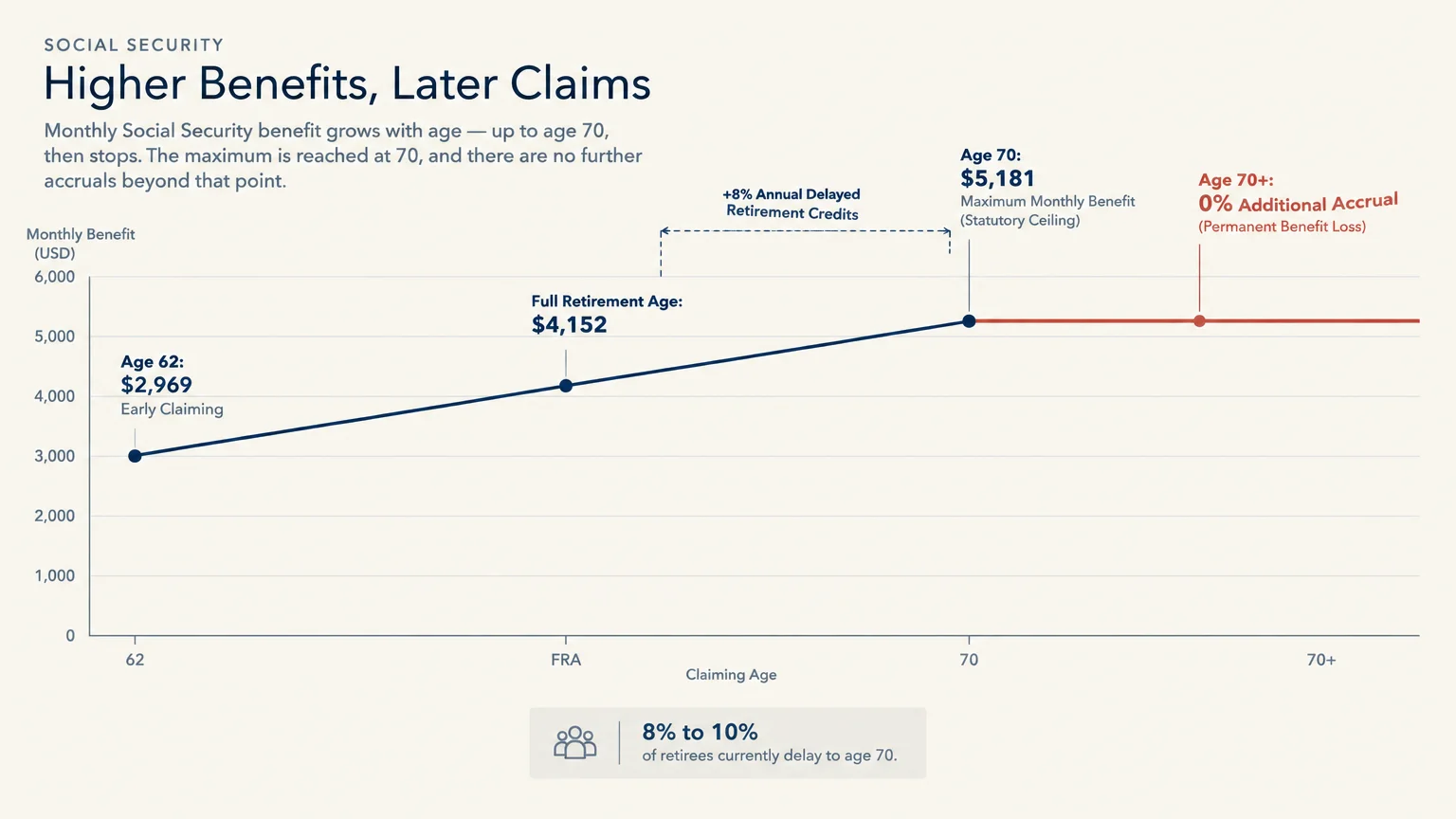
Many retirees believe that delaying Social Security always produces a larger monthly check. While patience pays off between your Full Retirement Age and age 70, that growth stops completely once you turn 70.
The Social Security Administration awards Delayed Retirement Credits for every month you postpone claiming past your Full Retirement Age. These credits accrue at a rate of 8% per year, or two-thirds of 1% per month.
However, federal law mandates that Delayed Retirement Credits completely cease accruing the month you reach age 70. Delaying past this point yields exactly 0% in additional credits.
If you celebrate your 70th birthday and fail to apply, your monthly check will not increase by even one penny. You simply forfeit the payments you were entitled to receive.
Only 8% to 10% of eligible Americans wait until age 70 to claim their benefits. While research indicates that up to 90% of retirees would optimize lifetime wealth by waiting until 70, waiting past 70 damages your balance sheet.
Leaving your benefits unclaimed after age 70 is equivalent to working for an employer and refusing your paycheck. You have already earned this guaranteed income; you must now collect it.
Quantifying Your Monthly Losses After Age 70
The financial cost of failing to file at age 70 is immediate and severe. Every month of delay represents a permanent loss of substantial liquidity.
In 2026, the maximum monthly benefit for a worker claiming at age 70 is $5,181. That compares to $4,152 at Full Retirement Age and $2,969 at age 62.
In 2027, the maximum benefit at age 70 climbs to $5,358 per month. At Full Retirement Age, that maximum is $4,188, while at age 62 and one month it is $3,094.
If you qualify for the maximum benefit in 2026, waiting just six months past age 70 forfeits $31,086. Waiting a full year forfeits $62,172 in benefits that you can never fully reclaim.
Even for the average retiree, the monthly loss remains substantial. The average monthly retirement benefit sits at approximately $2,089 to $2,095 in late 2026 and rises by roughly $75 per month to $2,170 in January 2027.
Failing to claim an average benefit of $2,170 for twelve months costs you over $26,000 in cash flow. No sound financial strategy justifies leaving that volume of guaranteed, inflation-adjusted capital untouched.
Understanding Full Retirement Age Cohorts and Payout Trajectories
Your benefit at age 70 depends directly on your birth year and your statutory Full Retirement Age. Knowing your exact cohort ensures you evaluate your monthly payout accurately.
Seniors turning 70 in 2026 were born in 1956. Their Full Retirement Age was 66 and 4 months.
By waiting 44 months past their Full Retirement Age to claim at 70, this cohort receives 129.3% of their primary insurance amount. That represents a dramatic guaranteed increase over their base benefit.
Seniors turning 70 in 2027 were born in 1957, with a Full Retirement Age of 66 and 6 months. By waiting 42 months until age 70, they lock in 128% of their base benefit.
A major milestone occurred for Americans born in 1960 or later, whose Full Retirement Age reached the statutory maximum of 67. For these individuals, delaying until age 70 yields a maximum boost of 24%, bringing their payout to 124% of their primary insurance amount.
Regardless of your cohort, all delayed retirement accruals terminate at age 70. The percentage you have earned by your 70th birthday is the permanent percentage you will receive for life.
The Six-Month Retroactive Benefit Trap
If you realize you have passed age 70 without claiming, you must navigate retroactive benefit rules carefully. The government offers a partial safety net, but it comes with strict boundaries.
The Social Security Administration allows retroactive benefit payments up to a maximum of six months prior to your application date. The agency will not pay you for months missed beyond that six-month window.
If you delay filing until age 70 and 9 months, you can only claim back-pay for six months. The three months between age 70 and age 70 and 3 months are permanently forfeited.
An even more dangerous pitfall catches retirees who file between age 70 and age 70 and a half. If you apply at age 70 and 2 months and accept a default six-month retroactive lump sum, the agency back-dates your claim to age 69 and 8 months.
This back-dating error strips away six months of Delayed Retirement Credits earned between age 69 and 8 months and age 70. Because each month of delay provides two-thirds of 1%, forfeiting six months permanently reduces your monthly benefit by 4%.
A 4% reduction on a $5,000 monthly benefit costs you $200 every month for the rest of your life. To avoid this trap, you must explicitly instruct the claims specialist to back-date your application only to the month of your 70th birthday.

Spousal and Survivor Benefit Realities
Misunderstandings surrounding spousal and survivor benefits cause many households to delay claiming inappropriately. The rules governing auxiliary benefits differ significantly from worker benefits.
Spousal benefits do not earn Delayed Retirement Credits under any circumstances. A spousal benefit reaches its maximum possible value when the claimant reaches their own Full Retirement Age.
If you are claiming strictly as a spouse, delaying past your Full Retirement Age produces no financial gain. Waiting until age 70 to claim a spousal benefit simply throws away three to four years of valid income.
Survivor benefits follow a different set of rules that reward the primary earner for delaying until age 70. When a primary breadwinner delays claiming until 70, they lock in the highest possible baseline for their surviving spouse.
Upon your passing, your surviving spouse can step into your full age-70 benefit amount, including all accrued Delayed Retirement Credits. Delaying past 70, however, adds nothing to that survivor benefit.
By claiming promptly at age 70, you maximize the future financial security of your spouse while securing present cash flow. Delaying past 70 serves neither your interests nor your survivor’s needs.
Working Past Age 70 and the 35-Year Wage Base
Many seniors delay filing because they continue to earn an active income. They worry that their wages will trigger benefit reductions or severe penalties.
This fear is entirely unfounded once you pass your Full Retirement Age. The Social Security earnings test disappears completely once you reach Full Retirement Age, meaning you can earn an unlimited salary without losing a single dollar of benefits.
Continuing to work past 70 can actually increase your monthly check through an automatic benefit recalculation. Your benefit amount is calculated based on your highest 35 years of inflation-indexed earnings.
If your earnings this year exceed one of the lowest indexed years in your top 35, the government recalculates your primary insurance amount upward. This adjustment happens automatically in the fall following your tax filing.
To reach the absolute maximum benefit, a worker must earn at or above the annual maximum taxable wage base for 35 years. That wage cap is $184,500 in 2026 and rises to $192,300 in 2027.
You do not need to postpone claiming to receive credit for ongoing earnings. You should claim your maximum age-70 benefit immediately and let your current wages trigger additional increases down the road.
Cost-of-Living Adjustments and Inflation Protection
Some retirees delay claiming because they worry about missing out on annual Cost-of-Living Adjustments. This belief reflects a fundamental misunderstanding of how the government calculates inflation adjustments.
You do not need to be actively receiving Social Security checks to receive the annual Cost-of-Living Adjustment. From age 62 onward, all annual adjustments are automatically added to your underlying benefit record.
The Cost-of-Living Adjustment was 2.8% in 2026, and the adjustment announced for 2027 is 3.6%. Both adjustments apply to your benefit formula regardless of whether you claimed earlier or waited until 70.
When you file at age 70, your starting monthly check incorporates every single Cost-of-Living Adjustment enacted since you turned 62. You also receive the full 8% annual Delayed Retirement Credits earned between your Full Retirement Age and 70.
Claiming at age 70 gives you an immediate, powerful hedge against persistent inflation. You receive a substantially higher base check, and all future annual percentage adjustments apply to that larger base amount.
Holding out past age 70 does not amplify future Cost-of-Living Adjustments. It simply denies you the inflation-protected cash flow you have already earned.
Coordinating Social Security with Portfolio Withdrawals
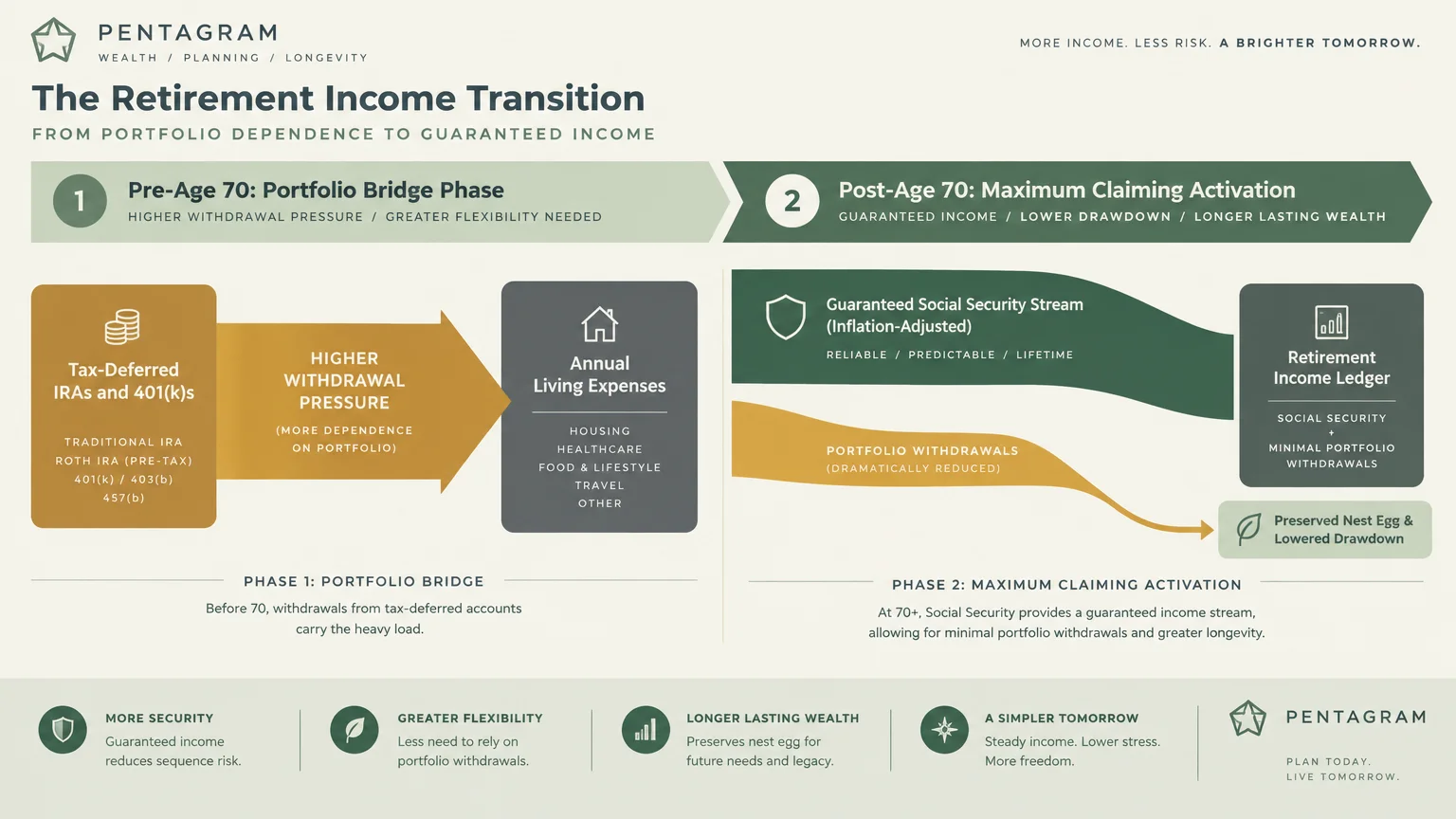
Claiming Social Security at age 70 provides an immediate infusion of guaranteed income that fundamentally changes your portfolio strategy. This steady cash flow allows you to adjust how you pull money from invested assets.
A higher guaranteed monthly benefit reduces your withdrawal demand on private brokerage and retirement accounts. This reduced withdrawal pressure protects your equities during major market downturns.
Financial planners frequently monitor sequence of returns risk during early retirement. If market drops coincide with heavy early withdrawals, portfolio longevity decreases dramatically.
By age 70, your high Social Security benefit covers a larger portion of your fixed monthly expenses. You can afford to leave volatile investments intact, allowing them time to recover from corrections.
This dynamic also allows you to reconsider rigid withdrawal frameworks like the classic 4% rule. With substantial guaranteed income flowing in monthly, your portfolio can accommodate more flexible, spending-adjusted distributions.
Always review your distribution plan alongside a fee-only fiduciary advisor to align asset allocation with your new income baseline. Proper portfolio alignment ensures your capital outlives you.
Pensions, Annuities, and Lifetime Cash Flow Alignment
Integrating your age-70 Social Security benefit requires a holistic view of your entire fixed-income structure. Many retirees also balance corporate pensions or commercial annuities alongside federal benefits.
Defined-benefit pensions provide steady income, but few private pensions include annual inflation adjustments. In contrast, Social Security provides an inflation-adjusted floor that rises alongside the Consumer Price Index.
If you hold commercial lifetime annuities, your age-70 Social Security payment completes your guaranteed income floor. When guaranteed income meets or exceeds your baseline living costs, your investment stress drops considerably.
Retirees who worked in state or local government must also evaluate whether non-covered pensions affect their benefits. While the Windfall Elimination Provision and Government Pension Offset historically reduced benefits for certain public workers, these rules apply regardless of whether you claim at 70 or later.
Claiming your federal benefits at 70 ensures your guaranteed income sources operate in tandem. Stacking these streams creates an ironclad foundation for discretionary retirement spending.
Failing to claim Social Security at 70 disrupts this balance, forcing you to over-rely on private assets that carry market or longevity risk.
Tax Planning: Required Minimum Distributions and Provisional Income
Claiming a substantial Social Security check at age 70 introduces important tax planning considerations. You must manage how this new income interacts with the Internal Revenue Service tax code.
Up to 85% of your Social Security benefits can become taxable depending on your provisional income. Provisional income equals your modified adjusted gross income plus non-taxable interest and half of your annual Social Security benefit.
If you file taxes as an individual and your provisional income exceeds $34,000, up to 85% of your benefits face taxation. For married couples filing jointly, that 85% threshold sits at just $44,000.
These thresholds have remained unindexed for inflation for decades, meaning most age-70 claimants will pay income tax on 85% of their benefits. Strategic planning is essential to prevent unnecessary bracket creep.
The tax landscape becomes more complex when Required Minimum Distributions begin. Under current federal law, Required Minimum Distributions from traditional IRAs and 401(k) plans must begin at age 73.
When large Required Minimum Distributions combine with an age-70 Social Security benefit, your taxable income can spike rapidly. Executing targeted Roth conversions prior to age 73 can help manage these future tax liabilities.
Consult a qualified CPA or fiduciary tax advisor to review your provisional income projections. Coordinated tax planning prevents your increased benefits from pushing you into an unexpectedly high marginal tax bracket.
Managing Healthcare Costs and Medicare Surcharges
Your claiming timing also influences your relationship with Medicare and overall healthcare spending. Many retirees overlook how their Social Security benefits interact with medical coverage.
Federal law requires that anyone receiving Social Security at age 65 or older must enroll in Medicare Part A. You cannot decline Part A while receiving retirement benefits unless you surrender all past benefits and repay the government.
Furthermore, enrolling in any part of Medicare disqualifies you from making further contributions to a Health Savings Account. If you plan to claim benefits at 70, you must stop all Health Savings Account contributions six months prior to applying to avoid tax penalties.
High earners must also evaluate the Income-Related Monthly Adjustment Amount, commonly known as IRMAA. Administered by the Centers for Medicare & Medicaid Services, IRMAA adds monthly surcharges to Medicare Part B and Part D premiums for higher-income beneficiaries.
IRMAA surcharges are calculated using your tax return from two years prior. A large retroactive Social Security lump sum, combined with high investment income, can inadvertently push you across an IRMAA income cliff.
Crossing an IRMAA threshold by even one single dollar triggers the entire surcharge for the full calendar year. Maintaining tight control over your taxable distributions helps keep Medicare premiums at standard rates.

Asset Protection and Long-Term Care Strategies
A comprehensive retirement plan protects your wealth from catastrophic health events and long-term care expenses. Claiming your maximum Social Security benefit at age 70 strengthens your defensive perimeter.
The heightened cash flow generated by your age-70 benefit can directly fund long-term care insurance premiums. Using guaranteed government income to cover asset-protection policies shields your investment portfolio from liquidation.
Many seniors utilize hybrid life and long-term care policies to lock in coverage without risking lost premiums if care is never needed. The monthly cash flow from Social Security makes these asset-based policies far more manageable.
If you prefer to self-insure, your age-70 benefit provides a substantial, perpetual funding baseline. Even in extended nursing care, your monthly check continues arriving on time, every month, fully backed by the federal government.
Pairing reliable Social Security cash flow with dedicated care planning safeguards your family from immense financial stress. It guarantees that healthcare needs will not derail your legacy objectives.
Take the time to evaluate long-term care options with a licensed fiduciary planner before medical needs arise.
Guarding Against Financial Fraud and Identity Theft
Seniors with large unclaimed Social Security balances represent prime targets for sophisticated financial fraudsters. Protecting your account requires proactive digital security measures.
Criminals frequently target seniors by filing fraudulent claims using stolen personal information. If you do not actively monitor your Social Security record, identity thieves can attempt to divert payments to unauthorized bank accounts.
The simplest way to defend your benefits is to open and secure a personal account at ssa.gov. Establishing your account locks your Social Security number behind multi-factor authentication, preventing criminals from registering in your name.
The Securities and Exchange Commission urges seniors to monitor all financial accounts regularly and implement rigorous password hygiene. Vigilance is your first line of defense against modern cyber schemes.
Similarly, the Financial Industry Regulatory Authority provides tools to verify the credentials of any professional offering retirement planning services. Never hand over sensitive personal data to unvetted solicitors.
Claiming your benefits at age 70 activates regular direct deposits into your designated depository account. Active accounts with steady transaction activity are substantially easier to monitor and protect.
Estate Planning and Beneficiary Realities
Social Security benefits carry unique estate planning characteristics that every retiree must recognize. Unlike an IRA, a 401(k), or a brokerage account, Social Security is not an inherited asset.
When you pass away, your monthly benefit payments terminate immediately. Social Security benefits do not pass through a will, trust, or probate court to your non-spouse heirs.
If you leave money unclaimed past age 70 and die, that unclaimed wealth simply evaporates back into the trust funds. Your adult children cannot file a posthumous claim to collect benefits you neglected to take.
The only post-death benefit available is the surviving spouse or eligible dependent child benefit. A surviving spouse can receive your age-70 payout, but your children will not inherit a residual balance.
To build a lasting legacy for children or grandchildren, claim your Social Security check and redirect unneeded cash flow into personal investment accounts. Capital stored in taxable brokerage accounts or Roth IRAs can pass seamlessly to your heirs with full stepped-up basis advantages.
Always review and update beneficiary designations on your private accounts annually. Ensuring your non-probate transfer instructions remain current guarantees a smooth wealth transition for your loved ones.
Filing Logistics: Timing Your Application Correctly
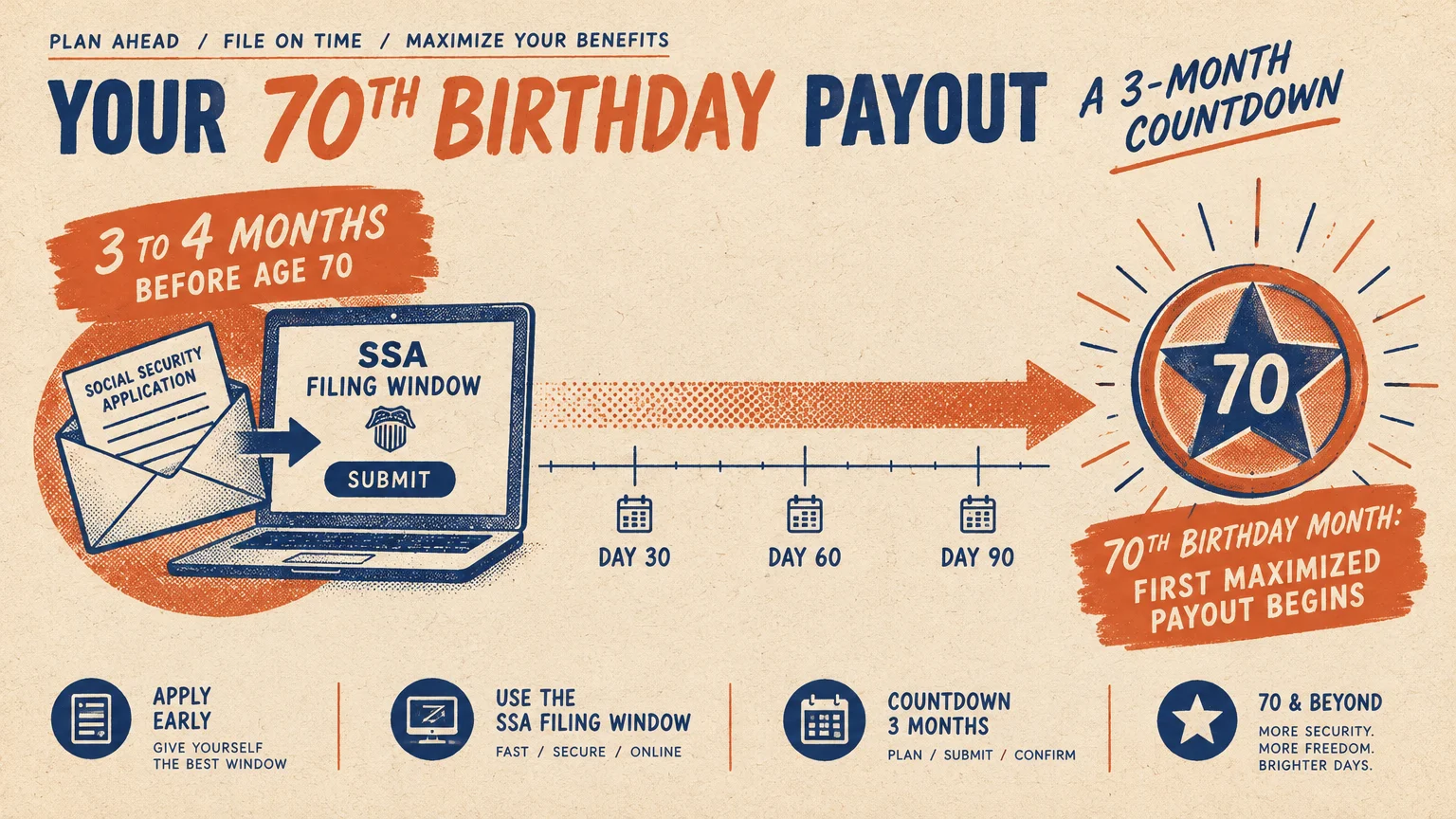
Claiming your benefits at age 70 requires strategic timing to ensure payments begin without administrative delays. You should not wait until the exact week of your birthday to contact the government.
The Social Security Administration allows you to submit your retirement application up to four months before you want payments to start. Submitting your application three to four months prior to your 70th birthday ensures all paperwork is processed seamlessly.
Social Security benefits are always paid one month in arrears. For example, your benefit for the month of your birthday is actually disbursed in the subsequent calendar month.
If your birthday falls in May, your May benefit will arrive in June. Knowing this schedule prevents unnecessary anxiety regarding initial direct deposit dates.
When completing form SSA-1 online or with a claims representative, be explicit about your desired start date. State clearly that you want your benefits to begin in the exact month you reach age 70.
This explicit instruction prevents agency representatives from accidentally applying the six-month retroactive back-dating feature. Proper filing ensures you capture 100% of your maximum delayed retirement credits.
Frequently Asked Questions
Can I still work full-time after claiming Social Security at age 70?
Yes, you can work as many hours and earn as much income as you desire without penalty. The retirement earnings test completely ends once you attain Full Retirement Age.
Your wages will not reduce your monthly benefit check by a single cent. In fact, high ongoing earnings can trigger an automatic upward adjustment to your benefit if they rank among your top 35 earning years.
How does claiming at 70 protect my retirement income against inflation?
Your age-70 benefit provides maximum inflation defense because annual Cost-of-Living Adjustments apply to a much larger monthly base. When inflation triggers an increase, you receive a larger dollar adjustment than early claimants.
Additionally, all historical Cost-of-Living Adjustments awarded since you turned age 62 are already baked into your age-70 check. You capture the maximum statutory compounding effect for the rest of your life.
How should I evaluate financial advisor fees when integrating Social Security?
Always ensure your financial advisor operates as a fee-only fiduciary who does not accept commissions for product recommendations. Fiduciary advisors must prioritize your best financial interests when recommending claiming and withdrawal schedules.
Verify whether an advisor charges an hourly fee, a flat retainer, or an assets-under-management fee. Because Social Security operates outside managed portfolios, ensure your advisor provides comprehensive distribution guidance rather than focusing solely on investment management.
How does my age-70 claiming decision impact my surviving spouse?
Delaying until age 70 locks in the absolute highest possible survivor benefit for your spouse. If you predecease your partner, they can step into 100% of your enhanced age-70 payout, provided it exceeds their own benefit.
However, delaying past age 70 provides no additional survivor value. You should claim promptly at 70 to maximize both your present marital income and your spouse’s future safety net.
Take Charge of Your Retirement Wealth
Delaying Social Security past age 70 produces zero additional monthly income and permanently wastes guaranteed federal dollars. The statutory incentives designed to encourage patience vanish entirely on your 70th birthday.
Review your latest earnings statement by logging into your account at ssa.gov today. Verify that all 35 years of your indexed wage history are recorded accurately before submitting your claim.
If you are approaching age 70, initiate your application three to four months before your birthday month. If you have already crossed age 70, contact the agency immediately to file your claim and safeguard retroactive benefits.
Coordinate your new income stream with a comprehensive tax, healthcare, and investment strategy. Partner with a licensed financial planner and tax professional to ensure every dollar serves your long-term security.