
A $2,400 monthly Social Security check rises by 3.6% in 2027, adding $86.40 per month—or $1,036.80 per year—to your gross benefit. That increase starts with your January 2027 deposit.
Your actual bank deposit will tell a slightly smaller story once healthcare deductions hit. Higher projected Medicare Part B premiums and Social Security rounding rules shave dollars off the top before funds arrive.
This guide breaks down your exact net payout, payment schedule, and prescription cost shifts for 2027. You will also learn practical tax and portfolio moves to keep more of your raise.
The Real Math Behind a $2,400 Social Security Check in 2027
On October 14, 2026, the Social Security Administration (SSA) announced a 3.6% cost-of-living adjustment (COLA) for 2027. That adjustment raises monthly payments for 76 million Americans, including nearly 72 million Social Security beneficiaries and about 7.3 million Supplemental Security Income (SSI) recipients.
Under the Social Security Act, the SSA ties your annual raise to inflation data from the Bureau of Labor Statistics. Specifically, the 2027 COLA measures the percentage climb in the Consumer Price Index for Urban Wage Earners and Clerical Workers (CPI-W).
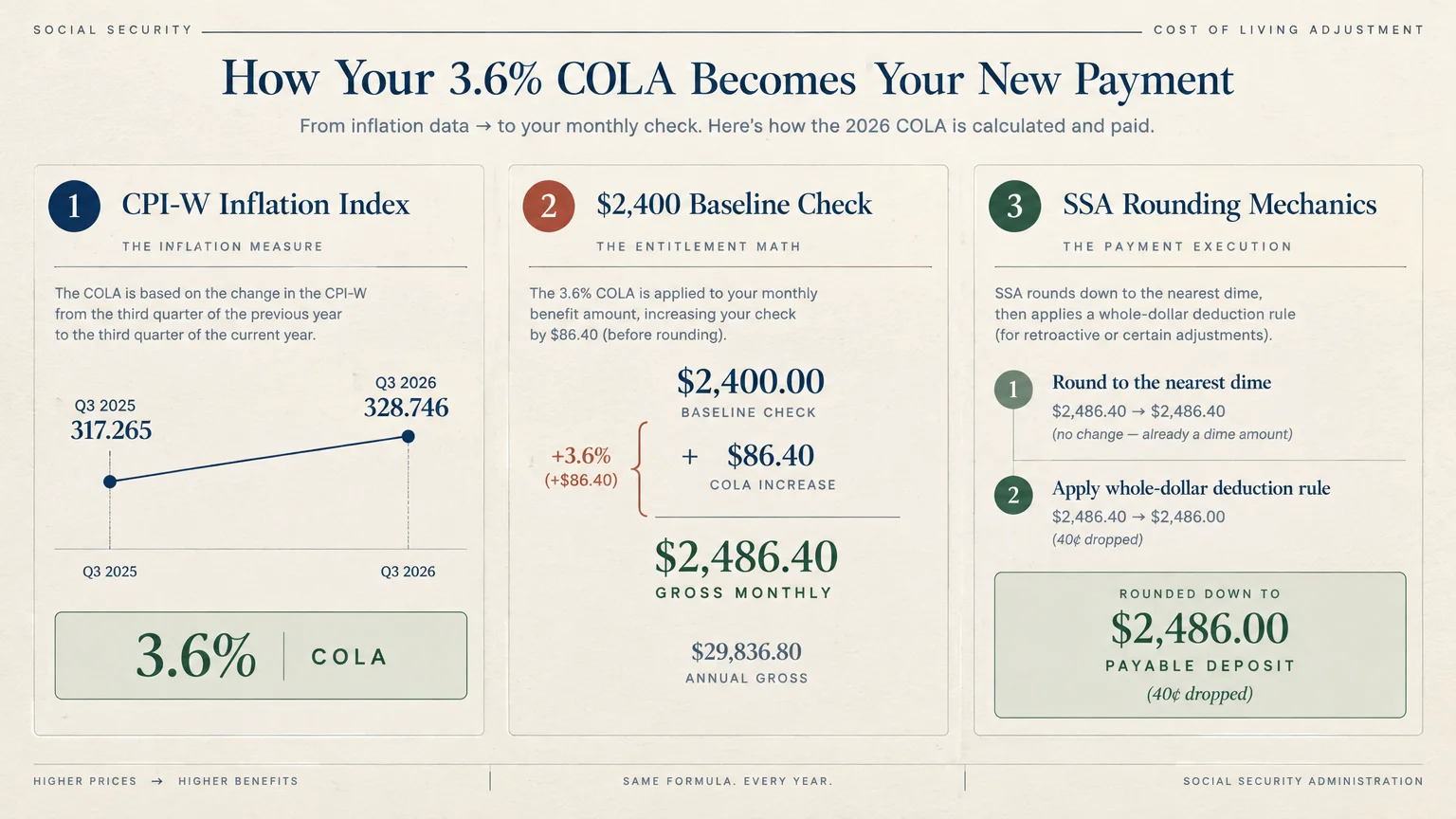
The index rose from 317.265 in the third quarter of 2025 to 328.746 in the third quarter of 2026. Rounding that jump to the nearest tenth of a percent locks in your 3.6% raise for the coming year.
Gross Increase vs. Actual Bank Deposit
Multiplying a $2,400 gross monthly benefit by 3.6% brings your new gross entitlement to $2,486.40 per month. Over a full twelve months, your gross annual Social Security income grows from $28,800 to $29,836.80.
You will not see those extra 40 cents hit your checking account, however. SSA computation rules round your Primary Insurance Amount down to the next lower dime at each calculation step.
Even more important, the agency rounds your final monthly payable benefit—after subtracting Medicare premiums—down to the next lower whole dollar. If you pay zero Medicare Part B premiums out of your check, $2,486.40 rounds down to $2,486 payable.
Comparing your $2,400 baseline against national averages shows where your check stands. According to SSA estimates, the average retired worker benefit rises from $2,094 in December 2026 to $2,170 after the COLA, adding roughly $75 to $76 per month.
The average spouse of a retired worker sees a climb from $989 to $1,024 per month, a $35 gain. Meanwhile, the maximum monthly benefit for a worker claiming at Full Retirement Age increases from $4,152 in 2026 to $4,188 in 2027.
When Your Higher Payment Arrives and How to Check Early
Your 2027 Social Security increase begins with January 2027 benefit payments, which reflect your December 2026 entitlement. If you receive SSI, your higher January payment arrives one day early on December 31, 2026, because January 1 is a federal holiday.
Your exact January deposit date depends on when you claimed and your birthday. If you started Social Security before May 1997, or receive both Social Security and SSI, your check arrives on the 3rd of the month.
SSI-only recipients normally get paid on the 1st of each month. Everyone who started Social Security after May 1997 receives Wednesday payments tied to birth dates.
Birthdays from the 1st through the 10th pay on the second Wednesday of the month. Birthdays from the 11th through the 20th pay on the third Wednesday, and the 21st through the 31st pay on the fourth Wednesday.
Whenever a scheduled deposit falls on a weekend or federal holiday, the Treasury sends your money on the preceding business day. Mark those dates on your 2027 budget calendar so automated bill payments never outrun your deposit.
You do not have to wait for December postal mail to verify your exact numbers. Create a personal account on the SSA my Social Security portal and opt into paperless notices by November 18, 2026.
Choosing digital delivery lets you view your simplified one-page 2027 COLA notice in late November. That gives you up to a three-week head start over beneficiaries waiting for paper letters mailed during December 2026.
Healthcare Deductions That Shrink Your 2027 Social Security Raise
A gross raise tells only half your retirement income story. Because most retirees have Medicare Part B premiums deducted directly from Social Security, rising healthcare costs eat into your COLA before you spend a dime.
How Medicare Part B Changes Your Net Check
As of mid-November 2026, the Centers for Medicare & Medicaid Services (CMS) has not yet released official 2027 Part B premiums, deductibles, or income surcharge brackets. Those final numbers typically publish later in November.
Until CMS announces final figures, the 2026 Medicare Board of Trustees Report offers the clearest benchmark. In 2026, the confirmed standard Part B premium stands at $202.90 per month alongside a $283 annual deductible.
For 2027, the Trustees Report projects the standard Part B premium will climb to $209.50 per month, an increase of $6.60 or roughly 3.3%. The projected annual Part B deductible rises by $9 to $292.
Run that projection through your $2,400 check to see your likely cash-flow reality. In 2026, subtracting $202.90 from $2,400 leaves $2,197.10, which SSA rounds down to $2,197 net payable.
Under the 2027 projection, subtracting $209.50 from your new $2,486.40 gross check leaves $2,276.90. Applying SSA whole-dollar rounding brings your net monthly deposit to $2,276.
That math gives you a real net raise of $79 per month, or $948 over the full year. Keep watching the official Medicare plan finder and resource center later in November so you can swap in finalized CMS premiums once published.
Part D Prescription Caps, Medigap, and Open Enrollment
Part B premiums are not the only healthcare shift competing for your extra $79 per month. Prescription drug coverage under Medicare Part D undergoes major cost-sharing changes starting January 1, 2027.
The annual Part D out-of-pocket cap for covered drugs rises from $2,100 in 2026 to $2,400 in 2027. At the same time, the standard Part D annual deductible climbs from $615 to $700.
A temporary federal Part D premium stabilization subsidy also expires at the end of 2026. Without that federal cushion, standalone drug plan premiums could jump unevenly across insurers and regions.
Medigap policyholders face higher out-of-pocket thresholds too. CMS set the 2027 annual deductible for Medigap High-Deductible Plans F, G, and J at $3,050.
Take immediate action before Medicare Advantage and Part D Open Enrollment closes on December 7, 2026. Compare your current prescriptions against 2027 plan formularies so an unexpected premium or deductible hike does not absorb your entire Social Security raise.
Managing IRMAA Surcharges and Health Savings Accounts
Higher-income retirees face an extra layer of Medicare deductions called Income-Related Monthly Adjustment Amounts (IRMAA). Your 2027 Part B and Part D surcharges depend on the modified adjusted gross income (MAGI) reported on your 2025 federal tax return.
Because the 2025 tax year has already closed, your 2027 IRMAA tier is largely set unless you experienced a qualifying life-changing event. Retirement, work reduction, marriage, or loss of a spouse all let you file Form SSA-44 to request an IRMAA reduction.
Even if your 2027 surcharge stays fixed, today is the time to protect your 2028 and 2029 net checks. Watch how late-year capital gains or retirement account withdrawals push your 2026 MAGI near an IRMAA cliff.
Health Savings Accounts (HSAs) offer another smart buffer if you built balances before enrolling in Medicare. Once Medicare coverage starts, you cannot make new HSA contributions, yet your existing account continues growing tax-free.
You can spend HSA dollars tax-free on qualified medical bills, Part B premiums, Part D premiums, and that rising $700 drug deductible. Covering medical bills from an HSA keeps you from pulling extra taxable money out of an IRA.

Aligning Social Security With Pensions, Annuities, and Portfolio Withdrawals
Your Social Security raise works best when you treat it as one coordinated piece of a larger retirement paycheck. Evaluating pensions, annuities, and investment accounts side by side prevents unnecessary tax spikes and market timing mistakes.
Coordinating Guaranteed Income Streams
Unlike most corporate pensions or fixed annuities, Social Security carries a government-backed inflation adjustment. A 3.6% raise on a $2,400 check helps protect your purchasing power when grocery, utility, and property tax bills climb.
Fixed private pensions typically pay the same flat dollar check year after year. Over time, inflation steadily erodes the real spending power of that fixed pension.
Your 2027 Social Security COLA helps offset that erosion across your household budget. Assign your guaranteed Social Security and pension deposits to cover core monthly essentials like housing, food, and insurance.
If you or your spouse have not yet finalized a pension election, weigh single-life payouts carefully against joint-and-survivor options. A slightly smaller joint pension check protects the surviving spouse when one Social Security check eventually disappears.
Some retirees bridge essential spending gaps with simple immediate annuities or Treasury bond ladders. Compare fees, credit ratings, and inflation exposure carefully before locking capital into any long-term insurance contract.
Timing Claim Decisions and Portfolio Withdrawals
When your Social Security check rises by $86.40 gross per month, look immediately at your investment withdrawal schedule. You can often trim your monthly IRA or brokerage transfer by an equal amount without changing your lifestyle.
Leaving extra dollars invested reduces sequence-of-returns risk during volatile market stretches. Every dollar you avoid selling during a stock market dip keeps compounding for later retirement years.
Married couples with one spouse still delaying Social Security have another strategic lever. Letting a higher earner wait until Full Retirement Age—or beyond—increases both lifetime benefits and future survivor protection.
Remember that the maximum monthly benefit at Full Retirement Age climbs to $4,188 in 2027. Coordinating withdrawals from taxable savings first can fund your lifestyle while a spouse’s future benefit grows.
Before signing irrevocable annuity paperwork or restructuring your withdrawal rate, verify any advisor’s background on the SEC investor education portal. Independent math and a second opinion from a fiduciary planner protect your nest egg from costly product mismatches.
Tax-Efficient Strategies to Protect Your 2027 Raise
Even a modest $1,036.80 annual Social Security boost can ripple through your federal tax return. Understanding how benefits combine with retirement withdrawals helps you avoid surprise April tax bills.
Navigating Federal Social Security Benefit Taxes
Despite persistent rumors online, federal law did not eliminate income taxes on Social Security benefits. The IRS still taxes a substantial share of benefits based on your combined income formula.
Combined income equals your adjusted gross income (AGI), plus any nontaxable interest, plus exactly half of your annual Social Security benefits. For a $2,400 check rising to $29,836.80 gross in 2027, half of your benefit adds roughly $14,918 to that calculation.
If your combined income tops $25,000 as a single filer—or $32,000 filing jointly—up to 50% of your Social Security becomes taxable. Above $34,000 single or $44,000 joint, up to 85% of your benefit enters taxable income.
Notice that Congress never indexed those threshold numbers for inflation. As your annual COLA pushes benefits higher, more retirees cross into the 50% or 85% taxable zone automatically.
Adding $1,036.80 in gross benefits can also trigger extra withholding needs if you already sit near a tax threshold. Instead of mailing quarterly estimated vouchers, you can ask the SSA to withhold federal taxes directly from your check.
Form W-4V lets you pick flat withholding rates of 7%, 10%, 12%, or 22%. Review current IRS withholding calculators and benefit worksheets on the IRS federal tax resource center before adjusting your percentage.
Using the Temporary Senior Deduction and Smart Withdrawals
Recent tax legislation delivers meaningful relief for retirees age 65 and older, even though benefit taxation remains intact. Under the One Big Beautiful Bill Act (OBBBA), signed July 4, 2025, eligible seniors receive a temporary enhanced deduction for tax years 2025 through 2028.
Taxpayers age 65 or older with a work-eligible Social Security number can claim an extra $6,000 senior deduction per person. Qualifying married couples filing jointly where both spouses are 65 or older can claim $12,000.
You can stack this temporary deduction on top of either your standard deduction or itemized deductions, plus the existing age-65-and-older additional standard deduction. Taxpayers filing Married Filing Separately do not qualify for this provision.
Watch the income phaseout closely when planning IRA distributions or Roth conversions. The enhanced deduction shrinks by 6 cents for every dollar of MAGI above $75,000 for single filers, or $150,000 for joint filers.
This creates a sharp planning opportunity through 2028. Keeping your taxable withdrawals below those MAGI thresholds preserves both your $6,000 or $12,000 deduction and lower Medicare IRMAA tiers.
Coordinate Required Minimum Distributions (RMDs), taxable brokerage sales, and qualified charitable distributions with a licensed CPA or enrolled agent. Because every tax situation carries unique state rules and carryover losses, personalized tax projections beat rules of thumb.

Protecting Your Retirement Income, Estate, and Beneficiaries
Optimizing an extra $79 per month means little if fraud, long-term care bills, or outdated estate paperwork derail your broader plan. Use your annual COLA review as a trigger to tighten household risk protections.
Planning for Long-Term Care and Fraud Prevention
An extra $948 per year helps cover groceries or utility hikes, yet it cannot fund assisted living or memory care. Map out how your household would pay for extended care using liquid reserves, home equity, or existing long-term care coverage.
Talking openly with your spouse or adult children before a medical crisis prevents rushed asset sales. Keep copies of insurance policies, policy numbers, and care preferences stored in one accessible folder.
COLA announcements also spark a yearly wave of impersonation scams targeting seniors. Scammers call, text, or email claiming you must verify your bank routing number or pay a processing fee to unlock your 3.6% raise.
Ignore those demands completely. The SSA applies your 2027 COLA automatically and never asks for gift cards, wire transfers, or banking passwords over the phone.
Be equally cautious when strangers pitch unsolicited annuity swaps or high-yield investments tied to your Social Security raise. Always run a broker’s name and firm through the FINRA BrokerCheck database before handing over statements or signing transfer forms.
Estate Basics and Beneficiary Audits
Outdated beneficiary forms create some of the costliest mistakes in retirement planning. Remember that beneficiary designations on IRAs, 401(k) plans, life insurance policies, and payable-on-death bank accounts legally override instructions inside your will.
Log into each financial institution once a year to confirm both primary and contingent beneficiaries match your current wishes. Check that former spouses, deceased relatives, or minor children are not listed inadvertently.
Confirm that your financial durable power of attorney and healthcare proxy documents are signed, witnessed, and stored with your primary care clinic. Clear legal authority ensures a trusted family member can manage Medicare appeals or SSA paperwork if illness strikes.
Frequently Asked Questions About the 2027 Social Security Raise
How much can I earn from part-time work in 2027 without losing benefits?
If you collect Social Security before Full Retirement Age, the 2027 retirement earnings test caps how much wage or self-employment income you can earn penalty-free. For beneficiaries under Full Retirement Age all year, the exempt limit rises from $24,480 in 2026 to $25,560 in 2027, or $2,130 per month.
SSA withholds $1 in benefits for every $2 you earn above $25,560. During the calendar year you reach Full Retirement Age, a higher limit rises from $65,160 to $67,920, or $5,660 per month, with $1 withheld per $3 over the limit in months prior to your birthday month.
Once you reach Full Retirement Age, the earnings test disappears completely and you can earn any amount with zero benefit withholding. Note that active workers still pay the 7.65% employee FICA tax—or 15.30% self-employed rate—on wages up to the 2027 taxable maximum of $192,300, with one Quarter of Coverage requiring $1,970 in earnings.
Does the 3.6% COLA fully protect my retirement budget against inflation?
The 3.6% raise tracks the CPI-W index, which reflects spending habits of urban wage earners rather than retirees. Senior households often spend a larger share of income on healthcare, prescriptions, property taxes, and homeowners insurance.
Notice how a $6.60 projected Part B premium increase, a $700 Part D deductible, and a higher $2,400 drug out-of-pocket cap can quickly absorb COLA gains. Pairing Social Security with Treasury Inflation-Protected Securities, diversified dividend stocks, and an emergency cash reserve strengthens your long-term inflation shield.
How should I evaluate advisor fees when adjusting my retirement withdrawal plan?
Ask any financial professional for a written, plain-English breakdown of all advisory, fund, and transaction costs before moving retirement dollars. Compare transparent fee-only fiduciaries against commission-based salespeople whose recommendations may carry surrender charges or hidden product markups.
Verify licenses and disciplinary records through federal and industry regulators before scheduling a rollover. A good planner shows exactly how their tax, withdrawal, and Medicare planning value outweighs their fee.
What happens to my $2,486.40 benefit if one spouse passes away?
When a married Social Security recipient dies, the smaller of the two household Social Security checks stops. The surviving spouse keeps whichever monthly benefit was higher—either their own check or 100% of the deceased spouse’s benefit, depending on claiming age rules.
Because household expenses rarely drop by half after losing a spouse, and taxes shift from joint brackets to steeper single-filer brackets, plan ahead now. Reviewing life insurance needs, pension survivor elections, and Roth conversion timing while both spouses are living protects the survivor’s cash flow.
Your Next Steps for a Stronger 2027 Retirement Budget
Treat your 2027 Social Security raise as an annual checkup moment rather than spare spending money. Small adjustments made in November and December 2026 pay dividends across every month of 2027.
First, opt into digital notices on your personal Social Security account before November 18, 2026, so you see your exact benefit letter early. Second, review Medicare Part D and Medicare Advantage formularies before Open Enrollment ends on December 7, 2026.
Third, check your 2027 federal tax withholding and projected MAGI against the temporary OBBBA senior deduction phaseouts. Finally, schedule an annual cash-flow check-in with a trusted fiduciary financial planner and tax professional to keep your income, healthcare, and estate working together.