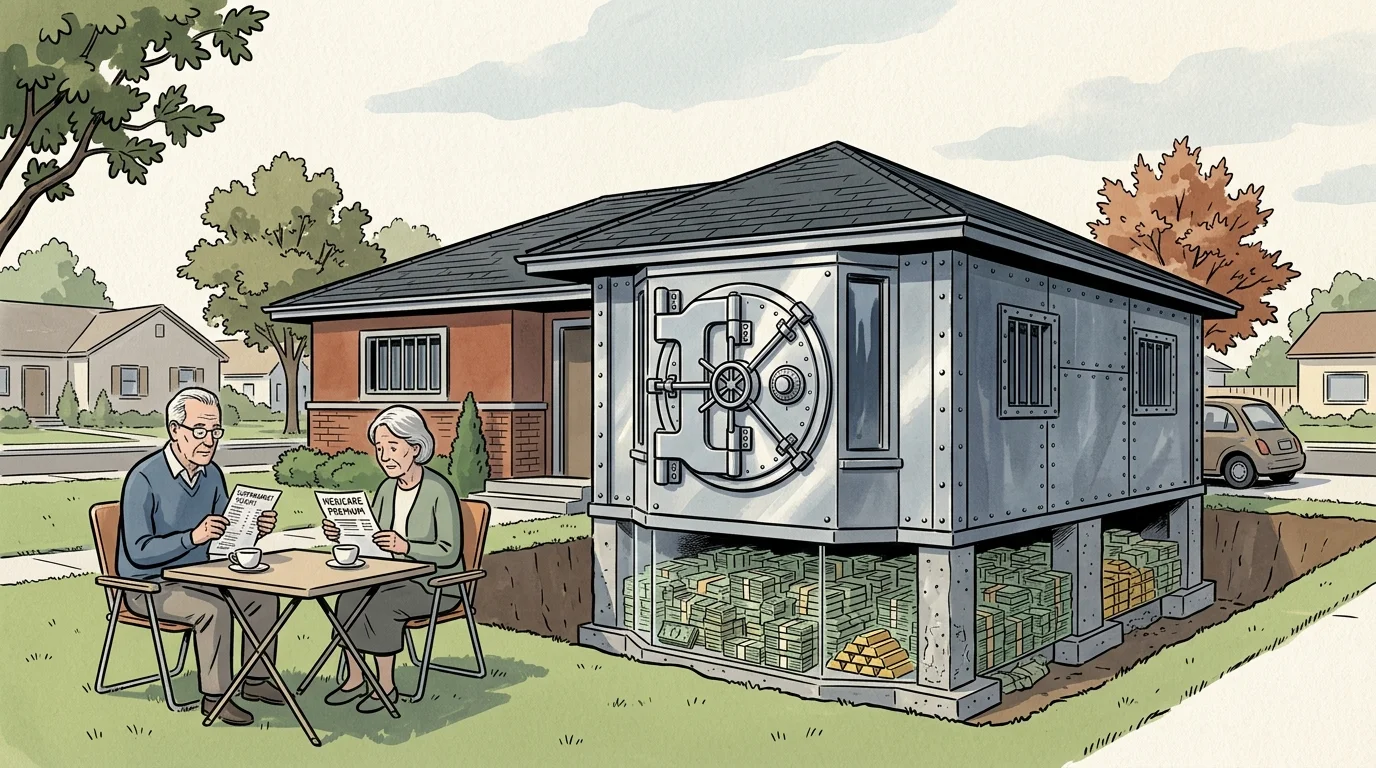
Burning through your retirement savings to pay off a low-rate mortgage can sabotage your monthly cash flow. A debt-free deed feels comforting, yet illiquid home equity cannot buy groceries, cover Medicare premiums, or handle sudden care bills.
Millions of retirees discover too late that eliminating a modest monthly payment leaves them vulnerable to tax spikes and shrinking cash reserves. Before you write that payoff check, examine the math behind liquidity, taxes, and retirement income.
You can build a stronger financial cushion by keeping cheap debt in place and letting your liquid assets work harder.
The Hidden Trap of a House-Rich, Cash-Poor Retirement
Why More Retirees Carry Mortgages Today
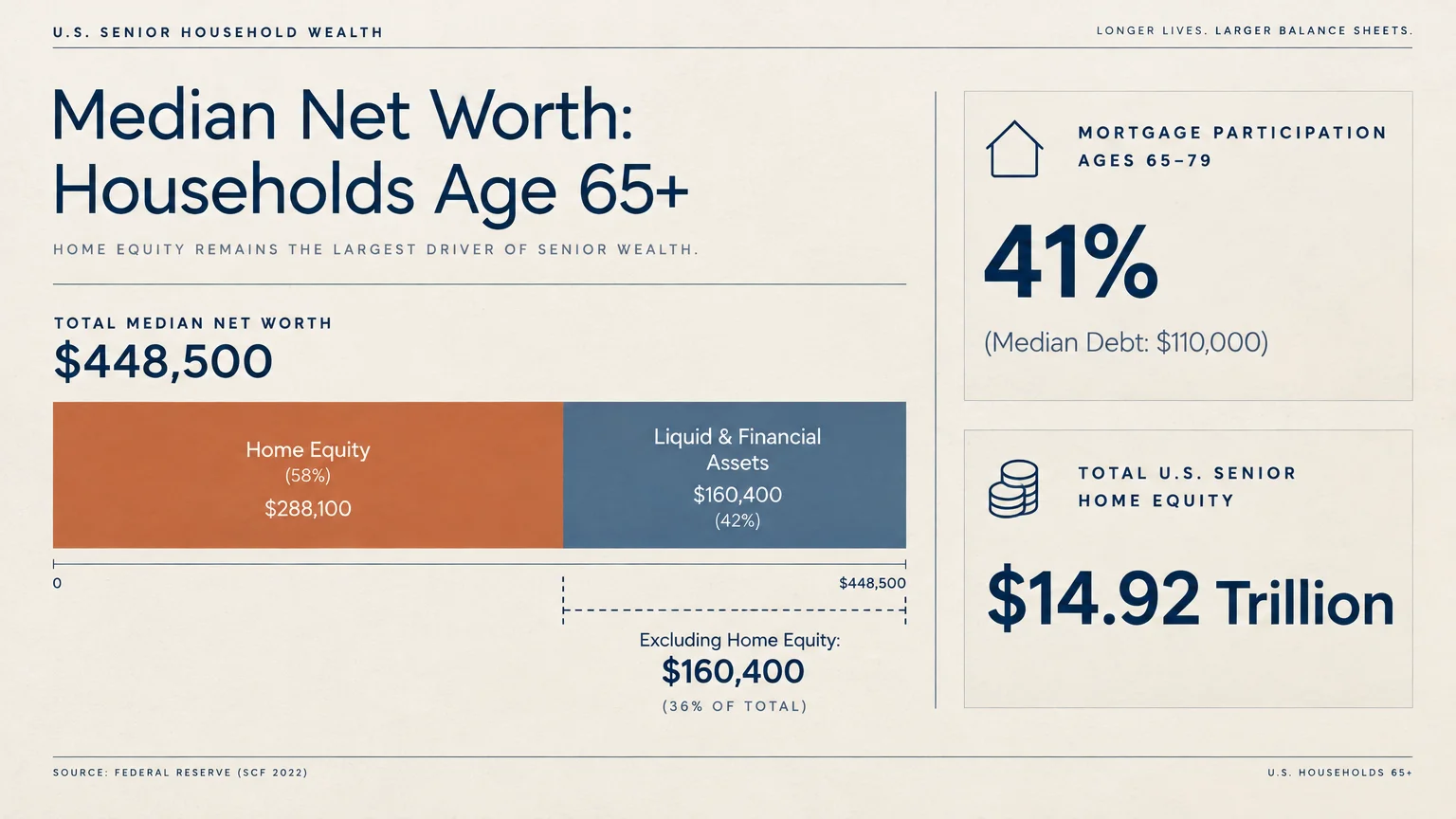
Holding a home loan into your seventies is no longer unusual. According to Harvard’s Joint Center for Housing Studies, 41% of homeowners ages 65 to 79 carried a mortgage in 2022, with a median debt of $110,000.
That share rose sharply from 24% in 1989, and mortgage debt now follows Americans even later in life. Among homeowners age 80 and older, 31% still carried a mortgage in 2022, up from just 3% in 1989.
U.S. Census Bureau 2024 data analyzed by SeniorLiving.org shows roughly 10.73 million mortgaged homes are owned by someone age 65 or older. That figure represents about one in five mortgaged U.S. homes.
Across the broader housing market, only 39.4% of owner-occupied U.S. homes were owned free and clear between 2020 and 2024. Carrying a loan into retirement has become standard rather than exceptional.
The Imbalance on Senior Balance Sheets
Paying off your house can distort your net worth if it drains accessible savings. The Federal Reserve’s 2025 Survey of Consumer Finances reported median net worth of $431,300 for families ages 65 to 74 and $504,900 for families 75 and older.
Across all homeowner families, median net housing value reached $230,000. Yet only 49% of families ages 65 to 74 and 44.6% of those 75 and older held dedicated retirement accounts such as a 401(k) or IRA.
Among older families who owned retirement accounts, the median balance was $257,000; across all families in those age brackets, the median balance dropped to $0. That gap highlights how heavily seniors depend on real estate for paper wealth.
Q3 Advisors analyzed the same Federal Reserve data and found excluding home equity cuts median net worth for households 65 and older from $448,500 to $160,400. Home equity makes up 58% of net worth for the middle fifth of older households.
Industry figures cited by Cornerstone Financing show homeowners age 62 and older held a record $14.92 trillion in home equity in the first quarter of 2026. Locking even more cash inside your walls rarely improves day-to-day financial security.
Interest Rate Math, Opportunity Cost, and Re-Borrowing Risks
Low Locked-In Rates Versus Safe Liquid Yields
Before you rush into a mortgage-free retirement, check your existing interest rate. Data from the Federal Housing Finance Agency National Mortgage Database cited by Redfin shows 78.8% of mortgaged U.S. homeowners held a rate below 6% as of late 2025.
Even more striking, 20% of mortgaged homeowners enjoy an interest rate under 3%. Only 21.2% of borrowers carry a mortgage rate of 6% or higher.
At the same time, safe cash alternatives pay attractive returns. Following its October 2026 meeting, the Federal Reserve kept its federal funds target range at 3.75% to 4.00%.
In mid-November 2026, one-year U.S. Treasury bills yielded 4.43% per Federal Reserve Board data, while 10-year Treasury yields hovered between 4.86% and 5.14%. Top certificates of deposit and high-yield savings accounts offered around 5.00% APY, beating the 0.38% FDIC national average.
When guaranteed savings earn more than your fixed mortgage costs, paying down the loan early reduces your net cash flow. Keeping money in Treasury bills or high-yield accounts preserves both flexibility and a positive interest spread.
A Concrete Cash-Flow Comparison
Consider a retiree couple carrying the median $110,000 mortgage balance at a locked-in rate near 3%. Keeping that $110,000 in a 4.43% one-year Treasury bill or a 5.00% certificate of deposit generates roughly $4,873 to $5,500 in annual gross interest.
By contrast, retiring that 3% loan saves about $3,300 in annual interest while wiping $110,000 off your liquid balance sheet. Even after paying ordinary income taxes on your interest earnings, you retain immediate access to emergency funds.
Homeowners holding loans at 6% or higher face very different math because guaranteed cash yields will not beat their borrowing rate. Always review your exact after-tax numbers with a licensed financial planner or certified public accountant before moving large sums.
The High Price of Tapping Home Equity Later
Many retirees assume they can simply borrow against home equity later if an emergency strikes. Unfortunately, reversing a mortgage payoff in today’s rate environment is expensive and far from guaranteed.
According to Freddie Mac’s Primary Mortgage Market Survey in mid-November 2026, new 30-year fixed mortgages averaged 7.11% and 15-year fixed loans averaged 6.45%. Bankrate reported the national average rate on a home equity line of credit at 7.49% that same week.
Qualifying for a conventional refinance or credit line also grows harder once your paycheck stops. Lenders scrutinize debt-to-income ratios closely, and fixed Social Security or pension checks may not satisfy strict underwriting standards.
Seniors age 62 and older turning to an FHA-insured Home Equity Conversion Mortgage reverse mortgage face steep transaction costs. Although the 2026 lending limit reached $1,249,125 per HUD rules, borrowers owe a 2% upfront insurance premium plus a 0.5% annual premium.
Reverse mortgage borrowers must also stay current on property taxes, homeowners insurance, and regular upkeep. Keeping liquid cash in your bank account today spares you from paying hefty origination fees to unlock your own equity tomorrow.
Non-Mortgage Housing Costs That Never Retire
Why Free and Clear Still Carries Heavy Bills
Eliminating your principal and interest payment does not mean you live in your home for free. Harvard’s Joint Center for Housing Studies found that 43% of older mortgaged owners were housing cost-burdened in 2023, yet 19% of free-and-clear owners still were too.
An October 2026 joint study by Zillow and Thumbtack revealed that the typical U.S. homeowner spends $16,566 per year—about $1,380 every month—on non-mortgage expenses. That annual tally includes $11,171 for maintenance, $3,129 in estimated property taxes, and $2,266 for homeowners insurance.
Those mandatory ownership bills rose 3% over the prior year and jumped 32% over five years. When Bankrate factored in utilities, internet, and cable, hidden single-family ownership expenses averaged $21,400 annually in 2025.
Spending your cash reserves to wipe out a monthly mortgage payment leaves you exposed when a roof replacement or plumbing failure hits. You need a healthy liquid reserve to absorb those unavoidable property bills.
Surging Property Taxes and Insurance Premiums
Local property taxes and casualty insurance continue climbing faster than many retirees expect. ATTOM’s April 2026 analysis of 89.6 million single-family homes showed the average property tax bill rose 3% year-over-year to $4,427, reflecting a 0.9% national effective rate.
Insurance inflation has hit seniors even harder over the past half-decade. LendingTree reported in June 2026 that homeowners insurance premiums surged 46.8% cumulatively from 2020 through 2025, reaching an average of $2,395 per year.
For policies carrying $350,000 in dwelling coverage, Forbes Advisor found premiums averaged $2,720 annually as of June 2026. Bloomberg Intelligence noted inflation-adjusted insurance rose 45% over the past decade, exceeding average property taxes in two-thirds of U.S. counties.
Because taxes and insurance rise indefinitely, your housing budget will never drop to zero. Protecting your cash cushion ensures you can pay rising escrow bills without selling stocks during a market downturn.

Aligning Home Equity With Your Retirement Income Streams
Using Cash Reserves to Optimize Social Security Timing
Deciding whether to pay off a mortgage before retiring directly affects when you claim Social Security. Claiming benefits early at age 62 permanently locks in smaller monthly checks, while delaying up to age 70 boosts your lifetime guaranteed income.
Social Security remains one of the few retirement income streams adjusted automatically for inflation. Beneficiaries received a 2.8% cost-of-living adjustment in 2026, and the Social Security Administration announced a 3.6% increase for January 2027.
That 2027 adjustment lifts the average monthly retirement benefit by roughly $75, rising from $2,095 to $2,170. Maximizing your baseline benefit compounds every future annual increase for life.
If you dump a large lump sum of savings into your house at age 62, you might feel forced to claim Social Security immediately just to cover bills. Keeping cash liquid lets you fund a bridge strategy and wait for higher checks.
You can model claiming ages and projected payouts using the official Social Security Administration retirement benefits planner. Pair those projections with your mortgage amortization schedule before making irreversible payoff moves.
Coordinating Pensions, Annuities, and Portfolio Withdrawals
Retirees with traditional corporate or public pensions should weigh survivor payout options alongside housing debt. Choosing a single-life pension payout delivers higher monthly cash today, yet leaves a surviving spouse without income if you pass away first.
Rather than draining liquid accounts to erase a low-rate mortgage, you can use those funds to offset a lower joint-and-survivor pension check or supplement fixed annuity income. Guaranteed monthly income works best when paired with flexible cash reserves.
Investment portfolio withdrawals also demand careful sequencing during your early years of retirement. Selling equities during a bear market to pay off a house locks in permanent losses and shrinks future compounding.
Maintaining liquid cash buffers—such as laddered Treasury bills or high-yield savings—lets you ride out stock market volatility while making routine mortgage payments effortlessly. Consult a fiduciary planner to test how your withdrawal rate holds up under both scenarios.
Tax Traps and Medicare IRMAA Penalties to Avoid
Why the Mortgage Interest Deduction Rarely Helps Seniors Now
Many older homeowners assume keeping a mortgage preserves valuable tax deductions, yet recent tax legislation changed that math dramatically. Under the Working Families Tax Cuts, the 2026 standard deduction sits at $16,100 for single filers and $32,200 for married couples filing jointly.
Taxpayers age 65 and older also receive an additional standard deduction of $2,050 if single or $1,650 per qualifying spouse on a joint return. On top of those amounts, a new enhanced senior deduction applies from 2025 through 2028.
Seniors age 65 and older can claim an extra $6,000 deduction—or $12,000 per couple when both qualify—whether they itemize or take the standard deduction. That break phases out above $75,000 in modified adjusted gross income for singles and $150,000 for couples.
The law permanently kept the $750,000 mortgage acquisition-debt limit and raised the 2026 state and local tax deduction cap to $40,400, or $20,200 if married filing separately. Still, large senior standard deductions mean few retirees itemize mortgage interest today.
Review official rules on the IRS tax guide for seniors and retirees before assuming your mortgage saves taxes. Your tax preparer can verify whether itemizing offers any real benefit on your return.
Lump-Sum Withdrawals and the Medicare IRMAA Cliff
While keeping a mortgage seldom creates a tax break, pulling cash from a pre-tax 401(k) or traditional IRA to pay off your loan can trigger severe penalties. Every dollar withdrawn from traditional retirement accounts adds directly to your modified adjusted gross income.
A large spike in income not only pushes you into higher federal tax brackets; it also inflates your Medicare premiums through the Income-Related Monthly Adjustment Amount. Medicare calculates these surcharges using your tax return from two years earlier.
In 2026, the standard Medicare Part B monthly premium climbed 9.7% to $202.90. However, beneficiaries whose modified adjusted gross income exceeded $109,000 for single filers or $218,000 for joint filers pay steeply higher monthly rates.
Across higher income tiers, total 2026 Part B premiums jump from $284.10 to $689.90 per month, alongside Part D drug surcharges of $14.50 to $91.00 monthly. Check exact surcharge brackets on the Medicare official costs and premiums page.
Spreading a mortgage payoff across multiple tax years—or skipping the lump-sum payoff altogether—can save thousands of dollars in avoidable Medicare surcharges. Always ask a qualified tax professional to project your modified adjusted gross income before taking large retirement distributions.
Protecting Social Security Benefits, RMDs, and HSAs
Extra retirement account withdrawals can also trigger higher taxes on your Social Security checks. Federal rules tax up to 50% or 85% of benefits once combined provisional income crosses $25,000 or $34,000 single, and $32,000 or $44,000 joint.
Using a big pre-tax IRA withdrawal to erase your mortgage can instantly push your provisional income past those low thresholds. Worse yet, spiking your income above $75,000 single or $150,000 joint simultaneously shrinks the new $6,000 to $12,000 enhanced senior deduction.
Smart retirement planning coordinates Health Savings Accounts, Roth accounts, and taxable brokerage funds before required minimum distributions begin. Qualified HSA withdrawals remain completely tax-free for eligible medical expenses and do not count toward provisional income or Medicare surcharge thresholds.
Drawing gradually from pre-tax accounts in low-tax years—perhaps to fund Roth conversions rather than a mortgage payoff—helps reduce future required minimum distributions. Keep your tax strategy flexible so your home never forces an expensive distribution.

Protection, Long-Term Care, and Legacy Planning
Funding Long-Term Care Without Selling the House
Healthcare and long-term care represent the largest unpredictable expenses in senior finance. Medicare covers short-term skilled rehabilitation, yet pays nothing for ongoing custodial care at home or inside an assisted living facility.
If you tie up your liquid savings in a mortgage-free home, paying for a sudden home health aide becomes stressful. You may face a slow home sale or expensive borrowing through a 7.49% credit line just to pay caregivers.
Maintaining dedicated cash reserves alongside long-term care insurance or hybrid life policies gives you immediate choices during a health crisis. Liquid money lets you bring care into your home quickly while preserving your living arrangement.
Guarding Home Equity Against Senior Fraud
Debt-free homes often attract financial predators looking to exploit older owners. Con artists frequently target retirees holding substantial unencumbered equity with fake home-repair liens, forged deed transfers, and aggressive refinancing pitches.
Fraudsters also pitch high-fee private loans or deceptive reverse mortgage schemes designed to strip equity through hidden commissions. Keeping a small, legitimate mortgage with an active lender actually adds an extra layer of monitoring on your property title.
Regardless of your loan balance, protect your accounts by freezing your credit reports and refusing unsolicited offers to tap your equity. Review warning signs and educational alerts through the SEC Investor.gov resources for seniors.
Updating Estate Plans and Beneficiary Designations
How you hold your wealth—inside a house or inside financial accounts—shapes how smoothly your estate passes to loved ones. Investment accounts such as IRAs, 401(k)s, and annuities transfer directly through named beneficiary forms, bypassing lengthy probate court delays.
Real estate often requires probate unless you establish a revocable living trust or use a state-approved transfer-on-death deed. If you drain beneficiary-designated accounts to pay off a home, you may unintentionally complicate estate administration for your children.
Review your beneficiary designations, wills, powers of attorney, and property titling whenever your mortgage or account balances change significantly. Consult an experienced estate planning attorney to align your home equity strategy with your legacy wishes.
Frequently Asked Questions About Mortgages in Retirement
Should I work part-time to pay off my mortgage before retiring?
Working part-time in your sixties can ease cash flow without forcing you to drain retirement accounts. However, directing every extra paycheck toward a mortgage under 3% still locks up cash you might need for emergencies.
If your mortgage rate sits below current Treasury or high-yield savings rates, consider parking part-time earnings in liquid reserves instead. Also watch how extra earned income affects your enhanced senior deduction phase-outs and Social Security taxation.
Does keeping a fixed-rate mortgage help protect against inflation?
Yes, a fixed-rate mortgage acts as a natural inflation hedge during retirement. While food, utilities, property taxes, and home insurance rise year after year, your monthly principal and interest payment stays frozen in nominal dollars.
Meanwhile, Social Security benefits receive annual inflation adjustments, and diversified portfolios tend to grow over time. Paying off a fixed low-rate loan early surrenders that built-in protection against rising living costs.
How do advisor fees affect the decision to pay off a home?
Management fees matter enormously when comparing investment returns against mortgage interest rates. Keeping $110,000 in direct Treasury bills yielding 4.43% without ongoing advisory fees preserves a clear spread over a mortgage rate under 3%.
By contrast, paying ongoing advisory fees on conservative bond funds shrinks your net after-tax yield and can erase any spread over a higher-rate loan. Always verify fee structures and disciplinary histories using FINRA BrokerCheck before hiring financial professionals.
How does a surviving spouse handle a mortgage after a partner passes?
Losing a spouse creates an immediate income shock alongside steep tax changes. The surviving partner loses the smaller of the two Social Security checks and may see pension income drop depending on the payout election.
After the year of a spouse’s death, the survivor shifts into single tax brackets, cutting the standard deduction in half. That shift also drops the Medicare IRMAA surcharge threshold from $218,000 down to $109,000.
Carrying sufficient liquid savings—and term life insurance when appropriate—gives a surviving spouse breathing room. Accessible cash lets them maintain mortgage payments or downsize comfortably on their own timeline.
Reviewing Your Numbers Before You Pay Off the Loan
A mortgage-free retirement brings genuine peace of mind when you hold abundant liquid savings and face borrowing rates of 6% or higher. Yet for millions of retirees holding low locked-in rates and modest retirement accounts, keeping the mortgage creates a stronger safety net.
Start this week by gathering your latest mortgage statement, bank yields, retirement account balances, and recent tax returns. Compare your mortgage interest rate against safe Treasury and high-yield savings returns, and calculate your annual non-mortgage housing costs.
Next, schedule a review with a fee-only fiduciary planner, a certified public accountant, and an estate attorney before sending any lump sum to your lender. Testing your liquidity, Medicare premiums, and tax brackets ensures your housing choice supports every year of your retirement.