
Itemizing your deductions can slash your federal tax liability far beyond the standard deduction when health or living costs climb. You can reclaim thousands of dollars each year by tracking overlooked expenses that typical software packages obscure.
Nearly nine in ten retirees default to the standard deduction without calculating their actual medical, housing, and charitable outlays. Running these numbers ensures you never forfeit valuable tax relief.
Recent shifts in tax policy make understanding your filing threshold more profitable than ever. Uncovering these hidden deductions protects your hard-earned wealth throughout your retirement years.
The 2026 Itemizing Threshold for Seniors
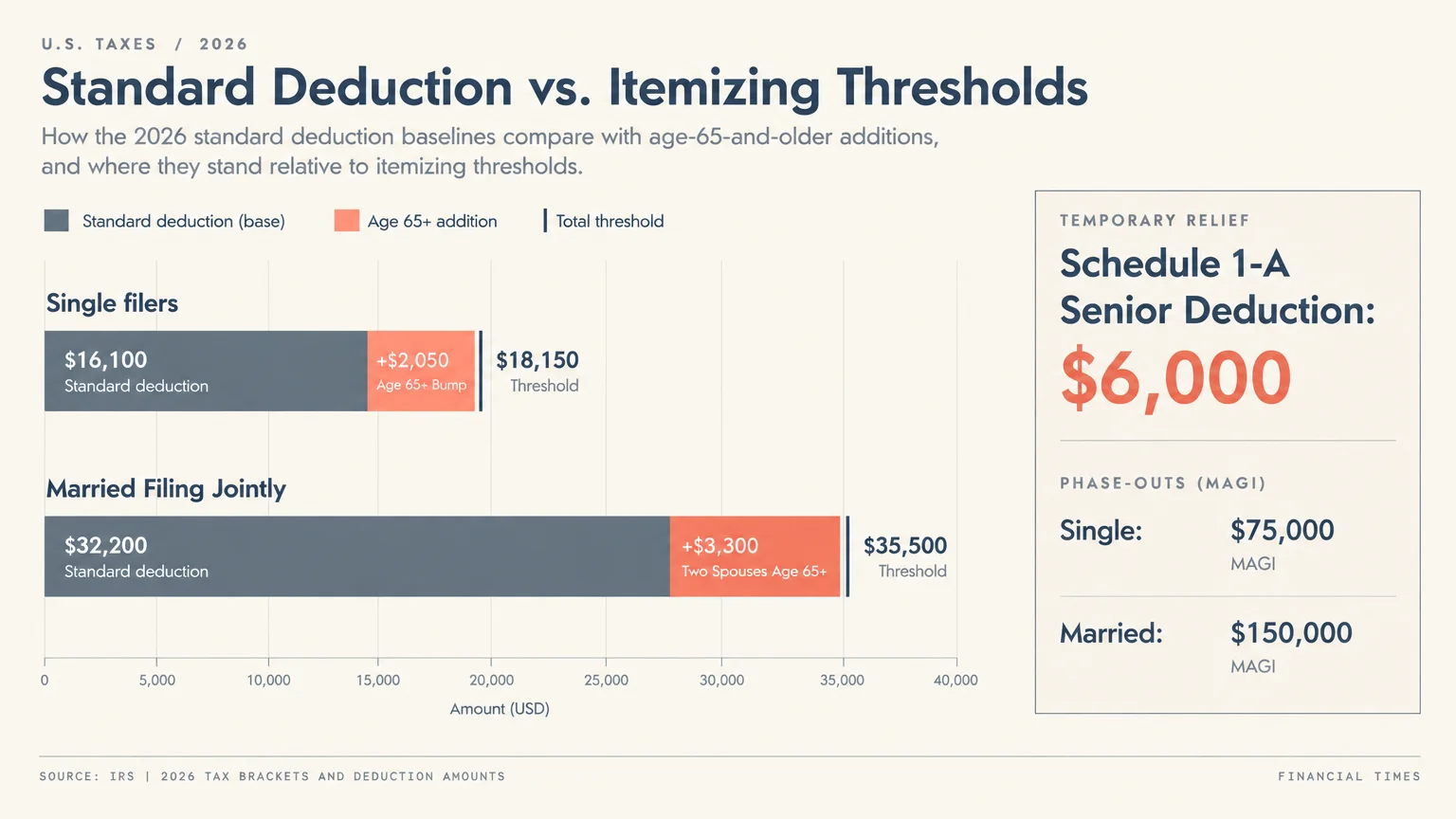
To benefit from itemizing on Schedule A, your combined deductions must exceed your standard deduction baseline. For 2026, the basic standard deduction is $16,100 for single filers and $32,200 for married couples filing jointly.
Retirees age 65 and older receive an additional standard deduction amount. In 2026, this extra bump provides $2,050 for single filers and $1,650 per qualifying spouse for joint returns.
In 2025, these baselines were $15,750 for singles and $31,500 for married couples, with age-based additions of $2,000 and $1,600 respectively. Knowing these exact benchmarks allows you to target your itemized savings accurately.
Do not confuse itemized write-offs with the temporary $6,000 senior tax deduction available from 2025 through 2028. Eligible seniors claim that deduction on Schedule 1-A regardless of whether they itemize or take the standard deduction.
That relief phases out at modified adjusted gross incomes above $75,000 for singles and $150,000 for joint filers. Schedule A itemization remains your primary tool to capture massive out-of-pocket medical and personal expenses.

Strategy Pillar 1: Health and Wellness Deductions
Healthcare expenses represent the largest pool of potential itemized deductions for older Americans. You can deduct unreimbursed qualified medical and dental expenses once they exceed 7.5% of your Adjusted Gross Income (AGI).
1. Medicare Part B, Part D, and Supplemental Medigap Premiums
Many retirees mistakenly believe that Medicare premiums cannot count toward itemized tax deductions. Out-of-pocket, post-tax premiums for Medicare Part B and Part D prescription plans qualify under medical expenses.
Monthly premiums for private Medicare Supplement insurance, commonly known as Medigap, also qualify toward your 7.5% AGI threshold. Review your annual statements from the Medicare program guidelines to tally these deductible cumulative costs.
If you lack sufficient work credits and must purchase Medicare Part A coverage out-of-pocket, those premiums count as well. Together, these recurring insurance payments can push you over the 7.5% deduction floor quickly.
2. Age-Based Long-Term Care Insurance Premiums
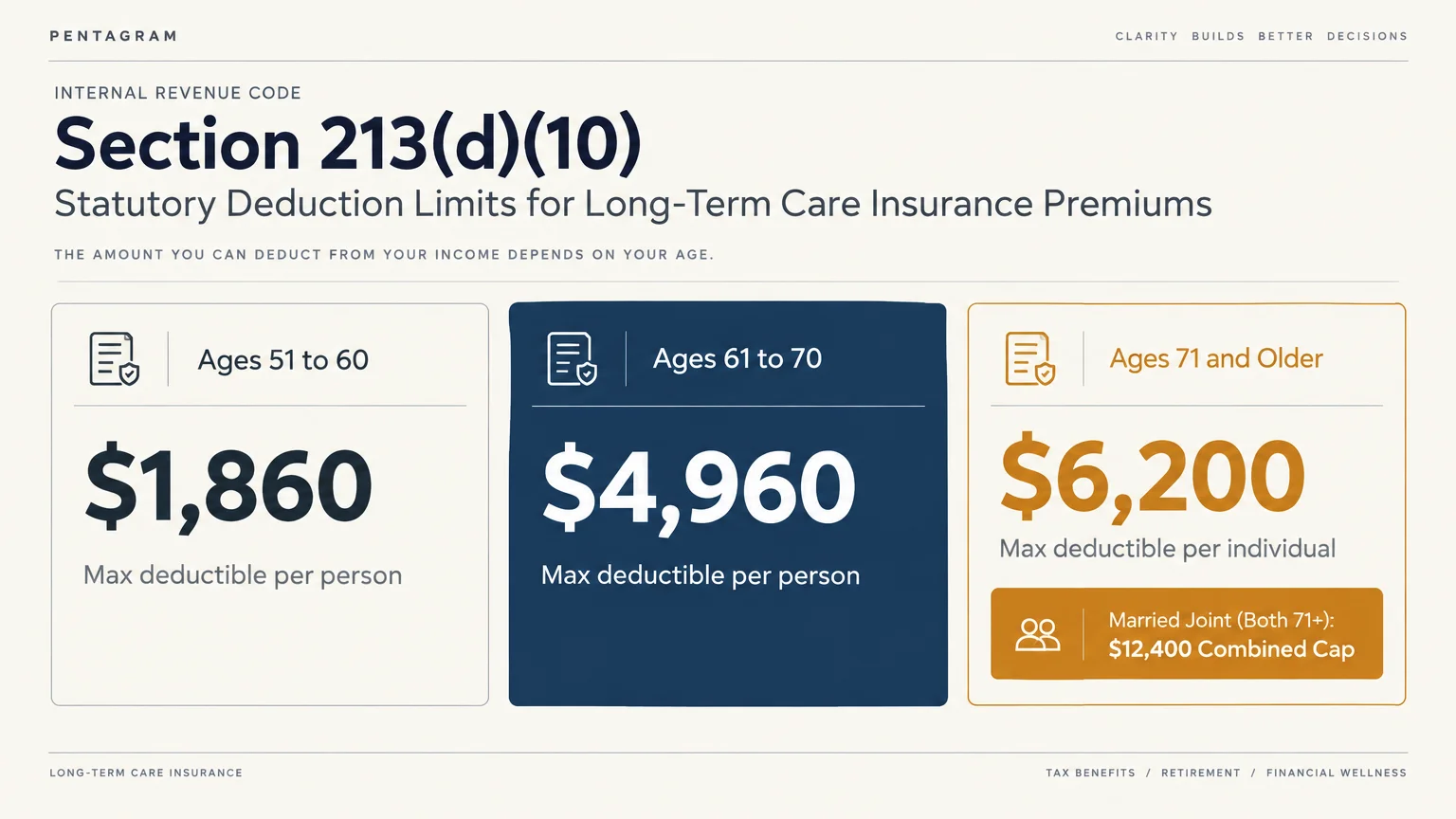
Purchasing long-term care insurance provides crucial protection, but the annual premiums can strain a fixed budget. The tax code provides relief under Internal Revenue Code Section 213(d)(10) through age-based statutory deduction limits.
For the 2026 tax year, filers age 61 to 70 can deduct up to $4,960 in qualified premiums per person. If you are age 71 or older, that statutory cap rises to $6,200 per individual.
A married couple filing jointly where both spouses are 71 or older can claim up to $12,400 in deductible premiums. Younger retirees age 51 to 60 can deduct up to $1,860 for 2026.
3. Capital Home Modifications for Accessibility
Aging in place often requires physical changes to your living space to accommodate evolving mobility needs. The tax code permits you to deduct home modifications installed for genuine medical or physical care reasons.
Deductible structural improvements include wheelchair ramps, widened doorways, support grab bars, and specialized stairlifts. You can review detailed qualifying criteria within IRS guidelines on medical deductions under Publication 502.
You can deduct the full expense to the extent it exceeds any increase in your home’s fair market value. Essential accessibility upgrades like entrance ramps rarely boost resale value, making them 100% includible as medical deductions.
4. Comprehensive Dental, Vision, and Hearing Care
Traditional Medicare generally excludes routine dental treatments, hearing aids, and vision care from coverage. Consequently, retirees pay for dentures, dental implants, hearing exams, and prescription bifocals entirely out-of-pocket.
The IRS treats these out-of-pocket vision and dental treatments as deductible medical expenses. When major reconstructive dental work or digital hearing aids cost thousands of dollars, they help unlock significant Schedule A tax savings.

Strategy Pillar 2: Lifestyle, Care, and Community Deductions
Your daily lifestyle adjustments and community involvement can open additional avenues for itemizing. Tracking your mileage, care arrangements, and charitable commitments will often yield substantial financial recovery.
5. Medical Travel, Mileage, and Transit Expenses
Trips to see physicians, physical therapists, and diagnostic centers involve real transportation costs that many seniors ignore. You can deduct the standard mileage rate for all travel undertaken primarily for medical treatment.
For the 2025 tax year, the IRS medical mileage rate stood at 21 cents per mile. For 2026, the rate is 20.5 cents per mile through June 30, increasing to 23.5 cents per mile starting July 1.
You can also write off related parking fees, highway tolls, and bus or taxi fares incurred during medical visits. Keep a written mileage log in your vehicle to document every trip cleanly for your tax records.
6. Assisted Living and Medically Necessary Nursing Care
Moving into an assisted living community or residential nursing facility involves substantial monthly living expenses. In specific circumstances, the IRS allows you to deduct these costs on your tax return.
If a physician certifies that you are chronically ill and require medical care, the full cost becomes deductible. This complete deduction covers personal medical treatment as well as regular room and board charges.
If you enter assisted living purely for personal reasons, only the specific medical and nursing fees qualify. Request an itemized annual billing statement from your facility administrator to isolate the deductible health services.
According to AARP research on caregiving costs, families frequently leave thousands of dollars unclaimed by neglecting this specific reporting method. Taking time to obtain written certifications from licensed practitioners ensures full compliance.
7. Charitable Volunteer Travel and Supplies
Many retirees donate their time to local food pantries, faith communities, and non-profit community organizations. While you cannot deduct the economic value of your volunteer hours, your unreimbursed out-of-pocket expenses are deductible.
Under Internal Revenue Code Section 170(i), driving your vehicle for charitable services yields a standard deduction of 14 cents per mile. You can also write off parking fees and tolls incurred during volunteer activities.
Additionally, you can deduct the cost of supplies you purchase directly for the charity, such as baking ingredients or event supplies. Maintain receipts and confirmation letters from the non-profit organization to validate your charitable claims.
Strategy Pillar 3: Financial Management and Specialized Care
Smart wealth management and adaptive health therapies provide two additional overlooked itemized deductions. Aligning your investment expenses and prescribed therapies creates a stronger financial cushion.
8. Taxable Investment Interest Expense
Retirees managing cash flow occasionally borrow against their taxable brokerage accounts using margin loans. You can deduct the interest you pay on money borrowed to purchase taxable investment assets.
You claim this deduction using IRS Form 4952 up to the total amount of your net taxable investment income. Any unused investment interest expense carries forward indefinitely into future tax years to offset subsequent gains.
This deduction does not apply to loans used to purchase tax-exempt municipal bonds or personal consumer purchases. Ensure your financial advisor segregates investment borrowing from personal lines of credit to safeguard the deduction.
9. Medically Prescribed Equipment and Specialized Diets
Doctors often prescribe specialized medical equipment, such as continuous positive airway pressure devices, orthopedic braces, or oxygen concentrators. The out-of-pocket cost to purchase and maintain this therapeutic equipment qualifies as a medical deduction.
In limited situations, the excess cost of medically required specialty diets—such as strict gluten-free foods for diagnosed celiac disease—is deductible. You can only deduct the difference between the specialty food cost and standard food prices.
You must obtain a formal letter of medical necessity from your treating physician before claiming dietary deductions. Keep accurate grocery receipts showing the exact retail price differences to substantiate your Schedule A calculations.

Expert Insights: Balancing Lifestyle and Tax Strategy
Structuring your retirement deductions requires coordinated planning across multiple disciplines. Financial and health professionals emphasize that smart recordkeeping transforms tax outcomes.
“Many retirees assume itemizing is obsolete following tax reform,” says certified financial planner David Reynolds. “However, once an individual encounters dental implants or long-term care insurance bills, itemizing frequently beats the standard deduction.”
Gerontologist Dr. Elena Morales emphasizes the connection between home adjustments and budget vitality. “Accessible home modifications protect your physical mobility while simultaneously generating vital tax savings under federal guidelines,” explains Dr. Morales.
Retiree Marcus Vance of Columbus, Ohio, discovered this advantage after undergoing bilateral knee surgery. “Tracking my mileage, physical therapy co-pays, and bathroom handrails saved me over $3,400 in federal taxes,” Vance reports.

Risks and Safeguards: Audits, Cliffs, and Scams
Claiming substantial Schedule A deductions requires rigorous documentation to prevent unwanted audit scrutiny. The IRS scrutinizes disproportionate medical expense claims relative to reported gross income levels.
Avoid generic summaries on your tax return by retaining itemized invoices, pharmacy records, and canceled checks. Store paper and digital copies of your tax records for at least three to seven years.
Beware of tax-prep scams that guarantee exaggerated refunds by fabricating medical travel or home renovation expenses. Work solely with licensed enrolled agents or CPAs bound by professional fiduciary standards.
Be aware of income thresholds that influence your benefits when managing taxable withdrawals. Large retirement account distributions taken to pay medical bills can trigger higher Medicare Part B surcharges under IRMAA rules.
Consult guidelines from the Social Security Administration to monitor how overall adjusted gross income shifts impact your monthly benefit withholdings. Strategic deduction timing helps keep taxable income beneath steep benefit cliff thresholds.
Frequently Asked Questions
Can I deduct the cost of over-the-counter vitamins and wellness supplements?
Generally, no. The IRS only allows deductions for over-the-counter supplements if a licensed physician prescribes them to treat a specific medical condition rather than general wellness.
How does the 7.5% AGI rule actually work on my tax return?
If your AGI is $60,000, your 7.5% threshold equals $4,500. If you accumulate $8,000 in qualifying medical bills, you can deduct $3,500 on Schedule A.
Are Medicare Part B premiums deducted automatically from Social Security still deductible?
Yes, Medicare Part B premiums deducted directly from your monthly Social Security benefits count as qualifying medical expenses. You can verify total annual premiums paid on your annual Form SSA-1099.
Can I combine home modification deductions with energy efficiency tax credits?
You cannot double-dip on the exact same expenditure. However, you can claim a medical deduction for physical accessibility adaptations while separately claiming energy credits for qualified heating or window improvements.
Take Action in the Next 48 Hours
Do not wait until April to scramble through shoe boxes of receipts and medical paperwork. Take one proactive step within the next 48 hours to secure your rightful tax deductions.
Log in to your healthcare and pharmacy online portals to download your annual out-of-pocket spending summaries. Tally your medical mileage and premiums to see how close you come to exceeding your standard deduction.
Schedule a planning session with a qualified tax advisor to benchmark your deductions against the 2026 thresholds. Proactive organization keeps your retirement funds right where they belong—in your own bank account.