
Executing a Roth IRA conversion can eliminate future tax spikes and protect your nest egg from market swings. However, complex tax traps often catch retirees off guard.
Moving money from a traditional account into a Roth requires precise timing and reliable cash planning. Missing critical federal guidelines can trigger steep penalties and unexpectedly inflate your healthcare expenses.
Before shifting your retirement savings, you must understand both the hidden risks and the strategic rewards. Here are ten vital lessons seasoned retirees wish they had known earlier.
The Modern Retirement Policy Landscape
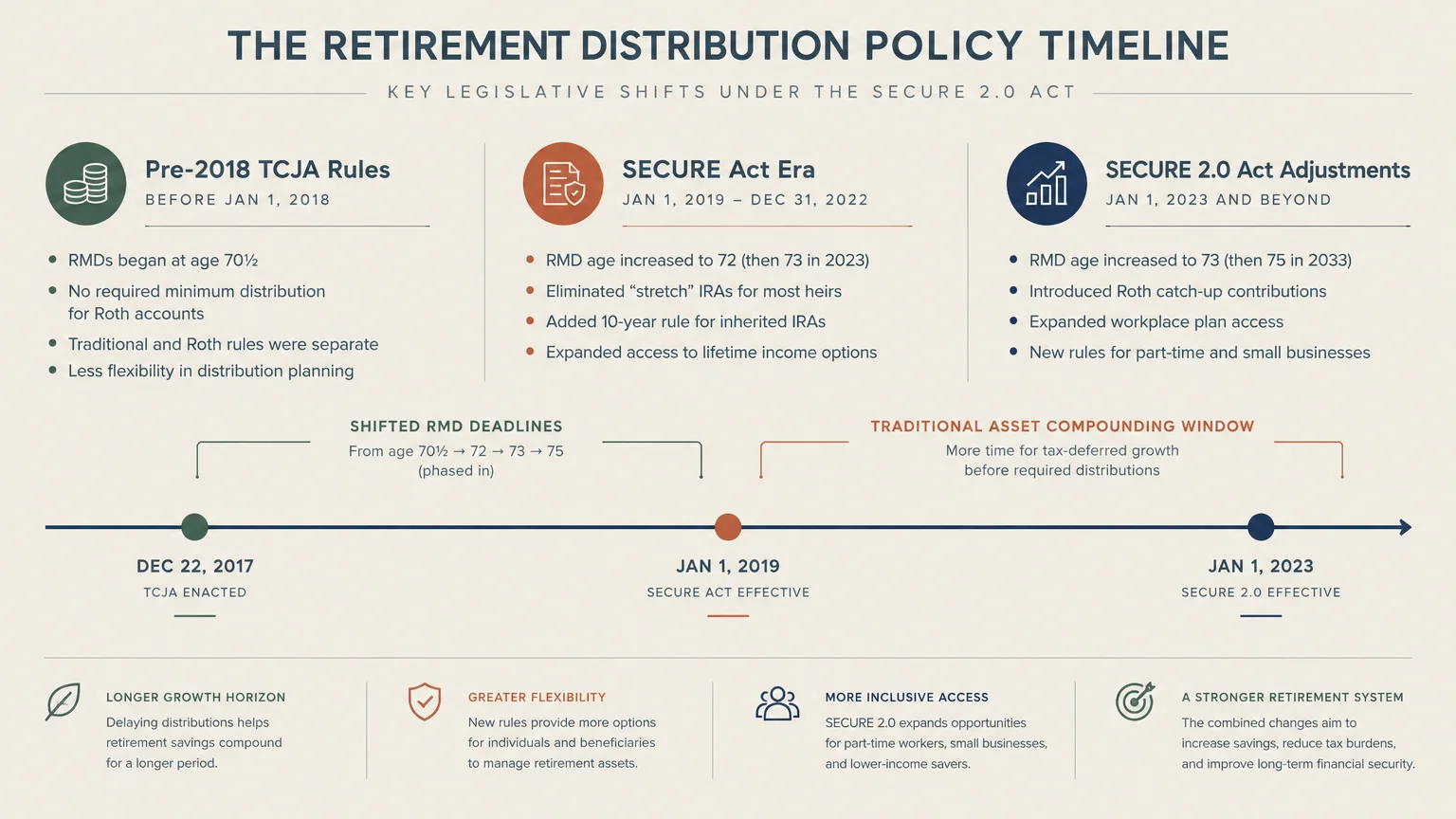
Recent federal legislation has altered the mechanics of retirement distribution planning across the United States. Rising living expenses and evolving tax codes require you to manage your accounts with heightened precision.
Congress enacted significant updates through the SECURE 2.0 Act, shifting required distribution deadlines and updating savings rules. These structural changes affect how long your traditional assets can compound before the government mandates withdrawals.
Exploring dependable AARP retirement planning tools helps you model various conversion scenarios against your projected living costs. Thoughtful preparation keeps you ahead of sudden regulatory shifts.
Ten Vital Lessons Retirees Learned the Hard Way
1. Conversions Are Permanent and Irreversible
Until 2017, retirees could undo a Roth conversion through a process called recharacterization. If converted investments plummeted, you simply reversed the transfer and erased the tax liability.
The Tax Cuts and Jobs Act permanently eliminated that safety net on January 1, 2018. Once you move funds into a Roth account today, you cannot undo the decision under any circumstances.
You must pay the resulting taxes even if your portfolio drops the following week. Careful valuation before initiating the transfer protects you from disastrous market timing mistakes.
2. The First-Dollar Rule Mandates Taking Your RMD First
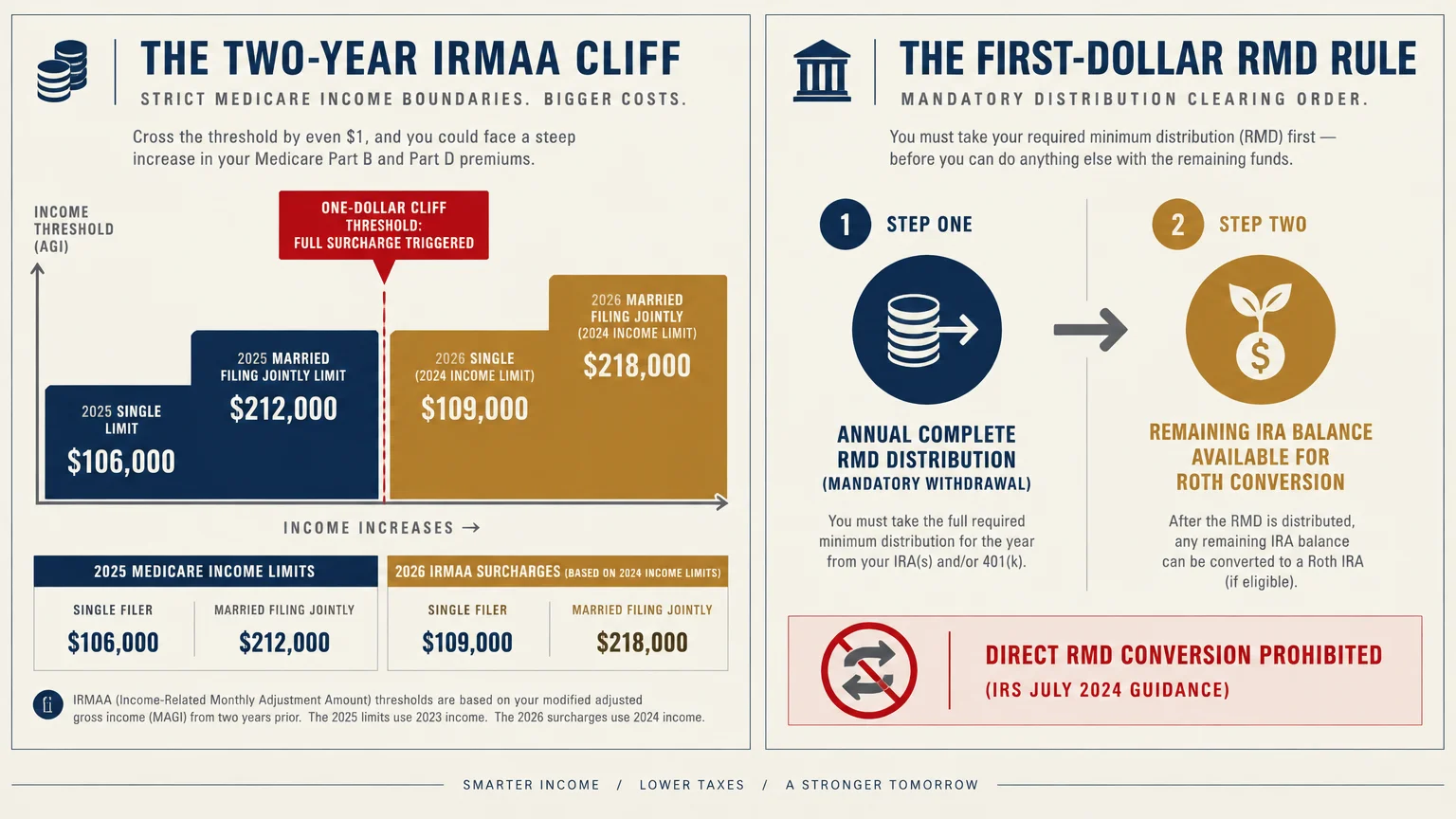
Many retirees assume they can convert their annual Required Minimum Distribution directly into a Roth IRA. However, federal tax rules explicitly forbid converting mandatory distribution amounts.
Under updated regulations finalized by the Internal Revenue Service guidelines in July 2024, the first money distributed from an IRA during an RMD year satisfies that required distribution.
You must withdraw and pay taxes on your complete annual RMD before converting any remaining funds. Converting before clearing that requirement triggers excess contribution penalties.
3. Medicare IRMAA Surcharges Create a Two-Year Cliff
Converting traditional assets increases your Modified Adjusted Gross Income for the current tax year. The federal government uses this income figure to determine your Medicare premiums two years later.
Exceeding income brackets triggers the Income-Related Monthly Adjustment Amount on Medicare Parts B and D. Because IRMAA uses strict cliffs, exceeding a threshold by just one dollar triggers the full surcharge.
The 2025 surcharges apply when 2023 income exceeds $106,000 for singles or $212,000 for married couples. The 2026 surcharges evaluate 2024 income against limits of $109,000 for singles and $218,000 for joint filers.
Reviewing updated Medicare Part B premium rules helps you keep conversions below those costly income cliffs. That calculation preserves your cash flow during vulnerable fixed-income stages.
4. The Social Security Tax Torpedo Strains Fixed Budgets
Extra conversion income feeds directly into your provisional income calculation, which dictates how much of your Social Security benefit faces taxation. This sudden income bump catches many retirees off guard.
Congress established provisional income thresholds in 1983 and has never adjusted them for inflation. Consequently, modest conversion sums quickly push you into higher tax exposure.
Once provisional income passes $34,000 for single filers or $44,000 for married couples, the government taxes up to 85% of your benefits. Checking official Social Security Administration tax formulas prevents this double-tax hit.
5. The Pro-Rata Rule Nullifies Cherry-Picked Conversions
Retirees often make non-deductible contributions to traditional IRAs hoping to convert only those after-tax dollars tax-free. Unfortunately, tax regulations prevent you from isolating specific non-deductible contributions.
The IRS aggregates all of your non-Roth traditional, SEP, and SIMPLE IRAs together on December 31 of the conversion year. Your taxable percentage matches your overall pre-tax balance ratio across all combined accounts.
You must file IRS Form 8606 instructions annually to calculate your taxable distribution ratio. Overlooking this requirement can generate surprising tax bills and compliance audits.
6. Dual Five-Year Rules Restrict Penalty-Free Withdrawals
The IRS enforces two separate five-year clocks on Roth IRA accounts, and confusing them creates expensive errors. Each rule protects a different component of your converted retirement balance.
To withdraw investment earnings tax-free, you must reach age 59½ and wait five tax years after opening your first Roth IRA. This master clock never resets once satisfied.
However, if you convert under age 59½, each conversion carries its own separate five-year clock for converted principal. Tapping those funds prematurely triggers an avoidable 10% early distribution penalty.
7. Withholding Conversion Taxes from the IRA Incurs Penalties
When processing a conversion, custodians ask if you want federal taxes withheld directly from the transfer balance. Choosing this withholding option severely diminishes your long-term wealth accumulation.
Every dollar diverted toward taxes reduces the compounding power of your new tax-exempt shelter. You forfeit decades of potential tax-free growth by shrinking the principal you transfer.
Additionally, if you are younger than age 59½, the IRS treats that withheld tax sum as an early distribution. That mistake slaps you with an immediate 10% penalty on the withheld funds.
You should always pay conversion taxes using outside cash reserves stored in taxable accounts. This safeguard protects your total retirement principal and eliminates early withdrawal penalties.
8. The Early Retirement Tax Valley Provides Prime Opportunities
The period between leaving your career and starting mandatory distributions represents your most lucrative conversion window. Financial advisors refer to this low-income gap as the retirement tax valley.
Under SECURE 2.0 legislation, your RMD starting age is 73 if born between 1951 and 1959. That age increases to 75 in 2033 for individuals born in 1960 or later.
During these transition years, your earned income drops before Social Security payments begin. You can convert sizable traditional balances while sitting comfortably within low federal marginal tax brackets.
Systematically converting funds during this valley reduces your future mandatory distributions. That proactive reduction saves thousands in lifetime retirement taxes.
9. SECURE 2.0 Removed Pre-Death Employer Roth RMDs
Before 2024, employer-sponsored Roth accounts carried mandatory distribution requirements that individual Roth IRAs never had. Retirees holding Roth 401(k) or Roth 403(b) balances faced compulsory withdrawals upon reaching their distribution age.
Effective January 1, 2024, SECURE 2.0 eliminated pre-death RMDs for all employer-sponsored designated Roth accounts. This reform aligns company plan rules directly with traditional Roth IRA protections.
You no longer have to roll company Roth assets into a private IRA simply to avoid forced distributions. Your money can continue compounding tax-free inside your institutional plan indefinitely.
10. Conversions Shield Heirs from the Ten-Year Rule
Estate planning dynamics changed fundamentally when the SECURE Act eliminated the traditional lifetime stretch IRA for most beneficiaries. Non-eligible designated heirs, such as adult children, must now fully liquidate inherited accounts within ten years.
These mandatory distributions often strike during your children’s peak earning years, pushing their income into punishing tax brackets. That sudden tax burden can erode a substantial portion of their inheritance.
When you convert those balances to a Roth IRA beforehand, your heirs still face the ten-year liquidation rule. However, every dollar they withdraw arrives completely free of federal income taxes.
Three Strategic Pillars for a Balanced Conversion Plan
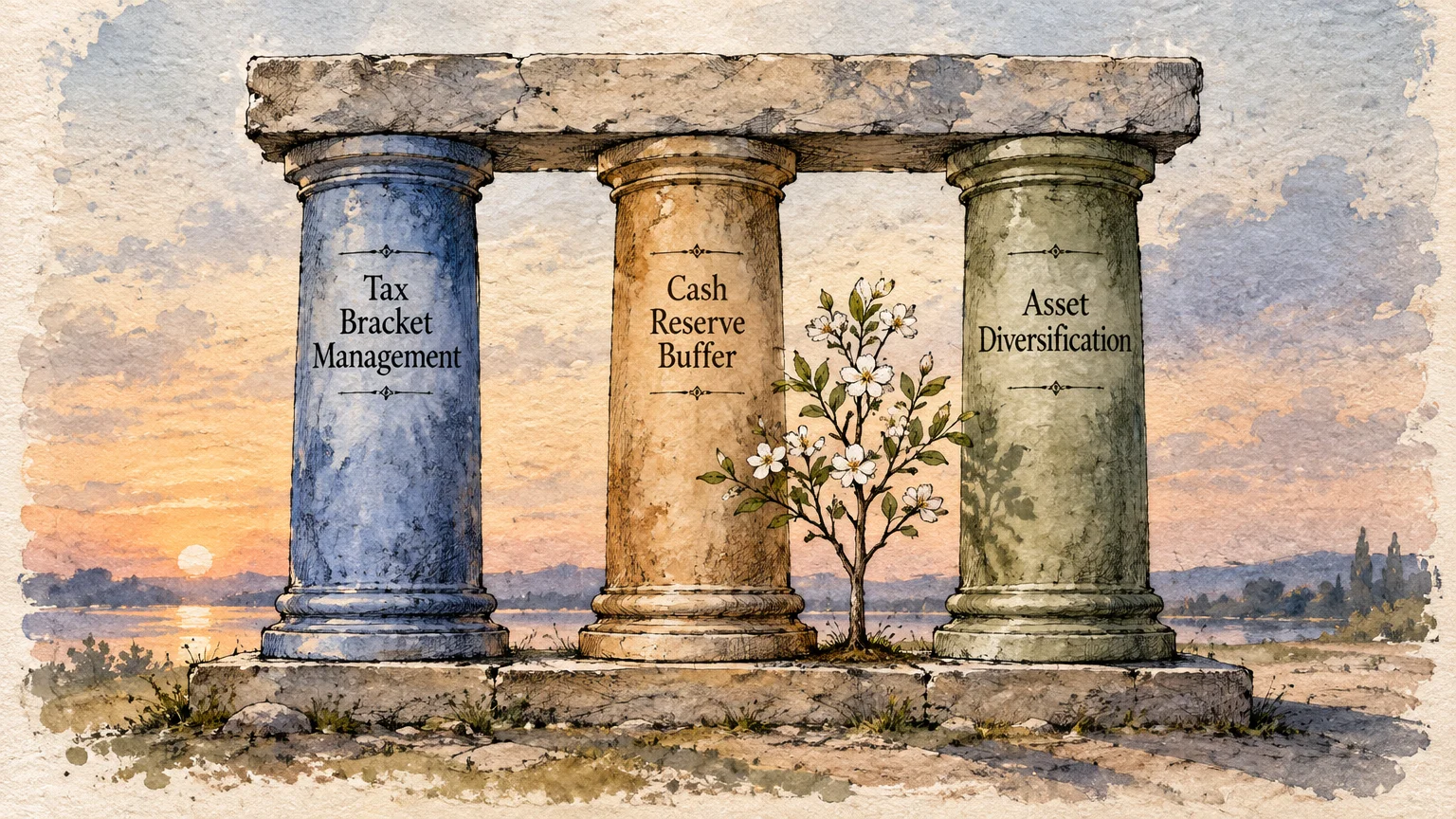
1. Structured Income Planning
Successful retirees never convert their entire traditional portfolio in a single tax year. Instead, they implement a multi-year bracket-bumping strategy that fills their existing marginal tax bracket without crossing into higher tiers.
This systematic method spreads your tax liability across several years, keeping your effective tax rate exceptionally low. It smooths your tax burden while methodically building your tax-free reserves.
2. Healthcare and Wellness Budgeting
Your financial strategies must align with your physical health and long-term care goals. Unexpected medical episodes or rising prescription costs can derail aggressive tax plans if you lack liquidity.
Balancing conversions alongside your healthcare reserves ensures you never exhaust cash needed for out-of-pocket medical bills. A healthy retirement requires stable finances that actively support your physical vitality.
3. Flexible Lifestyle Design
Retirement should empower you to pursue travel, creative passions, and family support without financial stress. Having a robust Roth account grants you absolute freedom to fund large purchases whenever you choose.
Unlike traditional withdrawals, tapping your Roth IRA for a major milestone never increases your taxable income. You protect your lifestyle while keeping your tax bill completely predictable.

Expert Perspectives and Protection Against Scams
Certified Financial Planner professionals consistently emphasize that Roth conversions are customized exercises rather than universal solutions. What works for an affluent neighbor might trigger severe tax penalties for your household.
Gerontologists also remind retirees that financial complexity increases cognitive strain as we advance in age. Simplifying your accounts through timely conversions reduces administrative burdens for you and your future caregivers.
You must also remain vigilant against aggressive sales pitches promoting deceptive conversion roll-overs. Unscrupulous brokers frequently encourage seniors to liquidate IRAs into illiquid, high-fee annuity products under the guise of tax planning.
Always verify financial credentials independently and avoid high-pressure seminars promising zero-tax conversion schemes. Working with a fee-only fiduciary protects your nest egg from predatory practices.
Frequently Asked Questions About Roth Conversions
Can I convert my traditional IRA if my household income is high?
Yes, federal income limits apply only to direct Roth IRA contributions, not conversions. Anyone can execute a conversion regardless of total earnings, provided the transaction complies with standard tax rules.
How does a Roth conversion affect my state income taxes?
Most states tax converted amounts as ordinary income, adding to your overall federal liability. However, states without income taxes or those offering retirement exemptions reduce your total conversion cost.
Should I convert my entire traditional IRA balance at one time?
Converting a full balance in a single year usually pushes you into top federal tax brackets, creating an unnecessarily high tax bill. Spreading conversions across multiple lower-income years delivers superior long-term tax efficiency.
What happens if my converted assets decline in value right away?
Because the IRS abolished conversion recharacterizations, your tax liability remains based on the asset value at the time of conversion. You must pay that calculated tax even if your portfolio subsequently drops.
Take Action in the Next 48 Hours
Navigating the conversion process may feel intimidating, but taking proactive control of your financial destiny yields immense peace of mind. Small, decisive steps today shield your lifestyle from future policy shifts and inflationary pressures.
Within the next 48 hours, pull your most recent tax return and locate your current taxable income line. Compare that number against your marginal tax bracket ceiling to identify your remaining conversion headroom.
Empowering yourself with knowledge ensures you convert on your own terms while safeguarding your hard-earned wealth. Start your assessment today to build a vibrant, tax-resilient retirement.