
Retiring together transforms your relationship and your finances overnight, requiring complete alignment to protect your hard-earned wealth. Asking the right money questions now prevents unexpected tax burdens and keeps your household budget resilient against inflation.
Recent research reveals that nearly two-thirds of couples disagree on their expected retirement age or post-career lifestyle expenses. Uncovering these hidden assumptions before leaving the workforce keeps your shared vision secure and harmonious.
By synchronizing your benefits, investment withdrawals, and healthcare plans today, you build lasting financial freedom together. Here are the eleven critical questions you must answer before stepping into retirement as a team.

Navigating the Modern Retirement Landscape Together
Retirement policy has shifted significantly in recent years, presenting couples with fresh opportunities and complex rules. Recent legislation introduces higher contribution limits alongside adjusted distribution timelines that alter long-term withdrawal planning.
Understanding these shifts ensures that you do not leave money on the table or face surprise tax penalties. Working collaboratively allows both partners to leverage updated federal tax brackets and maximize employer benefits before leaving work.
Certified Financial Planner professionals emphasize that joint planning must look beyond simple portfolio totals. True retirement security requires balancing individual longevity expectations, shifting tax obligations, and rising medical expenses.

Pillar One: Income Planning and Benefit Coordination
1. When Will Each of Us Claim Social Security Benefits?
Claiming Social Security requires careful coordination because your choice permanently sets your baseline household income. For anyone born in 1960 or later, your Full Retirement Age is 67.
Claiming as early as age 62 permanently reduces monthly benefits by up to 30%. Delaying past Full Retirement Age earns delayed retirement credits of 8% per year until age 70.
A spouse can claim up to 50% of the higher earner’s benefit at Full Retirement Age. You can verify your lifetime earnings records through the official Social Security Administration portal.
Delaying the higher earner’s benefit to age 70 maximizes both your monthly household cash flow and future survivor benefits. This single decision establishes a resilient, inflation-adjusted safety net for both partners.
2. How Will We Coordinate Retirement Account Withdrawals and RMDs?
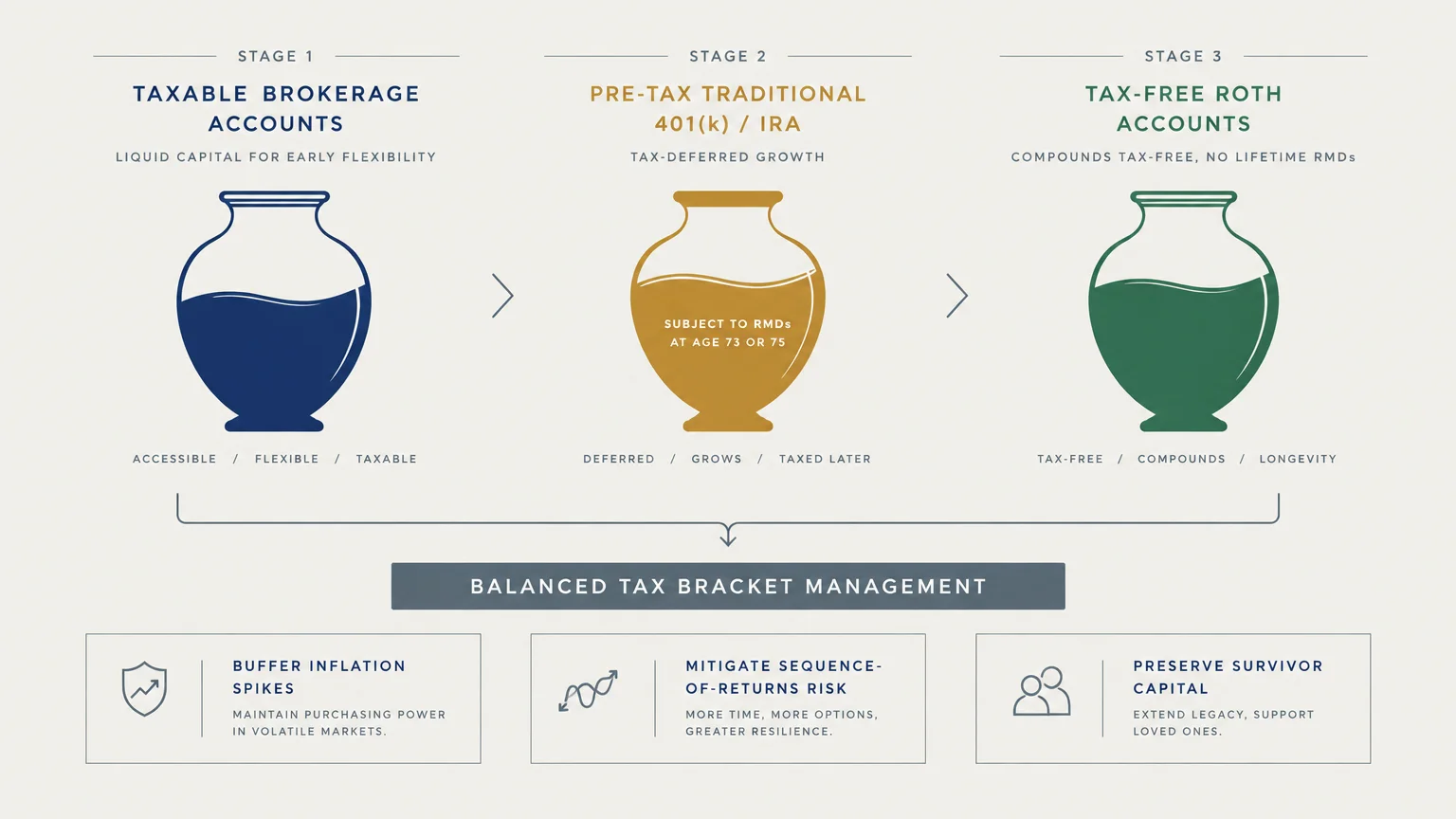
Tax efficiency depends heavily on which accounts you tap first during retirement. Balancing withdrawals across taxable brokerage accounts, traditional pre-tax funds, and tax-free Roth accounts helps control your annual taxable income.
Under the SECURE 2.0 Act, the mandatory age for Required Minimum Distributions is 73 for those born between 1951 and 1959. That threshold increases to age 75 in 2033 for workers born in 1960 or later.
Fortunately, Roth 401(k) accounts no longer mandate pre-death distributions under updated Internal Revenue Service regulations. This change allows your joint Roth balances to compound entirely tax-free throughout your lifetimes.
3. Can We Leverage Super Catch-Up Contributions Before Retiring?
If you or your spouse are in your final working years, recent legal changes offer a valuable savings boost. The SECURE 2.0 Act created enhanced super catch-up contributions for specific older workers.
Employees aged 60 to 63 can now contribute up to $11,250 in catch-up savings to workplace plans like 401(k)s and 403(b)s. Taking advantage of this provision allows couples to shelter substantial extra income right before transitioning into retirement.
Using these accelerated savings limits can bridge existing portfolio shortfalls rapidly. Discuss with your human resources department whether your workplace plan supports these specialized catch-up limits.
4. What Is Our Realistic Monthly Spending Baseline?
Every solid retirement strategy begins with a crystal-clear understanding of essential versus discretionary cash flow. Couples must distinguish between non-negotiable living costs like housing and food and lifestyle desires like travel.
Many pre-retirees mistakenly assume their living costs will drop by 20% immediately upon leaving work. Travel expenses, hobby supplies, and home improvement projects often cause initial spending to rise during early retirement years.
Track your actual living expenses for at least three consecutive months before setting a joint withdrawal rate. This baseline ensures you do not draw down your portfolio too quickly during market downturns.

Pillar Two: Health and Long-Term Care Realities
5. How Will We Bridge Health Insurance if One of Us Retires Early?
Couples rarely celebrate their sixty-fifth birthdays at the exact same moment. If one spouse leaves work before reaching Medicare eligibility at age 65, you face a coverage gap.
Continuing coverage through COBRA provides temporary relief, but it often carries high premiums without employer subsidies. Alternatively, purchasing coverage through the Affordable Care Act marketplace can provide comprehensive protection during early retirement years.
Carefully calculate your expected taxable income during this transition window. Keeping modified adjusted gross income moderate can qualify your household for valuable health insurance premium tax credits.
6. How Will Our Combined Income Impact Medicare Premiums?
Healthcare expenses extend well beyond standard doctor visits. The standard monthly premium for Medicare Part B is $185.00 with an annual deductible of $257.
Couples filing jointly face Income-Related Monthly Adjustment Amount surcharges once modified adjusted gross income exceeds $212,000. These surcharges add between $74.00 and $443.90 per person monthly for Part B.
Fortunately, the Inflation Reduction Act established a protective annual out-of-pocket cap of $2,000 per person on Medicare Part D prescription drugs. Review coverage details through the official Medicare coverage guidelines.
7. What Is Our Action Plan for Potential Long-Term Care?
An average 65-year-old couple needs approximately $345,000 to $371,000 in after-tax savings for healthcare, excluding long-term custodial care. About 70% of adults turning 65 will eventually require long-term care services.
The national median cost of an assisted living facility is roughly $70,800 to $74,400 per year. Meanwhile, private nursing home rooms average $127,750 annually, with semi-private rooms reaching $111,325.
Because traditional Medicare excludes non-skilled custodial support, couples must establish a dedicated funding strategy. Explore private hybrid policies or health savings accounts through AARP caregiving resources to safeguard your portfolio.

Pillar Three: Lifestyle Design and Asset Protection
8. Where Will We Live, and Should We Modify or Downsize Our Home?
Your home represents both your largest emotional anchor and one of your biggest monthly expenses. Couples must determine whether to age in place, downsize locally, or relocate to a state with lower property taxes.
Staying in your current home may require accessibility upgrades, such as zero-step entries or main-floor primary suites. Investing in universal design early ensures comfort while preventing costly emergency home renovations later in retirement.
If you choose to downsize, factor in closing fees, moving costs, and higher interest rates. Downsizing can free up valuable home equity, but only if your transaction expenses do not erase the financial gain.
9. What Are Our Financial Boundaries for Helping Family Members?
Supporting adult children or aging parents often strains joint retirement finances unexpectedly. Spouses must agree on explicit boundaries regarding financial gifts, co-signing loans, or offering ongoing living subsidies.
Gerontologists note that uncoordinated financial assistance to family members frequently causes deep marital conflict. Setting clear dollar limits upfront preserves your own financial security while maintaining healthy family relationships.
Prioritize your own retirement longevity before extending substantial financial help to loved ones. Remember that your children can finance college or mortgages, but you cannot borrow money to fund your retirement.
10. How Will Our Finances Withstand the Loss of a Spouse?
Losing a partner brings immediate financial consequences known as the widow penalty. When a spouse passes away, your household drops from two Social Security checks to one.
The surviving partner inherits the larger benefit, while the smaller check disappears. In addition, the surviving spouse transitions to single filer tax brackets, which frequently triggers higher effective tax rates.
Review estate plans, beneficiary designations, and life insurance policies together today. Proactive coordination ensures the surviving spouse maintains dependable financial independence during a vulnerable life stage.
11. How Will We Share Financial Tasks and Protect Against Elder Fraud?
In many marriages, one partner handles investment management while the other oversees daily bill paying. This division creates a critical vulnerability if the primary money manager faces cognitive decline or passes away suddenly.
Both partners must maintain full visibility over banking passwords, investment accounts, and insurance policies. Holding regular financial review dates keeps both spouses informed and confident about household assets.
Joint awareness also serves as your best defense against sophisticated financial scams targeting seniors. Establishing trusted emergency contacts with financial institutions adds an extra layer of protection against unauthorized portfolio withdrawals.
Safeguards Against Common Retirement Pitfalls
Couples often encounter unexpected financial traps when shifting from asset accumulation to portfolio decumulation. Failing to account for combined income thresholds can trigger steep tax increases or elevated Medicare surcharges.
Coordinate your capital gains realizations and Roth conversions carefully to avoid crossing crucial income cutoffs. Staggering large financial transactions across multiple tax years prevents sudden jumps into higher Medicare premium tiers.
Furthermore, do not overlook the emotional transition of leaving full-time professional careers at the same time. Spending twenty-four hours a day together requires intentional boundary setting, separate hobbies, and shared social networks.
Frequently Asked Questions
What happens if one spouse wants to retire years before the other?
Staggered retirement is common and often financially advantageous for couples navigating healthcare and savings goals. The working partner can provide employer health coverage while maintaining contributions to workplace retirement plans.
However, the couple must adjust household responsibilities to prevent resentment over differing levels of free time. Clear communication regarding daily expectations ensures both partners feel respected throughout the staggered transition.
How does the SECURE 2.0 Act change our joint withdrawal strategy?
The SECURE 2.0 Act delays Required Minimum Distributions until age 73, extending to age 75 by 2033. This extended window gives couples additional years to execute strategic, low-bracket Roth IRA conversions.
Additionally, eliminating RMDs on employer-sponsored Roth accounts gives couples greater flexibility to leave balances untouched. This ensures your joint portfolio continues growing tax-free without forced annual liquidations.
Can a surviving spouse collect both their own and their deceased partner’s Social Security?
No, a surviving spouse does not receive both monthly checks combined. Instead, the surviving partner receives the single larger benefit between their own payment and their deceased spouse’s actual check.
This drop in total household Social Security income reinforces why the higher earner should delay claiming until age 70 whenever possible. That strategic delay locks in the highest possible survivor benefit for life.
How do we prevent Medicare IRMAA surcharges if we sell an asset?
Medicare uses a two-year lookback period on your tax returns to calculate your monthly premiums. Selling real estate or realizing large capital gains can unexpectedly push joint income over the $212,000 threshold.
You can manage this risk by spreading capital gains across multiple tax years through installment sales or offset strategies. If your income dropped due to a life-changing event like retirement, you can file form SSA-44 for relief.
Take Action in the Next 48 Hours
Retirement planning succeeds when couples replace vague assumptions with open, honest conversations about money. Sitting down together today prevents financial friction tomorrow and aligns your shared path forward.
Choose one single question from this guide to discuss over coffee within the next 48 hours. Gather your latest account statements, log into your benefits portals, and take direct ownership of your joint financial future together.