
A single clerical error on your work record can quietly drain tens of thousands of dollars from your lifetime retirement income. You count on every dollar to fund your future, yet millions of Americans receive inaccurate monthly checks without realizing it.
The Social Security Administration relies on intricate historical formulas that frequently stumble over employer reporting gaps, name changes, and indexing glitches. Discovering these missteps early protects your hard-earned wealth before strict bureaucratic deadlines lock those errors in permanently.
This guide exposes eight ways your benefit numbers get miscalculated and provides actionable steps to fix them today.
The Fragile Nature of Benefit Calculations
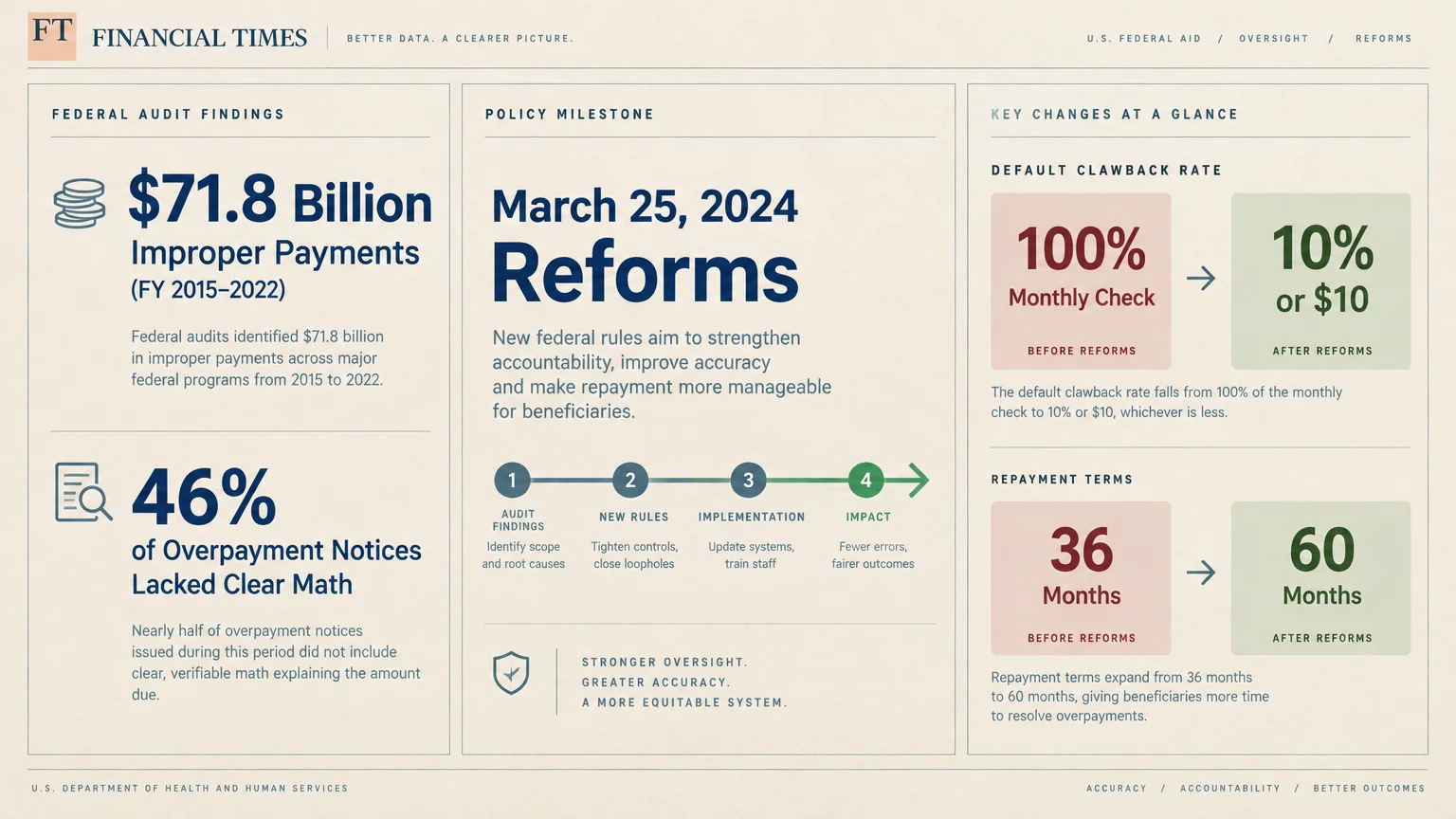
Audits by the federal government reveal staggering accounting discrepancies across the retirement system. Between fiscal years 2015 and 2022, the Social Security Administration logged approximately $71.8 billion in improper payments.
These blunders left over $23 billion in uncollected overpayments on federal ledgers while disrupting the budgets of vulnerable retirees. Official audits found that 46% of overpayment notices lacked accurate or complete calculation explanations.
In response to intense public scrutiny, the agency enacted critical policy reforms on March 25, 2024. The default clawback rate dropped from 100% of your monthly check to just 10% or $10.
Standard repayment terms also expanded from 36 months to 60 months. Furthermore, the agency shifted the burden of proof away from beneficiaries during fault determinations.

1. Missing Earnings and Record Clerical Errors
Your monthly check stems entirely from the annual wages that employers report to the Internal Revenue Service. If a payroll clerk transposed two digits of your Social Security number, those earnings never reached your master record.
Name changes after marriage or divorce also create unlinked wage files that languish inside agency suspense databases. You must regularly check your Social Security earnings record through your personal online portal to spot these omissions.
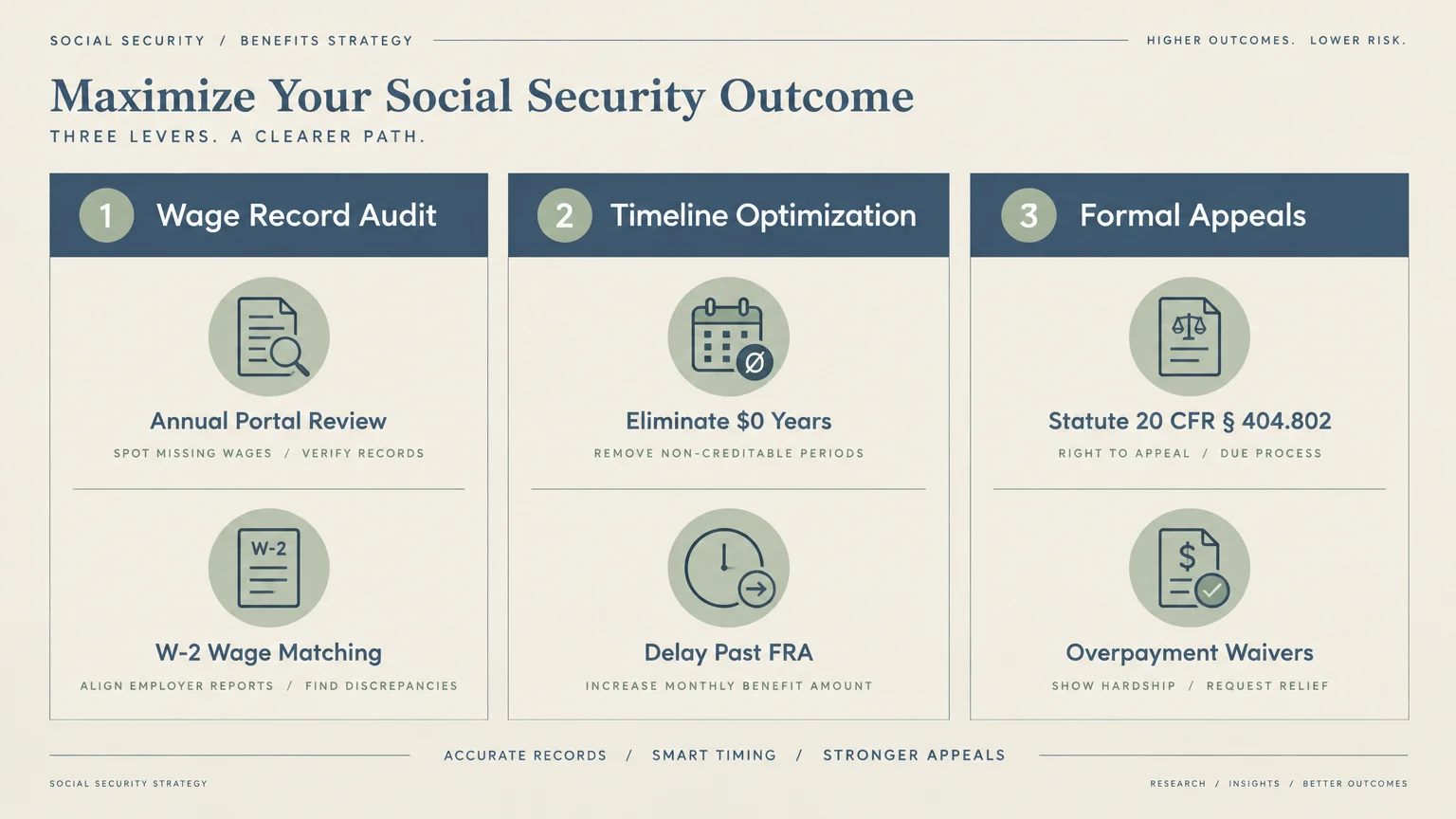
Federal regulation 20 CFR § 404.802 enforces a strict statute of limitations on record corrections. You have exactly 3 years, 3 months, and 15 days from the end of the tax year to fix errors.
Once that legal deadline passes, correcting your earnings statement requires rigorous evidence like Form W-2 copies or certified tax transcripts. Inspecting your record annually ensures you catch wage discrepancies before legal time limits expire.
2. The Dreaded Zero-Year Averaging Trap
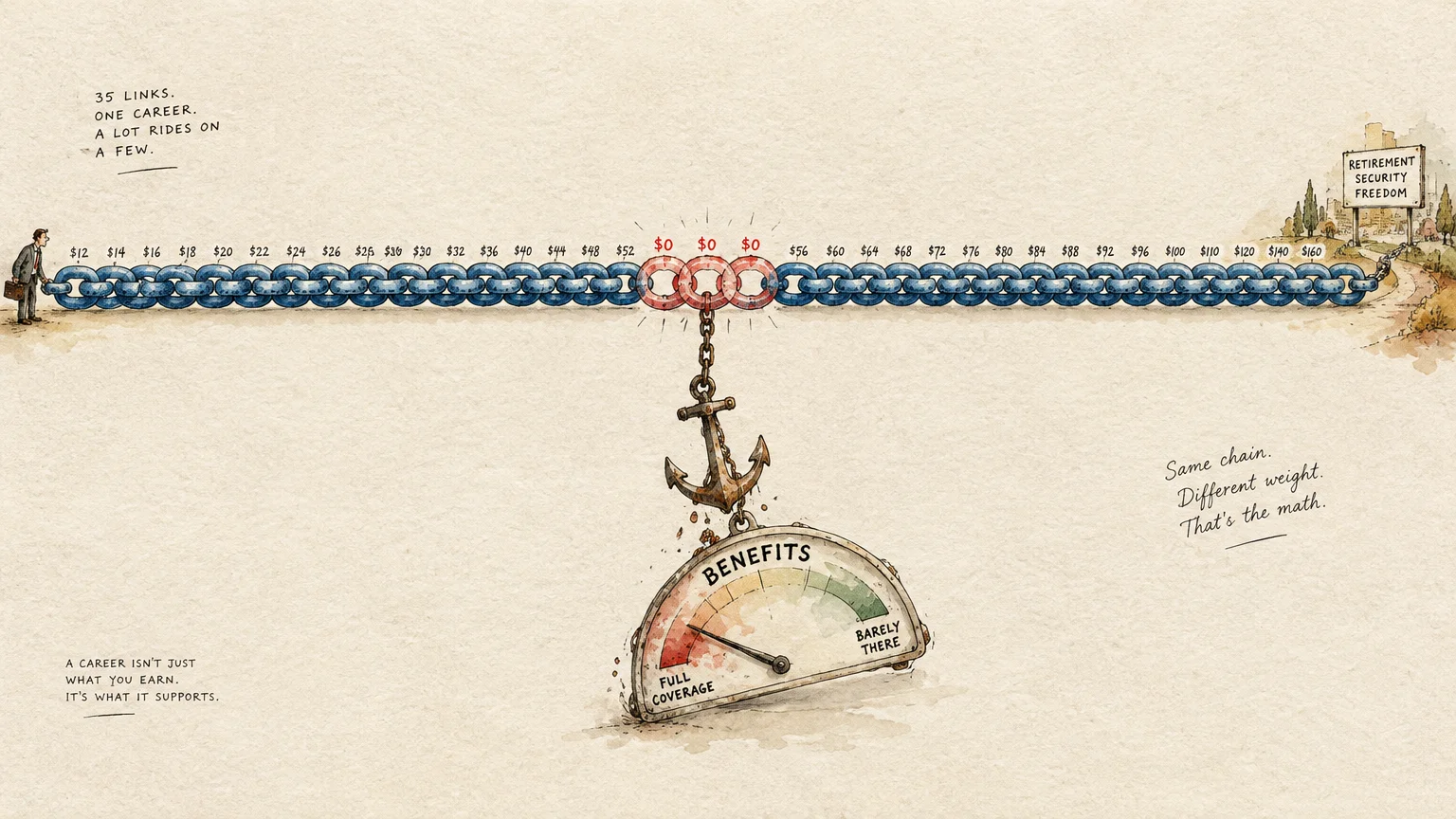
The government computes your baseline retirement benefit using your highest 35 years of wage-indexed earnings. If you worked for 32 years, the calculation formula averages in three zero-dollar years.
Each zero-dollar placeholder significantly depresses your Average Indexed Monthly Earnings, permanently lowering your monthly benefit check. Caregivers, gig workers, and individuals who faced extended unemployment face the heaviest financial penalties from this math.
The agency indexes your past earnings using national wage indexes to match contemporary purchasing power. However, earnings accrued after age 60 enter the calculation at their nominal face value without indexing adjustments.
You can eliminate these penalizing zeros by extending your career by a year or two. Working part-time replaces those zero-dollar slots with positive earnings, instantly lifting your lifetime payout average.
3. Misunderstanding Progressive Bend Point Formulas
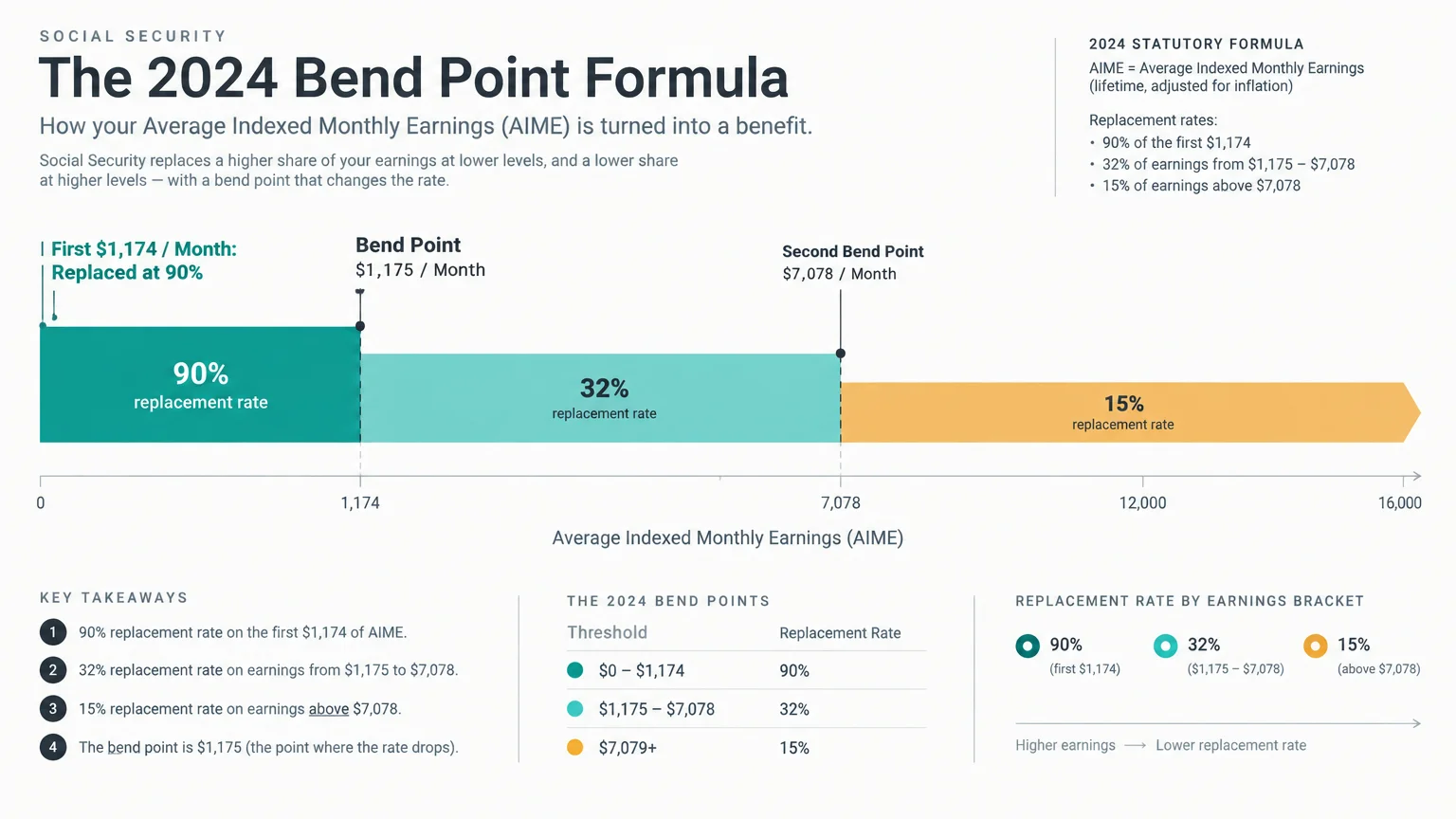
The agency translates your career earnings into your Primary Insurance Amount through progressive mathematical formulas called bend points. These statutory formulas adjust every calendar year to reflect national wage trends.
For 2024, the formula awards 90% of the first $1,174 of monthly earnings, 32% between $1,174 and $7,078, and 15% above $7,078. The 2025 thresholds expand to $1,226 and $7,391 respectively.
Wage indexing stops at age 60, after which your benefit amount only rises through annual Cost-of-Living Adjustments. Confusing wage indexing with cost-of-living adjustments frequently leads retirees to miscalculate their future monthly entitlement.
Agency software bugs or outdated wage indexing data can skew these calculations. Reviewing how Social Security benefits are calculated helps you identify whether your award letter reflects your accurate wage bracketings.

4. Retirement Earnings Test Mistakes Before Full Retirement Age
If you claim your benefits before reaching Full Retirement Age while continuing to work, federal rules restrict your earned income. The Retirement Earnings Test mandates temporary benefit withholding when your wages cross annual limits.
In 2024, the agency withholds $1 for every $2 earned above $22,320, rising to $23,400 in 2025. In the calendar year you reach Full Retirement Age, those limits jump to $59,520 and $62,160.
Agency caseworkers often misapply these earnings limits by improperly counting non-wage income like pensions, capital gains, or severance packages. Such mistakes trigger improper benefit reductions that disrupt your household cash flow.
Special monthly earnings rules protect workers who retire mid-year from unfair benefit withholding. If you retire mid-year, verify that the agency applies the monthly test rather than the standard annual test.
The agency must credit all withheld sums back into your monthly payout once you reach Full Retirement Age. You should review your post-FRA benefit adjustment to ensure the government restored your withheld dollars.
5. Claiming Timing and Delayed Retirement Credit Omissions
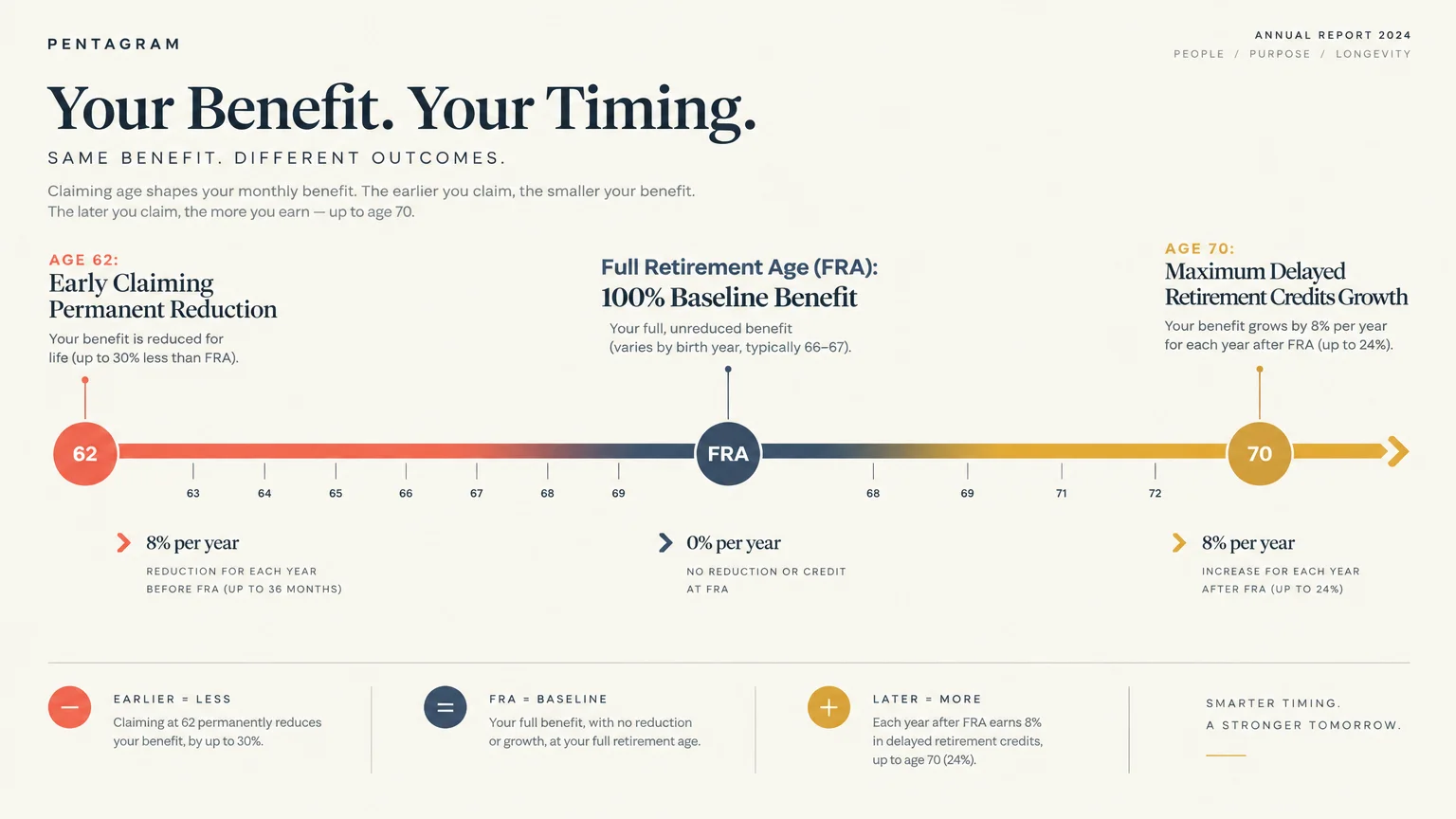
Your Full Retirement Age is exactly 67 if you were born in 1960 or later. Claiming benefits at age 62 permanently slashes your monthly payout by up to 30%.
Conversely, waiting beyond your Full Retirement Age earns you delayed retirement credits of 8% per year until age 70. This guaranteed growth provides substantial longevity protection against persistent inflation.
Delayed retirement credits stop accumulating once you reach age 70. Waiting past your 70th birthday to claim benefits yields no extra money and permanently forfeits monthly payments you cannot recover.
Agency claims specialists occasionally process claims under early retirement assumptions despite late filing dates. This administrative error can omit thousands of dollars in earned delayed retirement credits from your baseline check.

6. Government Pension Offsets and Windfall Elimination Flaws
State employees, public school teachers, and municipal workers who earned non-covered pensions face complex benefit reduction rules. The Windfall Elimination Provision and Government Pension Offset significantly adjust your benefit entitlements.
The Windfall Elimination Provision alters your Primary Insurance Amount formula if you earned a pension from non-covered employment. Meanwhile, the Government Pension Offset can slash your spousal or survivor benefit by two-thirds of your pension.
If you accumulated 30 or more years of substantial earnings under covered employment, you are completely exempt from the Windfall Elimination Provision. Tracking your substantial earnings history prevents caseworkers from improperly applying these cuts.
Caseworkers frequently apply these harsh reductions to individuals who paid full FICA taxes throughout their careers. “We routinely discover mistaken pension offsets on retired educators,” notes Certified Financial Planner™ Marcus Vance.
Always review your pension plan classification with your human resources department before filing for Social Security. Supplying proper documentation prevents the agency from misapplying these substantial benefit penalties to your monthly income.

7. Post-Divorce and Spousal Benefit Calculation Blunders
If you were married for at least 10 consecutive years, you maintain legal eligibility for spousal benefits based on your former partner’s work record. Yet administrative caseworkers frequently miscalculate or overlook these auxiliary benefits.
Caseworkers often calculate spousal benefits using outdated earnings histories rather than your former spouse’s peak earning years. This oversight depresses your monthly payment below your statutory entitlement.
Remarrying before age 60 generally extinguishes your eligibility to claim on an ex-spouse’s record. However, remarrying after age 60 allows you to retain your survivor benefit rights without interruption.
Surviving divorced spouses encounter even greater risks when transitioning between personal retirement checks and survivor benefits. You must ensure the claims representative evaluates both records and awards the higher monthly amount.

8. Agency Overpayment Notices and Flawed Calculations
The agency frequently issues sudden overpayment demand letters stemming from its own delayed record processing. Beneficiaries often receive notices demanding thousands of dollars without any clear explanation of the mathematical error.
Federal audits reveal that nearly half of all overpayment notices fail internal guidelines by omitting essential mathematical details. Demanding full repayment without providing clear accounting violates basic administrative fairness.
The agency’s 2024 policy overhaul establishes that you are not at fault if you relied on incorrect official guidance. If a claims representative gave you erroneous advice, document that interaction to support your formal waiver request.
You have exactly 60 days from receiving a determination letter to challenge the decision or request an administrative waiver. Filing Form SSA-561 for reconsideration or Form SSA-632 for a waiver halts immediate clawback actions.
Never assume the agency’s overpayment dollar amount is accurate. Demand an itemized accounting breakdown from your local field office before agreeing to any repayment schedule.
Three Strategy Pillars to Protect Your Retirement Benefits
Pillar 1: Proactive Income Planning
Building a dependable retirement income requires coordinating your Social Security filing date with withdrawals from tax-advantaged retirement accounts. Aligning traditional IRA withdrawals with delayed claiming optimizes your lifetime tax liability.
Coordinating your claiming age with your spouse creates substantial portfolio longevity. Allowing the higher earner to delay until age 70 maximizes the surviving spouse’s lifelong safety net.
Remember that federal law caps earnings subject to Social Security taxation at $168,600 in 2024 and $176,100 in 2025. Earnings beyond these annual limits generate no additional benefit credits, requiring alternative investment strategies.
Pillar 2: Purposeful Lifestyle Design
Structuring your retirement lifestyle requires balancing fixed baseline living expenses with flexible discretionary spending. Aligning your essential bills with guaranteed Social Security income shields your lifestyle from market turbulence.
Relocating to a state that exempts Social Security benefits from state income taxes stretches your net monthly budget. Many states exempt federal retirement benefits completely, but several jurisdictions continue to tax them.
Gerontologist Dr. Elena Rostova notes that financial security directly reinforces physical and emotional vitality as you age. Stable, predictable monthly income eliminates the chronic financial anxiety that undermines cognitive health.
Pillar 3: Integrated Health and Wellness Management
Healthcare expenses remain one of the steepest financial challenges facing older Americans today. Managing your taxable income directly protects you from surging Medicare Part B and Part D surcharge penalties.
Excessive retirement withdrawals can trigger costly Income-Related Monthly Adjustment Amounts that erode your Social Security check. You can forecast your healthcare costs using resources on the official Medicare portal.
Preventive wellness habits reduce your reliance on costly prescription medications and specialized clinical interventions. Maintaining physical mobility keeps your healthcare outlays low while protecting your retirement savings against unexpected medical shocks.

Risks and Safeguards: Defending Your Retirement Security
Modern retirees face growing risks from sophisticated imposter scams targeting their monthly government benefits. Criminals frequently impersonate federal agents over the telephone, claiming your Social Security number has been suspended.
The federal government will never call you demanding immediate wire transfers, prepaid debit cards, or private bank account details. If you receive a threatening call, hang up immediately and report the incident.
You can find reliable fraud prevention checklists through consumer defense networks such as AARP Financial Programs. Activating multi-factor authentication on your federal portal account provides an essential defense against unauthorized access.
Regularly reviewing your annual Social Security statements alerts you to fraudulent activity before criminals compromise your benefits. Promptly reporting unauthorized address or direct deposit changes stops payment diversion in its tracks.
Additionally, watch out for benefit cliffs when transitioning between disability, survivor, and standard retirement pensions. Seeking guidance from a certified financial planner helps you navigate these complex administrative transitions safely.
Frequently Asked Questions
Can the Social Security Administration reduce my benefits after approving them?
Yes, the agency can recalculate and lower your monthly check if it discovers historical wage errors or missed pension offsets. However, you maintain the legal right to challenge any reduction through formal administrative appeals.
What should I do if my earnings record shows zero dollars for a year I worked?
Gather historical W-2 statements, tax returns, or old pay stubs that prove your wage earnings for that specific year. Submit Form SSA-7008 alongside your financial evidence to request an immediate correction to your wage record.
How does the agency calculate spousal benefits if my spouse claimed early?
Your spousal benefit is based on your spouse’s Full Retirement Age entitlement, not their early-reduced payment amount. However, claiming your spousal benefit before reaching your own Full Retirement Age will permanently reduce your check.
What happens if I cannot afford to repay a benefit overpayment?
You can file Form SSA-632 to request an overpayment waiver if the mistake occurred through no fault of your own. Under current rules, the agency caps monthly withholding at 10% under a 60-month repayment plan.
Take Control of Your Benefit in the Next 48 Hours
Protecting your retirement security does not require mastering thousands of pages of federal administrative law. You simply need to verify the earnings foundation you spent decades building.
Log into your account on the Social Security Administration website within the next 48 hours. Download your complete earnings statement and inspect every single calendar year for accuracy.
If you spot an error, order your past wage transcripts through the Internal Revenue Service immediately. Taking proactive action today ensures that your hard-earned benefits remain secure throughout your retirement.