
Modern retirees no longer view life insurance merely as a payout for surviving beneficiaries. You can now deploy permanent coverage as a dynamic financial shield during your active retirement years.
From buffering stock market downturns to paying for eldercare, these contracts serve as liquid wealth reserves. Savvy policyholders use them to safeguard retirement income while adapting to shifting tax regulations.
Rethinking your existing policy transforms a recurring expense into a hardworking, multipurpose wealth engine. Here is how American retirees rewrite the rules of coverage to build lasting peace of mind.

Why the Retirement Playbook Has Shifted
The economic landscape for older Americans has undergone major structural shifts over the past five years. Persistent inflation and evolving tax statutes require fresh thinking about capital preservation.
Traditional retirement accounts often struggle under unexpected tax hikes and soaring medical expenses. Consequently, retirees increasingly turn to permanent life insurance to solve urgent living challenges.
10 Innovative Ways Retirees Are Using Life Insurance Today
1. Buffering Market Volatility with Non-Correlated Cash Value
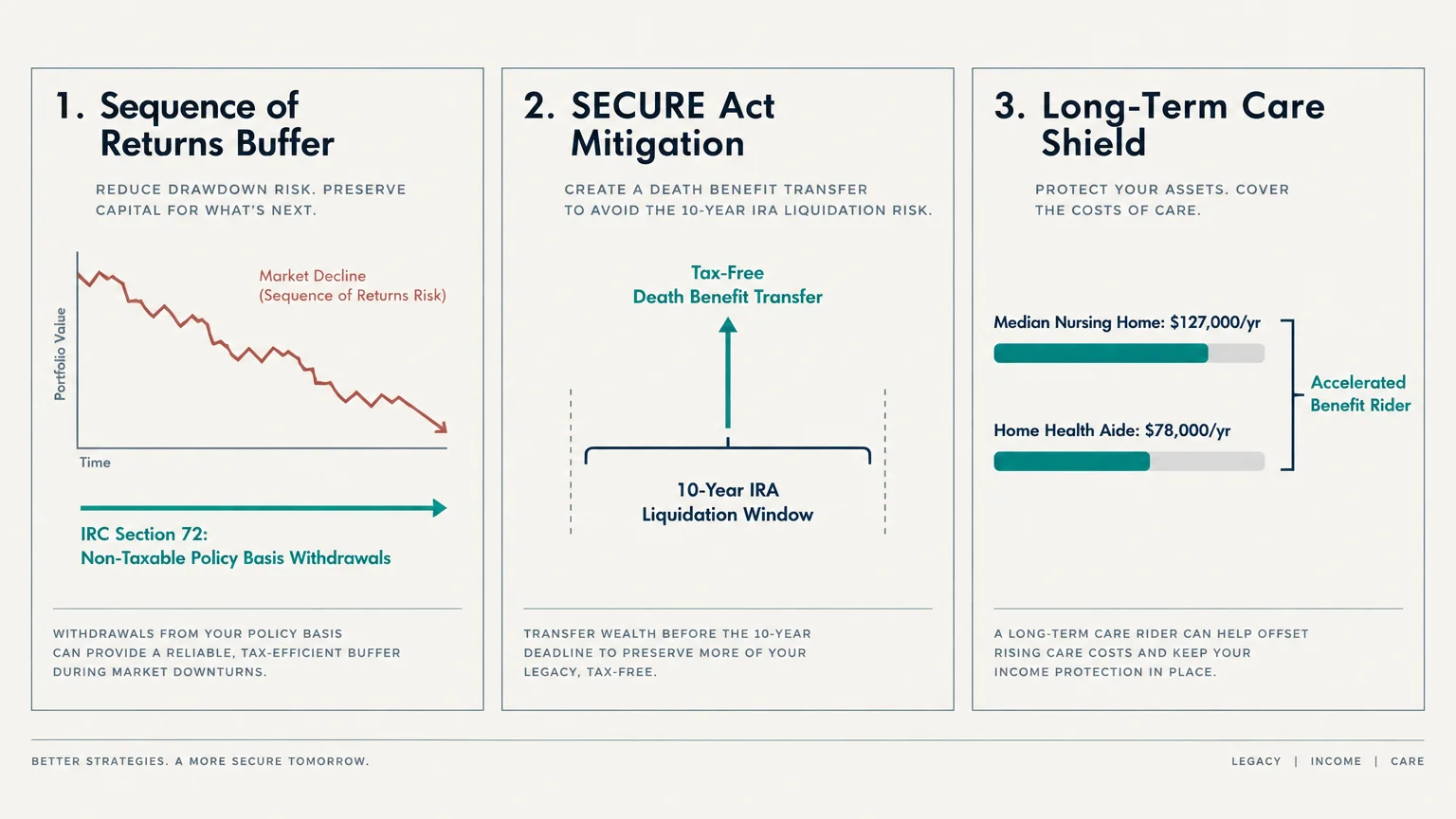
Market downturns early in retirement can permanently damage your portfolio through sequence-of-returns risk. You lock in paper losses when you sell equities during a market correction to fund basic living expenses.
Instead of liquidating depreciated stocks, retirees withdraw cash value or take policy loans. Internal Revenue Code Section 72 treats withdrawals as a non-taxable return of principal up to your cost basis.
Policy loans taken against remaining cash values are also non-taxable as long as your policy remains active. This approach provides reliable cash flow while your investments have time to recover.
2. Neutralizing the SECURE Act Elimination of the Stretch IRA
The SECURE Act eliminated the traditional stretch IRA for most non-spouse beneficiaries. Your adult children must now fully withdraw inherited traditional IRAs within a compressed 10-year window.
These forced distributions often push heirs into their peak earning and tax brackets. Many retirees now withdraw pre-tax IRA funds gradually to pay premiums on permanent life insurance policies.
When you pass away, your beneficiaries receive income-tax-free death benefits instead of heavily taxed retirement distributions. This strategy bypasses mandatory liquidation schedules and maximizes the actual net wealth you transfer.
3. Funding Long-Term Care Through Hybrid Asset-Based Policies
Standalone long-term care policies often hit retirees with unpredictable premium hikes. Many seniors abandon their coverage after years of payments because they cannot afford steep rate increases.
Modern hybrid life insurance policies solve this dilemma by combining a death benefit with accelerated health riders. If you require chronic care assistance, you draw down the death benefit tax-free.
According to healthcare data published by the AARP, median costs for private nursing home rooms now exceed $127,000 annually. Home health aide costs also average nearly $78,000 per year.
If you stay healthy and never need long-term care, your heirs receive the complete death benefit intact. This structure guarantees that your premium dollars never go to waste.
4. Preparing for the 2025 Estate Tax Exemption Sunset
The Tax Cuts and Jobs Act set the federal lifetime gift and estate tax exemption at historic highs. For 2025, that individual exemption reaches $13.99 million, or $27.98 million for married couples.
However, those elevated limits expire on December 31, 2025. Unless Congress intervenes, the individual exemption drops back to roughly $7 million on January 1, 2026.
Retirees use permanent coverage inside an Irrevocable Life Insurance Trust to manage projected estate liabilities. The policy provides liquidity to pay estate taxes directly without liquidating family real estate or businesses.
Retirees also leverage the 2025 annual gift tax exclusion of $19,000 per recipient to fund trust premiums. Spouses can combine gifts to transfer $38,000 tax-free each year to trust-owned policies.
5. Unlocking Hidden Equity Through Life Settlements
Many seniors continue paying expensive premiums on policies purchased decades ago for dependent children who are now financially independent. Continuing these payments can place unnecessary strain on a fixed retirement budget.
Rather than surrendering the policy for nominal value, you can sell it in a secondary life settlement transaction. Institutional investors purchase the contract, pay all future premiums, and collect the death benefit later.
Data from the Life Insurance Settlement Association indicates selling retirees receive an average payout of $212,066. That amount is nearly nine times higher than the average cash surrender value of $24,360.
You can use those unexpected funds to eliminate high-interest debt, boost liquid reserves, or fund specialized medical treatments.
6. Modernizing Stale Policies via Section 1035 Exchanges
Older universal life policies issued during past decades often suffer from low crediting rates and rising internal fees. Carriers frequently demand unplanned premium payments to keep these underperforming contracts alive.
Under IRS Section 1035, you can execute a direct tax-free transfer of cash value into a modern contract. This rollover lets you reallocate funds without recognizing accumulated capital gains.
Retirees commonly exchange outdated policies for contemporary hybrid contracts offering robust chronic illness riders. You secure vital living benefits and guaranteed coverage without spending additional personal savings.
7. Maximizing Social Security and Defined-Benefit Pensions
When selecting a defined-benefit pension option, many workers choose joint-and-survivor payouts to protect a spouse. Unfortunately, this choice often slashes monthly pension checks by 10 to 25 percent for life.
Retirees now deploy a strategy called pension maximization. You elect the higher single-life pension payout and use the extra monthly cash to fund a permanent life insurance policy.
If you pass away first, your surviving spouse receives an income-tax-free death benefit that replaces the lost pension. If your spouse predeceases you, you keep the larger pension check for life.
8. Establishing an Agile Emergency Reserve Without Cash Drag
Holding substantial cash in traditional bank accounts causes severe purchasing power erosion over decades of inflation. Yet every retiree needs immediate access to capital for sudden home repairs or medical emergencies.
Permanent life insurance cash value provides a stable alternative reserve. Most contracts provide steady dividend crediting or guaranteed floor rates that typically outpace standard checking accounts.
You can access your policy values within days without credit underwriting or formal bank approvals. Furthermore, you determine your own repayment timeline, protecting your everyday retirement cash flow.
9. Executing Strategic Philanthropy and Wealth Replacement
Retirees often want to make substantial donations to charities or religious institutions during their lifetimes. However, they worry that large charitable gifts will diminish the financial security of their children.
A wealth replacement trust eliminates this conflict entirely. You donate appreciated real estate or stock directly to charity, eliminating capital gains taxes and securing a large income tax deduction.
You then use the resulting tax savings to purchase permanent life insurance for your heirs. The charity receives vital financial support today, while your children receive an equivalent tax-free inheritance later.
10. Protecting Surviving Spouses from the Single Tax Bracket Trap
When one spouse passes away, the survivor transitions from married filing jointly to single filing status. This shift cuts income tax brackets roughly in half, leading to significantly higher tax rates.
At the same time, the household loses one Social Security benefit, shrinking overall household income. The survivor must manage higher effective tax rates on reduced gross revenue.
Life insurance proceeds provide an essential counterweight to this widow penalty. A tax-free death benefit supplies liquid funds that cover daily expenses without elevating the survivor’s taxable income or Medicare surcharges.

Essential Safeguards, Tax Traps, and Policy Hazards
While life insurance offers powerful living benefits, careless execution can cause severe financial distress. You must understand the strict mechanics governing cash value, policy loans, and federal tax classifications.
Policy loans accrue interest continuously against your death benefit and cash value. If total debt exceeds policy value, the contract will lapse, triggering massive income taxes on all previous gains.
You must also avoid converting your policy into a Modified Endowment Contract under IRC Section 7702A. Exceeding statutory funding limits strips away tax-free loan privileges, turning subsequent withdrawals into taxable distributions.
Secondary market life settlements also carry potential traps for unwary seniors. Transparent pricing and fair treatment require working exclusively with licensed settlement providers who clearly disclose all transaction commissions.
Carefully analyze how policy changes or settlement proceeds might affect your eligibility for government assistance programs. Large cash influxes can trigger sudden Medicare Part B premium hikes two years later.

Expert Insights on Holistic Longevity Planning
Certified Financial Planner professionals stress that life insurance works best as a coordinated balance sheet tool. Isolating insurance decisions from tax planning and investment management limits your overall financial security.
Gerontologists point out that financial stability directly correlates with psychological well-being and longevity. Eliminating anxiety over healthcare and spousal protection fosters better mental health as you age.
Specialists recommend scheduling an annual policy review with an independent fiduciary advisor. Requesting an updated in-force illustration ensures your contract remains solvent and properly funded throughout your entire retirement.
Frequently Asked Questions
Can I withdraw money from my life insurance without paying taxes?
Yes, withdrawals remain tax-free up to your total cost basis in the policy. The IRS considers initial withdrawals a return of your premium payments under first-in, first-out accounting rules.
Once you withdraw all paid premiums, you can borrow remaining cash value tax-free via policy loans. Your contract must remain active to preserve this favorable non-taxable status.
What happens if I borrow too much money from my policy?
Borrowing excessively against your cash value creates substantial lapse risks. If compound loan interest causes total debt to eclipse the policy value, the insurer will terminate your coverage.
When a leveraged policy lapses, the IRS treats the outstanding loan balance as ordinary taxable income. You could receive a staggering tax bill without having cash left to satisfy it.
How does a life settlement affect my taxes and healthcare benefits?
Life settlement proceeds are taxed across three tiers depending on your sale price. Funds up to basis are tax-free, gains up to cash surrender value face ordinary income taxes, and remaining amounts generate capital gains.
Large proceeds will increase your modified adjusted gross income for the tax year. This income bump could trigger higher Medicare premium surcharges under federal income-related monthly adjustment rules.
Is a hybrid life and long-term care policy right for every budget?
Hybrid policies provide exceptional value because they never expire without delivering a benefit. Unlike traditional care insurance, your family receives the death benefit if you never need medical assistance.
However, hybrid contracts require higher upfront premiums or substantial single-premium deposits. Retirees living on modest fixed budgets may find other healthcare savings strategies more financially practical.
Your 48-Hour Retirement Action Plan
Rethinking your life insurance does not require an immediate overhaul of your entire financial estate. You can make measurable progress toward optimizing your assets within the next two days.
Locate your existing insurance contracts today and review your most recent annual policy statements. Verify your current cash surrender values, death benefits, and designated primary and contingent beneficiaries.
Next, contact your insurer or fiduciary financial advisor to request an official in-force illustration. This document provides clear insight into whether your policy will remain solvent throughout your retirement.
Taking this single step ensures your insurance policies continue serving your living needs and protecting your family.