
Taxes can silently drain your hard-earned nest egg faster than market volatility. Shifting assets toward revenue sources that federal law shields from taxation protects your cash flow and preserves your financial independence throughout retirement.
Recent data from the Employee Benefit Research Institute shows that unexpected healthcare and tax burdens cause significant stress for most American seniors. You can eliminate that anxiety by mastering legitimate, non-taxable income streams.
Federal statutes provide explicit pathways that exempt withdrawals, home equity, and investments from taxable liability. Understanding these rules ensures that you keep more of what you worked decades to build.
The Evolving Landscape of Retirement Taxation
Today’s retirement policy environment demands proactive vigilance from every saver. Recent legislative overhauls have rewritten traditional distribution rules, altering how the government assesses your annual earnings.
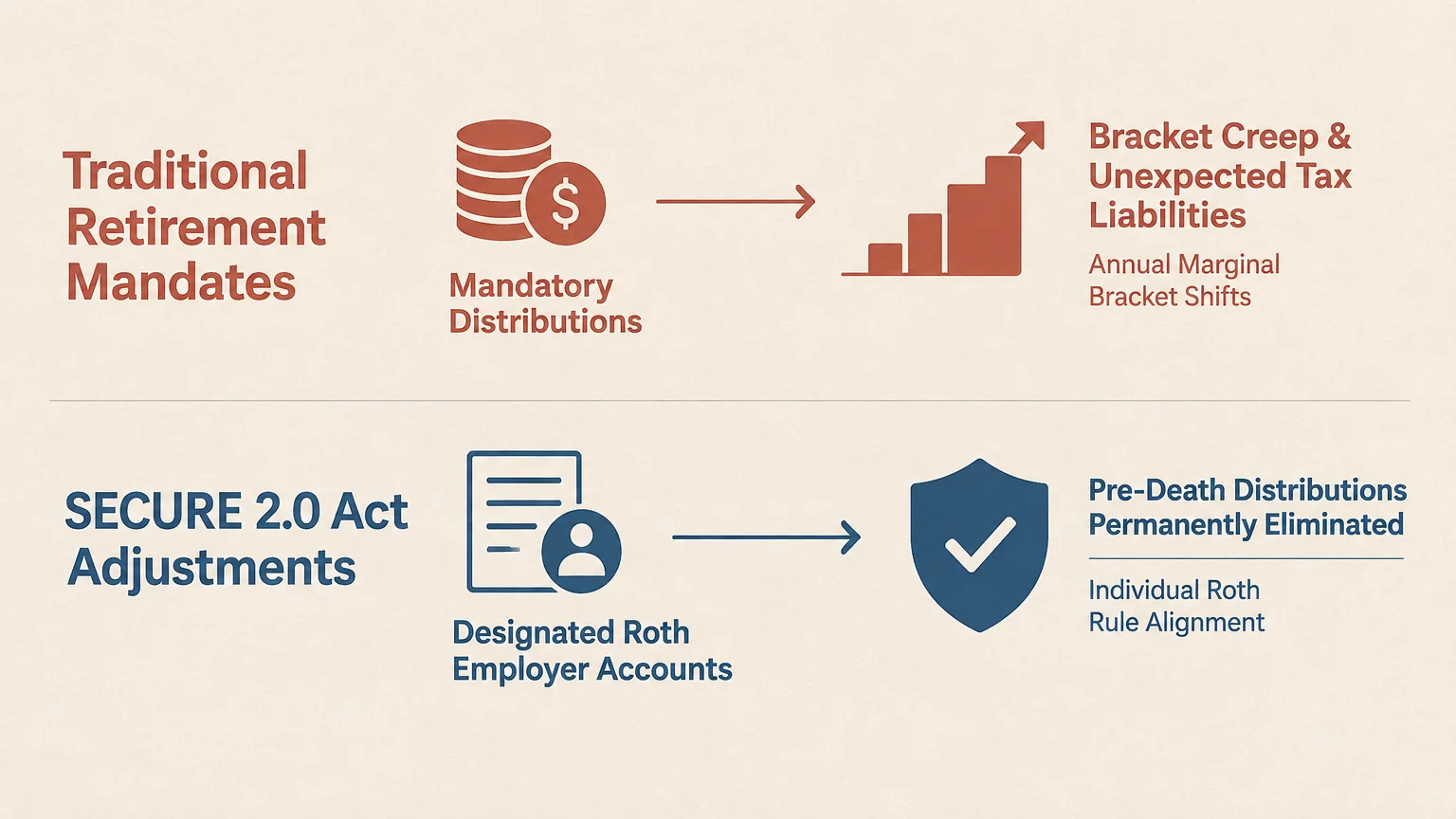
The SECURE 2.0 Act introduced significant adjustments to retirement mandates. It permanently eliminated pre-death distribution requirements for designated Roth employer accounts, aligning employer plans with individual retirement rules.
Meanwhile, persistent inflation forces the IRS to adjust contribution caps and marginal income tax brackets annually. Staying ahead of these adjustments allows you to shield your wealth from bracket creep.
Many retirees mistakenly believe that leaving the workforce automatically drops them into a benign tax bracket. In reality, mandatory traditional distributions and taxable benefits often trigger unexpected tax liabilities.
A proactive withdrawal blueprint prevents this outcome. Aligning your assets across diversified, non-taxable channels ensures predictable lifetime liquidity.

Strategic Pillars: Balancing Wealth, Health, and Purpose
Sustainable retirement security requires deliberate integration of income planning, living arrangements, and healthcare funding. Addressing these domains simultaneously ensures that your lifestyle choices support your balance sheet.
Dynamic income planning involves categorizing your assets by their tax character. When you draw systematically from tax-exempt accounts, you control your reported adjusted gross income with precision.
Your living environment directly affects your financial flexibility. Optimizing home equity through downsizing or structured borrowing provides liquidity without adding a single dollar to your taxable income.
Healthcare represents one of the largest ongoing expenses in your later years. Establishing dedicated medical reserves shields your core lifestyle portfolio from catastrophic health costs.
Maintaining clear financial control reduces daily emotional stress. It allows you to focus on community connections, lifelong hobbies, and purposeful daily routines without constant budgetary anxiety.
A balanced lifestyle and a tax-efficient balance sheet reinforce one another. You preserve your wealth while living with dignity, mobility, and confidence.
Eight Post-Retirement Income Streams the IRS Can’t Touch
1. Qualified Roth IRA and Roth 401(k) Distributions
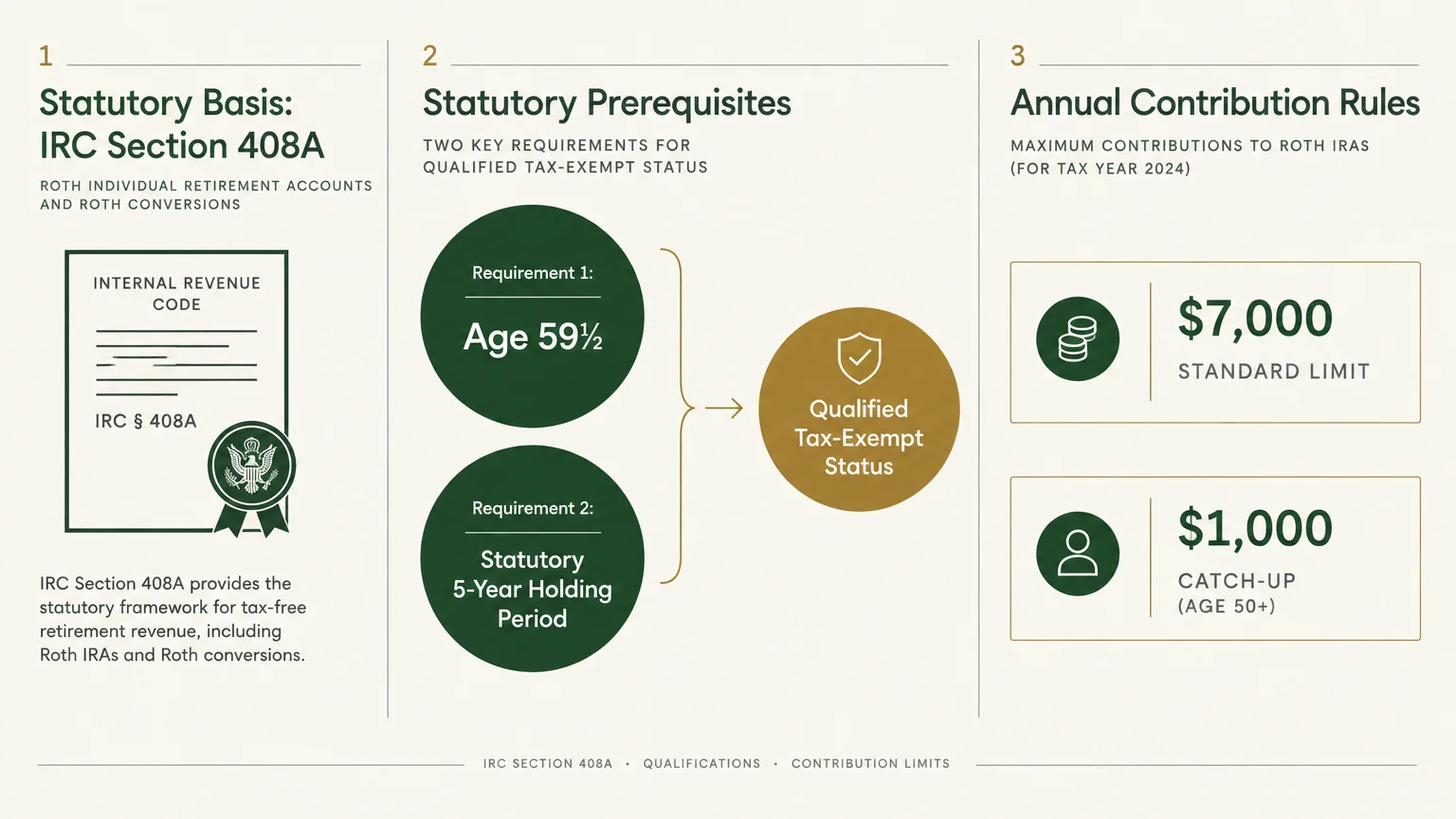
Qualified Roth distributions stand as the gold standard of tax-free retirement cash flow. Under Internal Revenue Code Section 408A, your withdrawals bypass federal income taxes entirely.
You must satisfy two straightforward criteria to ensure complete tax exemption. You must reach age 59½ and satisfy the statutory five-year holding period for your account.
You can review the official Internal Revenue Service guidance on qualified distributions to confirm your eligibility timeline.
For 2024 and 2025, standard contribution limits remain $7,000 per year. Savers aged 50 and older can contribute an additional $1,000 catch-up amount.
Furthermore, SECURE 2.0 permanently removed pre-death Required Minimum Distributions from designated Roth 401(k) and 403(b) accounts. Your assets can now compound tax-free throughout your lifetime.
Because these withdrawals never enter your tax return as taxable income, they protect your Social Security benefits from surcharges.
2. Health Savings Account (HSA) Medical Withdrawals
A Health Savings Account provides an unmatched triple-tax advantage under IRC Section 223. You contribute pre-tax funds, grow your balance tax-free, and withdraw assets without paying federal taxes for medical costs.
For 2025, the contribution cap reaches $4,300 for individual coverage and $8,550 for family plans. Individuals aged 55 and older may add an extra $1,000 catch-up contribution.
You can pay for doctor visits, prescription medications, dental procedures, and hearing aids without surrendering a penny to taxes.
Once you turn 65, the account grants you additional operational flexibility. You can withdraw funds for general living expenses without penalty, paying ordinary income tax just like a traditional IRA.
Preserving receipts for qualified expenses incurred over decades allows you to reimburse yourself tax-free at any future date.
3. Municipal Bond Interest
Investing in municipal bonds allows you to fund public infrastructure while collecting federally tax-exempt interest payments. IRC Section 103 explicitly excludes this interest from your gross income.
If you buy bonds issued by your home state or local municipality, you frequently escape state and local taxes as well. This double or triple exemption makes municipal paper attractive for conservative portfolios.
City, county, and state agencies issue these bonds to build schools, highways, and water systems. You generate dependable income while supporting civic development.
However, you must track municipal interest on Form 1040 because the IRS counts it toward your provisional income. This reporting requirement can indirectly expose your Social Security benefits to taxation.
Balancing municipal holdings with other non-reportable income streams keeps your total taxable profile under control.
4. Primary Residence Capital Gains (Section 121 Exclusion)
Your home often represents your most substantial store of accumulated wealth. When you sell your primary residence, federal tax law offers a massive tax break on your net profits.
Under IRC Section 121, single filers can exclude up to $250,000 of capital gains from federal taxation. Married couples filing jointly can exclude up to $500,000 in realized gains.
To qualify, you must have owned and occupied the property as your primary home for at least two of the five years preceding the sale.
You can check the official IRS tax topic on home sales to understand depreciation recapture and documentation standards before listing your property.
Downsizing into a smaller home lets you convert your trapped equity into liquid, tax-free reserves that support your ongoing living expenses.
You can repeat this exclusion every two years, giving you exceptional flexibility if you relocate during retirement.
5. Reverse Mortgage Proceeds (HECM)
Home Equity Conversion Mortgages, insured by the Federal Housing Administration, allow homeowners aged 62 and older to convert home equity into spendable cash.
The IRS classifies reverse mortgage payments as borrowed loan proceeds rather than taxable earned income. Because you are accessing your own equity through a debt vehicle, you owe zero income tax.
You can structure these disbursements as a lump sum, regular monthly tenure payments, or a flexible line of credit. The unused portion of a line of credit even grows over time.
You retain title to your property as long as you maintain the home, pay property taxes, and honor hazard insurance premiums.
This structure provides essential cash flow during bear markets, preventing you from selling depreciated equities at a loss.
6. Life Insurance Policy Cash Surrender and Loans
Permanent life insurance policies accumulate internal cash value over time. Under IRC Section 72(e), you can access this pool of capital using tax-free distribution strategies.
The tax code uses first-in, first-out accounting for permanent life insurance surrenders. You can withdraw your cumulative premium contributions completely free from federal tax.
Once you withdraw your cost basis, you can borrow against the remaining cash value through non-taxable policy loans. As long as your policy remains active, these borrowed funds trigger zero tax liability.
Furthermore, IRC Section 101(a) excludes life insurance death benefit proceeds from the gross taxable income of your named beneficiaries.
You must monitor policy loan interest carefully to ensure the contract never lapses, which could cause past gains to become taxable.
7. Family Gifts and Inherited Capital
Receiving financial support or wealth transfers from family members provides clean, tax-free liquidity. Federal tax statutes place the gift tax burden entirely on the donor, not the recipient.
For 2025, donors can give up to $19,000 per recipient without filing a gift tax return; married couples can combine exclusions to transfer $38,000. You receive these funds completely tax-free.
Inherited capital assets benefit from IRC Section 1014, which adjusts the asset’s tax basis to fair market value on the date of the decedent’s death.
This step-up in basis erases all prior unrealized capital gains. When you liquidate inherited non-retirement stocks or real estate immediately, you pay zero capital gains tax to the government.
These rules allow multi-generational families to pass accumulated prosperity directly to heirs without government friction.
8. Veterans Affairs (VA) Disability Benefits
Military veterans who sustained service-connected injuries or illnesses during active duty can receive monthly disability compensation from the federal government. Title 38 of the United States Code explicitly protects these payments from taxation.
According to the U.S. Department of Veterans Affairs, disability compensation, special housing grants, and disability pension payments are exempt from federal and state income taxes.
These monthly payments arrive fully sheltered, regardless of your personal tax bracket or other retirement earnings. They provide dependable, guaranteed cash flow that never inflates your taxable income.
These benefits adjust annually for inflation, safeguarding your purchasing power against rising living expenses throughout retirement.

Expert Perspectives on Tax-Free Longevity
Certified Financial Planner Dr. Marcus Vance emphasizes the power of strategic withdrawal sequencing. He notes that pairing taxable accounts with tax-free streams keeps retirees below destructive tax thresholds.
“When clients integrate tax-free income streams, they insulate their households against future tax rate hikes,” Vance explains. “This predictability protects emotional well-being as much as it protects wealth.”
Gerontologist Dr. Elena Ramirez points out that financial complexity directly accelerates cognitive fatigue in older adults. She advocates for simple, automated cash-flow streams that require minimal annual tax filing.
“Retirees experience better health outcomes when they do not worry about surprise tax audits or penalties,” Ramirez observes. “Straightforward financial structures create lasting cognitive peace of mind.”
Both experts agree that building tax-free diversification should begin years before you step away from full-time employment.

Critical Safeguards: Protecting Your Benefits and Avoiding Traps
While these income streams escape standard income taxes, you must remain mindful of subtle financial traps. One primary risk involves Medicare Part B and Part D premium surcharges.
The federal government calculates your monthly premiums using Modified Adjusted Gross Income from two years prior. Crossing an income tier by a single dollar triggers substantial monthly surcharges.
You can review the Medicare income-related monthly adjustment details to monitor your threshold proximity.
Another major pitfall involves the taxation of Social Security benefits. The IRS determines benefit taxation through a statutory formula known as combined income.
You should consult the Social Security Administration benefit calculations to evaluate how tax-exempt interest impacts your total liability.
When combined income crosses $32,000 for couples or $25,000 for singles, up to 85 percent of your benefits become taxable.
You must also guard against predatory financial schemes targeting seniors. Unscrupulous brokers frequently pitch high-fee annuities or abusive reverse mortgage products under the guise of tax avoidance.
Always verify credentials through independent databases like FINRA BrokerCheck before transferring money or signing binding loan contracts.
Frequently Asked Questions
Does tax-free income affect my Medicare Part B premiums?
It depends on the specific income source you utilize. Roth withdrawals and loan proceeds do not appear on your tax return and will not increase your premiums.
In contrast, municipal bond interest appears on Form 1040 and factors directly into the calculation for Medicare premium surcharges.
Can I roll over a traditional 401(k) into a tax-free Roth IRA without penalties?
Yes, you can execute a Roth conversion at any age without incurring early withdrawal penalties. However, you must pay ordinary income tax on the converted amount during the conversion year.
Executing partial conversions across several low-income retirement years allows you to build tax-free reserves while managing your tax bracket efficiently.
How do municipal bonds impact my Social Security taxation?
Even though municipal bond interest is exempt from federal income tax, federal law requires you to add it back when calculating your combined income.
This inclusion can push your total income past statutory limits, forcing you to pay taxes on up to 85 percent of your Social Security benefits.
What happens if I withdraw money from an HSA after age 65 for non-medical expenses?
Once you turn 65, the IRS waives the standard 20 percent early withdrawal penalty on non-medical distributions.
You will pay regular income tax on the withdrawal amount, functionally treating your HSA like a traditional individual retirement account.
Your 48-Hour Action Plan
Building an insulated retirement does not require an immediate, total overhaul of your balance sheet. You can make measurable progress by executing one focused task over the next 48 hours.
Locate your most recent tax return and identify which income streams generated your current taxable liability. Check your reported adjusted gross income against upcoming Medicare surcharge brackets.
Next, contact your financial institution to review your current Roth conversion options or open a dedicated Health Savings Account if you maintain high-deductible healthcare coverage.
Taking proactive ownership of your tax profile today preserves your hard-earned wealth for the decades ahead.