
Healthcare expenses can quietly disrupt your retirement security if state subsidy rules change without your knowledge. Recent legislative overhauls and court battles are reshaping public retiree healthcare options across the nation.
Many state governments face rising obligations, driving adjustments to health reimbursement accounts, Medicare options, and premium shares. Monitoring these evolving policies helps you protect your monthly income and secure essential medical services.
Whether you already left the workforce or plan to retire soon, these updates influence your healthcare budget. Examining state-specific statutory frameworks allows you to adapt your financial strategy before unexpected medical bills arrive.

The Shifting Landscape of Public Retiree Health Benefits
Rising medical inflation and lingering unfunded liabilities continue to challenge state budgets across the country. The Bureau of Labor Statistics reports that medical care costs consistently outpace general inflation across consumer categories.
These financial pressures force state legislatures and pension boards to reconsider long-standing retiree healthcare subsidies. Many jurisdictions are transitioning away from state-funded indemnity plans toward private exchange models or Medicare Advantage networks.
Other states face significant resistance from organized retiree groups fighting to protect their original benefit promises. These legal and legislative conflicts directly affect your monthly out-of-pocket medical expenses.
10 States Transforming Retiree Healthcare Rules
State legislatures and pension boards recently enacted meaningful policy revisions for public service retirees. Here is how ten states are reshaping healthcare subsidies, coverage networks, and contribution formulas today.
1. Delaware: Protecting Supplemental Coverage and Restructuring Tiers
Delaware lawmakers enacted landmark legislation following intense public advocacy by state pensioners. The state repealed a planned mandate that would have forced retirees to leave traditional Medicare for private Medicare Advantage.
This statutory package preserves the popular Special Medicfill supplement for eligible pensioners hired before January 1, 2025. It guarantees access to traditional Medicare without requiring prior authorizations for routine medical care.
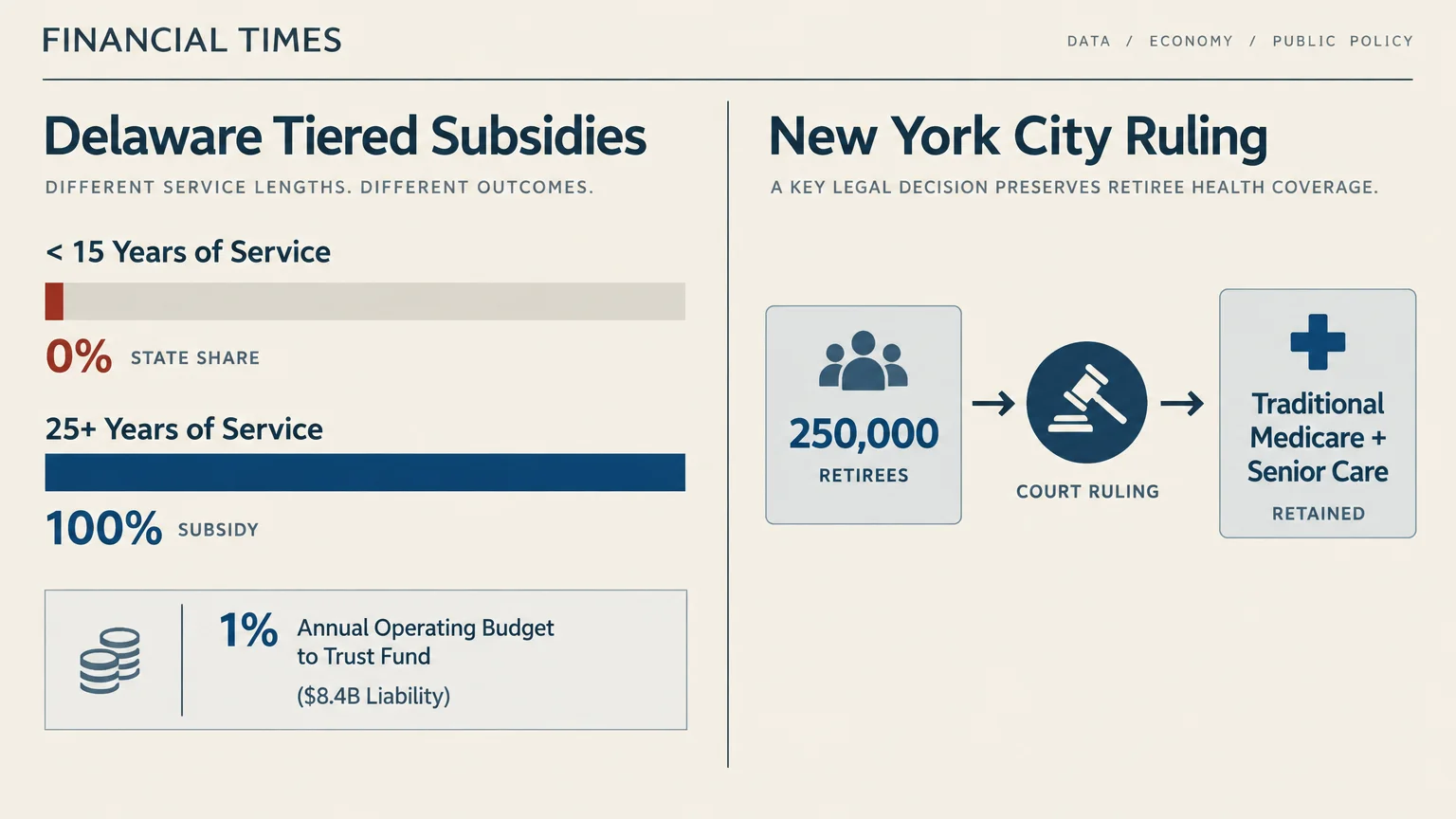
Lawmakers also established revised service-length tiers for state premium contributions. Retirees with under 15 years receive no state share, while those with 25 or more years earn a 100% subsidy.
The state deposits 1% of its operating budget annually into its trust fund to address an $8.4 billion unfunded liability. This dedicated funding stream secures long-term benefits for qualifying public workers.
2. New York: Court Battles Preserve Traditional Medicare in New York City
New York municipal retirees secured critical legal protections through high-profile judicial rulings. The New York Court of Appeals affirmed that local statutory codes mandate full city payment for retiree medical plan options.
This landmark ruling established that the municipal administration cannot compel retirees into an unwanted private Medicare Advantage plan. Retirees preserved their access to traditional Medicare paired with Senior Care supplemental coverage.
Following further appellate decisions, the city abandoned its multi-year effort to shift roughly 250,000 retirees into managed commercial coverage. You maintain your choice of healthcare providers without restrictive managed care network limits.
3. Maryland: Discontinuing State Prescription Plans for Medicare Part D HRAs
Maryland discontinued its state-administered prescription drug program for Medicare-eligible state retirees. State leaders transitioned retirees to individual commercial Medicare Part D plans during open enrollment periods.
To soften this transition, the state established Health Reimbursement Accounts through an external benefits administrator. These dedicated accounts reimburse your qualified out-of-pocket medication expenses to approximate prior plan protections.
You must actively submit eligible receipts to receive reimbursement from your allocated account balance. Staying organized ensures you do not forfeit valuable funds earmarked for your prescription expenses.
4. Texas: Major Premium Reductions for TRS-Care Retirees
The Teacher Retirement System of Texas delivered welcome financial relief to public school retirees. The system implemented roughly 45% premium reductions across its Medicare Advantage health options.
Individual retirees now pay $75 per month instead of $135, saving $720 annually. Retirees covering a spouse save nearly $3,000 each year under these lower rates.
Texas also introduced optional dental and vision plans through MetLife to address supplemental wellness needs. These expanded coverage options help you maintain overall wellness on a predictable monthly budget.
5. North Carolina: Phasing Out Healthcare Subsidies for Newer Public Workers
North Carolina established a definitive boundary for future state employee healthcare benefits. Workers hired on or after January 1, 2021, will receive no state healthcare subsidy upon their retirement.
Employees hired before that cutoff date maintain grandfathered status under older vesting tiers. Pre-2021 employees need 20 years of state service to secure fully subsidized retiree health premiums.
If you joined public service after the statutory cutoff, you must fund your post-career medical coverage independently. Building a dedicated healthcare reserve through personal savings protects your retirement stability.
6. Ohio: Expanding Monthly Allowances for OPERS Retirees
The Ohio Public Employees Retirement System approved substantial enhancements to its Health Reimbursement Arrangement. Leaders raised the monthly HRA base allowance for Medicare-enrolled retirees from $350 to $400.
The retirement board also locked this elevated $400 monthly allowance in place through 2030. This statutory commitment provides reliable budgeting certainty for aging retirees navigating variable medical bills.
Pre-Medicare retirees also received protections against planned benefit cuts. OPERS canceled a proposed allowance reduction, preserving a generous $1,200 monthly stipend for early retirees.
7. New Jersey: Managing Escalating Health Premium Spikes
New Jersey public retirees face severe budget pressure from double-digit premium increases. The State Health Benefits Commission approved significant rate hikes driven by reserve deficits and expensive specialty medications.
Local government early retirees absorbed a 17.9% overall increase alongside a 33.1% surge in prescription drug charges. State actuaries projected further double-digit increases across Medicare supplemental lines.
Surging demand for GLP-1 weight-loss medications contributed heavily to these substantial premium adjustments. Retirees must budget carefully to absorb these higher monthly benefit deductions from pension distributions.
8. Vermont: Switching Carriers to Defend Against Steep Cost Hikes
The Vermont State Teachers’ Retirement System severed ties with its longtime health insurance administrator. The carrier attempted to impose a near-50% rate hike despite agreed contractual increase caps.
State officials transferred approximately 7,000 retired teachers to HealthSpring to protect members from extreme price shocks. This decisive administrative shift limited premium growth to 16.2% while retaining identical coverage tiers.
Reviewing network directory adjustments helps you keep seeing your preferred local doctors without interruption. Confirming that your primary physicians accept the replacement carrier prevents unexpected out-of-network claims.
9. Connecticut: Scrutinizing Mandatory Managed Care Contracts
Connecticut mandates that Medicare-eligible state retirees enroll in a single group Medicare Advantage plan. The state requires this specific coverage model for members seeking state-sponsored premium subsidies.
Retiree coalitions voiced significant concerns regarding aggressive prior-authorization requirements and narrow provider networks under this corporate plan. Lawmakers directed state oversight agencies to evaluate member claim denials thoroughly.
With collective bargaining agreements expiring in 2027, retiree advocates are lobbying to restore subsidized traditional Medicare options. You should document any claim disputes carefully to support administrative appeals.
10. Washington: Aligning State Subsidies and Deductible Resets
Washington state maintains a valuable monthly Medicare retiree premium subsidy capped at $183. The Public Employees Benefits Board updated plan cost structures to mirror broader federal healthcare reforms.
Under federal guidelines administered by Medicare, retiree prescription drug out-of-pocket costs now cap at $2,400 annually. This statutory ceiling prevents catastrophic financial exposure for seniors requiring expensive treatments.
Pre-Medicare retirees must prepare for higher Consumer-Directed Health Plan deductibles of $1,750 for individuals and $3,500 for families. Surcharges for tobacco use and spousal coverage also require careful annual benefit verification.

Strategic Pillars to Protect Your Retirement Healthcare
Pillar 1: Proactive Income and HRA Optimization
Health Reimbursement Arrangements require active management if your state replaces direct insurance coverage with reimbursement accounts. You must track medical receipts and submit claims promptly to collect every eligible dollar.
Consider coordinating Health Savings Account withdrawals with state stipends. Consulting IRS guidelines on qualified medical deductions ensures you minimize your annual tax liabilities while preserving retirement cash flow.
Pillar 2: Strategic Lifestyle Design and Geographic Moves
Retirees often relocate across state lines seeking warmer weather or lower income taxes. However, moving can alter your retiree healthcare subsidy eligibility or shrink your local medical provider network.
Check whether your state health subsidy transfers to out-of-state providers before purchasing a new home. Researching regional hospital access and specialist availability protects your health as your physical needs evolve.
Pillar 3: Active Health and Wellness Navigation
Preventive health routines lower your long-term medical expenditures while enhancing your everyday quality of life. Scheduling annual wellness visits ensures your care team identifies emerging chronic conditions early.
Review your prescription drug lists each autumn to determine if cheaper therapeutic alternatives exist. Switching to generic medications lowers out-of-pocket costs and preserves your available subsidy allowances.

Expert Perspectives and Critical Safeguards
Certified Financial Planner™ professionals urge retirees to avoid viewing healthcare subsidies as permanent guarantees. State legislatures retain broad authority to revise contribution formulas and plan networks during fiscal downturns.
Gerontologists emphasize that provider continuity directly influences treatment outcomes for older adults facing chronic conditions. Retaining access to your trusted medical specialists often matters more than saving a modest premium difference.
Watch out for misleading marketing pitches and deceptive advertisements during annual open enrollment cycles. The AARP routinely warns seniors against telephone solicitations promising unrealistic free benefits.
Beware of sudden benefit cliffs where small pension cost-of-living adjustments disqualify you from income-based healthcare assistance. Reviewing total household income thresholds with a professional advisor protects your net subsidy value.
Frequently Asked Questions About State Retiree Health Benefits
How do state retiree healthcare subsidies interact with standard Medicare?
State subsidies typically act as secondary support once you reach age 65 and enroll in Medicare. The state may pay your Medicare Part B premium, subsidize a supplemental Medigap plan, or fund a Medicare Advantage policy.
Some states deposit fixed monthly allowances directly into a Health Reimbursement Arrangement instead of paying insurers directly. You then use those allocated funds to purchase private Medicare coverage through an exchange.
Can a state legally revoke retiree healthcare benefits after you retire?
State legal protections vary significantly based on state constitutions, statutory contract language, and judicial precedents. Some state courts protect public retiree healthcare benefits under contractual vesting principles.
Other state courts view healthcare subsidies as non-vested gratuities that lawmakers can alter or eliminate at will. Recent lawsuits in Delaware and New York demonstrate how retiree advocacy groups can successfully defend earned coverage.
What happens to your healthcare subsidy if you move to another state?
Many state health plans permit you to maintain your subsidy when you establish residency outside your home state. However, your insurance provider network may change dramatically, requiring nationwide commercial options.
If your state relies on regional HMO plans, you may face higher out-of-pocket expenses when seeking care elsewhere. Contact your state pension administrator to verify out-of-state coverage terms before finalizing your moving plans.
How do Health Reimbursement Arrangements differ from direct premium subsidies?
A direct premium subsidy involves the state paying your insurance carrier directly to lower your monthly premium bill. This arrangement minimizes administrative hassle because you only pay the remaining balance.
An HRA provides you with an allocated spending account that reimburses approved medical and insurance expenditures. You must pay initial costs yourself and file documentation to receive your entitled cash reimbursement.
Your 48-Hour Healthcare Action Plan
Protecting your retirement finances begins with taking immediate, deliberate action to evaluate your medical coverage. Small organizational steps today shield your household from unexpected administrative surprises tomorrow.
Log in to your state pension portal within the next 48 hours to confirm your current subsidy tier. Review your plan documents to identify any upcoming rate adjustments or carrier transitions scheduled for next year.
Gather your recent medical receipts and check the Social Security Administration portal to review how your income tier affects your premiums. Taking proactive control of your healthcare benefits empowers you to enjoy retirement with lasting peace of mind.