
You can significantly expand your monthly income by strategically coordinating survivor benefits with your personal retirement record. Making the right election shields your financial future during an already demanding life transition.
Nearly six million Americans receive monthly survivor support through the Social Security Administration. Yet thousands of surviving spouses leave substantial money behind simply because federal claiming rules remain confusing and complex.
Understanding your filing age, dual entitlement, and switching strategies ensures you maximize household stability. Exploring your options now gives you immediate clarity and long-term financial peace of mind.

A Shifting Policy Landscape for Surviving Spouses
Recent cost-of-living adjustments highlight how rapidly economic conditions shift for single retirees. Surviving spouses often confront a sudden drop in household revenue while property taxes and utilities remain unchanged.
Federal data from the Social Security Administration shows that women represent the vast majority of survivor benefit recipients. Many of these beneficiaries navigate fixed monthly budgets on a single check for the first time.
Congress continues to debate updates to spousal protections as inflation strains older households. Understanding the current rules allows you to insulate your budget against future legislative adjustments.
Taking time to examine how benefits interact with your taxes protects your baseline standard of living. Proactive planning transforms an overwhelming bureaucratic process into an empowering roadmap for your future.
Core Rules of Social Security Survivor Benefits
Survivor benefits function under a completely separate set of statutory guidelines than regular spousal or retirement benefits. This distinct legal framework gives you unique strategic options that standard retirees do not enjoy.
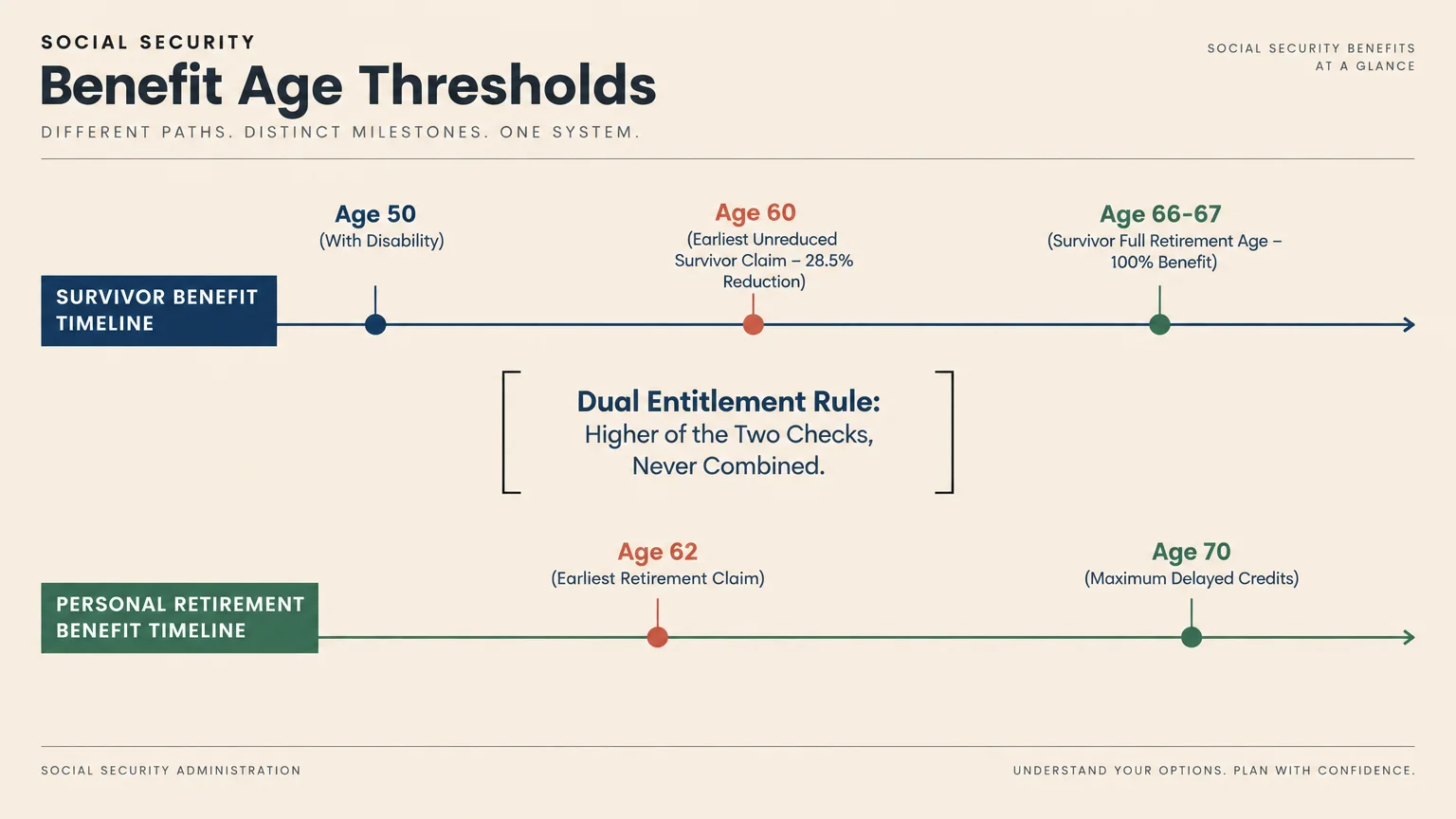
The survivor benefit age begins at age 60 for unreduced cognitive health, or age 50 if you live with a disability. In contrast, you cannot touch your personal retirement benefit until age 62.
When your spouse passes away, you do not simply receive both monthly checks combined. Instead, the agency pays you the higher of the two benefits under strict dual entitlement provisions.
This sudden consolidation can cut total spousal income by one-third to one-half overnight. Mastering claiming tactics helps you recover that lost purchasing power through deliberate timing.
The 7 Strategic Options for Widows and Widowers
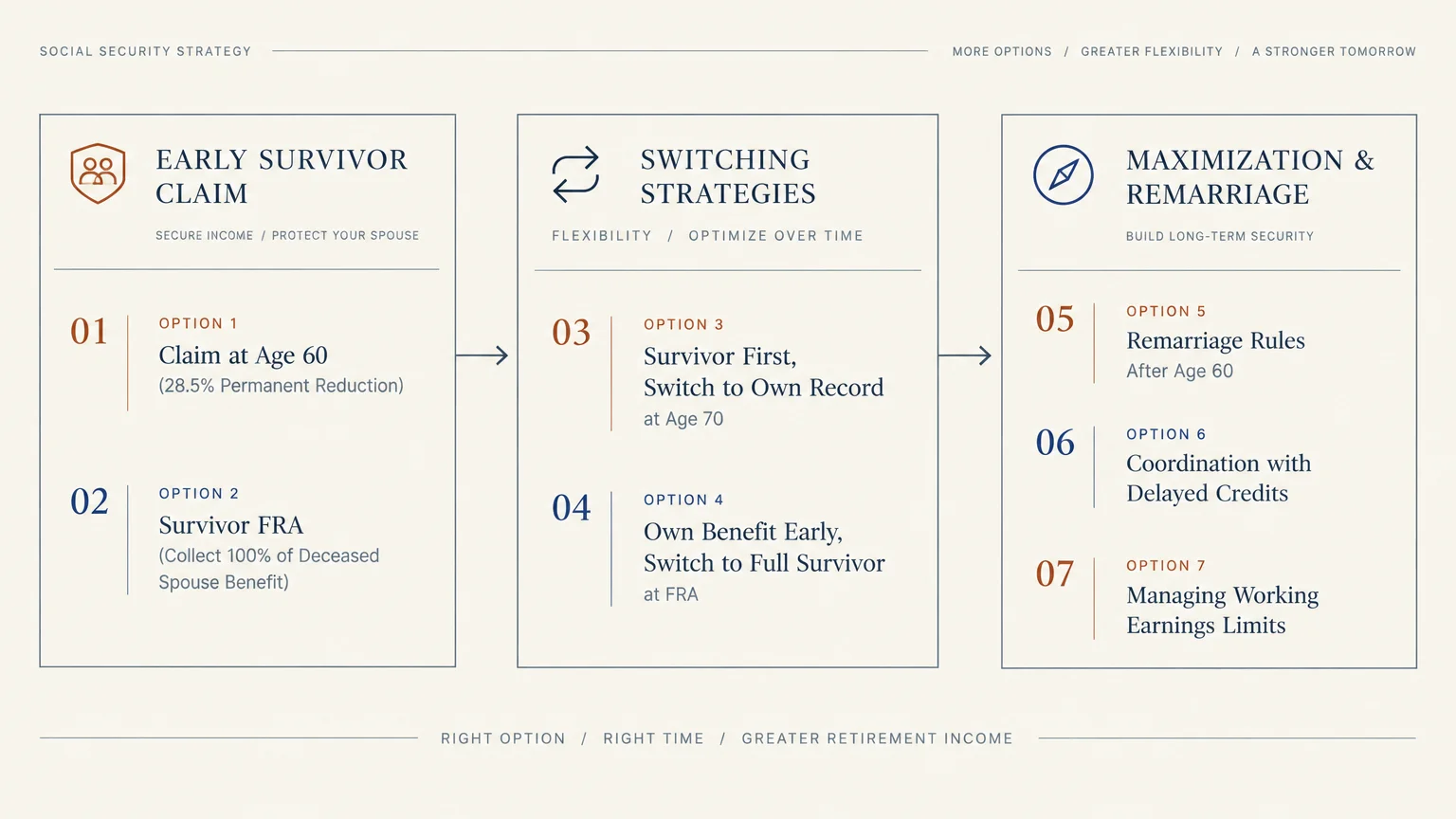
Every surviving spouse carries distinct financial needs, health priorities, and personal goals. These seven tactical pathways help you choose the best route for your household.
Option 1: Claim Reduced Widow Social Security Benefits Early at Age 60
You can start receiving widow Social Security benefits as early as age 60. However, filing at this earliest threshold permanently locks in a 28.5 percent reduction compared to your full entitlement.
This early income provides an essential lifeline if you face sudden unemployment or immediate mortgage obligations. It supplies reliable cash when liquid savings cannot cover your monthly living expenses.
Keep in mind that early claiming also triggers annual earnings limits if you continue working. Evaluating your immediate cash needs against long-term reductions will clarify if age 60 serves your plan.
Option 2: Wait for Full Retirement Age to Collect 100 Percent
Your survivor full retirement age ranges between 66 and 67, depending entirely on the year you were born. Waiting until this milestone ensures you collect 100 percent of your deceased spouse’s primary benefit.
If your spouse delayed claiming until age 70, their monthly benefit grew through delayed retirement credits. As a surviving spouse at full retirement age, you inherit that expanded monthly amount in full.
Delaying until full retirement age also eliminates all annual earnings limitations on your employment income. You can earn an unlimited salary without sacrificing any portion of your survivor check.
Option 3: Collect Survivor Benefits First, Then Switch to Your Own at Age 70
One of the most potent strategies involves switching Social Security benefits between your survivor and personal records. Surviving spouses possess the rare legal ability to restrict their application to one specific benefit pool.
You can collect a survivor benefit at age 60 while letting your personal retirement benefit accumulate delayed credits. Your own benefit continues to grow by roughly eight percent every year until age 70.
At age 70, you switch to your maximized personal benefit; this transition permanently increases your lifetime monthly check. This maneuver works exceptionally well when your personal lifetime earnings surpass your late spouse’s record.
Option 4: Claim Your Own Retirement Benefit First, Then Switch to Survivor Benefits
Conversely, you can reverse this claiming order if your late spouse earned significantly higher wages than you did. In this scenario, you claim your own retirement benefit at age 62 to generate immediate cash.
While you collect your own smaller benefit, your survivor benefit continues to grow until your survivor full retirement age. You then switch to the full survivor benefit once it reaches maximum value.
Survivor benefits do not earn delayed retirement credits past your full retirement age. Therefore, you should execute this switch as soon as you reach your designated full retirement age.
Option 5: Protect Benefits by Timing Remarriage After Age 60
If you decide to remarry, the calendar date of your nuptials carries massive financial ramifications. Remarrying before age 60 forfeits your right to collect widower benefits or widow benefits on an ex-spouse’s record.
However, federal statutes state that remarrying at age 60 or older preserves your complete survivor eligibility. You can marry your new partner without losing a single dollar of your previous survivor entitlement.
Later in life, you can even choose between your current spouse’s spousal benefit and your late spouse’s survivor benefit. This flexibility provides unmatched stability as your marital life and financial landscape evolve.
Option 6: Balance Work and Benefits Under the Earnings Test
Many surviving spouses must continue working to support their households after a partner passes away. If you claim survivor benefits before reaching full retirement age, the Retirement Earnings Test restricts your wages.
The government temporarily withholds one dollar in benefits for every two dollars you earn above the annual earnings ceiling. In the calendar year you reach full retirement age, the withholding formula eases significantly.
The agency does not keep these withheld funds permanently; it recalculates your monthly check at full retirement age. Even so, unexpected benefit withholding can severely disrupt your short-term household budget if you work full-time.
Option 7: Navigate Offsets for Public Pensions
If you worked in public service without paying into Social Security, statutory offsets may reduce your benefits. The Government Pension Offset can drastically reduce or completely eliminate survivor benefits for retired educators and municipal workers.
Under current law, the offset reduces your monthly survivor payment by two-thirds of your non-covered government pension amount. For many public servants, this reduction reduces spousal survivor checks down to zero.
Reviewing your state pension rules alongside federal benefit guidelines prevents unpleasant surprises. Consulting with a benefits specialist helps you uncover alternative assets to offset any lost survivor payments.

Three Strategy Pillars for Long-Term Independence
Recovering your footing after the loss of a life partner requires more than filing federal paperwork. You must align your financial architecture, home environment, and personal health to build lasting resilience.
Pillar 1: Income Planning and Tax Bracket Management
Losing a spouse often pushes you into the dreaded widow tax penalty during the subsequent tax year. You move from the married filing jointly tax bracket into the single filer bracket, where higher rates hit lower income thresholds.
The Internal Revenue Service taxes up to 85 percent of your Social Security benefits if your combined provisional income crosses modest thresholds. You can mitigate this sudden jump by strategically converting traditional IRA funds into Roth accounts.
Staggering your distributions across multiple tax years prevents unexpected spikes in your adjusted gross income. Careful tax planning preserves more of your survivor check for essential daily living costs.
Pillar 2: Lifestyle Design and Housing Adjustments
Your home represents both your largest physical asset and a potential drain on your reduced monthly cash flow. Evaluating property taxes, maintenance expenses, and utility bills helps determine whether remaining in your current residence makes sense.
Downsizing into a smaller, single-story home can free up trapped home equity while eliminating difficult maintenance burdens. Alternatively, sharing housing or moving closer to family can dramatically cut expenses while fostering vital social connections.
Accessibility matters deeply as you advance through retirement on your own. Investing in universal design features now—such as zero-step entries and grab bars—ensures safety on any budget.
Pillar 3: Health, Wellness, and Medicare Coordination
Grief inflicts severe physical and emotional wear on surviving partners, often triggering acute health episodes. Prioritizing routine preventative screenings keeps minor conditions from transforming into costly medical crises.
Review your coverage options through Medicare to ensure your prescription drugs and preferred providers remain fully covered. Income adjustments can also trigger Income-Related Monthly Adjustment Amounts, driving up your Medicare Part B and Part D premiums.
Seeking grief counseling through local community centers or non-profit support groups provides structured emotional stabilization. Nurturing your physical health ensures you have the vitality needed to enjoy the financial security you establish.

Expert Voices on Spousal Benefit Optimization
Financial professionals emphasize that emotional strain frequently clouds critical claiming decisions after a partner dies. Taking a deliberate breath before signing government documents prevents irreversible claiming errors.
Certified Financial Planner Sarah Jenkins advises clients to pause before immediately applying for every available benefit at the local agency office. She notes that agency representatives often default to processing the highest immediate check, ignoring your age-70 growth potential.
Gerontologists also stress the connection between financial clarity and physical well-being among surviving spouses. When you eliminate monetary anxiety through a structured claiming plan, your cardiovascular health and cognitive resilience improve measurably.
Critical Safeguards: Protecting Against Scams and Pitfalls
Surviving spouses face heightened vulnerability to financial exploitation during the early stages of bereavement. Sophisticated criminal networks routinely scan public obituary listings to target newly single seniors with deceptive schemes.
Scammers frequently impersonate government officials, threatening benefit suspension unless you wire money or purchase gift cards. Remember that federal agencies never contact you by phone or text to demand immediate financial transfers.
Advocacy organizations like AARP provide robust fraud-watch resources to help you identify deceptive solicitations. Freezing your credit files across major bureaus adds an impenetrable defensive barrier against unauthorized loans.
You must also watch out for steep benefit cliffs within means-tested state and local assistance programs. A small bump in survivor income could potentially disqualify you from vital supplemental property tax exemptions.
Consulting trusted family members or fee-only advisors before signing financial paperwork keeps predatory actors at bay. Establishing clear boundaries around your financial accounts protects your lifetime independence.
Frequently Asked Questions About Survivor Benefits
Can I collect survivor benefits if I divorced the deceased worker?
Yes, you qualify for survivor benefits if your marriage lasted at least ten continuous years prior to final divorce. You must also remain unmarried, or wait until after age 60 to remarry your current partner.
Your claiming decision does not affect the benefit amount that the worker’s current surviving spouse receives. The government treats your eligible divorced claim as an independent entitlement.
Do my survivor benefits stop if I remarry after reaching age 60?
No, remarrying after age 60 has zero adverse impact on your eligibility to collect survivor benefits. You continue receiving the full monthly survivor check from your late spouse’s earnings history.
If your new partner also passes away later, you can elect whichever survivor benefit provides the greater monthly sum. This guarantees you maintain the strongest possible monthly financial foundation.
Can I apply for Social Security survivor benefits online?
You cannot complete an initial application for survivor benefits through the standard federal online portal. The agency requires an in-person meeting at your local field office or a structured telephone interview.
You can, however, access your personal statement online to inspect your deceased spouse’s earnings history prior to calling. Gathering required documents, including death certificates and marriage licenses, expedites your formal claim.
How does my deceased spouse’s early claiming affect my survivor check?
If your spouse claimed their benefit early, your survivor benefit is capped under the statutory widow’s limit rule. Your maximum survivor payout cannot exceed what your deceased spouse would have received if alive.
Conversely, this cap never drops below 82.5 percent of their primary insurance amount once you reach full retirement age. Understanding this threshold prevents unexpected surprises when calculating your long-term monthly income.
Taking Action in the Next 48 Hours
Grief often feels paralyzing, but taking one concrete financial step will restore a meaningful sense of personal control. You do not need to solve every retirement dilemma by tomorrow morning.
Commit within the next 48 hours to locate your marriage certificate and your spouse’s earnings records. Place these documents in a secure folder so you can access them without friction when speaking with advisors.
Next, schedule a free informational consultation with your local Social Security field office to discuss your options. Armed with reliable knowledge, you can move forward with genuine confidence and protect the future you built together.