
A sudden, life-altering medical diagnosis can jeopardize your financial stability and peace of mind long before you reach traditional retirement age. To protect families facing devastating health crises, the Social Security Administration maintains the Compassionate Allowances program, an accelerated approval framework that fast-tracks disability claims for severe conditions. On August 11, 2025, SSA Commissioner Frank J. Bisignano announced an expansion bringing the total list to 300 qualifying medical conditions. By reducing waiting times from years to a matter of days or weeks, this crucial safety net ensures you receive monthly financial support and healthcare resources when you need them most.
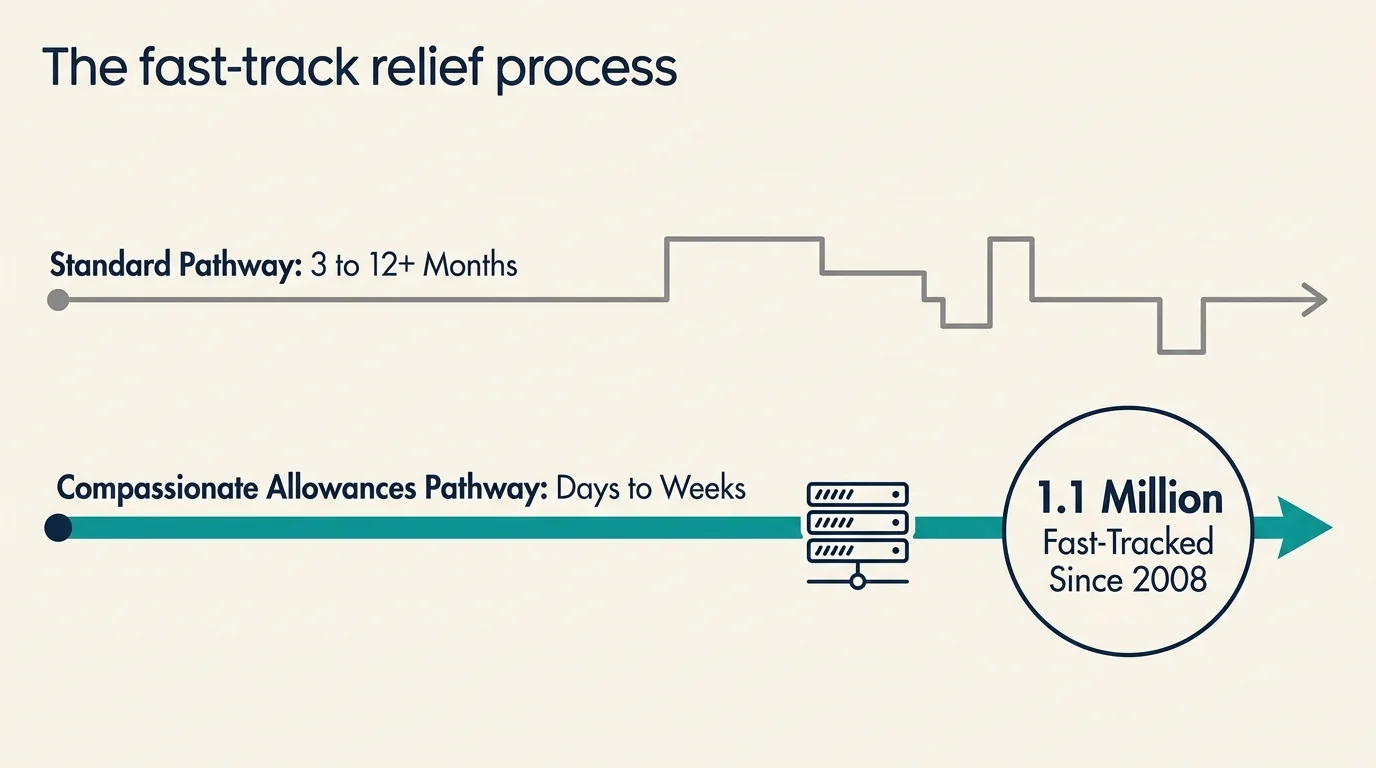
How the Compassionate Allowances Program Fast-Tracks Relief
Navigating a severe medical diagnosis creates immediate emotional and financial stress; waiting months for disability approval only compounds that burden. The Social Security Administration established the Compassionate Allowances initiative to streamline determination for individuals facing severe, life-threatening illnesses. Since launching in 2008, this program has helped over 1.1 million applicants secure expedited approvals for Social Security Disability Insurance and Supplemental Security Income benefits.
Standard disability applications often stretch from several months to over a year due to extensive administrative reviews. In contrast, claims identified under the Compassionate Allowances framework bypass traditional waiting queues. The agency utilizes Health IT technology to retrieve and analyze electronic medical evidence immediately upon application submission. When diagnostic records match clinical criteria, claims advance rapidly, reducing processing times down to days or weeks.
For pre-retirees and mature adults, this fast-track framework provides a vital economic bridge. Rapid approval stabilizes household income, preserves retirement savings, and accelerates access to long-term government assistance programs. Understanding how the agency evaluates eligible conditions empowers you to submit a complete application from day one.

8 Conditions Recently Added to the Compassionate Allowances List
The Social Security Administration periodically expands its qualifying roster based on medical advancements, scientific research, and expert advocacy. On August 11, 2025, SSA Commissioner Frank J. Bisignano announced 13 new additions, building on the 9 conditions added during the previous expansion on August 12, 2024. Today, the list features 300 total qualifying conditions. Examining eight newly designated conditions illustrates the broad scope of this critical safety net.
1. Thymic Carcinoma. Thymic carcinoma is an aggressive, rare cancer originating in the epithelial tissue of the thymus gland. Unlike slower-growing thymomas, thymic carcinomas invade adjacent chest structures quickly and carry high rates of distant metastasis. Because treatment demands intensive multimodal interventions—such as extensive surgery, chemotherapy, and radiation—patients face immediate work disability. Clear histological biopsy reports trigger immediate compassionate allowance processing.
2. Pulmonary Amyloidosis – AL Type. Pulmonary Amyloidosis AL Type involves abnormal, misfolded light-chain amyloid proteins accumulating in lung tissues. As these protein deposits build up, they compromise pulmonary structures, causing severe restrictive lung disease, shortness of breath, and organ failure. Establishing diagnosis through tissue biopsy with Congo red staining provides objective proof required for fast-track benefit determination.
3. Progressive Muscular Atrophy. Progressive Muscular Atrophy is a rare neurodegenerative disorder affecting lower motor neurons. Unlike classical Amyotrophic Lateral Sclerosis, this condition causes progressive muscle weakness, muscle wasting, and loss of reflexes specifically across lower motor pathways. Neurological evaluation demonstrating widespread electromyographic denervation fulfills expedited approval criteria.
4. WHO Grade III Meningiomas. While many meningiomas remain benign, World Health Organization Grade III meningiomas are malignant, fast-growing central nervous system tumors. These aggressive tumors infiltrate surrounding brain tissue and show high recurrence rates despite surgery and radiation therapy. Resulting neurological impairments and cognitive deficits render individuals unable to engage in substantial work. Histological confirmation matching Grade III criteria prompts fast-track approval.
5. Hematopoietic Stem Cell Transplantation. Hematopoietic Stem Cell Transplantation is a major medical procedure used to treat advanced blood cancers, severe bone marrow failure, and non-cancerous blood disorders. High-dose conditioning treatments followed by stem cell infusion cause severe immunosuppression, persistent fatigue, and elevated complication risks. The agency recognizes that undergoing this intensive transplantation qualifies individuals for expedited disability benefits throughout treatment and recovery.
6. Rasmussen Encephalitis. Rasmussen Encephalitis is a rare, severe inflammatory neurological disease marked by chronic inflammation of one brain hemisphere, intractable seizures, and progressive loss of motor and cognitive skills. Clinical evidence featuring serial brain Magnetic Resonance Imaging, electroencephalograms, and neurological assessments showing unilateral cerebral atrophy establishes rapid qualification.
7. LMNA-related Congenital Muscular Dystrophy. LMNA-related Congenital Muscular Dystrophy is a rare genetic neuromuscular disorder caused by mutations in the LMNA gene. Characterized by early-onset severe muscle weakness, loss of head control, and spinal rigidity, the condition quickly progresses to life-threatening respiratory failure and cardiac defects. Genetic testing confirming LMNA gene mutations coupled with clinical findings meets compassionate allowance standards.
8. Adult Heart Transplant Wait List – Status Levels 1–4. Added during recent program expansions, this designation covers adult patients placed on the national heart transplant waitlist under United Network for Organ Sharing Status Levels 1 through 4. These status tiers apply to individuals facing severe, end-stage heart failure who depend on mechanical circulatory support or continuous intravenous medications. Official transplant registry listing verifies qualifying impairment status without delay.

Strategic Blueprint: Managing Income, Health, and Care
Securing an expedited disability determination is only one part of safeguarding your future. Managing a severe diagnosis demands a structured strategy across financial, medical, and personal domains.
Income Planning and Benefit Mechanics
Social Security Disability Insurance benefits provide predictable monthly income calculated from your past work record. To qualify, you generally need 40 work credits, with 20 earned within the last ten years prior to your disability onset date. Crucially, when you reach Full Retirement Age, your disability benefits automatically convert into Social Security retirement benefits without any reduction in monthly income. Navigating the mandatory five-month disability waiting period requires coordinating emergency liquid savings or employer-sponsored short-term disability coverage. You can learn more about official eligibility guidelines through the Social Security Administration official site.
Healthcare Access and Medicare Transitions
Disability entitlement unlocks vital healthcare resources, but understanding timing rules prevents coverage gaps. Social Security Disability Insurance recipients automatically qualify for Medicare after a 24-month waiting period from their entitlement date. During this interim, maintaining continuous health coverage through COBRA, spousal coverage, or Affordable Care Act marketplace plans protects your financial security. Once eligible, compare Medicare options at Medicare.gov to ensure adequate prescription and specialist coverage.
Care Design and Legal Preparedness
Adapting your home environment and updating legal paperwork preserves your autonomy. Complete a Durable Power of Attorney and a Healthcare Proxy early to authorize trusted family members to handle decisions if your health declines. Educational toolkits from non-profit organizations like AARP offer valuable guidance for family caregivers organizing daily support.

Expert Perspectives on Navigating Disability
Combining professional financial advice with medical advocacy mitigates risks during health crises. Experienced planners emphasize preserving long-term wealth while establishing reliable short-term cash flow.
Certified Financial Planner professionals caution against making premature, large withdrawals from tax-deferred retirement accounts. According to guidelines set by the Internal Revenue Service, up to 50% or 85% of your disability income may become subject to federal tax if your combined income exceeds specific limits ($25,000 for individual filers, $32,000 for married couples). Structuring withdrawals carefully prevents unexpected tax burdens.
Medical advocates emphasize gathering detailed clinical evidence immediately. Claim adjudicators evaluate specific diagnostic parameters rather than condition titles alone. Requesting complete biopsy reports, imaging scans, and clear physician clinical summaries ensures your submission contains necessary diagnostic proof.

Crucial Safeguards: Scams and Financial Hazards
Facing a severe medical illness leaves individuals vulnerable to high-cost scams and reporting mistakes. Protecting your assets requires awareness of official government rules.
Beware of private companies promising “guaranteed” fast-track Social Security approval for high upfront fees. The Social Security Administration screens every application for Compassionate Allowance flags automatically at zero cost. No private service can bypass government review protocols. While hiring an accredited disability representative can assist with complex claims, legal fees are capped by federal law and paid exclusively from past-due benefits upon approval.
Additionally, avoid failing to report small return-to-work earnings during your benefit period. Unreported income can cause benefit suspensions or unexpected overpayment debts that destabilize your household finances.
Frequently Asked Questions
How quickly does the Social Security Administration process a Compassionate Allowance claim?
While standard disability claims often take six months to over a year, Compassionate Allowance claims are fast-tracked. When an application contains complete, high-quality medical evidence matching clinical criteria, approval can occur in a matter of days or weeks.
Do you need to submit a separate application to request Compassionate Allowance status?
No separate application or specialized form is required. You complete the standard Social Security Disability Insurance or Supplemental Security Income application. The agency’s software automatically flags qualifying conditions upon submission.
What happens to your disability benefits when you reach Full Retirement Age?
When you reach Full Retirement Age, your disability benefits automatically convert into Social Security retirement benefits. Your monthly payout amount remains unchanged, ensuring seamless financial continuity without benefit interruptions.
Can a family member apply on behalf of a severely ill individual?
Yes, designated family members, legal guardians, or individuals holding durable power of attorney can complete and submit the disability application on behalf of a severely ill applicant. Submitting full medical records alongside authorization documentation prevents administrative delays.
Take Action for Your Security Today
Managing a major health condition requires proactive planning to protect your financial foundation. Within the next 48 hours, log into your personal Social Security account online to verify your work credits and benefit estimates. Reach out to your medical providers to obtain copies of recent pathology reports, diagnostic scans, and clinical notes to ensure your medical file is complete. Taking these practical steps today gives you and your family confidence, clarity, and essential financial security for the future.