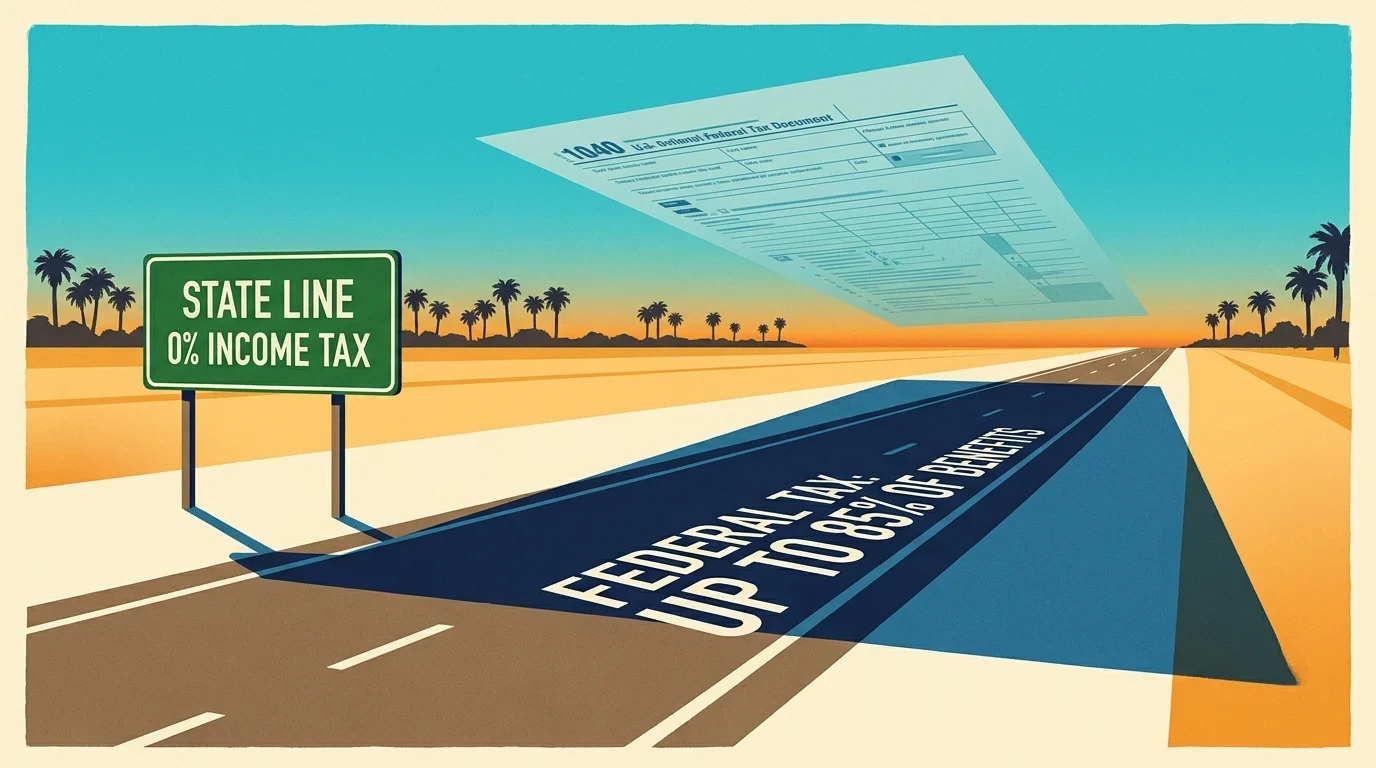
Moving to a state with zero income tax can shrink your state tax bill overnight. Yet your Social Security benefits remain firmly within reach of the federal government.
Every retiree across all 50 states faces federal rules that tax up to 85% of Social Security benefits once total income crosses decades-old thresholds. Even major 2025 federal tax legislation left those underlying formulas completely untouched.
Understanding how state tax laws, provisional income formulas, and withdrawal timing interact lets you protect your monthly cash flow. A smart plan coordinates every income stream before tax season arrives.
The Myth of Tax-Free Retirement and the Federal Reality
Relocating for lower taxes ranks among the top financial moves retirees consider when leaving high-cost regions. State income tax savings can look dramatic on paper when you compare tax brackets across state lines.
Unfortunately, many newcomers assume state-level exemptions shield their Social Security checks completely. That misunderstanding often triggers an unpleasant surprise when they file their first federal return from a sunny new address.
Which States Actually Skip Social Security Taxes
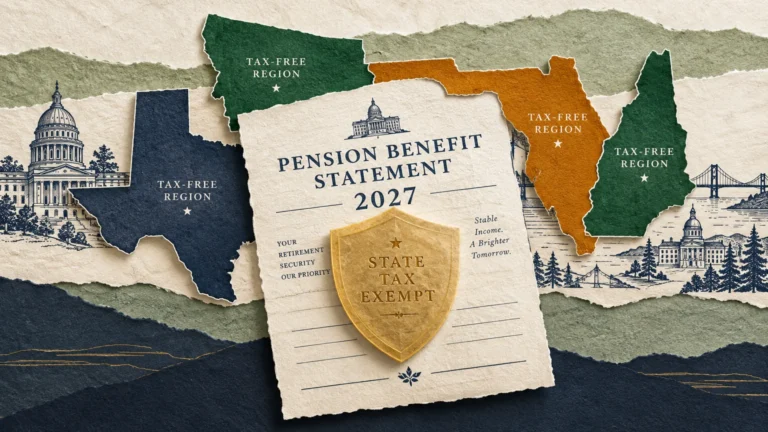
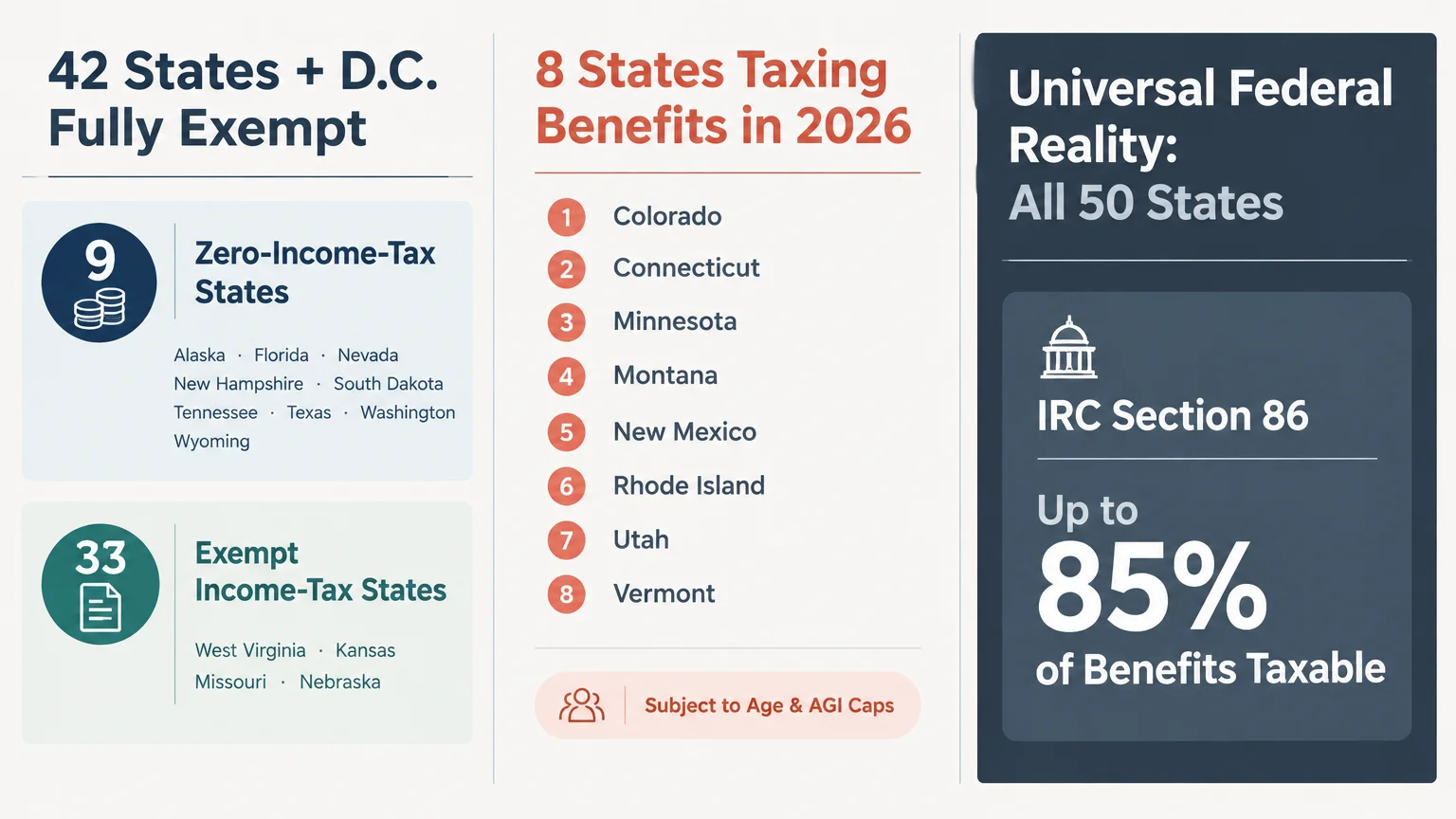
Across the country, 9 states impose no broad-based individual income tax on wages or Social Security benefits. That list includes Alaska, Florida, Nevada, New Hampshire, South Dakota, Tennessee, Texas, Washington, and Wyoming.
Even within that group, tax rules vary in subtle ways that catch retirees off guard. New Hampshire repealed its 3% Interest and Dividends Tax effective January 1, 2025, per the New Hampshire Department of Revenue Administration and the Tax Foundation, eliminating its remaining personal income tax.
Washington collects no tax on wages or Social Security, yet the Tax Foundation notes it still levies a tax on capital gains income. You must verify how your specific investment income is treated before assuming a move erases every state bill.
Meanwhile, state taxation of Social Security has shrunk dramatically nationwide. In 2026, 42 states plus Washington, D.C., do not tax Social Security benefits at all.
That figure includes the 9 no-income-tax states alongside 33 states with income taxes that fully exempt benefits. West Virginia completed its benefit tax phase-out in tax year 2026, following Kansas, Missouri, and Nebraska, which ended benefit taxation in 2024.
Only 8 states still tax Social Security benefits in some form in 2026: Colorado, Connecticut, Minnesota, Montana, New Mexico, Rhode Island, Utah, and Vermont. Most of those states shield low- and middle-income seniors through age exemptions or adjusted gross income caps.
For instance, Colorado lets residents age 65 and older subtract all federally taxable benefits. Connecticut fully exempts benefits for single filers with adjusted gross income under $75,000 and joint filers under $100,000, capping the taxable portion at 25% above those limits.
Because so many states already exempt Social Security, moving purely to avoid state benefit taxes often delivers zero extra savings on your monthly check. Your real tax battleground sits at the federal level.
What the 2025 Tax Law Changed—and What It Kept
Widespread confusion followed the passage of the One Big Beautiful Bill Act on July 4, 2025. Many retirees read early headlines and assumed Congress had eliminated federal taxes on Social Security entirely.
In July 2025, the Social Security Administration even had to issue a public correction after an initial email claimed the law eliminated benefit taxes for most recipients. In reality, analyses from the Center for Retirement Research at Boston College, the Tax Policy Center, and the IRS confirm the underlying law stayed intact.
Federal taxation under Internal Revenue Code Section 86 still applies in all 50 states. Congress added a temporary extra senior deduction for 2025 through 2028, which softens tax bills for many households, yet it left the provisional income formula completely unchanged.
The stakes for federal budgets explain why total repeal remains elusive. In August 2026, the Congressional Budget Office estimated that federal income taxes on Social Security benefits total $120 billion in 2026, equal to 7.1% of all benefits paid that year.
Revenue from the first 50% taxable tier flows directly into Social Security’s Old-Age and Survivors Insurance and Disability Insurance trust funds. Revenue from the 50% to 85% tier supports Medicare’s Hospital Insurance trust fund.
With the Congressional Budget Office projecting in March 2026 that combined Social Security trust funds face exhaustion in 2033—and the retirement trust fund alone in fiscal year 2032—lawmakers face intense pressure to preserve existing revenue streams.
How Provisional Income Unlocks Federal Taxes on Your Benefits
Federal tax liability on Social Security does not depend on your zip code or your marginal tax bracket alone. Instead, the IRS relies on a specialized calculation that captures income sources you might otherwise consider tax-free.
Reviewing the official IRS guidance on Social Security income and Publication 915 shows how easily ordinary retirement cash flow triggers federal benefit taxes. Every dollar you draw from traditional accounts interacts with your monthly benefit.
Breaking Down the Provisional Income Formula
The IRS refers to base amount comparisons in Publication 915, while the Social Security Administration calls the metric combined income. Financial planners commonly refer to this calculation as provisional income.
You calculate provisional income by adding three distinct numbers together. First, take your adjusted gross income excluding Social Security, which covers pensions, wages, dividends, capital gains, and traditional retirement account withdrawals.
Second, add any tax-exempt interest you earned during the year, such as interest from municipal bonds. Including municipal bond interest surprises many affluent retirees who bought tax-free bonds assuming those payouts stayed invisible on their federal return.
Third, add 50% of your annual Social Security benefits, which appears in Box 5 of Form SSA-1099. Note that Supplemental Security Income is never taxable and stays completely outside this calculation.
Fortunately, certain tax-advantaged accounts bypass the provisional income trap altogether. Qualified withdrawals from a Roth IRA, a Roth 401(k), or a Health Savings Account do not enter federal taxable income and do not count toward provisional income.
Frozen Thresholds and What the 50% and 85% Caps Mean
Once you calculate your provisional income, you compare that total against rigid federal thresholds set by Congress in 1983 and 1993. Because lawmakers never indexed these dollar figures to inflation, rising wages and annual cost-of-living adjustments push more seniors across the line every year.
For single filers, heads of household, qualifying surviving spouses, or married couples filing separately who lived apart all year, the first tier sits between $25,000 and $34,000. Within that band, up to 50% of your Social Security benefits become subject to federal tax.
Once provisional income for those filers exceeds $34,000, up to 85% of annual benefits can become taxable. Married couples filing jointly face a $32,000 to $44,000 band for the 50% tier, with up to 85% taxable above $44,000.
Married couples filing separately who lived together at any point during the year face a harsh penalty. Their base amount drops to $0, meaning up to 85% of their benefits can be taxed starting from the very first dollar.
A crucial distinction separates the taxable portion of your benefits from your actual tax rate. Neither 50% nor 85% is a tax rate; rather, those figures cap the share of your Social Security check added to taxable income.
Once that taxable portion enters your adjusted gross income, it gets taxed at ordinary federal marginal rates ranging from 10% to 37% in 2026 and 2027. Prior Social Security microsimulation projections estimated an annual average of roughly 56% of beneficiary families would owe federal tax on benefits between 2015 and 2050 under these unindexed rules.
Annual inflation adjustments accelerate that bracket creep. Benefits rose 2.8% in January 2026, and the Social Security Administration announced on October 14, 2026, that benefits will increase another 3.6% starting January 2027—adding about $75 per month on average for nearly 72 million beneficiaries.
Real-World Math: How Two Retirees Trigger Benefit Taxes
Seeing the formula in action reveals how modest middle-class retirement income crosses the 85% ceiling quickly. Consider a hypothetical single retiree, age 66, living in a zero-income-tax state like Texas or Florida.
Suppose she receives the 2026 average retired-worker benefit of $2,071 per month, or $24,852 per year, and withdraws $30,000 from her traditional 401(k). Half of her Social Security equals $12,426, making her provisional income $42,426.
Because $42,426 exceeds the $34,000 single threshold, up to 85% of her Social Security enters her taxable income calculation before deductions apply. In 2026, her $16,100 standard deduction, $2,050 age-65-plus deduction, and temporary $6,000 senior deduction total $24,150, trimming her final bill substantially.
Now consider a married couple, both age 65 or older, receiving $3,208 per month in combined benefits—the 2026 average for aged couples—totaling $38,496 annually. Suppose they also draw $40,000 from a traditional IRA and collect $2,000 in municipal bond interest.
Adding $40,000, $2,000, and half of their Social Security ($19,248) produces $61,248 in provisional income, well above the $44,000 joint ceiling. Up to 85% of their benefits become potentially taxable, though their 2026 combined deductions of $47,500 absorb much of that hit.
These simplified illustrations show how fast provisional income stacks up when you mix pre-tax withdrawals with Social Security. Always consult a licensed tax professional or Certified Financial Planner to run personalized projections using your exact Form SSA-1099 and investment statements.
Aligning Your Income Streams to Protect Every Dollar
You cannot change frozen federal thresholds, yet you hold substantial control over how and when income hits your tax return. Smart retirement planning aligns Social Security claiming decisions, pensions, annuities, and portfolio draws to smooth out taxable spikes.
Before locking in permanent payout elections, review the Social Security Administration benefit tax planner to see how timing affects your future taxable base. Coordinating income sources early pays compounding tax dividends for decades.
Timing Social Security Alongside Pensions and Annuities
Delaying Social Security past full retirement age boosts your monthly check permanently, pushing lifetime payouts closer to—or beyond—the 2026 full-retirement-age maximum of $4,152 per month. Delaying also creates a valuable multi-year window in your sixties with zero Social Security income on your return.
During those gap years, you can draw down traditional IRAs or execute strategic Roth conversions at lower marginal rates without triggering Social Security taxation at all. Shrinking pre-tax balances early also lowers mandatory withdrawals later in life.
If you receive a corporate or government pension, remember that pension income counts dollar-for-dollar toward adjusted gross income and provisional income. Combining a full pension with early Social Security often pushes retirees directly into the 85% taxable tier immediately.
Annuities require similar scrutiny depending on how you funded them. Distributions from qualified annuities inside an IRA are generally fully taxable as ordinary income, feeding straight into provisional income.
Non-qualified annuities bought with after-tax dollars return a portion of each payout as tax-free principal alongside taxable earnings. Only the earnings portion enters adjusted gross income, though heavy upfront withdrawals can still bump you over federal thresholds.
Coordinating Portfolio Withdrawals Across Account Types
Many retirees follow a rigid habit of spending taxable brokerage cash first, traditional IRAs second, and Roth accounts last. While simple, that sequence often creates an unintended tax bomb in your seventies when mandatory IRA withdrawals collide with Social Security.
Blending withdrawals across account buckets each year keeps your provisional income predictable. You might draw from a traditional IRA up to the top of a favorable tax bracket, then cover remaining living expenses with Roth IRA cash or high-basis brokerage sales.
Watch capital gains carefully inside taxable brokerage accounts. Even when long-term capital gains qualify for preferential federal tax rates, those realized gains still inflate your adjusted gross income.
Higher adjusted gross income raises provisional income, which can pull more of your Social Security benefits into ordinary income brackets at the exact same time. Harvesting tax losses or gifting appreciated shares to charity can offset those spikes cleanly.

Tax and Healthcare Strategies for 2026 and Beyond
Managing retirement taxes means looking beyond Form 1040 marginal brackets alone. Two hidden surcharges—the phase-out of senior deductions and income-based Medicare premiums—can turn an extra dollar of IRA income into a surprisingly expensive mistake.
Planning withdrawals with both IRS schedules and healthcare surcharges in mind helps preserve your net purchasing power. Take full advantage of temporary rules currently on the books before they expire.
Using the Temporary Senior Deduction Wisely
For tax years 2025 through 2028, IRS Tax Tip 2026-14 outlines a temporary $6,000 enhanced deduction for taxpayers age 65 or older by year-end. Married couples filing jointly can claim $12,000 total if both spouses are 65 or older, though married filers filing separately cannot claim it.
You claim this bonus on IRS Schedule 1-A whether you itemize or take the standard deduction, and it stacks directly on top of existing deductions. In 2026, the base standard deduction equals $16,100 for single filers and $32,200 for joint filers, plus the existing age-65-plus deduction of $2,050 per single filer or $1,650 per qualifying married spouse.
Under IRS Revenue Procedure 2026-35 released November 5, 2026, the 2027 base standard deduction rises to $16,600 for single filers, $33,200 for joint filers, and $24,925 for heads of household. The existing age-65-plus deduction climbs to $2,100 for single filers and $1,700 per qualifying spouse.
According to July 2025 estimates from the White House Council of Economic Advisers, this senior deduction leaves 88% of seniors receiving Social Security paying no federal tax on their benefits. However, the Tax Policy Center noted roughly two-thirds of beneficiaries were already exempt before the law because of lower incomes.
Crucially, the enhanced $6,000 deduction phases out by 6% of modified adjusted gross income above $75,000 for single filers or $150,000 for joint filers. It vanishes completely at $175,000 for single filers and $250,000 for couples.
Because this deduction expires after 2028 unless extended, the next few tax years offer an ideal window to fill lower brackets with strategic Roth conversions. Keep your modified adjusted gross income below the $75,000 or $150,000 phase-out lines whenever possible so you do not forfeit the bonus deduction.
Managing RMDs, Medicare IRMAA, and HSA Withdrawals
Once required minimum distributions begin in your seventies, you lose the flexibility to skip pre-tax IRA withdrawals. Large mandatory distributions automatically inflate adjusted gross income, pushing Social Security into the 85% taxable tier and threatening your senior deduction.
Worse, elevated income triggers Medicare’s Income-Related Monthly Adjustment Amount, known as IRMAA. Medicare evaluates your modified adjusted gross income from tax returns filed two years earlier to add monthly surcharges onto Part B and Part D premiums.
You can review current premium structures through the official Medicare cost and surcharge overview before making large portfolio moves. Because IRMAA uses strict income cliffs rather than gradual phase-ins, exceeding a threshold by a single dollar triggers a full year of higher premiums.
A Health Savings Account remains one of your strongest tools against both IRMAA and Social Security taxes. Funds withdrawn from an HSA for qualified medical expenses come out completely tax-free and never count toward provisional income or Medicare surcharge calculations.
If you built HSA savings during your working years, let those investments grow tax-free and tap them in retirement for dental work, hearing aids, prescriptions, or Medicare premiums. Saving receipts for out-of-pocket medical care also lets you reimburse yourself tax-free later when you need cash without touching your IRA.
Retiring in Florida: What the Numbers Show After 2026
Florida remains the nation’s premier destination for retirees seeking tax relief, yet relocating there requires looking past the zero-percent income tax headline. Recent voter-approved property tax changes in November 2026 have reshaped the math for both longtime residents and new arrivals.
Evaluating the complete state and local tax mix ensures your move strengthens your budget rather than shifting costs from income taxes to housing and local fees. Run the numbers on your target county before signing a purchase contract.
Sales, Property, and Everyday Living Costs
Florida charges 0% individual income tax, meaning zero state tax on Social Security, pensions, 401(k) or IRA withdrawals, capital gains, and dividends. Per analyses from the Tax Foundation, AARP, and SmartAsset, Florida also imposes no state estate or inheritance tax.
Instead, the state relies heavily on consumption and real estate taxes to fund public services. Florida raises 39.0% of its state and local tax revenue from general sales taxes and 34.8% from property taxes, according to the Tax Foundation.
Florida levies a 6.00% statewide sales tax, with an average combined state and local rate between 6.98% and 7.02%, though groceries and prescription medications remain exempt. On housing, Florida’s average effective property tax rate on owner-occupied homes sits at 0.78% per the Tax Foundation—below the 0.89% national average cited by SmartAsset.
In 2026, Florida’s primary residence homestead exemption lowers taxable property value by roughly $50,722 to $51,411 after inflation adjustments and activates the Save Our Homes assessment cap. Those protections keep annual tax hikes predictable for established homeowners.
Amendment 3 and the Relocation Catch
On November 3, 2026, Florida voters passed Amendment 3, enacting a sweeping overhaul of non-school district property taxes. Per the National Conference of State Legislatures and Ballotpedia, the measure raises the homestead exemption for non-school district property taxes to $150,000 in 2027 and $250,000 in 2028, indexed to inflation starting in 2029.
Amendment 3 also caps annual assessment increases for non-homestead properties at 5%. While those headlines thrilled existing homeowners, retirees planning a move face a critical residency deadline.
New Florida residents arriving after December 31, 2026, receive a smaller exemption of up to $50,000 and face a five-year wait before qualifying for the expanded exemption. Furthermore, Florida TaxWatch estimated the property tax cuts will reduce local government revenue by $4.9 billion in the first fiscal year and $45.8 billion over five years.
As reported by Fortune on November 16, 2026, several municipalities—including Sanford—have begun considering new direct homeowner fees, such as fire assessment fees, to plug budget shortfalls. Factor potential municipal assessments, coastal homeowners insurance, and homeowners association dues into your Florida budget alongside income tax savings.

Protecting Your Nest Egg, Estate, and Beneficiaries
Tax optimization loses its value if an unexpected healthcare crisis, financial scam, or outdated estate document derails your plan. Protecting your retirement income requires pairing smart tax moves with strong risk management.
When seeking help to coordinate taxes, investments, and estate protection, verify advisor credentials using the SEC guide to working with investment professionals. Confirming fiduciary standards upfront guards your household from conflicted advice.
Long-Term Care, Fraud Defense, and Estate Basics
Uninsured long-term care expenses represent one of the sharpest tax hazards in late retirement. Paying six-figure memory care or assisted living bills out of a traditional IRA forces massive taxable distributions that push Social Security into the 85% tier and wipe out senior deductions.
Reviewing long-term care insurance options, hybrid life policies, or dedicated Roth reserves in your sixties helps insulate your tax plan from sudden healthcare shocks. Medical deductions can offset large care bills on Schedule A, yet planning dedicated funding early prevents forced asset sales.
Retirees also face surging fraud risks tied to tax confusion. Scammers frequently exploit news about the 2025 tax law and annual cost-of-living adjustments by sending fake emails or texts claiming you must click a link to claim tax-free Social Security status.
Remember that the Social Security Administration and IRS never demand immediate payment via gift cards, wire transfers, or cryptocurrency, nor do they ask for sensitive banking details through unsolicited text messages. Freeze your credit files and verify any benefit notice by logging directly into your secure official account.
Finally, confirm your estate basics and beneficiary designations match your current wishes. Even in states like Florida with zero state estate or inheritance tax, outdated primary or contingent beneficiaries on IRAs and life insurance policies override what you wrote in your will.
Review account titling, transfer-on-death instructions, and durable powers of attorney every two years or after any interstate move. Laws governing wills, healthcare proxies, and probate vary widely by state, so have an estate attorney licensed in your new home state review your documents promptly.
Frequently Asked Questions on Retirement Taxes and Planning
Does part-time work in retirement increase taxes on my Social Security?
Yes, wages from part-time work or consulting feed directly into your adjusted gross income and raise your provisional income dollar for dollar. Even modest earnings can push you across the $25,000 single or $32,000 joint thresholds, making up to 50% of your benefits federally taxable.
If you claim Social Security before full retirement age, earned income above annual limits can also trigger temporary benefit withholdings under the retirement earnings test. Check your marginal tax impact before accepting seasonal work, or direct spare wages into a deductible traditional IRA or Roth IRA if eligible.
How can I hedge against inflation without triggering higher benefit taxes?
Because provisional income thresholds remain frozen, inflation-driven income growth naturally exposes more of your Social Security to federal taxation over time. Holding inflation-sensitive assets like Treasury Inflation-Protected Securities or dividend equities inside a Roth IRA shields their inflation adjustments from your tax return.
Inside taxable accounts, favor broad equity index funds with low annual turnover and minimal ordinary dividend payouts so gains compound without generating annual taxable distributions. Delaying Social Security also builds a larger inflation-adjusted payout base backed by federal cost-of-living increases.
What should I look for in advisor fees when hiring retirement tax help?
Look for transparent, fee-only fiduciaries who charge flat retainers, hourly planning fees, or clear assets-under-management percentages without earning product commissions. Fee-only planners avoid conflicts of interest when recommending whether you should keep cash in low-cost index funds, execute Roth conversions, or pay down a mortgage.
Before hiring anyone, ask for a written fiduciary oath and review disciplinary records carefully. You can search vetted fee-only planners through the National Association of Personal Financial Advisors directory and cross-check credentials with an independent CPA for complex tax filings.
How does surviving spouse planning change my tax picture?
Losing a spouse often triggers a steep tax increase known as the widow’s penalty, even when total household income drops. While your household loses the smaller of the two Social Security checks, the surviving spouse transitions from joint filing status to single filing status in the year after death.
That shift cuts your standard deduction in half—dropping from $33,200 to $16,600 in 2027 base figures—and drops your provisional income ceiling from $44,000 to $34,000. Completing partial Roth conversions while both spouses are alive and filing jointly locks in lower joint brackets and shields the survivor from higher single-filer taxes later.
Next Steps to Tighten Your Retirement Tax Plan
Living in a state without income tax gives your retirement budget a strong head start, yet federal rules still reward careful coordination. Pull your latest Form SSA-1099, recent tax return, and current retirement account balances into one folder this week.
Calculate your current provisional income to see whether you sit near the 50% or 85% federal thresholds or the senior deduction phase-out limits. Then schedule a dedicated check-in with a trusted CPA or fee-only fiduciary advisor before year-end to map out withdrawals, Roth conversions, and Medicare projections tailored to your exact numbers.