
Your decades of professional expertise represent a valuable financial asset that does not expire when you leave the traditional workforce. Thousands of retirees are turning spent career wisdom into reliable passive and active revenue streams by packaging their knowledge into online courses. According to recent labor trends, self-employed older adults represent one of the fastest-growing segments of the knowledge economy; they leverage digital platforms to maintain intellectual engagement while supplementing their retirement budgets. Whether you spent forty years in corporate management, engineering, accounting, or creative arts, modern course platforms give you direct access to global students. By sharing your specialized insight, you can secure meaningful income while shaping the next generation of industry leaders.

Reimagining Retirement: Income Planning, Purpose, and Cognitive Health
Transitioning into full retirement presents dual challenges: protecting your nest egg against inflation and replacing the daily purpose your career provided. Creating and selling online courses directly addresses income planning, lifestyle design, and overall wellness. Course revenue creates a recurring cash flow stream that reduces portfolio drawdowns during market downturns. According to Bureau of Labor Statistics data, participation rates for older workers continue climbing as individuals seek flexible earnings opportunities that accommodate varying physical mobility.
Teaching online allows you to set your own hours, deliver lessons remotely, and balance personal hobbies with intellectually stimulating work. You determine whether to build pre-recorded curriculum or host live workshops. Furthermore, gerontologists emphasize that ongoing intellectual challenges promote long-term cognitive health. Insights from AARP research on second-act careers show that retirees who mentor others or teach specialized skills report higher life satisfaction and reduced social isolation. Monetizing expertise provides a structured outlet for lifelong passion while rewarding you financially.
The 8 Best Platforms for Retirees Selling Online Courses
Selecting the right platform depends on your technical comfort, financial goals, and teaching style. Some retirees prefer automated marketplaces handling customer acquisition, while others want total control over branding, website design, and pricing. Here is an overview of eight top platforms empowering retiree creators today.
Udemy: Best for Instant Global Marketplace Reach
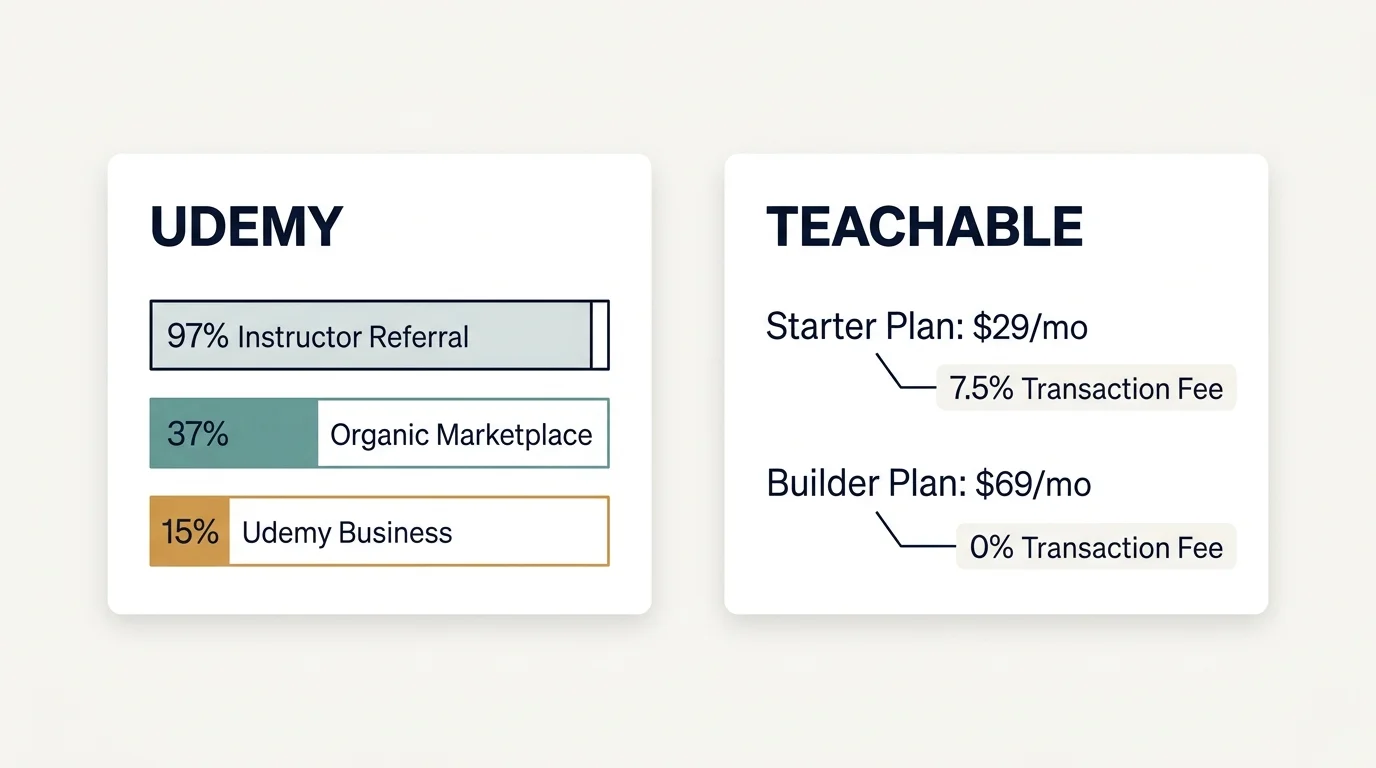
Udemy remains the largest marketplace for online learning, offering immediate exposure to global audiences. Following a major merger, the combined ecosystem reaches over 290 million registered learners worldwide. As an instructor, you upload pre-recorded video lectures and downloadable resources, while Udemy manages video hosting, payment processing, and delivery. You keep 97% of net revenue when students purchase using your direct referral link or custom coupon. However, for organic marketplace sales driven by Udemy search algorithms, the platform pays a 37% revenue share; for courses selected for the curated Udemy Business subscription catalog, the instructor payout rate is 15%. Udemy works best for retirees who prefer avoiding website management and sales funnels to focus purely on content creation.
Teachable: Best for Simple Independent Course Creation
If you want to build a distinct personal brand without complex web development, Teachable offers an intuitive interface tailored for independent creators. Teachable phased out its standalone free plan to focus on paid tiers. The entry-level Starter plan costs $29 per month on annual billing ($39 monthly) with a 7.5% platform transaction fee per enrollment. Upgrading to the Builder plan at $69 per month annually ($89 monthly) eliminates platform transaction fees entirely (0%). Teachable lets you customize video lessons, upload PDF worksheets, issue completion certificates, and connect custom domains while handling sales tax automatically.
Thinkific: Best for Complete Brand Control Without Transaction Fees
Thinkific provides exceptional design flexibility and student engagement tools, making it popular among retired consultants and coaches. The Basic plan starts at $36 per month billed annually ($49 monthly), while the Start plan costs $74 per month annually ($99 monthly) to unlock live lessons and compliance settings. Thinkific charges 0% transaction fees across its plans when using Thinkific Payments. You retain full ownership of student contact lists and financial data, helping you build long-term advisory relationships through a simple drag-and-drop builder.
Skillshare: Best for Creative and Design Expertise
Skillshare operates on a subscription model ideal for creative fields like writing, design, photography, and project management. Instructors earn payouts from a shared royalty pool based on premium video minutes watched, averaging $0.05 to $0.10 per minute. To qualify for payouts, instructors must maintain at least 50 followers and log a minimum of 75 watched minutes across their catalog each month. Skillshare favors bite-sized, project-focused classes ranging from 20 to 45 minutes, suiting creative retirees who prefer producing short video modules.
Kajabi: Best for All-In-One Digital Products and Marketing
Kajabi caters to serious creators and former executives who want an all-in-one operating system. While pricier, it replaces separate tools by bundling course hosting, community spaces, membership sites, email marketing, and sales funnels. The Basic plan starts at $143 per month annually ($179 monthly), while the Pro plan reaches $399 per month annually ($499 monthly). Kajabi charges 0% transaction fees when using Kajabi Payments. For retirees packaging career wisdom into high-value coaching programs, masterminds, and digital downloads alongside standard courses, Kajabi provides comprehensive infrastructure.
Podia: Best for Digital Downloads, Courses, and User-Friendly Setup
Podia emphasizes simplicity, making it accessible for retirees seeking easy setup. You can sell video courses, digital ebooks, webinars, and coaching sessions from a clean storefront. The entry-level Mover plan costs $33 per month billed annually ($39 monthly) with a 5% transaction fee. The upgraded Shaker plan costs $75 to $99 per month and eliminates transaction fees (0%). Podia manages customer checkout, landing pages, and email broadcasts cleanly, allowing you to organize teaching materials quickly without wrestling with complicated software.
Maven: Best for High-Ticket Cohort-Based Live Masterclasses
Maven specializes in live, cohort-based online courses rather than pre-recorded videos. Instructors host live video sessions, break-out discussions, and structured group assignments over several weeks. Cohort-based courses command premium pricing, with seats typically priced between $800 and $2,500 per student. Maven charges a standard 10% platform fee on enrollments and provides landing pages, email management, and automated calendar scheduling. Maven suits retired executives, engineers, and consultants who thrive on real-time dialogue and active mentorship.
Mighty Networks: Best for Building a Thriving Community Around Your Knowledge
Mighty Networks anchors course hosting within an interactive community hub. On this platform, courses, social feeds, group chats, and live events coexist seamlessly. The Launch plan starts at $79 per month annually, while Scale or Courses plans cost $99 to $119 per month. Mighty Networks charges a low 2% to 3% transaction fee on course sales depending on your plan. This setup suits retirees who want to foster peer networking around their industry specialty, creating active alumni networks.

Essential Financial Safeguards: Taxes, Social Security, and Medicare
Generating course income brings financial rewards, but you must manage tax obligations and benefit thresholds carefully. Course earnings represent self-employment income, subject to federal, state, and self-employment taxes. Setting aside 25% to 30% of net profits in a business account ensures you meet estimated tax deadlines required by Internal Revenue Service tax policies.
If claiming Social Security benefits before Full Retirement Age (FRA), monitor the annual earnings limit closely. Earning above threshold limits causes the Social Security Administration to temporarily withhold a portion of benefits. Consult official Social Security Administration guidelines to see how self-employment income impacts your payments. Once reaching full retirement age, earnings limits end, allowing unlimited earnings without benefit reductions.
Additionally, Medicare beneficiaries must monitor Modified Adjusted Gross Income (MAGI). Crossing specific income thresholds triggers Income-Related Monthly Adjustment Amounts (IRMAA), increasing Medicare Part B and Part D premiums. Reviewing Medicare premium thresholds with a financial planner helps structure business expense deductions effectively to protect your retirement income.

Expert Perspectives: Strategy from Financial Planners and Gerontologists
Certified Financial Planner™ practitioners recommend treating course creation as a low-overhead venture. Keep startup expenses minimal by using a high-definition webcam, a clear USB microphone, and platform templates instead of buying studio lighting or high-end equipment. Validating your course idea with a small pilot group before investing heavily in software or advertising protects your savings while confirming student demand.
Gerontologists note that balancing teaching activities supports healthy aging. Working 10 to 15 hours per week provides cognitive stimulation and social connection without corporate stress. Be cautious regarding online business scams guaranteeing instant six-figure income for steep upfront fees. Sustainable course growth stems from genuine authority, organized curriculum design, and direct student interaction.
Frequently Asked Questions
Do I need advanced technical skills or expensive recording equipment to start teaching?
No advanced technical skills or commercial equipment are necessary. Modern computers feature solid webcams, and an affordable USB condenser microphone delivers clear audio. Most hosting platforms offer simple drag-and-drop video uploads and pre-designed landing page templates. Focus primary effort on clear lesson planning and concise presentation.
How does online course income affect my Social Security retirement benefits?
Course revenue counts as net self-employment income. If you have reached full retirement age, earnings will not reduce your Social Security benefits. If you are under full retirement age, net earnings above the annual limit temporarily reduce monthly benefits until you reach full retirement age.
Should I create a pre-recorded course or host live classes?
Pre-recorded courses offer passive income potential and scheduling freedom once uploaded. Live cohort-based classes require dedicated scheduling but command higher tuition rates and foster direct engagement. Many instructors host a live workshop first to test content before recording permanent video modules.
How can I protect my personal privacy while selling digital courses online?
To protect personal privacy, form a dedicated Limited Liability Company (LLC) rather than operating under your personal name. Use a commercial mailbox or virtual office address for entity filings to keep your home address private, and conduct student communications through dedicated business email addresses.
Your 48-Hour Action Plan to Monetize Your Wisdom
Launching an online course does not require months of prep work; momentum starts with one simple step. In the next 48 hours, list three specific professional challenges you solved during your career that junior colleagues frequently asked you to explain. Pick the topic that energizes you most, write down five core lessons, and outline a brief 20-minute presentation. Taking this single action today initiates a rewarding secondary career that keeps your mind engaged and supplements your retirement security.