
Your dream of retiring in a coastal paradise or a vibrant metropolis requires a precise financial strategy, as the most sought-after American destinations now demand an unprecedented level of wealth. Planning a luxury retirement in 2026 requires stress-testing your portfolio against the astronomical costs of living in places like Honolulu, Manhattan, and San Francisco. Recent inflation shifts and rising healthcare premiums mean that an affluent lifestyle in these prime locales easily exhausts an underprepared nest egg. Navigating these elite markets successfully involves understanding the exact financial thresholds required for housing, taxes, and daily expenses, allowing you to secure your ideal quality of life without compromising your long-term security.

The Current Landscape of Affluent Aging
The economic realities of retirement have shifted drastically over the past few years. As we move through 2026 and look toward 2027, the stabilization of inflation has not reversed the massive price increases seen in premium real estate, property insurance, and specialized healthcare. Retirees seeking to settle in top-tier destinations face a compounded financial challenge; you must generate sufficient income to support a luxury lifestyle while navigating aggressive state tax policies designed to capture high-net-worth revenue.
Property insurance in coastal and high-risk climate areas has become a dominant budget line item. In exclusive enclaves across Florida, California, and Hawaii, retirees are experiencing staggering premium hikes or facing the reality of self-insuring their properties. Furthermore, the cost of specialized labor—ranging from estate maintenance to private in-home care—has surged in dense urban environments. To sustain a high quality of life in these demanding markets, you need a dynamic financial plan that adapts to localized inflation rates, which often exceed national averages significantly.
Understanding these localized economic pressures is vital. National inflation metrics rarely reflect the lived reality of purchasing groceries in Honolulu or paying cooperative apartment maintenance fees in New York City. Evaluating your readiness for an expensive retirement destination means setting aside generic withdrawal rules and building a bespoke budget that accounts for the specific, granular costs of your chosen zip code.

Profiling the Most Expensive Retirement Destinations
Certain regions consistently demand a massive premium for the privilege of calling them home. Honolulu, Hawaii, remains the undisputed apex of high-cost retirement. The “paradise tax” is a very real economic force; because the islands must import the vast majority of consumer goods, groceries, and construction materials, everyday living expenses severely outpace the mainland. Housing inventory is fiercely constrained by geography, keeping real estate prices permanently elevated. Retiring comfortably in Honolulu requires immense liquidity and a tolerance for exorbitant daily expenses.
San Francisco and the broader Bay Area in California present a distinct set of financial hurdles for the affluent retiree. While the region offers incredible cultural amenities, a temperate climate, and world-renowned dining, it also features some of the highest state income tax rates in the nation. Purchasing a high-end property here triggers significant initial property tax assessments. Furthermore, the immense cost of living for service workers in the Bay Area means that hiring contractors, landscapers, or private home health aides will command premium wages.
New York City, specifically Manhattan, offers an unparalleled, vibrant retirement for those who value walkability, the arts, and cosmopolitan energy. However, the costs extend far beyond the price of luxury dining or theater tickets. The real financial weight of a Manhattan retirement lies in cooperative apartment board requirements, exorbitant monthly maintenance fees, and overlapping state and city income taxes. As mobility needs change, navigating the city often requires hiring private drivers or utilizing premium delivery services, which quickly escalates your monthly burn rate.
Boston, Massachusetts, and its affluent suburbs like Cambridge and Brookline, attract retirees prioritizing world-class healthcare and rich historical surroundings. Yet, the region suffers from notoriously high housing costs and severe winter weather that frequently necessitates hiring snow removal and exterior maintenance services. Massachusetts also imposes strict estate tax thresholds, which can severely complicate the legacy planning of wealthy retirees who relocate there without updating their trust structures.
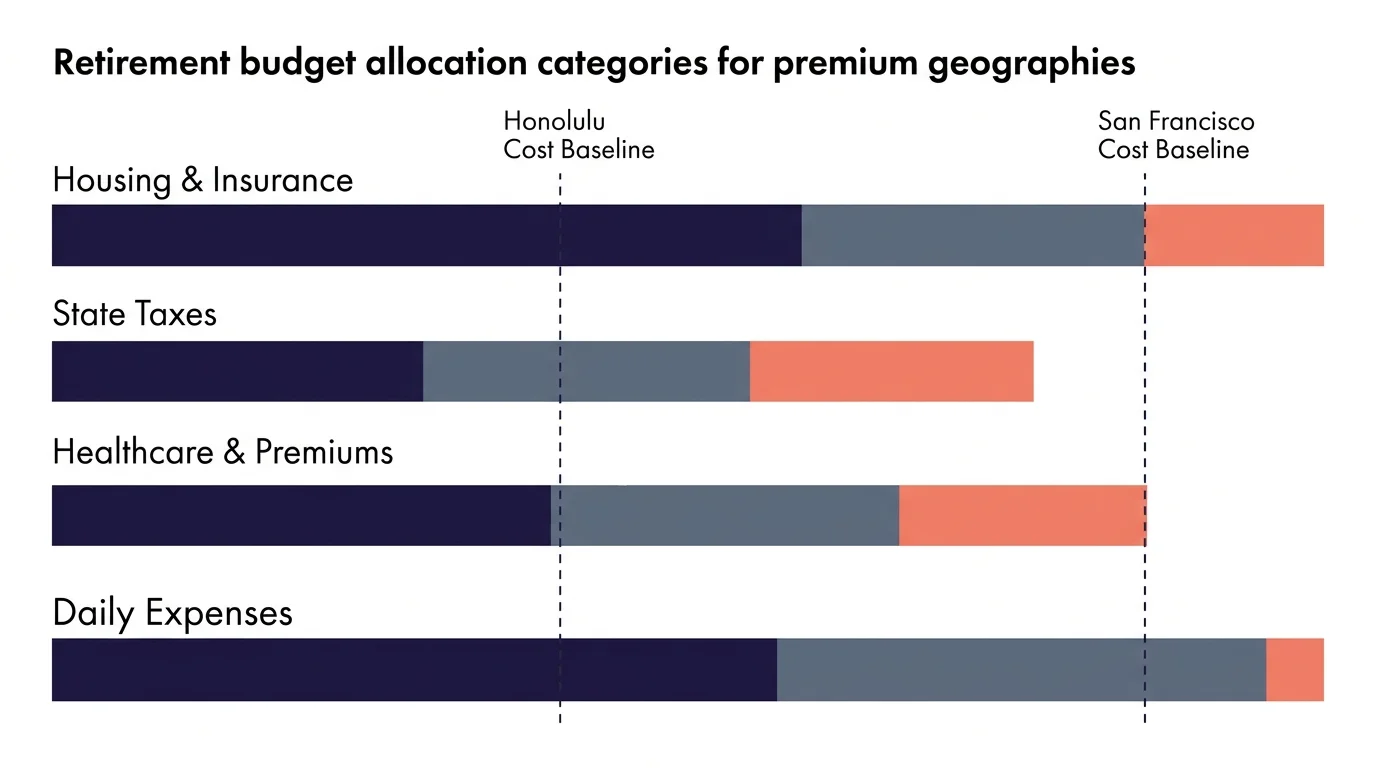
Income Planning for High-Cost Geographies
Generating sustainable income in an elite retirement destination requires you to look far beyond the traditional four percent withdrawal rule. When you relocate to a high-cost, high-tax state, your gross withdrawal rate must increase substantially just to net the exact same spendable cash you would have in a tax-friendly state. This aggressive withdrawal strategy introduces a severe sequence of returns risk if the market experiences a downturn early in your retirement.
Tax-efficient distribution becomes the single most important lever in your financial strategy. Drawing heavily from tax-deferred accounts like traditional IRAs to fund an expensive coastal lifestyle can instantly push you into the highest federal and state tax brackets. Strategic Roth conversions, implemented years before your relocation, can help manage this burden. Leading Certified Financial Planners emphasize that high-net-worth retirees must meticulously balance distributions between taxable brokerage accounts, tax-deferred accounts, and tax-free Roth accounts to optimize their adjusted gross income.
Failing to manage your taxable income precisely can trigger harsh secondary consequences. Spiking your income to buy a luxury property or cover high state taxes will rapidly inflate your healthcare costs. It is critical to review the detailed guidelines updated by the Internal Revenue Service regarding required distributions, as forced withdrawals can inadvertently push your income over the threshold for Medicare surcharges. Managing these interconnected financial levers dictates whether your wealth will sustain your lifestyle or slowly erode under the weight of taxes and penalties.

Lifestyle Design and Real Estate Realities
Retiring in a high-cost area requires you to rethink how your physical environment will support you as you age. Lifestyle design in expensive markets heavily revolves around housing accessibility and the hidden costs of adapting luxury real estate. If you choose an urban environment like Manhattan or San Francisco, multistory townhomes or walk-up apartments quickly become liabilities as mobility decreases. Securing an elevator building with a 24-hour doorman and concierge services is a necessity for aging gracefully in the city, but these amenities command astonishing monthly fees.
In coastal markets like Hawaii or Southern California, single-story living is highly desirable but severely limited by land scarcity, driving up the purchase price of accessible homes. If you plan to age in place, you must factor in the cost of universal design renovations. Widening hallways, installing curbless luxury showers, and integrating smart home health-monitoring technology requires specialized contractors who charge a premium in these high-cost zip codes.
Your lifestyle design must also account for proximity to essential services. A truly successful retirement integrates seamlessly with your local community. When evaluating expensive neighborhoods, prioritize environments that offer walkable access to grocers, pharmacies, and green spaces, allowing you to maintain independence even if you decide to stop driving. You can explore livability metrics and community design research highlighted by AARP to help quantify the accessibility of your target destination. The goal is to purchase real estate that naturally supports your evolving physical needs without requiring constant, expensive interventions.

Health and Wellness at Premium Price Points
A primary motivation for retiring in cities like Boston, New York, or San Francisco is immediate access to elite, world-renowned medical institutions. However, navigating the healthcare landscape in these affluent areas carries hidden, substantial costs. Many top-tier specialists and primary care physicians in high-net-worth zip codes do not accept standard health insurance and frequently opt out of Medicare entirely. Instead, they operate under a concierge or direct primary care model.
Concierge medicine requires you to pay a significant annual retainer—often ranging from five to twenty thousand dollars out-of-pocket—simply to secure a physician’s services and guarantee priority access. While this model provides highly personalized care, longer appointment times, and direct cell phone access to your doctor, it represents a permanent, non-negotiable expense layered on top of your existing insurance premiums. You must factor these retainers into your permanent retirement budget.
Furthermore, managing your standard Medicare premiums in an expensive state requires vigilance. Because living in a high-cost area often forces you to generate higher taxable income, you are highly likely to trigger the Income-Related Monthly Adjustment Amount. This surcharge can double or even triple your standard Medicare Part B and Part D premiums. Reviewing the details on income-related premiums provided by Medicare is essential for mapping out your actual monthly healthcare liabilities, ensuring you are never caught off guard by sudden premium spikes.

Risks and Safeguards to Protect Your Wealth
Affluent retirees moving capital into high-cost luxury markets frequently become targets for sophisticated financial exploitation. Real estate wire fraud is a catastrophic threat during the purchase of premium retirement properties. Cybercriminals monitor the communications of real estate agents and title companies, waiting for the moment a buyer is instructed to wire a multi-million dollar down payment. They then intercept the communication and substitute fraudulent wiring instructions. You must establish strict, in-person verbal verification protocols with your financial institution and title company before transferring any funds.
Beyond external fraud, you must protect your wealth from structural risks, such as state-level legislative changes. Relocating to a state with an aggressive tax code introduces the risk of the “benefit cliff,” where a minor increase in your taxable income drastically reduces your eligibility for certain tax deductions or forces you into a punishingly high tax bracket. You must continuously monitor the fiscal health of your chosen state; jurisdictions with massive unfunded pension liabilities often solve their budget shortfalls by aggressively raising property and wealth taxes on affluent residents.
Staying informed about emerging financial threats and consumer protection data is a non-negotiable part of wealth preservation. Regularly reviewing fraud trends and alerts issued by the Internet Crime Complaint Center provides critical intelligence on how cybercriminals are targeting high-net-worth individuals, allowing you to harden your digital security and protect your hard-earned retirement assets from sophisticated theft.
Frequently Asked Questions
How much capital do I actually need to retire comfortably in a top-tier US city?
While personal spending habits dictate exact numbers, sustaining a luxury retirement in places like Manhattan, Honolulu, or San Francisco in 2026 generally requires a highly robust balance sheet. Financial professionals often recommend holding between four to six million dollars in liquid, investable assets, entirely separate from the equity in your primary, paid-off residence. This baseline ensures you can absorb high property taxes, concierge medical fees, and aggressive local inflation without constantly worrying about depleting your principal during market downturns.
Are there hidden costs to coastal retirements that I should anticipate?
Yes, coastal environments punish real estate and demand relentless maintenance. Beyond the massive increases in flood and windstorm insurance premiums, you must budget for the physical toll that salt air, high humidity, and extreme weather take on your home. HVAC systems degrade faster, exterior paint peels prematurely, and metal fixtures corrode rapidly. Retirees in coastal Florida or Hawaii often spend tens of thousands of dollars annually on preventative maintenance and specialized contractors just to keep their luxury properties in pristine, habitable condition.
Does relocating to a high-tax state immediately affect my estate plan?
Relocating across state lines absolutely disrupts your existing estate plan and requires immediate legal review. While you may be well below the federal estate tax exemption limit, many expensive states, such as Massachusetts and New York, impose their own state-level estate or inheritance taxes with drastically lower exemption thresholds. Failing to update your trusts and legal domiciles upon relocation can result in your heirs facing a devastating, unexpected tax burden on your property and assets.
How does concierge medicine work with standard health coverage in affluent areas?
Concierge medicine retainers primarily cover your access to the physician, extended consultations, and comprehensive annual physicals that insurance will not cover. However, the retainer does not replace traditional health insurance. You still absolutely need comprehensive coverage—whether through Medicare or private insurance—to cover hospitalizations, emergency room visits, specialist surgeries, and prescription medications. The concierge fee is simply an out-of-pocket premium you pay to secure an elite primary care quarterback for your broader healthcare strategy.
Your Next 48 Hours
Do not let the complexity of high-cost retirement planning paralyze your progress. Within the next 48 hours, pull your most recent tax return and calculate your exact Modified Adjusted Gross Income. Compare this number against the current Medicare IRMAA surcharge brackets. Understanding exactly where you sit on this income threshold today will reveal how much flexibility you have to increase your withdrawals for a luxury relocation without triggering severe healthcare premium penalties. Taking this single, concrete step immediately grounds your dream destination in financial reality, empowering you to make strategic adjustments before you pack your bags.