
Your career in public safety demanded immense personal sacrifice and unwavering dedication. Now that you have hung up the uniform, specialized state laws, federal tax exclusions, and consumer programs can save you thousands of dollars each year.
Many retired police officers and firefighters leave substantial money on the table because departments rarely host comprehensive transition seminars.
Exploring your public safety pension benefits, healthcare deductions, and earned privileges helps you protect your hard-won wealth throughout retirement. Taking advantage of these programs ensures you maximize your household cash flow immediately.
Navigating the Public Safety Retirement Landscape
The financial landscape for first responder retirees is shifting rapidly due to legislative reforms and inflationary pressures. Recent statutory updates provide significant relief for those managing early retirements and complex healthcare expenses.
According to recent Bureau of Labor Statistics data, protective service workers retire years earlier than general civilian workers. This early career exit requires a delicate balance of pension management and medical cost containment.
Recent updates under the SECURE 2.0 Act have modernized critical tax exemptions for public safety alumni. These adjustments eliminate outdated administrative hurdles that previously discouraged retirees from claiming their lawful deductions.
Certified Financial Planner Marcus Vance notes that proactive paperwork is crucial. Vance explains that many retirees lose thousands of dollars simply because they do not track legislative changes affecting their pensions.
Tax Advantages and Pension Protections
Structuring your retirement distributions correctly can drastically lower your annual adjusted gross income. Federal lawmakers have established targeted tax code carve-outs specifically tailored to public safety veterans.
1. The HELPS Retirees Act Tax Exclusion
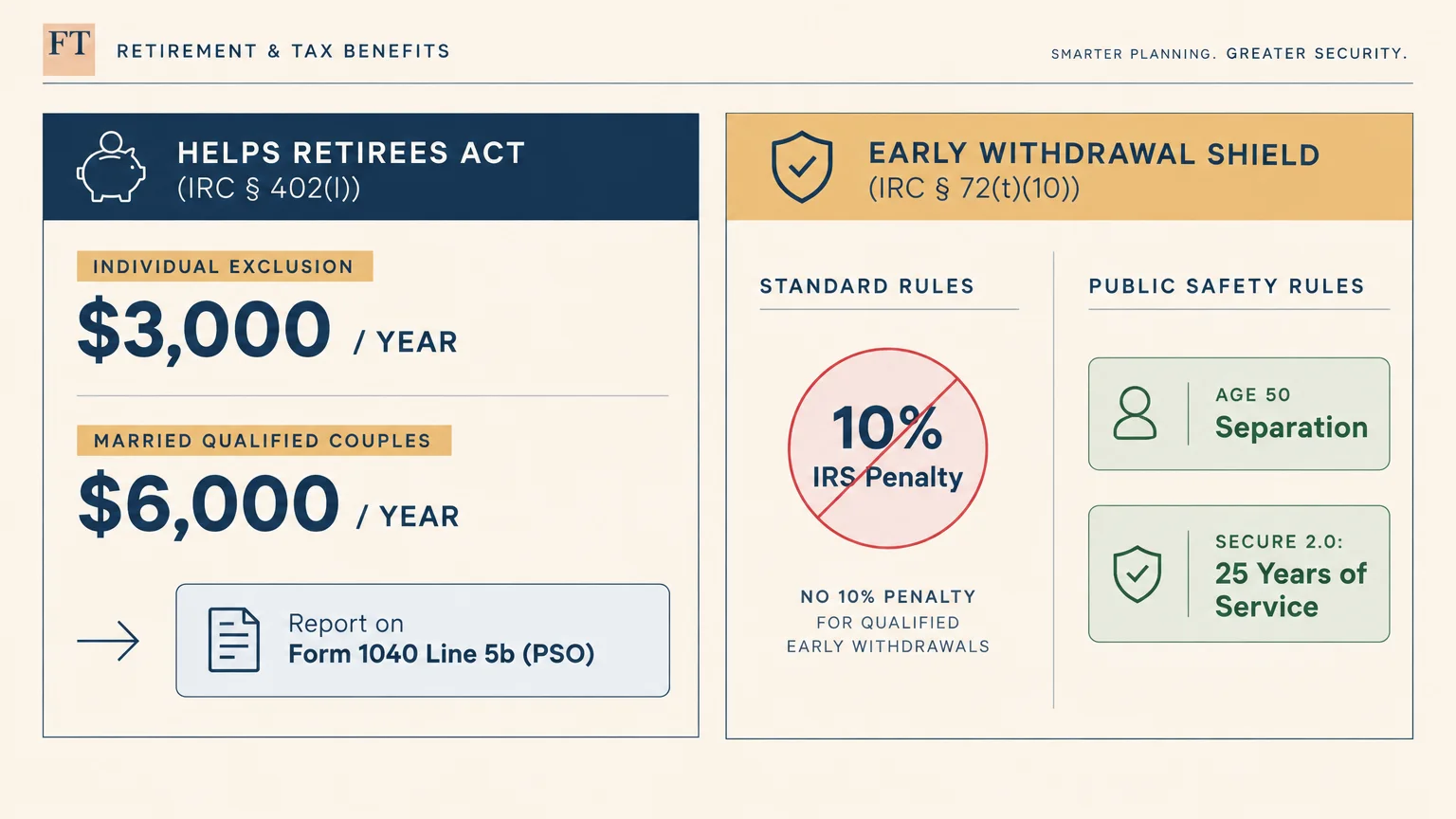
Under Internal Revenue Code Section 402(l), eligible retired public safety officers can exclude up to $3,000 annually from gross retirement distributions. Married couples where both spouses are qualified retirees can exclude up to $6,000 per year.
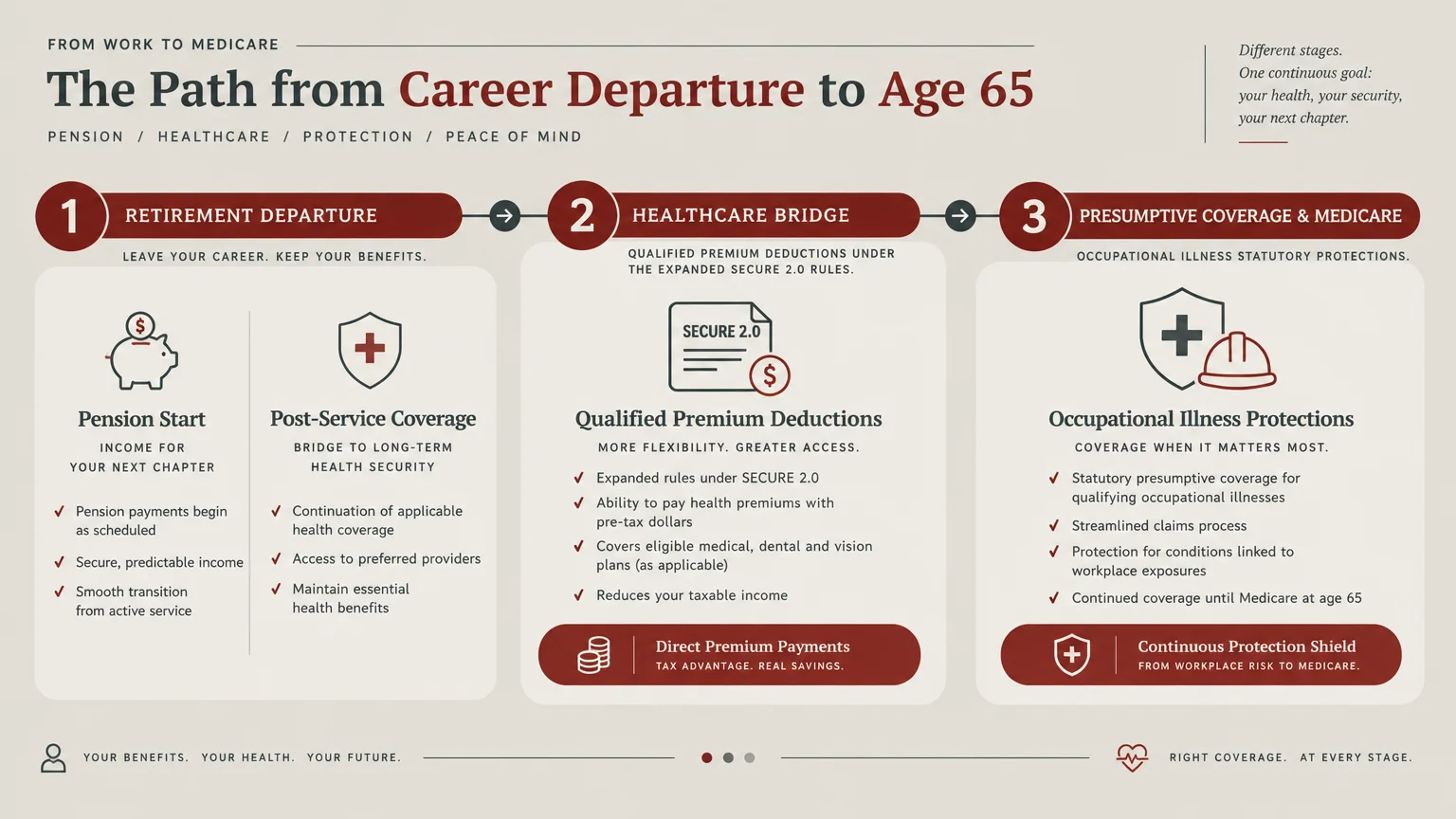
You must direct these distributions toward qualified health, dental, vision, or long-term care insurance premiums. This exclusion provides direct tax relief regardless of whether you choose to itemize deductions.
The SECURE 2.0 Act significantly improved this provision by removing the restrictive direct-payment rule. You can now pay premiums directly from your personal account and claim the exclusion on your return.
Consult current Internal Revenue Service guidelines to report this benefit accurately. You will indicate the excluded sum on Form 1040 Line 5b, annotating the entry with the letters PSO.
2. Penalty-Free Pension and 457 Withdrawals
Most Americans face a steep 10% tax penalty if they withdraw qualified retirement funds before age 59½. Public safety personnel, however, benefit from an essential statutory exception under Internal Revenue Code Section 72(t)(10).
You can access defined benefit pensions and governmental 457(b) plans without penalty if you separate from service during or after the calendar year you reach age 50. This rule provides vital liquidity for early retirees.
The SECURE 2.0 Act expanded this exemption even further under Section 329. Qualified public safety employees with at least 25 years of service can now make penalty-free withdrawals regardless of their actual age.
Review specific IRS retirement plan rules before transferring funds. Rolling money into a traditional individual retirement account before age 59½ can accidentally forfeit this specific early-withdrawal shield.

Legal Privileges and Community Relief
Beyond basic income planning, first responder status unlocks distinct legal rights and state-level relief. These legal mechanisms honor your service while safeguarding your family budget.
3. Nationwide Concealed Carry Through LEOSA
The Law Enforcement Officers Safety Act, commonly known as LEOSA or HR 218, grants qualified retired law enforcement officers nationwide concealed-carry rights. This federal statute overrides most state and municipal concealed-carry prohibitions.
To maintain this federal privilege under 18 U.S.C. § 926C, you must have served at least 10 aggregate years in law enforcement. Alternatively, officers separated after probation due to a service-connected disability also qualify.
Federal law mandates that you carry your departmental retired identification card alongside an active qualification certification. You must successfully pass an active-duty firearms qualification course every 12 months.
Refer to official federal statutory guidelines regarding sensitive location restrictions. LEOSA does not grant access to federal facilities, certain national park properties, or private buildings that explicitly prohibit firearms.
4. Comprehensive Homestead Property Tax Exemptions
Housing costs represent a major expenditure for households on fixed pensions. Fortunately, several states provide substantial property tax relief to honor disabled public safety veterans.
Jurisdictions such as Texas, Florida, and Virginia offer up to a 100% homestead property tax exemption for first responders with total, permanent line-of-duty disabilities. This exemption eliminates county, school, and municipal tax burdens.
Many of these statutes also extend complete tax exemptions to surviving spouses if the responder died in the line of duty. This critical safeguard ensures that your spouse retains their family home without financial distress.
Contact your county appraisal district or local tax assessor to review documentation requirements. You will generally need your formal agency separation orders and medical disability determinations to establish eligibility.
Extended Healthcare and Occupational Protections
First responders encounter hazardous environments that present long-term health risks decades after active duty ends. Specialized post-retirement medical policies protect you against these delayed occupational hazards.
5. Presumptive Cancer and Cardiovascular Coverage Windows
Firefighters and police officers face intense exposure to carcinogenic toxins and severe cardiovascular stress. Over 40 states now maintain presumptive illness statutes that recognize specific health conditions as occupational injuries.
Crucially, these laws extend protection well into your retirement years. Presumptive coverage windows frequently remain open for 5 to 10 years following your official separation date.
Some states maintain coverage windows until a retiree reaches age 65 or 70. If you receive a diagnosis during this window, state funds or workers’ compensation programs cover medical treatments and related disability benefits.
Maintain thorough personal copies of your incident reports, exposure logs, and annual physical evaluations. Having comprehensive records will expedite your claim if you must file for presumptive benefits after retirement.
6. Specialized First Responder Mental Health and Wellness Networks
Career public safety service often generates cumulative psychological trauma that surfaces after retirement. Fortunately, specialized mental health resources cater exclusively to the unique experiences of retired emergency personnel.
Organizations such as the International Association of Fire Fighters offer clinical facilities and alumni networks dedicated to trauma recovery. Similarly, dedicated hotlines like Copline provide confidential 24-hour peer support answered exclusively by retired officers.
Gerontologist Dr. Elena Ramirez emphasizes the value of specialized support groups. Ramirez notes that retired emergency workers experience superior therapeutic outcomes when engaging with clinicians who understand responder culture.
Many departmental employee assistance programs now extend telehealth access to retirees and their immediate family members. Investigate whether your former department or union maintains post-retirement peer support contracts.

Everyday Savings and Consumer Perks
Commercial affinity programs offer everyday savings that quickly reduce annual living costs. Private corporations and digital verification hubs regularly reward public safety service with exclusive discounts.
7. Telecommunications and Wireless Rate Reductions
Major telecommunications companies provide ongoing monthly discounts to retired first responders. While active-duty personnel frequently use FirstNet, major carriers provide dedicated civilian programs for verified retirees.
AT&T offers up to 25% off qualified unlimited mobile plans for retired public safety officers. You can apply this discount across multiple family lines on your primary account.
Verizon provides recurring account credits that typically range from $10 to $25 per month depending on how many lines you maintain. These wireless savings accumulate hundreds of dollars in annual household cash reserves.
Upload your retirement ID or departmental discharge paperwork through your mobile carrier’s online verification portal. Your billing statements will reflect these adjustments within one or two billing cycles.
8. Permanent Commercial Discounts via Verification Portals
Commercial verification services eliminate the need to carry physical departmental credentials for retail discounts. Digital platforms like GovX and ID.me offer free, permanent accounts to verified retired first responders.
These platforms unlock discounted ticketing, sporting goods savings, electronics deals, and reduced rates on travel. Major hotel chains and automotive brands routinely partner with these portals to offer substantial consumer markdowns.
Digital credentials also provide access to complimentary or deeply discounted state park passes and recreational permits. Engaging with nature through these recreation perks provides therapeutic benefits during your transition into retirement.
Registering for these portals requires only a few minutes and a digital copy of your retirement letter. Once verified, your status remains permanently active without annual re-certification hassles.

Critical Safeguards: Pitfalls and Benefit Offsets
While retired police perks and firefighter benefits provide substantial value, uncoordinated planning can create costly financial traps. You must understand how your pension interacts with federal entitlement programs.
Many municipal retirees do not contribute to Social Security during their careers. Consequently, the Social Security Administration offset provisions known as the Windfall Elimination Provision and Government Pension Offset apply.
The Windfall Elimination Provision reduces your personal earned Social Security benefit if you receive a pension from non-covered employment. This statutory reduction can eliminate up to roughly one-half of your anticipated monthly entitlement.
The Government Pension Offset affects spousal or survivor benefits, reducing them by two-thirds of your public pension amount. This offset frequently wipes out secondary Social Security benefits entirely, requiring careful budgeting.
Watch out for financial scams that specifically target public safety pensions. Dishonest advisors often market high-commission annuities or risky alternative investments to retired officers possessing stable lump-sum distributions.
Be mindful of credential expiration dates. Allowing your LEOSA firearms certification to lapse or missing presumptive disease medical windows can permanently forfeit valuable legal and healthcare rights.
Frequently Asked Questions
Can I claim the HELPS Act exclusion if my pension does not pay my insurer directly?
Yes, you can claim this exclusion directly under modernized rules. The SECURE 2.0 Act eliminated the direct-payment rule, allowing you to pay premiums out-of-pocket and report the deduction on Form 1040.
How does the Rule of 50 apply if I roll my 457 plan into an IRA?
Rolling your governmental 457 or pension into a traditional IRA will cause you to lose early penalty-free access. Individual retirement accounts enforce strict 10% penalties on withdrawals made before age 59½.
Does LEOSA exempt retired officers from all local firearm restrictions?
LEOSA overrides many state concealed-carry laws, but important exceptions remain. The statute does not override restrictions on private property, state government buildings, or federal gun-free school zones.
Can a surviving spouse keep my public safety property tax exemption?
Many state statutes permit surviving spouses to maintain the property tax exemption as long as they remain unmarried. Check with your local appraisal district to verify your jurisdiction’s specific surviving spouse provisions.
Take Action for Your Retirement Security
You spent decades serving your community and keeping the public safe. Claiming your full suite of retired firefighter perks and police officer benefits is simply collecting the compensation you rightfully earned.
Take one practical step within the next 48 hours to improve your financial standing. Pull out your latest pension statement, review your healthcare premiums, or register on a verification portal to secure your benefits today.






If you suck out of the public trough the benefits never end.