
Trimming your transportation expenses can instantly protect your retirement nest egg from persistent inflation. Choosing a state with low vehicle taxes, cheap insurance, and modest registration fees saves you thousands of dollars each year.
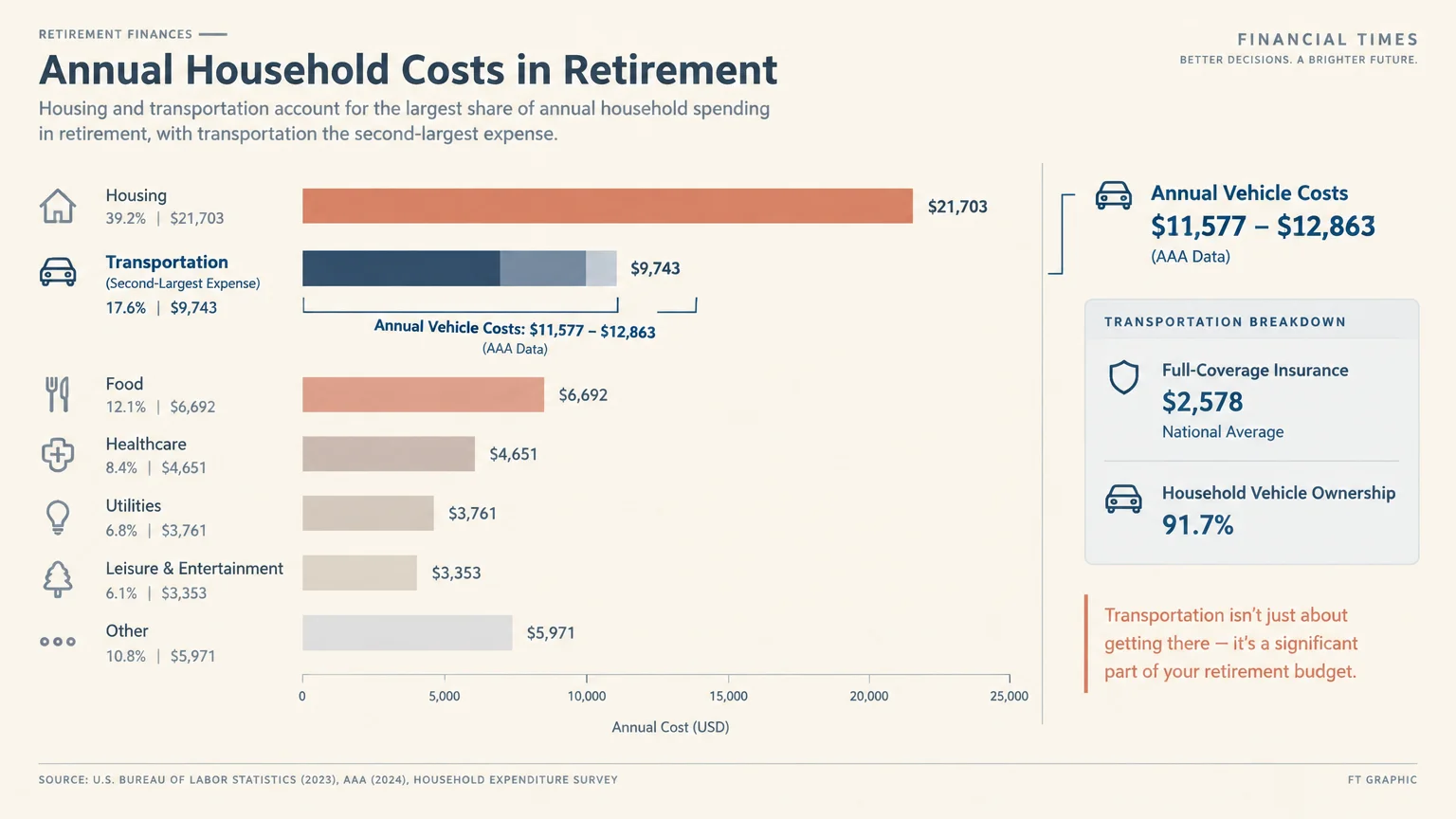
According to AAA, owning and operating a typical vehicle now costs between $11,577 and $12,863 annually. Where you decide to park your car dramatically shapes that recurring burden.
State policies on personal property taxes, mature driver discounts, and sales levies vary dramatically across the country. Understanding these geographic differences empowers you to safeguard your fixed income without sacrificing personal mobility.
The Hidden Drain of Vehicle Ownership in Retirement
Data from the Bureau of Labor Statistics reveals that transportation consistently ranks as the second-largest expense for older Americans, trailing only housing.
For many households, auto costs consume a larger share of retirement cash flow than out-of-pocket medical care.
According to the U.S. Census Bureau, 91.7% of American households own at least one vehicle. Giving up the keys is rarely an appealing option when you value your independence.
However, national averages conceal massive state-level disparities. The national average cost for full-coverage auto insurance has climbed to approximately $2,578 per year.
Fixed fees like registration, state ad valorem taxes, and insurance do not shrink just because you drive fewer miles. You end up paying full price for an asset that spends most of its time in the garage.
In high-tax jurisdictions, recurring vehicle levies and steep insurance premiums quickly erode your monthly pension checks. Relocating or registering your car in a tax-friendly state can slash these annual carrying charges by half.

Strategy Pillars: Balancing Mobility, Health, and Wealth
Smart retirement planning requires you to address vehicle expenses through three interconnected disciplines: financial architecture, daily lifestyle, and physical wellness.
Income Planning and Fixed-Budget Optimization
Certified Financial Planner™ practitioners frequently advise clients to treat transportation as an essential fixed liability rather than a flexible discretionary item.
“Automobile overhead acts as a silent drain on investment portfolios,” explains CFP® professional Marcus Vance. “Minimizing recurring property taxes on your car preserves your liquid capital for healthcare and travel.”
You should factor registration renewals, mandatory safety inspections, and insurance premiums directly into your baseline withdrawal calculations.
Eliminating state-level vehicle ad valorem taxes creates an immediate buffer against market volatility. That stability ensures unexpected tax bills never force you to sell equities in a down market.
Lifestyle Design and Environmental Fit
Your physical surroundings determine how much you actually need to drive. Moving to an area with walkable retail corridors or golf-cart-friendly paths can drastically reduce your annual mileage.
Lower mileage directly translates into cheaper insurance premiums through low-mileage discount tiers.
Additionally, choosing a home in a mild climate reduces severe winter wear and tear on your vehicle.
Avoiding heavy road salt and icy conditions prolongs the operational life of your car. That longevity prevents you from entering the inflated new car market prematurely.
Health, Longevity, and Safe Driving
Preserving your driving privileges supports cognitive vitality and emotional well-being by preventing social isolation. Gerontologists emphasize that personal mobility remains a central pillar of successful aging.
“When older adults lose driving independence unexpectedly, depression rates climb significantly,” notes gerontologist Dr. Elena Ramirez. “Maintaining an affordable, reliable vehicle keeps you connected to your social circles and medical providers.”
Enrolling in defensive driving programs helps you adapt to normal sensory changes while yielding tangible financial rewards.
In 34 states and Washington, D.C., insurance providers must offer discounts to mature drivers who complete approved coursework.
You can easily access these courses through organizations like AARP Driver Safety to refresh your skills and lower your monthly bills.
11 States With the Lowest Vehicle Costs for Retirees
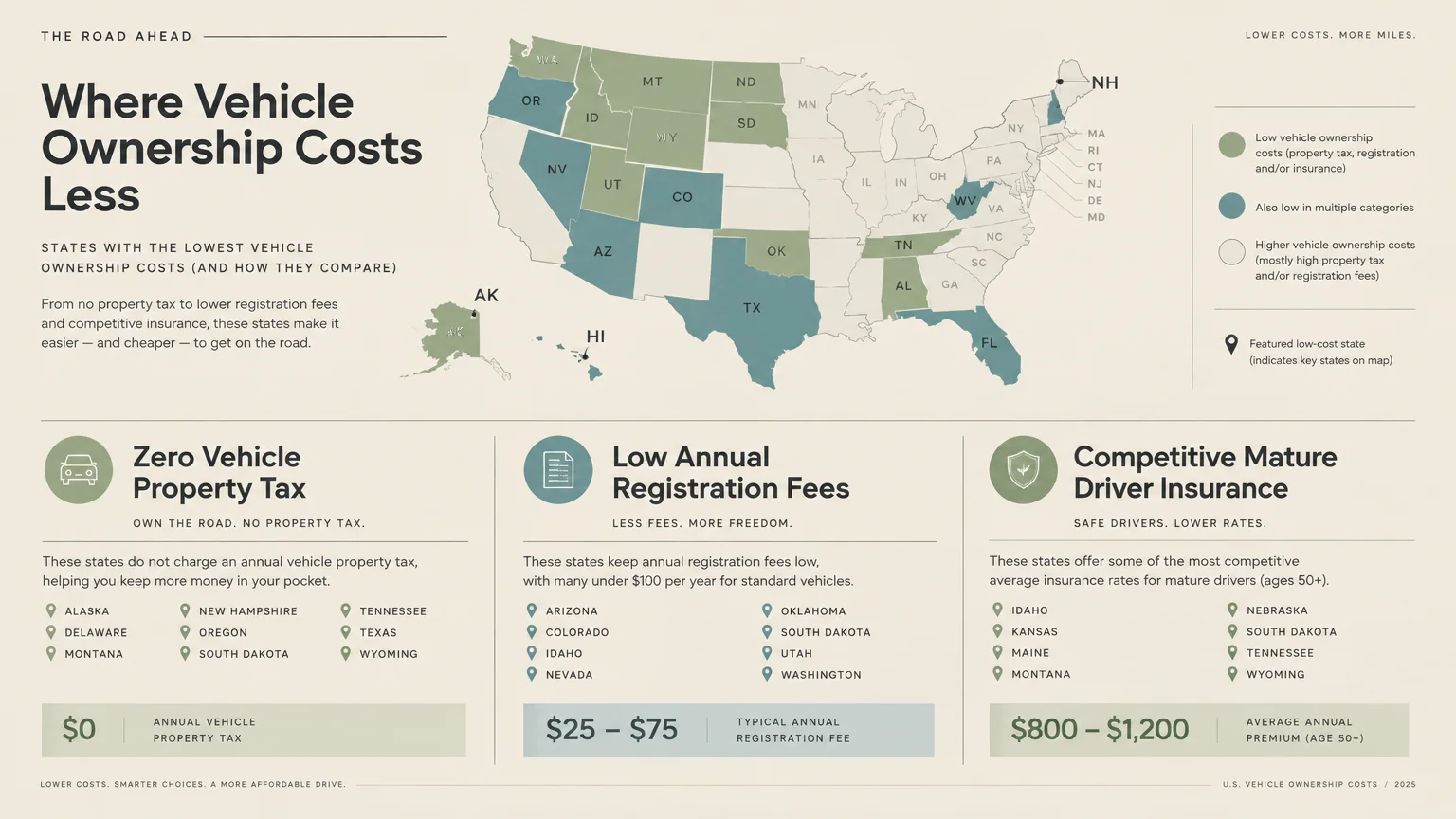
These eleven states provide the ideal combination of modest insurance rates, favorable tax codes, and senior-friendly registration rules.
1. New Hampshire
New Hampshire regularly ranks as the most affordable state in the nation for total car ownership. LendingTree reports average recurring annual operating costs of just $3,030.
The Granite State levies zero state sales tax when you purchase a vehicle. Furthermore, you will not pay a statewide general personal property tax on your passenger car.
2. Oregon
Oregon completely exempts vehicle purchases from general state sales tax, saving retirees thousands upfront. Personal motor vehicles are also entirely exempt from recurring personal property taxes.
The state features below-average vehicle registration and documentation fees. Because cities like Eugene and Corvallis offer extensive public transit, retirees can easily maintain low annual mileage.
3. Alaska
Alaska offers exceptional statutory relief specifically tailored for aging drivers. Residents aged 65 and older can exempt one passenger vehicle per household entirely from state registration fees and motor vehicle taxes.
The state imposes zero statewide sales tax on auto purchases. Combined with generous annual permanent fund dividends, Alaska keeps vehicle maintenance burdens remarkably light for lifelong residents.
4. North Carolina
North Carolina caps its vehicle sales tax equivalent, known as the Highway Use Tax, at an exceptionally low 3%. This policy prevents massive upfront tax penalties when you replace an aging vehicle.
According to the Federal Highway Administration, the state also maintains an affordable base vehicle registration fee of just $15. Full-coverage insurance averages roughly $1,307 per year, far below national benchmarks.
5. Ohio
Ohio provides some of the most competitive auto insurance rates across the entire Midwest. Drivers frequently pay between $1,112 and $1,783 annually for full-coverage policies.
State law strictly exempts non-commercial passenger vehicles from annual personal property taxation. Flat registration fees and affordable repair labor make Buckeye State vehicle ownership remarkably economical for fixed incomes.
6. Vermont
Vermont delivers peaceful rural driving conditions coupled with remarkably low insurance premiums. Average annual full-coverage rates sit near $1,660, shielding retirees from high insurance overhead.
Five-year car ownership costs benchmark at roughly $23,667, among the lowest in the country. Vermont drivers also avoid recurring annual personal property taxes on their personal transportation.
7. Idaho
Idaho consistently places within the five most economical states for car insurance. Annual policy premiums range comfortably between $1,021 and $1,900 for comprehensive coverage.
The state maintains low base registration charges and straightforward vehicle licensing protocols. Retirees enjoying the Mountain West benefit from manageable fuel taxes and minimal administrative fees.
8. Maine
Maine boasts some of the safest roads and lowest auto insurance rates in the United States. Typical full-coverage policies cost older drivers between $1,216 and $1,808 annually.
Although municipalities collect an excise tax, affordable premiums and modest baseline registration fees keep overall costs exceptionally low. The state also mandates premium discounts for seniors completing defensive driving education.
9. Pennsylvania
Pennsylvania offers a unique financial lifeline directly targeting older adults living on fixed incomes. The Commonwealth allows retirees earning $30,778 or less annually to register their vehicle under a special retired person status.
Qualifying seniors pay a nominal processing fee of around $11 to $12 instead of standard annual renewal charges. Pennsylvania also exempts passenger cars from ongoing personal property taxes.
10. North Dakota
A comprehensive analysis by MotiveGrid identified North Dakota as having the lowest annual running costs for commuter vehicles. Average operating expenses tally just $3,216 per year across fuel, insurance, and municipal fees.
The state features very low traffic congestion, which significantly reduces accident frequencies and insurance loss ratios. Straightforward tax structures prevent unpleasant fiscal surprises during your golden years.
11. South Carolina
South Carolina provides explicit age-based motor vehicle discounts through the Department of Motor Vehicles. Drivers aged 65 and older pay reduced biennial vehicle registration renewal fees.
The Palmetto State also limits sales tax on vehicle purchases to a statutory maximum dollar ceiling. Warm weather prevents expensive winter rust, keeping vehicle repair bills predictable and modest.

Risks and Safeguards: Protecting Your Wallet on the Road
Reducing your vehicle expenses requires more than just choosing the right geographic location. You must also avoid predatory schemes and complex administrative traps.
Auto Warranty Scams and Phishing Schemes
Retirees remain frequent targets for deceptive phone calls, text messages, and letters warning that their vehicle warranty has expired. Scammers often spoof official agency phone numbers to manufacture panic.
Legitimate automakers never demand immediate credit card payments over unsolicited telephone calls. Always verify service notices directly with your local certified dealership or trusted independent mechanic.
Similarly, beware of fraudulent text messages claiming you owe unpaid highway tolls. Never click links in unexpected text messages requesting payment for toll road violations.
Asset Limits and Benefit Cliffs
If you qualify for Supplemental Security Income or Medicaid, vehicle ownership rules demand careful attention. The Social Security Administration completely excludes one vehicle per household from countable asset calculations.
However, owning a second recreational vehicle or an extra unused car can disqualify you from crucial healthcare subsidies. Always verify local asset thresholds before purchasing an additional vehicle in retirement.
Surprise Ad Valorem Property Taxes
Some states lure retirees with zero income taxes but impose crushing annual ad valorem taxes on personal vehicles. States like Virginia and Missouri can charge over $1,500 annually for a newer family car.
Before buying a new vehicle or relocating, consult local county tax assessors to calculate your true recurring tax burden. Choosing an exempt state eliminates this unpredictable annual expense.
Frequently Asked Questions
How can I lower my auto insurance premiums immediately?
You can complete an approved defensive driving course to unlock state-mandated mature driver discounts. Most insurers apply these discounts for up to three full policy years.
Additionally, ask your carrier about low-mileage pay-per-mile policies if you drive fewer than 7,500 miles annually. Many retirees save 20% or more simply by updating their commute status to retired.
Which states have zero sales tax on vehicle purchases?
Alaska, Delaware, Montana, New Hampshire, and Oregon do not levy statewide sales taxes on vehicle purchases. Purchasing your vehicle in these states eliminates thousands of dollars in upfront acquisition costs.
Be mindful that you must legally reside in that state to register the vehicle tax-free. Attempting to register out of state without legal residency can trigger severe tax penalties.
Do vehicle registration discounts automatically apply when I turn 65?
No, state DMV offices rarely apply senior fee reductions automatically. You must actively present valid age verification or income documentation when submitting your renewal paperwork.
States like Alaska, South Carolina, and Pennsylvania require specific application forms to initiate your senior savings. Check your state’s motor vehicle website before paying standard renewal fees.
Is it cheaper to downsize to a single vehicle in retirement?
Eliminating a second car cuts your recurring insurance, maintenance, and registration expenses completely in half. Most retired couples discover that coordinating schedules on one vehicle easily frees up $5,000 annually.
You can supplement occasional conflicting transportation needs using rideshare services or public transit. The occasional taxi fare costs far less than maintaining a second vehicle full-time.
Take Control of Your Transportation Budget
Retirement affords you the freedom to redesign your finances around what matters most. Trimming vehicle overhead frees up vital cash flow for family visits, hobbies, and personal passions.
Within the next 48 hours, pull out your current auto insurance policy and annual registration receipts. Check whether you qualify for mature driver education discounts, low-mileage reductions, or state senior exemptions.
A single phone call to your insurance agent or motor vehicle bureau can put hundreds of dollars back in your pocket this week. You have earned your financial freedom; protect it with smart, proactive choices.