
Continuing Care Retirement Communities across the United States now boast an average independent living occupancy rate of 93.7%. Securing your ideal retirement home requires proactive planning years before you actually intend to move.
Waiting lists at premier senior living communities frequently stretch from two to six years. Joining these rosters early protects your independence while locking in comprehensive healthcare on your own terms.
A modest refundable deposit today grants you priority housing access without forcing an immediate relocation. You can explore the nation’s premier communities right now to safeguard your future peace of mind.
Navigating the High-Demand Senior Housing Market
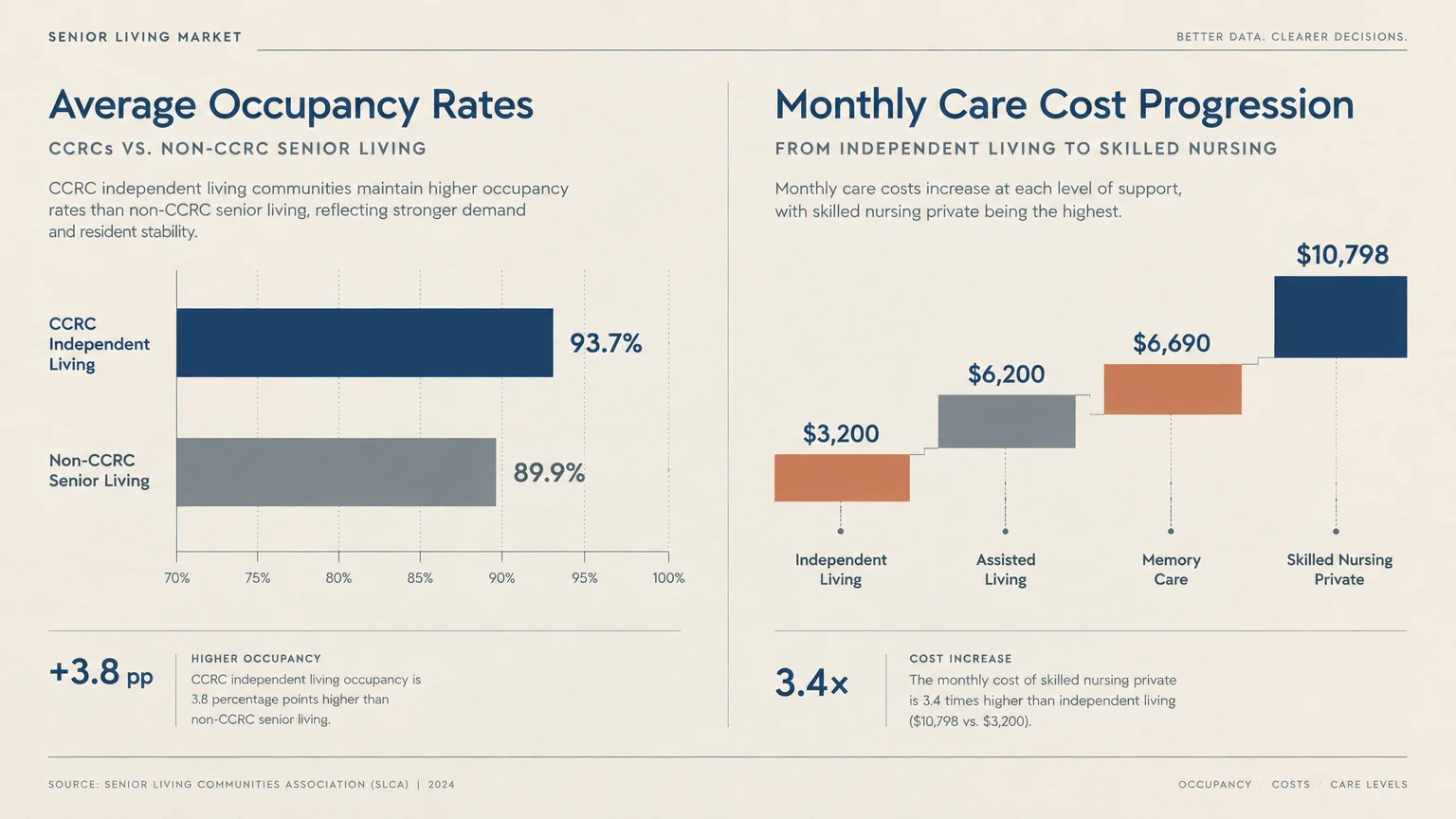
Data from the National Investment Center for Seniors Housing & Care reveals an unprecedented surge in demand for life plan campuses. Independent living occupancy in these communities has reached 93.7%.
By comparison, non-CCRC senior housing communities maintain an average occupancy rate of 89.9%. This spread illustrates why waiting lines for premier continuing care homes continue to lengthen nationwide.
High occupancy directly restricts immediate move-in availability when unexpected health challenges arise. When you wait for a medical emergency before searching for housing, your choices shrink dramatically.
National entrance fees now average more than $480,000 across entrance-fee life plan communities. Depending on your chosen geographic region and contract structure, entrance costs span from $40,000 to well over $2 million.
Average monthly service fees for independent living in entrance-fee communities sit between $4,166 and $4,246. These fees cover home maintenance, campus dining, security, activities, and municipal utility services.
Stand-alone long-term care alternatives present substantial financial volatility over time. Current market figures show median independent living costs average $3,200 monthly, while assisted living reaches $6,200 each month.
Specialized memory care facilities now require a median rate of $6,690 per month. Skilled nursing care escalates even further, averaging $9,581 for semi-private rooms and $10,798 monthly for private suites.
Joining a waitlist protects you from these sudden market spikes by establishing predictable lifetime care costs. You preserve your wealth while securing a structured continuum of care on your own terms.
Strategic Planning Pillars for Waitlist Success
Securing a residence in a top-tier retirement community demands proactive management across three distinct domains. You must align your financial portfolio, healthcare expectations, and lifestyle vision well before your moving date.
Pillar 1: Financial Architecture and Contract Structuring
Understanding the nuances between senior living contract models prevents unexpected expenses later in life. Communities typically structure agreements around three primary frameworks that dictate lifetime healthcare costs.
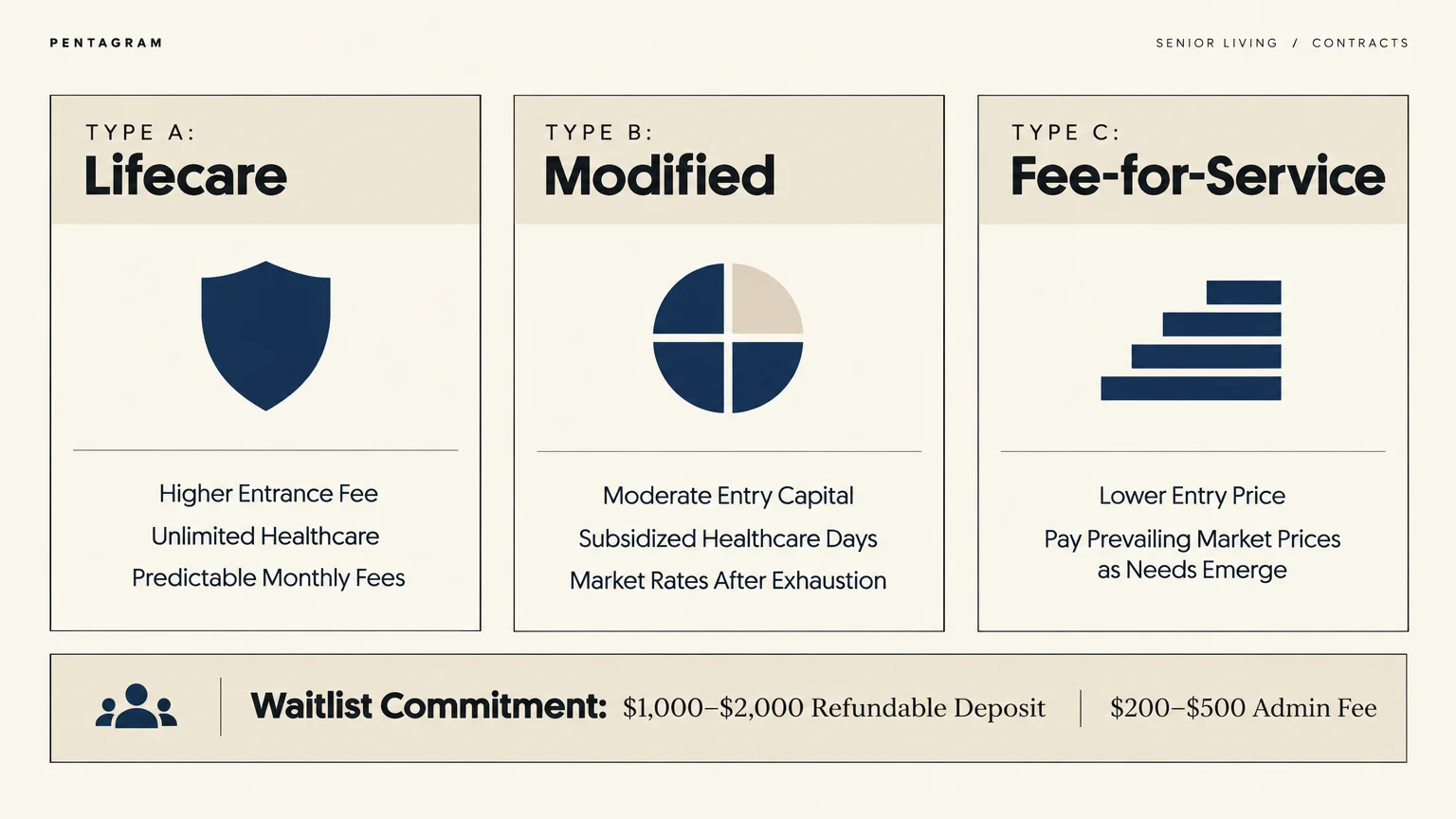
Type A Lifecare contracts require higher upfront entrance fees but provide unlimited healthcare with virtually no increase in monthly fees. Your monthly service fee remains steady even if you transition into skilled nursing.
Type B Modified contracts lower your upfront capital requirements but limit subsidized healthcare access to a designated timeframe. Once you exhaust those covered care days, you pay market rates for ongoing nursing support.
Type C Fee-for-Service contracts feature lower entry prices but offer no healthcare subsidies. You pay prevailing market prices for assisted living, memory care, and nursing care as needs emerge.
Joining a prospective community waitlist generally requires a refundable deposit between $1,000 and $2,000. Communities also assess a non-refundable administrative processing fee between $200 and $500.
When your preferred residence becomes available, communities require a 10% entrance fee reservation deposit. This commitment holds your selected unit for approximately 90 days while you finalize home sales.
Consult the Internal Revenue Service regarding medical expense deduction rules. Many residents deduct a substantial portion of non-refundable entrance fees as prepaid healthcare on their tax returns.
Pillar 2: Proactive Health and Wellness Management
Entering a life plan community while you are fully independent unlocks the greatest long-term advantages. Communities mandate thorough medical reviews to verify functional independence before executing an independent living agreement.
Delaying your application until physical or cognitive frailties emerge can jeopardize your admission status. Underwriters may deny entry or restrict you from accessing favorable Type A Lifecare protections.
Review the exact coverage parameters established by Medicare for long-term health services. Medicare covers acute post-hospital rehabilitation but never pays for permanent custodial care in assisted living or nursing facilities.
CCRCs eliminate this healthcare gap by integrating comprehensive care clinics directly into community campuses. You receive preventative wellness oversight, physical therapy, and emergency response without leaving home.
Pillar 3: Lifestyle Design and Community Integration
Retirement living has evolved beyond quiet retreats into energetic centers of intellectual vitality and social engagement. Modern campuses offer lifelong learning partnerships, fine arts studios, and comprehensive fitness facilities.
Joining a waitlist early allows you to experience campus culture well before your physical relocation. Most communities invite waitlist members to attend cultural lectures, dine on-site, and join campus social groups.
This trial period enables you to build meaningful friendships with future neighbors years ahead of time. You transition seamlessly into an established peer community rather than facing the isolation of moving alone.

Twelve Premier Retirement Communities With Waitlists Worth Joining
The following twelve communities deliver exceptional financial stability, superior care ratings, and vibrant resident cultures. Each campus commands substantial regional demand, making an immediate waitlist application an intelligent decision.
1. Kendal at Oberlin (Oberlin, Ohio)
Kendal at Oberlin operates under Quaker values of inclusion and mutual respect adjacent to Oberlin College. Residents frequently attend conservatory concerts, audit university seminars, and collaborate on community initiatives.
Under its Platinum Type A Lifecare contract, single-occupancy entry fees range from $130,598 to $616,564. Double-occupancy entrance fees span from $248,307 to $713,019, with monthly fees between $3,732 and $7,498.
Joining the Kendal Priority List requires a $1,000 refundable deposit alongside a $200 to $500 processing fee. Priority status grants you access to the Priority Portal, virtual courses, and annual financial statements.
The community excels in environmental sustainability, boasting extensive walking trails and accredited arboretum grounds. You secure predictable lifelong care backed by robust philanthropic reserves.
2. Vi at Palo Alto (Palo Alto, California)
Vi at Palo Alto delivers luxury Type A living on 23 private acres leased from Stanford University. Its prime Silicon Valley location provides seamless access to world-class academic lectures, cultural venues, and medical specialists.
For spacious two- and three-bedroom floor plans, entrance fees range from $4,096,000 to $9,940,200 under 0% repayable terms. Contracts featuring a 75% repayable refund option reach up to $13,453,600.
Monthly service fees range between $10,550 and $14,510, with a second-person entrance fee of $50,000 to $80,000 and monthly fee of $3,090. Residents enjoy valet parking, culinary excellence, and complete on-site care.
Waitlists for these premier northern California residences move deliberately due to exceptionally low annual turnover. Securing your reservation today positions you for peerless Bay Area retirement living.
3. Willow Valley Communities (Lancaster, Pennsylvania)
Willow Valley Communities encompasses 210 manicured acres in Lancaster County, offering more than 100 distinctive home layouts. The campus features a 2,000-seat cultural center, bowling alleys, and multiple culinary venues.
The community stands out as one of the few CCRCs nationwide holding an ‘A’ credit rating from Fitch Ratings. Fitch affirmed this outstanding financial rating in December 2025, confirming fiscal strength.
Under its Type A Lifecare contract, monthly costs average $5,462, with base rates spanning from $2,585 to $8,340. Entrance fees vary depending on the home layout and your chosen refund structure.
Waitlist timelines average between one and three-plus years depending on your requested architectural style. Joining early protects your future healthcare expenses across all levels of assistance.
4. Oak Hammock at the University of Florida (Gainesville, Florida)
Oak Hammock partners with the University of Florida to deliver an intellectually stimulating retirement environment. Residents receive university identification cards, attend athletic events, and audit collegiate academic courses.
An on-site UF Health clinic delivers primary medical care directly on campus grounds. In mid-2025, Fitch Ratings affirmed its revenue bonds at ‘BBB’ with a stable financial outlook.
The community recently financed an expansion of 56 new independent living units to satisfy escalating applicant rosters. Both maintenance-free apartments and private club homes remain in high demand.
Joining the waitlist requires a $1,500 fully refundable deposit. Oak Hammock permits unlimited passes on offered units, providing a convenient 48-hour decision window whenever a residence opens.
5. Horizon House (Seattle, Washington)
Horizon House offers dynamic vertical senior living within Seattle’s walkable First Hill neighborhood. Residents govern their community actively through dozens of intellectual, artistic, and social committees.
Current monthly service fees for independent and assisted living accommodations start at approximately $6,200. Residents enjoy immediate walking access to cultural landmarks, symphony performances, and top-tier medical complexes.
The community is accepting advance waitlist reservations for its ambitious West Tower expansion project. This sustainable 33-story high-rise building is scheduled to open its doors in 2029.
Reserving your position today ensures priority selection for modern, energy-efficient high-rise residences. You lock in vibrant metropolitan senior living in the heart of the Pacific Northwest.
6. Galloway Ridge at Fearrington (Pittsboro, North Carolina)
Galloway Ridge occupies 67 serene acres just minutes from Chapel Hill in the historic Fearrington area. Residents enjoy on-campus primary care suites operated by Duke Primary Care and UNC Health Clinic.
Single-occupancy entry fees range from $309,000 to $1,214,000, with monthly fees between $3,358 and $6,461. Prospective residents select between traditional declining refund and 75% return-of-capital Type A Lifecare agreements.
High regional demand causes prospective residents to spend up to six years navigating its two-tier waitlist. Applicants initially sign a Waitlist Agreement before executing the formal Residence Preference Agreement.
Securing a position years in advance ensures you access this premier Research Triangle community on your schedule. You protect your assets while accessing exceptional collegiate healthcare networks.
7. Enso Village (Healdsburg, California)
Enso Village represents America’s first Zen-inspired Life Plan Community, located in Northern California’s scenic Sonoma County. Developed by The Kendal Corporation and the San Francisco Zen Center, it centers on contemplative aging.
The community offers both 50% and 80% repayable entrance fee contracts to safeguard family estates. Monthly service fees range from $1,850 to $8,695, with an overall campus average of $5,272.
Dining options emphasize seasonal, farm-to-table vegetarian and locally sourced cuisine supported by an expansive teaching garden. Meditation halls, tranquil courtyards, and walking paths foster holistic spiritual and physical wellness.
You can enter the Enso Village Priority Program with a refundable $1,000 deposit. This early commitment secures your placement within one of the country’s most groundbreaking mindful communities.
8. RiverWoods Exeter (Exeter, New Hampshire)
RiverWoods Exeter spans three distinct wooded campuses near New Hampshire’s charming seacoast. It ranks in the top 2% of continuing care retirement communities nationwide with an ‘A-‘ credit rating from Fitch Ratings.
Under its 90% refundable contract schedule, entrance fees range from $237,000 for studios to $1,137,000 for private cottages. Monthly service fees range from $3,153 to $9,410.
Second occupants pay an entrance fee of $60,000 alongside an additional monthly fee of $2,052. The not-for-profit community continually reinvests net operating revenues into enhanced resident services.
Waitlists for independent cottages and large apartments routinely exceed three years. Joining the registry today preserves your capital through refundable contracts while guaranteeing future care.
9. Peachtree Hills Place (Atlanta, Georgia)
Peachtree Hills Place provides luxury 55+ senior living through an equity-ownership framework in Atlanta’s prestigious Buckhead neighborhood. Rather than paying traditional entrance fees, residents purchase luxury condominium homes outright.
Homeowners pay a Monthly Club Service Fee of $4,060, with a second-person fee of $2,030. This monthly fee includes a generous $500 monthly dining credit per person across gourmet venues.
Ongoing building maintenance is funded through a monthly homeowners association assessment of $0.47 per square foot. The gated campus features regulation croquet lawns, fitness studios, and licensed healthcare wings.
Available homes sell quickly through dedicated real estate channels and internal member waitlists. Registering early ensures you receive notice of condominium resales in this prime Buckhead location.
10. Shell Point Retirement Community (Fort Myers, Florida)
Shell Point Retirement Community covers waterfront islands along the Caloosahatchee River near the Gulf of Mexico. This sprawling campus enforces a minimum entry age of 60 and offers four distinct contract options.
Residents can select Standard Type A Lifecare or a Type A contract offering a 75% refund option. To choose the 75% refund contract, at least one spouse must be 85 or younger.
Shell Point also provides a Type B Modified Lifecare option featuring a 15% reduction on the Type A entrance fee. Their Type C Fee-for-Service structure delivers a complete 100% entrance fee refund.
With on-site championship golf, boat docks, and dedicated medical centers, waitlists remain extensive across the property. Submitting a waitlist deposit protects your future access to premier Florida coastal living.
11. Glenaire (Cary, North Carolina)
Glenaire is a premier Type B Modified Life Plan Community located near Raleigh in Cary, North Carolina. The community requires a minimum entry age of 62 for primary applicants and 58 for co-applicants.
Entrance fees range from $87,000 to $1,025,000 depending on home layout and refund structure. Glenaire provides multiple agreement choices, including declining refund, 50% refundable, and 90% refundable options.
Monthly service fees range between $3,309 and $6,901, ensuring steady operational support and healthcare buffers. Residents enjoy an expansive wellness pavilion, saltwater pool, and walkable access to downtown Cary.
Waitlists for spacious two-bedroom apartments and single-story cottages span several years. Joining the registry now allows you to orchestrate your downsizing timeline with complete peace of mind.
12. Searstone (Cary, North Carolina)
Searstone delivers boutique Type A LifeCare living nestled within a walkable commercial village in Cary. In March 2024, the campus opened its Highview expansion, adding 149 elegant independent living residences.
Entrance fees range from $409,000 to $1,030,000, with monthly service fees spanning from $3,720 to $8,680. Second-person monthly fees sit at an affordable $1,740 per month.
The campus showcases farm-to-table dining spaces, landscaped walking promenades, and contemporary wellness facilities. Type A coverage shields your finances against unpredictable long-term nursing care costs.
Because the Highview expansion experienced rapid pre-leasing, replacement waitlists have formed across premium floor plans. Securing your waitlist status today ensures you capture upcoming apartment openings.

Expert Voices: Why Waiting Lists Require Early Action
Retirement planning professionals emphasize that waiting until a health crisis occurs eliminates your housing options. Delaying senior living decisions leaves you vulnerable to emergency placements in facilities you did not choose.
Certified Financial Planner professional Marcus Vance advises clients to treat waitlist deposits as strategic risk management. Vance highlights that selling property during economic downturns can damage retirement portfolios.
“A waitlist deposit functions as a low-cost call option on your future quality of life,” Vance notes. “You gain priority access to premier care without surrendering substantial investment capital today.”
Gerontologist Dr. Elena Morales studies the relationship between social connectivity and cognitive health in aging adults. Her clinical research indicates that proactive transitions into communal environments yield superior longevity outcomes.
“Moving while you remain active allows you to form deep friendships before health challenges arise,” Dr. Morales explains. “Those established social bonds significantly reduce cognitive decline and depression in later years.”
Retiree Barbara Jenkins joined two regional waitlists at sixty-six before moving into her chosen campus at seventy-two. “Passing on offers gave me complete control until I felt ready to downsize,” Jenkins shares.
“When my husband required physical rehabilitation, our community handled every medical transition seamlessly,” Jenkins adds. “Joining that waitlist years early was the single smartest financial decision we ever made.”

Financial Safeguards and Contract Evaluation Strategies
Committing significant capital to a life plan community requires comprehensive due diligence. You must evaluate the provider’s balance sheet, occupancy history, and statutory reserve funds before executing an entrance contract.
Examine credit ratings from major independent analytical agencies such as Fitch Ratings to confirm operational viability. Organizations maintaining investment-grade ratings demonstrate sufficient liquidity to endure economic fluctuations.
Scrutinize the legal conditions governing entrance fee refunds in your contract disclosure. Some agreements mandate that the community must re-lease your specific residence before releasing refundable funds to your estate.
Beware of wire transfer fraud when paying initial application fees or reservation deposits. Always verify banking wiring instructions directly with community financial directors by telephone before authorizing payments.
Understand the community’s clinical assessment policies before signing binding residency paperwork. If your physical or cognitive health declines prior to move-in, providers may reassign you directly to assisted living.
Consult resources from the AARP Public Policy Institute regarding long-term care contracts and resident rights. Reviewing fee escalation histories helps you anticipate future monthly service fee adjustments.
Review your lifetime retirement income through the Social Security Administration before finalizing your budget. Aligning your guaranteed pension and Social Security payments with base monthly fees prevents portfolio depletion.
Frequently Asked Questions About Senior Housing Waitlists
How do priority waitlists actually operate?
Communities organize priority lists based on the date your deposit clears into their escrow account. When a residence becomes available, administrators contact registered members matching that specific floor plan profile.
Most campuses offer “active” and “ready” list categories. Active members seek immediate move-in opportunities, while ready members hold their place in line until they feel prepared to transition.
Can you decline an offered residence without losing your seniority?
Most reputable life plan communities allow you to decline an offered unit without penalty. You simply exercise a “pass,” and your name remains at the top of the priority roster.
Certain communities, such as Oak Hammock, explicitly permit unlimited passes on offered residences. However, always review contract terms carefully, as some providers restrict members to two or three passes before resetting seniority.
Are CCRC entrance fees tax-deductible as medical expenses?
A substantial portion of your upfront entrance fee often qualifies as a deductible medical expense under federal tax law. Communities supply annual actuarial letters detailing the exact percentage attributable to prepaid healthcare.
Additionally, a portion of your ongoing monthly service fees generally qualifies for medical deductions. You must itemize deductions on your federal tax return to claim these valuable savings.
What occurs if my health declines while on a waitlist?
If your health deteriorates before move-in, the community evaluates whether you can reside safely in independent living. If not, administrators may transition your admission directly into assisted living or memory support.
Certain Type A contracts require functional independence at entry to secure lifetime discounted healthcare rates. Joining a waitlist early allows you to transition while satisfying all independent clinical criteria.
Take Meaningful Action in the Next Forty-Eight Hours
Securing a vibrant retirement lifestyle requires proactive planning rather than reactive scrambling. By establishing your priority status today, you protect both your financial assets and your family from unnecessary emotional strain.
Select two or three communities that match your preferred climate, lifestyle interests, and budget. Contact their marketing teams this week to request comprehensive disclosure statements and waitlist agreements.
Reviewing community financial disclosures costs you nothing but provides extraordinary clarity for your retirement roadmap. Submitting a modest refundable deposit gives you unmatched flexibility over your future.
Take the first step within the next forty-eight hours by scheduling an introductory campus tour or phone consultation. You will experience profound peace of mind knowing your retirement plan is securely in place.