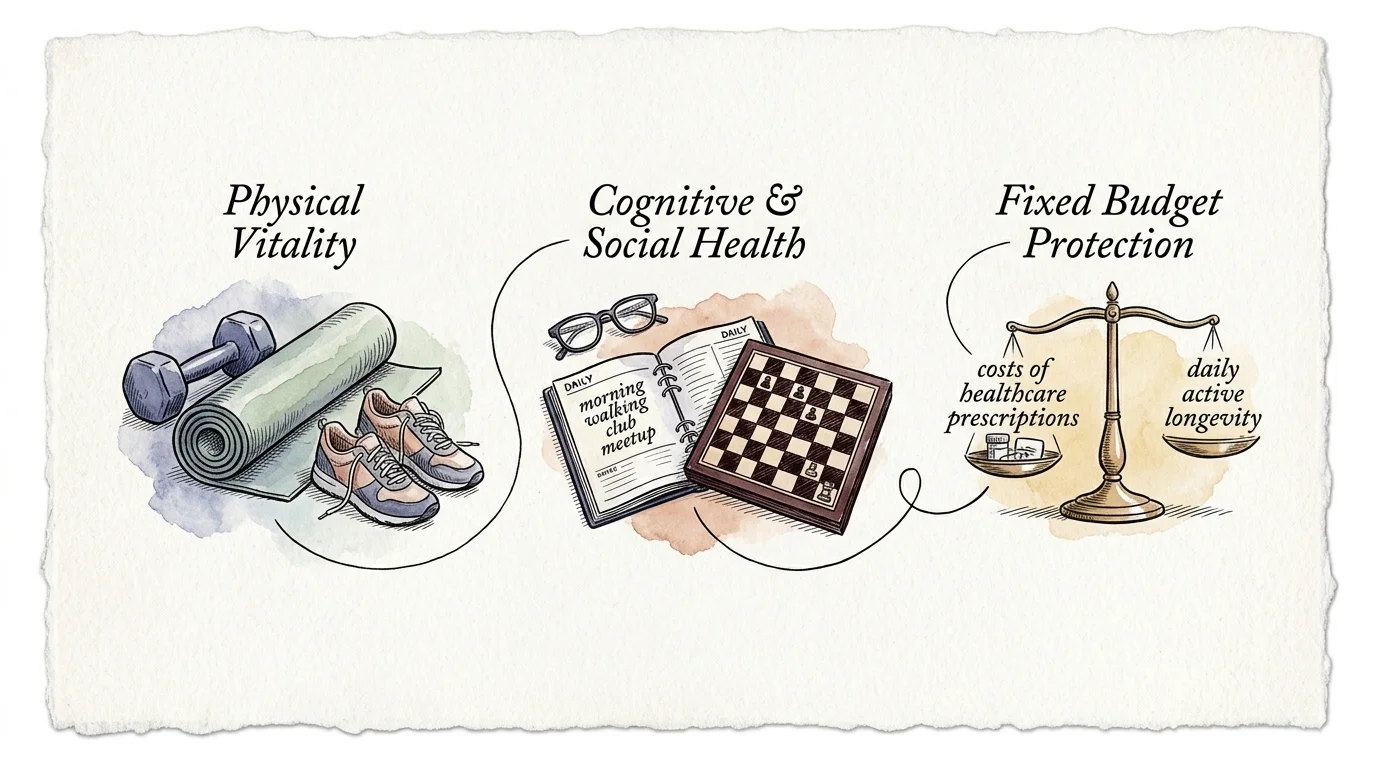
Three Strategic Pillars: Integrating Fitness into Your Retirement Plan
Viewing your gym benefit as an isolated perk underutilizes its true financial and personal value. Incorporating regular physical activity into your financial, lifestyle, and healthcare strategies produces compounded rewards throughout retirement.
Pillar 1: Financial Optimization and Budget Preservation
Commercial gym memberships average between $50 and $100 per month across the United States. Utilizing your Medicare Advantage fitness benefit immediately redirects $600 to $1,200 back into your annual retirement budget.
Over a twenty-year retirement, investing those avoided membership dues into a conservative growth portfolio yields significant supplemental wealth. You eliminate a recurring discretionary expense without sacrificing your daily wellness routine.
Furthermore, preventive exercise drastically curtails personal healthcare spending over time. Data from the Centers for Disease Control and Prevention shows regular physical activity reduces individual chronic care costs substantially.
Certified Financial Planner™ Marcus Vance notes that clients who utilize wellness benefits spend far less on unexpected medical out-of-pocket expenses. He advises retirees to treat free fitness perks as an essential hedge against rising healthcare inflation.
Pillar 2: Functional Mobility and Fall Prevention
Maintaining physical independence forms the core foundation of a fulfilling retirement lifestyle. Functional training targets balance, joint stability, and core strength to preserve your ability to travel and live independently.
Accidental falls represent the primary cause of injury-related hospitalizations among older adults, according to the National Institute on Aging. Regular participation in guided balance classes cuts fall risk dramatically.
Gerontologist Dr. Elena Rostova emphasizes that progressive resistance training reverses age-related muscle loss, known clinically as sarcopenia. She notes that two weekly strength sessions preserve bone density and keep retirees self-reliant.
Whether you practice water aerobics or lift light dumbbells, consistent movement protects your musculoskeletal system. Senior-focused classes provide expert supervision to ensure you perform every movement safely.
Pillar 3: Social Infrastructure and Cognitive Longevity
Retirement abruptly removes the built-in social network that daily employment previously provided. Fitness facilities serve as vital community hubs where older adults build lasting friendships and supportive social circles.
Research confirms that prolonged social isolation poses severe health risks comparable to smoking fifteen cigarettes a day. Gathering for a morning yoga class or walking club establishes a dependable social routine.
Physical movement also stimulates neuroplasticity by increasing blood flow to the brain and promoting new neural connections. Engaging both your muscles and mind guards against cognitive decline and elevates daily mood.
When you pair physical workouts with cognitive brain tools like those in Renew Active, you protect your mental clarity. This dual approach sharpens your focus and enriches your everyday retirement experience.