
Market rents across the country sit between $1,384 and $1,913 a month, while typical retired workers collect $2,092 from Social Security. Trying to cover housing, groceries, and medical bills on $2,000 a month in a major city feels impossible.
You can still retire comfortably on $2,000 a month by pairing disciplined cash-flow tracking with smart geographic arbitrage. This guide maps out your baseline budget, reveals 10 affordable retirement towns, and shows you how to cut recurring bills without sacrificing daily joy.
The Reality Check: Stretching $2,000 a Month Today
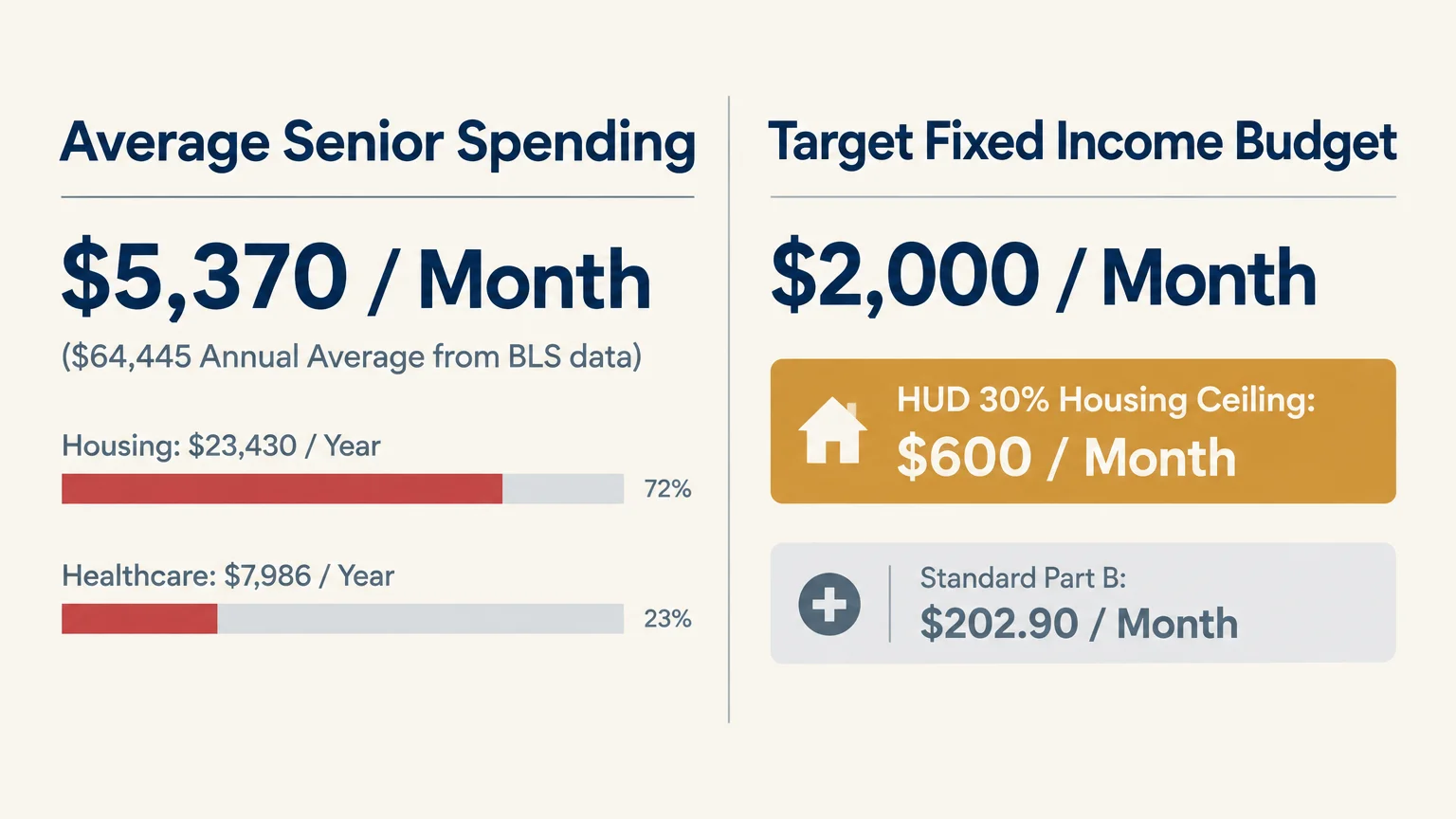
Living on Social Security requires clear math because typical senior expenses far exceed a $2,000 monthly check. Data from the 2025 Bureau of Labor Statistics Consumer Expenditure Survey shows households age 65 and older spent an average of $64,445 a year, or about $5,370 monthly.
Housing and medical care drive most of that pressure. Older households averaged $23,430 a year on housing—35% of spending at ages 65 to 74 and 39% at age 75 and older—plus $7,986 a year on healthcare.
Meanwhile, Clever Real Estate reported in 2026 that 46% of retirees struggle to pay expenses and 29% hold no retirement savings. Those numbers explain why a high-cost zip code quickly drains a fixed income.
The U.S. Department of Housing and Urban Development (HUD) defines spending more than 30% of your income on shelter as cost-burdened. On a $2,000 monthly budget, your total housing ceiling sits at just $600 a month.
National real estate benchmarks make that target look daunting at first glance. Zillow placed the typical U.S. home value near $365,000 in late 2026, while the National Association of Realtors reported a $409,000 median single-family home price.
According to RetireCityIQ in May 2026, retiring comfortably on $2,000 a month—or $24,000 a year—works only under specific conditions. You generally need a paid-off mortgage, a partner or roommate sharing expenses, income-restricted senior housing, or a very low-rent market.
When you lower your shelter overhead first, the rest of your budget gains breathing room. Small-town retirement gives you the space to meet your health, housing, and family goals on a predictable check.
Baseline Assessment: Map Your Cash Flow Before You Move
Before comparing cheap places to retire, audit every dollar entering and leaving your checking account. Start by listing your exact net income after automatic deductions rather than relying on gross benefit estimates.
In October 2026, the average retired-worker Social Security benefit stood at $2,092 a month following a 2.8% cost-of-living adjustment. Across all beneficiaries—including survivors and disability recipients—checks averaged $1,946.23, while spousal benefits averaged $988 a month.
Remember that Medicare Part B premiums usually come straight out of your monthly deposit. In 2026, the standard Part B premium is $202.90 a month, though roughly 20.8 million Original Medicare enrollees received a one-time $90 rebate in October 2026.
Next, separate your monthly outflows into fixed obligations and flexible spending. Fixed obligations include rent or property taxes, homeowners or renters insurance, utility base charges, debt minimums, and supplemental health premiums.
Variable expenses cover groceries, gasoline, home maintenance, dining out, and gifts for grandchildren. Tracking thirty days of bank and card statements exposes hidden leaks like forgotten streaming bundles or high-fee bank accounts.
Check your tax exposure early so surprises never derail your spring cash flow. Under IRS rules, federal taxes apply when your combined income—adjusted gross income plus tax-exempt interest and half of Social Security—hits $25,000 single or $32,000 joint.
If you live solely on $2,000 a month in Social Security, your combined income equals just $12,000 a year. That sits well below federal taxation thresholds, leaving every benefit dollar in your pocket.
Retirees with modest pension or IRA withdrawals also gain extra protection through tax year 2028 under Public Law 119-21. Taxpayers age 65 and older receive an extra $6,000 senior deduction—or $12,000 for joint filers both 65 or older—phasing out above $75,000 single or $150,000 joint.
That temporary break stacks atop the standard deduction and existing age-65 add-ons, which total $32,200 plus $1,650 per qualifying spouse for 2026 joint filers. State taxes matter just as much when selecting your destination.
Only eight states—Colorado, Connecticut, Minnesota, Montana, New Mexico, Rhode Island, Utah, and Vermont—tax Social Security in any form for 2026. Forty-two states and Washington, D.C., exempt benefits completely, including nine states with no broad individual income tax.
If high-interest credit card balances or lingering car notes crowd your fixed budget, get objective help right away. You can work with a certified advisor through the National Foundation for Credit Counseling to build a realistic debt payoff plan before relocating.

10 Charming Affordable Retirement Towns for a $2,000 Budget
Roughly 4.1 million Americans turn 65 in both 2026 and 2027, and over 338,000 moved in retirement over the prior year—a 44% jump. GOBankingRates found that livable small towns with 1,000 to 10,000 residents post rents starting as low as $888 a month.
The 10 towns below offer genuine charm, community connection, and verified 2026 cost benchmarks. Pay close attention to whether each spot fits a solo renter, a couple pooling two checks, or a paid-off homeowner.
1. Bluefield, West Virginia
Tucked into the Appalachian mountains, Bluefield delivers crisp scenery and high elevation that keeps summer highs mostly below 90 degrees. Average rents run around $850 a month, and median home prices sit near $107,000, according to Far & Wide in April 2026.
West Virginia finished phasing out its state Social Security tax in 2026, preserving more of your monthly check. You can also audit lifelong learning classes through Bluefield State University while keeping housing costs close to your target.
Solo retirees with modest savings can buy a starter cottage outright or share a two-bedroom rental to beat HUD’s $600 housing benchmark. Couples combining benefits gain substantial room for travel and healthcare reserves.
2. Corning, Iowa
Iowa ranks among the three lowest-rent states in the country at $987 a month statewide, per Apartments.com in November 2026. In quiet Corning, average rents drop even lower to roughly $700 a month, with median home values near $140,960.
About 20% of Corning residents are age 65 or older, creating an established peer network around town events and local clubs. Iowa also exempts Social Security and most retirement income from state taxation.
Because rent sits near the $600 threshold before utilities, a solo retiree living on $2,000 a month can rent comfortably here without touching principal. Paid-off homeowners enjoy an exceptionally low annual tax and upkeep burden.
3. Freeport, Illinois
Located in northern Illinois within reach of regional medical centers, Freeport blends historic brick architecture with parks and walking trails. Average rents hover around $722 a month, while typical home values sit near $120,331.
That pricing lets a solo renter keep shelter near one-third of a $2,000 monthly income. If you sell a higher-priced suburban home elsewhere, buying here free and clear eliminates mortgage payments entirely.
Verify local property tax rates before purchasing in Illinois, since county assessments vary widely across the state. Renters avoid property tax spikes while keeping monthly housing predictable.
4. Decatur, Illinois
Set beside Lake Decatur in central Illinois, this welcoming community offers waterfront parks, public golf courses, and community theater at 90% of the national cost of living. U.S. News and AmeriSave reported a median home value of roughly $89,855 in October 2026.
Purchasing a modest home under $90,000 with cash from a prior home sale unlocks huge monthly flexibility on a $2,000 budget. Without a mortgage, your fixed income covers taxes, insurance, utilities, and groceries comfortably.
Decatur also provides regional hospital access right inside town limits, cutting long highway drives to medical appointments. Keeping specialist visits local trims fuel and vehicle wear over time.
5. Enid, Oklahoma
Apartments.com ranked Oklahoma the least expensive rental state in November 2026, averaging just $928 a month statewide. Enid brings small-city conveniences, museums, and friendly neighborhoods alongside median home values between $143,000 and $200,000.
If you prefer renting, look for one-bedroom apartments or senior-focused complexes below the statewide average to protect your monthly cash cushion. Couples combining two Social Security checks can easily afford a modest mortgage or comfortable rental.
Oklahoma exempts Social Security benefits from state income tax, keeping your net check intact. Check local wind and hail homeowners insurance quotes early so storm coverage fits cleanly inside your fixed budget.
6. Hot Springs, Arkansas
Arkansas holds the second-lowest state average rent at $973 a month, and Hot Springs pairs that affordability with a national park running straight through downtown. Appearing on multiple 2026 budget-retirement lists, the town offers thermal bathhouses, lake recreation, and walkable historic blocks.
Retirees on $2,000 a month do best here by owning a paid-off home, sharing rent with a companion, or applying for income-qualified senior apartments. State tax exemptions on Social Security add extra breathing room every April.
Free trails and historic district strolls replace pricey entertainment memberships. You can stay physically active year-round without draining your discretionary line.
7. Fort Smith, Arkansas
Sitting along the Arkansas River, Fort Smith delivers frontier history, regional medical facilities, and a low-stress pace in a state averaging $973 a month for rent. Both Far & Wide and RetireBetterNow highlighted Fort Smith as a standout budget-retirement pick in 2026.
Because housing runs far below national averages of $1,384 to $1,913, your Social Security check stretches further at the grocery store and pharmacy. Solo retirees should target smaller rentals or manufactured-home communities with low lot fees.
Couples pooling benefits—projected to average over $3,355 a month at age 67 in 2027—can live generously in Fort Smith while building cash reserves. Local arts centers and riverfront parks provide low-cost ways to host visiting grandchildren.
8. Hickory, North Carolina
Nestled in the Catawba Valley near the Blue Ridge foothills, Hickory offers four mild seasons and strong healthcare access. GOBankingRates estimated single-person living costs around $28,400 a year in March 2026, with average rents at $1,168 and home values near $285,672.
At $1,168 a month in market rent, a solo retiree earning $2,000 cannot rent alone here without exceeding HUD’s 30% affordability cap. Instead, Hickory shines if you bring equity to buy mortgage-free, share housing with a roommate, or retire as a couple.
North Carolina also exempts Social Security benefits from state income tax, improving your net cash flow. Enjoy local furniture outlets, farmers markets, and lakeside walks without paying coastal or big-city premiums.
9. Casper, Wyoming
If wide-open mountain views and zero state income tax appeal to you, Casper combines outdoor access with a lively regional downtown. GOBankingRates placed average rent at $1,003 a month, home values near $300,839, and single-person annual costs around $32,000.
Because single-person costs exceed $24,000 a year, Casper fits $2,000-a-month budgets best when you own your home outright or split housing costs with a partner. Wyoming levies no broad individual income tax, shielding pensions and retirement account withdrawals as well.
Plan winter utility budgets carefully in central Wyoming, where heating bills rise during cold months. Choosing a compact, well-insulated condo or townhome keeps snow removal and heating expenses manageable.
10. Green Valley, Arizona
South of Tucson, Green Valley was built with retirees in mind, with roughly 80% of residents age 65 or older across about 130 mostly age-restricted communities. Forbes listed its median single-family home price at $282,000 in May 2026—well under the $409,000 national median.
This desert town works on $2,000 a month primarily for downsizers who buy a condo or modest home mortgage-free with equity from a previous house. Once your mortgage disappears, HOA dues, utilities, and property taxes fit comfortably inside your monthly check.
Arizona exempts Social Security from state income tax, and Green Valley’s recreation centers pack pools, pickleball courts, and hobby clubs into low annual fees. Verify exact HOA assessments and special-assessment histories before signing any purchase contract.
Optimization Moves: Cut Monthly Bills Without Losing Joy
Choosing an affordable town sets the foundation, yet smart daily habits keep your cash flow positive year after year. Focus your adjustments on the three categories that consume the biggest share of senior budgets.
Housing and Utility Relief
If buying mortgage-free isn’t an option, explore income-restricted senior apartments and Section 202 supportive housing before signing a market-rate lease. Waitlists take time, so apply early across several preferred towns.
Check local utility billing options such as budget-billing plans that spread summer cooling and winter heating spikes evenly across twelve months. You can also apply for federal heating and cooling relief through the Low Income Home Energy Assistance Program if your household income qualifies.
Simple weatherization swaps—LED bulbs, door sweeps, programmable thermostats, and water-heater blankets—lower monthly kilowatt usage immediately. Many small-town electric co-ops offer free home energy audits and rebates for seniors.
Healthcare and Prescription Savings
Healthcare averaged $7,986 a year for older households in 2025, making annual insurance reviews one of your highest-return habits. Review your coverage every year during Medicare Open Enrollment from October 15 through December 7.
Prescription rules are shifting, so check drug formularies carefully each autumn. Medicare Part D’s national base beneficiary premium moves from $38.99 in 2026 to $41.33 in 2027, while the annual out-of-pocket drug cap rises from $2,100 to $2,400 and the maximum standard deductible rises from $615 to $700.
Ask your doctors about 90-day generic refills, preferred network pharmacies, and therapeutic alternatives that sit in lower copay tiers. Even a single tier shift can save hundreds over twelve months.
If your income hovers near $2,000 a month and your savings are modest, screen yourself for Extra Help and Medicare Savings Programs through Medicare.gov cost assistance programs. Qualifying can eliminate Part B premiums or dramatically lower prescription copays.
Groceries, Transportation, and Free Community Joy
Grocery inflation hits fixed incomes hard, yet small-town shoppers often find lower produce prices at local farm stands and discount grocers. Build weekly meal plans around the USDA monthly food plans to benchmark your kitchen spending against realistic nutritional targets.
Cook batch meals like soups, stews, and casseroles to cut per-serving costs and reduce food waste. Check local senior centers for free or low-cost congregate lunches that double as social outings.
Transportation drains cash quietly through insurance premiums, registration fees, and surprise repairs. Couples who drop from two cars to one after moving to a walkable small town instantly eliminate an entire set of ownership bills.
Replace paid entertainment with public libraries, municipal parks, volunteer ushering at community theaters, and tuition-free university classes where available. Rich social connection costs almost nothing when you plug into local civic life.
Working Part-Time Without Losing Benefits
Picking up a few hours at a local library, golf course, or hardware store adds welcome cash for travel or family gifts. If you haven’t reached full retirement age yet, watch Social Security’s earnings test closely.
In 2027, early retirees under full retirement age can earn up to $25,560 a year—or $2,130 a month, up from $24,480 in 2026—before $1 is withheld for every $2 above the limit. During the calendar year you reach full retirement age, that limit jumps from $65,160 to $67,920, with $1 withheld per $3 over.

Guardrails to Protect Your Fixed Income and Family Goals
A lean budget needs sturdy guardrails because a single unexpected bill can disrupt an entire season. Prioritize a liquid emergency fund before spending extra cash on home upgrades or discretionary trips.
Remember that Original Medicare carries steep cost-sharing during extended medical events. In 2026, Medicare Part A charges a $1,736 inpatient hospital deductible per benefit period, plus $434 a day in coinsurance for days 61 through 90 and $217 a day for skilled nursing days 21 through 100.
Keeping an emergency savings account dedicated strictly to medical deductibles, car tires, and appliance repairs prevents you from turning to high-interest credit cards. Automate a small transfer on the day your Social Security check lands so reserves rebuild after any withdrawal.
Set real-time text or email alerts on your checking and credit card accounts for every transaction above a modest threshold. Instant alerts spot billing errors, double charges, and fraudulent activity within minutes rather than weeks.
Protect yourself from financial scams by freezing your credit files at all three bureaus and ignoring unsolicited calls claiming your Social Security number is suspended. Never share one-time verification codes or move money to protect accounts—legitimate agencies never make those demands.
Keep long-term policy risks in view as you design your housing and debt footprint. Social Security trustees project the combined trust fund could be depleted in 2034 without congressional reform, leaving incoming payroll taxes able to cover roughly 80% of scheduled benefits.
Keeping your fixed monthly bills as low as possible today gives you built-in resilience if future adjustments arrive. Low overhead turns potential policy shifts into manageable tweaks rather than crises.
Frequently Asked Questions About Small-Town Retirement
How do I handle requests for money from adult children on a fixed budget?
Protecting your $2,000 monthly baseline keeps you from becoming financially dependent on your family later. Tell adult children clearly what your monthly budget allows before an emergency arises, and offer non-cash help such as childcare, cooking, or advice instead of loans.
If you genuinely want to help during a crisis, set a hard annual family-gift cap funded solely from surplus savings—never from rent, utility, or medication money. Clear boundaries preserve both your solvency and your relationships.
Can I still budget for travel while living on Social Security?
Yes, provided housing stays near or below 30% of your income and you plan trips during shoulder seasons. Build a separate travel sinking fund by sweeping rebates, part-time earnings, or grocery savings into a high-yield savings bucket each month.
Small-town retirees also slash trip costs by driving to regional state parks, swapping homes with friends, and booking midweek lodging outside peak holiday dates. Traveling off-peak turns a modest travel fund into multiple memorable trips.
What should I test before relocating to one of these cheap places to retire?
Rent a furnished place for at least a month—ideally during the town’s toughest weather season—before hiring movers or buying real estate. Test your exact commute to grocery stores, pharmacies, and the nearest full-service hospital.
Verify that your Medicare Advantage plan or Medigap network includes primary care doctors and specialists accepting new patients locally. Confirm property taxes, homeowners insurance, and utility averages from actual sellers rather than rough online estimates.
Will Social Security COLA increases keep up with my rising expenses?
Cost-of-living adjustments help, though rising healthcare premiums often absorb part of the raise. The Social Security Administration announced a 3.6% COLA on October 14, 2026, adding roughly $75 a month to push the average retired-worker check near $2,170 starting January 2027.
At the same time, Medicare Trustees project the standard Part B premium rising from $202.90 in 2026 to $209.50 in 2027, alongside a $292 Part B deductible and higher Part D caps. Budgeting conservatively for net raises ensures your lifestyle stays comfortable year after year.
Start Your 30-Day Spending Reset This Week
You do not need a six-figure pension to enjoy safe neighborhoods, friendly neighbors, and financial peace of mind. When you align your housing costs with your net Social Security deposit, every other piece of your budget clicks into place.
Commit to a 30-day spending review starting tomorrow morning, writing down every fixed bill and flexible purchase. Pick one concrete move this week—comparing rents in two of the towns above, cancelling an unused subscription, or checking Extra Help eligibility—and put those saved dollars straight into your emergency reserve.