
Paying over two hundred dollars every month for cable television and home internet quietly drains a fixed retirement income. You can slash those combined bills to thirty dollars or less without losing local news, favorite shows, or video calls.
Federal broadband discounts, low-cost senior plans, and free streaming apps have changed how retirees stay connected. Today, overpaying for unused channels or bloated internet speeds is completely optional.
Auditing your monthly statement, claiming income-based internet discounts, and dropping traditional cable frees up serious cash every year. Those extra dollars go straight toward rising prescription, grocery, and housing expenses.
The Hidden Retirement Drain of Bundled Internet and Cable
Staying connected is no longer a luxury when doctors run telehealth appointments online and utility companies push paperless billing. Pew Research Center data shows that 90% of U.S. adults age 65 and older—a population of 61.2 million—now use the internet.
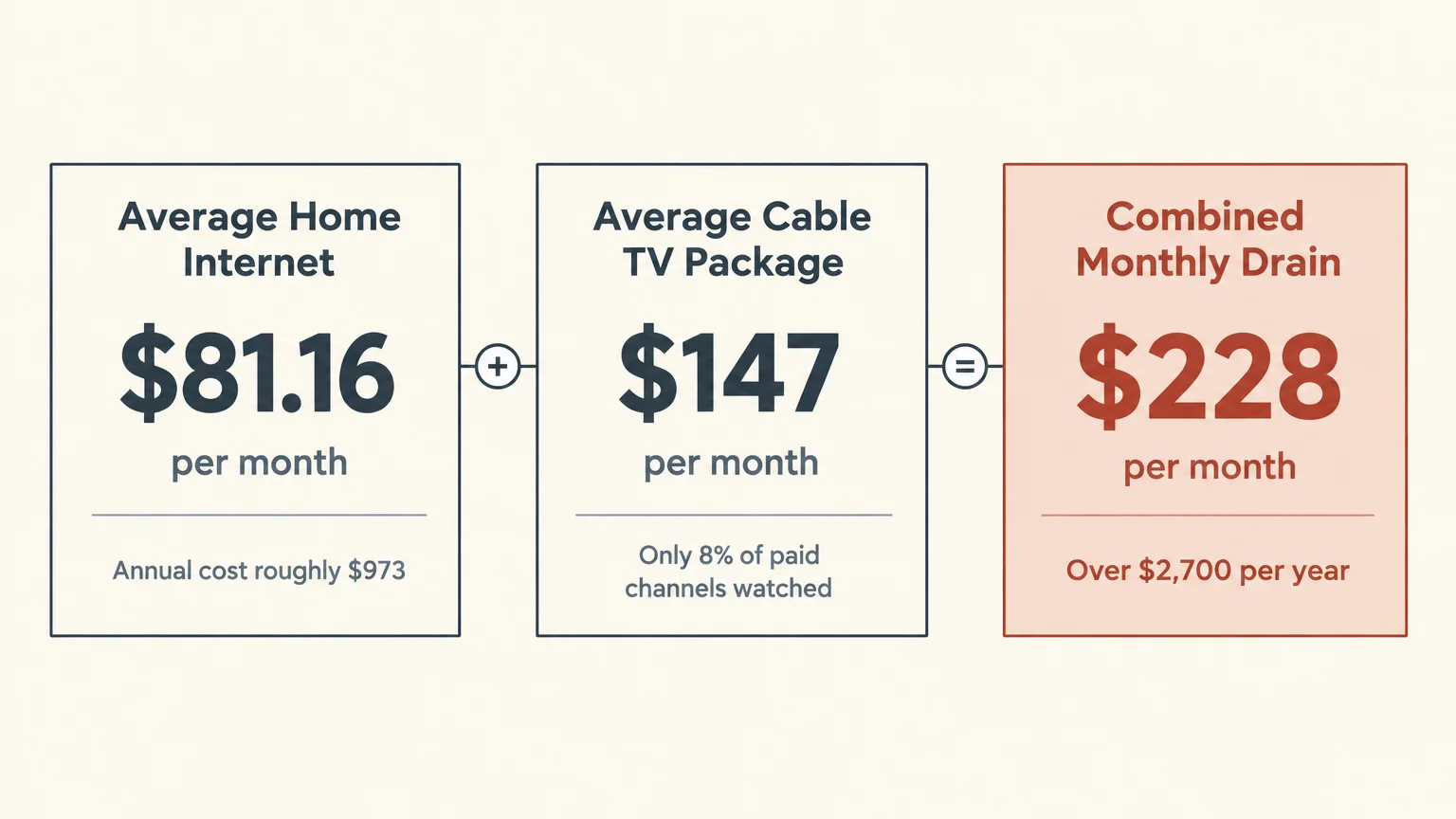
Yet traditional telecom pricing punishes households living on Social Security and modest retirement withdrawals. According to BroadbandNow, the average U.S. home internet bill reached $81.16 per month, or roughly $973 per year, as of March 2026.
Depending on where you live, that bill swings from $65.43 monthly in New Jersey to $109.88 in Alaska. Worse still, equipment rentals, setup charges, and overage fees can tack another $30 per month onto your base rate.
Using the Federal Communications Commission (FCC) 2% of monthly income affordability benchmark, a household needs at least $57,600 in annual income to afford a $96 monthly benchmark plan. Many retirees live on far less while juggling mortgage payments, property taxes, and caregiving costs.
Cable television adds an even heavier anchor to your monthly cash flow. The CableTV.com 2026 Industry Report puts the average cable TV package at $147 per month, even though subscribers watch only about 8% of the channels they pay for.
Combined, typical internet and cable bills quietly consume around $228 every month, or more than $2,700 per year. Nearly half of cable subscribers say they would cancel if prices rise again, and 80.7 million U.S. households are projected to rely on non-pay TV by the end of 2026.
You do not have to accept triple-digit telecom bills as an unavoidable cost of aging in place. Reclaiming even $150 per month gives your retirement budget immediate breathing room.
Baseline Assessment: Auditing Your Cash Flow and Connectivity Bills
Before calling a provider or canceling a single channel, take thirty minutes to see how telecom expenses fit into your wider financial picture. Smart budgeting starts with knowing every dollar coming in and every dollar going out.
Separating Fixed Obligations From Flexible Bills
List every guaranteed monthly income source first, including Social Security benefits, pensions, Supplemental Security Income (SSI), and systematic portfolio withdrawals. Writing down the exact net deposit amounts prevents wishful math when bills arrive.
Next, separate your non-negotiable fixed obligations—housing, property taxes, insurance premiums, minimum debt payments, and Medicare out-of-pocket costs—from variable spending like groceries, fuel, and entertainment. You can compare your spending mix against national Bureau of Labor Statistics consumer expenditure data to spot categories creeping above typical levels.
If high-interest credit card balances or medical debt make even basic utilities feel unmanageable, connect with a nonprofit financial counseling agency before making drastic lifestyle cuts. Free or low-cost budget coaching helps you stabilize debt payments while protecting essential services.
Treat internet access as an essential utility for banking, family contact, and healthcare, while treating paid television as a flexible variable expense. Making that mental shift unlocks huge monthly savings.
Reading Your Broadband Facts Label and Cable Statement
Pull your last three cable and internet statements, then look closely at every line item beyond the advertised package price. Providers routinely bury broadcast TV surcharges, regional sports fees, modem leases, and Wi-Fi router rentals near the bottom of page two.
Every internet provider is now required by the FCC to display standardized Broadband Facts consumer labels at the point of sale. Modeled after nutrition labels, these charts show base monthly rates, introductory rate expiration dates, equipment fees, typical speeds, and data caps.
In July 2026, the FCC approved updated rules to make those labels even easier to read. Pull up the Broadband Facts label for your exact plan online to verify whether your promotional discount already expired.
Write down four numbers from your audit: your current download speed, your monthly equipment fee, your contract end date, and your total out-of-pocket monthly cost. That baseline becomes your bargaining chip—and your exit checklist.
How to Get Cheap Internet for Seniors Without Losing Speed
BroadbandNow reports that 19% of Americans worry about paying their internet bill, jumping to 41% among households that previously relied on the Affordable Connectivity Program (ACP). That $30 monthly federal subsidy officially ended on May 31, 2024, leaving many retirees scrambling for relief.
Although Congress has not enacted a nationwide ACP replacement as of October 2026, strong federal discounts and low-income provider tiers remain wide open. You simply need to know which programs fit your household income or benefit status.
Claiming the FCC Lifeline Discount in 2026
The FCC Lifeline program remains active and reduces monthly bills for eligible low-income households across the country. Through the Universal Service Administrative Company (USAC) Lifeline portal, qualifying households receive up to $9.25 per month off eligible broadband or bundled service, or up to $34.25 per month on qualifying Tribal lands.
Voice-only plans receive a $5.25 monthly discount through November 30, 2026, limited to one Lifeline benefit per household. Qualifying fixed broadband plans must also include at least 1,280 GB of monthly data, while mobile plans include at least 4.5 GB through December 1, 2026.
You qualify based on income if your gross annual household income sits at or below 135% of the 2026 Federal Poverty Guidelines. In the 48 contiguous states and D.C., that threshold is $21,546 for a one-person household or $29,214 for two people.
Higher limits apply outside the mainland—$26,933 for one person and $36,518 for two in Alaska, or $24,786 and $33,602 in Hawaii. Even if your income sits slightly higher, you qualify automatically if anyone in your home receives SNAP, Medicaid, SSI, Federal Public Housing Assistance, or a Veterans Pension or Survivors Benefit.
Gather proof of your benefit award letter or recent tax return before applying online. Once approved, apply your Lifeline discount to a participating low-cost internet plan to push your monthly bill even lower.
Comparing Low-Income Senior Internet Programs
Major internet providers run dedicated low-cost tiers that cost a fraction of standard retail rates—and several require no Lifeline approval at all. Checking eligibility based on age, SSI, or 200% of the federal poverty guidelines opens doors that many retirees miss.
Xfinity Internet Essentials costs $14.95 per month for speeds up to 75/10 Mbps, or $29.95 monthly for 100/20 Mbps Essentials Plus, with zero activation fees and an included Wi-Fi gateway. Households qualify through Medicaid, SNAP, SSI, housing assistance, or income at or below 200% of the Federal Poverty Level—$31,920 for one person or $43,280 for two in 2026—provided they have not held Xfinity internet in the past 90 days.
Spectrum Internet Assist offers 50 Mbps with a free modem, no data caps, and no contracts for $24.99 to $25 per month, dropping as low as $15 with local eligible discounts. Adding in-home Wi-Fi costs $5 extra per month, and new customers age 65 and older receiving SSI qualify directly.
Access from AT&T delivers up to 100 Mbps for $30 per month—equipment included and no data caps—or takes $20 monthly off fiber plans up to 1 Gbps. Eligibility covers SNAP recipients, California SSI participants, and households at or below 200% of federal poverty guidelines.
Verizon Forward starts at $20 per month across Fios, Frontier Fiber, 5G Home, and LTE Home Internet via a discount of up to $30 monthly. Qualifying pathways include Lifeline, SNAP, WIC, a recent Federal Pell Grant, or prior ACP enrollment.
Regional cable carriers offer steep senior breaks too. Optimum Advantage Internet charges $15 per month for 50 to 100 Mbps with a router included and no contracts for SSI-eligible seniors and veterans on public assistance, while Cox ConnectAssist charges $30 monthly for up to 100 Mbps for adults on SNAP, SSI, or TANF.
Wireless 55+ Bundles and Fee-Slashing Moves
If your household income exceeds assistance thresholds, cellular home internet offers an easy escape from cable company rate hikes. AARP reports that 90% of adults age 50 and older already own a smartphone, making mobile-plus-home bundles a natural fit.
T-Mobile 5G Home Internet (Rely) normally costs $50 per month with AutoPay—delivering typical speeds of 133 to 415 Mbps with no contracts or equipment fees—and drops to $30 per month when paired with any T-Mobile 55+ wireless plan. Verizon 5G Home Internet starts at $35 per month with AutoPay when bundled with a Verizon mobile plan via a $15 Mobile + Home discount, while bundled Fios starts at $30.
Do not fall for sales pitches pushing gigabit speeds you will never use. One or two people checking email, joining telehealth video visits, and streaming high-definition television need roughly 50 to 100 Mbps, not 1,000 Mbps.
USTelecom’s 2026 Broadband Pricing Index shows that inflation-adjusted prices for 100 to 249 Mbps entry-level plans fell 17.2% in a single year. Ask your provider to downgrade you to their base speed tier, or switch carriers to capture a lower permanent rate.
Finally, stop paying monthly rental fees for a cable modem or Wi-Fi router if your plan charges for them. Buying a compatible router once eliminates those monthly rental fees for good.

Cutting Cable Without Giving Up Your Favorite Shows
Traditional pay TV is fading fast as retirees realize how much cash disappears into unused channel lineups. Pew Research Center found that only 36% of U.S. adults subscribed to cable or satellite TV in 2025, while 83% used streaming services.
CableTV.com estimates that streaming households spend an average of $30 per month—typically between $20 and $60—compared to $147 monthly for traditional cable. Switching smartly saves over $1,400 per year while keeping your favorite dramas, classic movies, and local broadcasts on screen.
Zero-Dollar TV With Antennas, Free Streaming, and Your Library
Before paying a dime for live TV streaming, test what you can watch completely free. A one-time digital over-the-air (OTA) TV antenna pulls in local ABC, CBS, NBC, FOX, and PBS stations in crisp high definition without an internet connection or monthly bill.
Place a flat indoor antenna near a window facing local broadcast towers, then run a channel scan through your television’s settings menu. Many seniors regain local news, weather alerts, Jeopardy!, Wheel of Fortune, and weekend NFL broadcasts in fifteen minutes flat.
Next, explore Free Ad-Supported Streaming TV (FAST) apps already built into modern smart TVs, Roku sticks, and tablets. Gracenote data tracks over 1,300 FAST channels available in the U.S., and eMarketer projects 131.4 million Americans will use FAST platforms in 2026.
Leading zero-cost apps include Tubi with over 300,000 titles, Pluto TV with more than 250 live channels, Sling Freestream with 400 to 600 channels, The Roku Channel, and Samsung TV Plus. You simply download the app, press play, and tolerate brief commercial breaks just like old-fashioned broadcast TV.
Your local public library card unlocks another hidden goldmine for entertainment and connectivity. Many U.S. public libraries provide free, ad-free movie and documentary streaming through Kanopy and Hoopla, alongside lendable Wi-Fi hotspots for cardholders who need temporary home or travel internet.
Low-Cost Live TV Bundles for Every Viewing Habit
If you miss classic cable networks like Hallmark, History, Lifetime, or The Weather Channel, ultra-budget streaming bundles fill the gap for a tiny monthly fee. You no longer have to buy a hundred sports channels just to watch cozy evening movies.
Frndly TV carries 40 to 50 channels—including Hallmark, A&E, History, Lifetime, MeTV, and The Weather Channel—starting at $8.99 per month for Basic standard definition, $10.99 for Classic HD with two streams and a three-month DVR, or $12.99 for Premium. Paying annually drops Frndly TV to $83.88 to $119.88 per year, though it excludes local broadcast networks and major sports.
Philo offers a free tier with over 150 channels and a 30-day DVR, an Essential plan at $25 per month for 70-plus live cable channels and an unlimited one-year DVR, or Bundle+ at $33 monthly adding HBO Max, Discovery+, and AMC+. Pair either Frndly TV or Philo with an indoor antenna, and you cover local stations plus dozens of cable favorites for $25 or less monthly.
Live sports fans and loyal cable news viewers can still cut costs, though bundles carrying ESPN and local stations cost more. Sling TV starts at $19.99 per month for Sling Essentials with ESPN on one stream, while Sling Orange and Sling Blue each start at $45.99 monthly.
Full cable-replacement streamers mirror traditional lineups without hardware rental fees. As of November 2026, YouTube TV runs $82.99 per month with genre plans starting at $64.99, Fubo Pro starts at $88.99 plus regional sports fees, DIRECTV Entertainment sits at $94.99, and Hulu + Live TV costs $99.99—still cheaper than average cable, yet pricey for lean budgets.
Dodging the Subscription Stacking Trap
Cutting cable fails if you accidentally replace one $147 cable bill with eight overlapping streaming apps. Fortune reported in September 2026 that subscribing to all eight major U.S. services—Netflix, Apple TV, Disney+, Hulu, Paramount+, Peacock, HBO Max, and Prime Video—costs $139.41 per month ($1,672.92 yearly) ad-free, or $89.92 monthly with ads.
Recent price hikes have made stacked subscriptions nearly identical to an inflation-adjusted 2016 cable bill of $143 per month. Base ad-supported Disney+ or Hulu plans sit at $11.99 monthly, Peacock’s ad-supported tier runs $12.99, Apple TV costs $14.99, and standalone Prime Video runs $8.99 with ads.
Beat subscription stacking using the one-app rotation rule: keep just one paid streaming service active each month, binge the shows you want, cancel before renewal, and switch to a different service next month. Since streaming services carry zero cancellation fees, churning intentionally slashes entertainment spending to under $15 per month.
When you genuinely want two or three services at once, always buy discounted bundles rather than standalone apps. The Disney+ and Hulu ad-supported bundle costs $12.99 monthly—just $1 more than either service alone—while adding HBO Max brings it to $19.99, and a Peacock plus Apple TV bundle costs $14.99.
Redirecting Your Savings Across Your Retirement Budget
Dropping your internet bill from $81 to $30 and swapping $147 cable for an antenna plus one $13 streaming bundle frees up $185 every single month. That equals $2,220 per year staying inside your checking account instead of flowing to telecom giants.
Give those saved dollars an immediate job before everyday impulse spending absorbs them. Directing $100 monthly toward out-of-pocket prescription co-pays or dental reserves cushions healthcare inflation that regularly outpaces annual Social Security adjustments.
Channel the remaining $85 toward rising grocery prices, car insurance, or utility bills so you never have to choose between keeping your home comfortable and staying connected. Small, permanent savings on passive bills deliver far more joy than trimming Sunday family dinners or skipping hobbies.
If soaring winter heating or summer cooling costs still strain your fixed income alongside internet expenses, check federal and state utility bill assistance programs such as LIHEAP. Stacking energy relief with Lifeline internet discounts protects both your physical health and your cash reserves.

Financial Guardrails to Protect Your Savings
Cutting your bills once feels wonderful, yet telecom billing quirks and targeted scams can quickly erode your progress without strong guardrails. Put simple automated systems in place to guard every dollar you just reclaimed.
Building a Telecom and Emergency Buffer
Set up an automatic monthly bank transfer moving half of your cable-and-internet savings into a dedicated high-yield emergency savings account. Even $75 per month builds a $900 cushion in twelve months—enough to replace a broken television, buy a new router, or cover an unexpected medical copay without touching credit cards.
Keeping that buffer separate from daily checking removes the temptation to spend saved telecom money on non-essentials. When an urgent home or vehicle repair hits, you pay cash calmly instead of taking on high-interest debt.
Stopping Scams and Surprise Price Hikes
Scammers actively target retirees with fake promises of restored ACP rebates or special senior cable refunds. Because the ACP ended in May 2024 with no replacement program, treat any unsolicited call, text, or email offering a new $30 government internet check as fraud.
Never share your Social Security number, Medicare ID, or bank routing numbers with inbound callers claiming your internet will disconnect within hours. Always hang up and dial the customer service number printed directly on your legitimate monthly statement or Broadband Facts sheet.
Protect yourself against silent corporate price hikes by setting two calendar reminders whenever you sign up for a new plan or streaming bundle. Mark the exact day your promotional internet rate expires—found right on your Broadband Facts label—and mark free-trial cancellation dates 48 hours early.
Turn on text or email spending alerts through your bank or credit card for any recurring charge above $15. Instant notifications catch forgotten subscriptions or unannounced price increases on day one rather than six months later.
Frequently Asked Questions About Retirement Connectivity and Budgeting
Real-life retirement cash flow rarely fits a neat spreadsheet, especially when family needs, travel plans, and inflation enter the picture. Here are practical answers to the four budgeting questions retirees ask most often.
Should I pay for adult children on my cell phone or streaming plans?
Sharing a multi-line wireless plan can actually lower your own monthly bill—especially on T-Mobile 55+ or Verizon bundles—only if adult children reliably reimburse their share via automatic monthly transfers. If you cover their lines or extra ad-free streaming tiers out of pocket without repayment, gentle boundaries protect your retirement security.
Offer to keep shared passwords only if you already pay for a multi-stream plan, or ask adult children to take over the primary account while you pay a flat $15 monthly share. Supporting family works best when it fits comfortably inside your fixed-income guardrails.
How should I budget for internet and TV when traveling or snowbirding?
Never pay full price for empty-house internet while spending three months visiting grandkids or living in a winter condo. Call your ISP to ask about seasonal hold or vacation pause pricing, which often drops monthly charges to a small maintenance fee while preserving your equipment and email.
Cancel all month-to-month streaming apps before locking the front door, or watch your mobile apps on the road using smartphone data and secure personal hotspots. If you rent a seasonal home, verify whether Wi-Fi and basic cable are already included in HOA or lease fees before opening a second account.
What connectivity checks matter most before relocating or downsizing?
Before signing a lease or buying a smaller retirement home, run an address-level broadband and over-the-air TV check rather than assuming coverage matches your old neighborhood. Rural or wooded communities may lack low-cost cable tiers, leaving pricey satellite internet as the sole wired choice.
Check whether Xfinity Internet Essentials, Spectrum Internet Assist, AT&T Fiber, or T-Mobile 5G Home Internet serve the exact street address. Look up local broadcast tower maps online too, since thick walls or distant hills affect whether a cheap indoor antenna picks up your local news stations.
How do I keep inflation from erasing my internet and TV savings?
Schedule an annual 20-minute connectivity audit every January right after your Social Security cost-of-living adjustment arrives. While inflation-adjusted broadband prices fell 6.0% year-over-year in 2025 according to USTelecom, streaming apps and live TV bundles routinely raise prices every autumn.
Review your bank statement for every recurring media charge, cancel any streaming app you have not opened in thirty days, and check your provider’s current Broadband Facts labels for cheaper tiers. Switching between rival internet providers or rotating down to free FAST channels neutralizes price hikes before they take root.
Put Your 30-Day Bill Reset Into Action
Start a 30-day spending review today by highlighting every internet, cable, cellular, and streaming charge on last month’s bank and credit card statements. Seeing the combined annual total in black and white gives you immediate motivation to act.
Pick just one high-impact move to complete this week—check your eligibility on the Lifeline portal, call your provider to drop unused cable channels, or order an inexpensive indoor TV antenna. Once that first savings hits your account, build momentum by moving to your next target until your connectivity setup delivers maximum enjoyment at the lowest possible price.