
You can lose up to 85 percent of your Social Security benefits to federal income taxes if you overlook joint income thresholds. Smart married couples evaluate their combined tax exposure early to protect thousands of dollars in annual retirement cash flow.
When you file jointly, the Internal Revenue Service uses an outdated formula that penalizes household savings and secondary earnings. Without proper coordination, ordinary retirement moves can trigger an unexpected tax spike across both of your monthly benefit checks.
Discover the five costly tax traps married couples face and the proven strategies you can use right now to preserve your hard-earned benefits.

The Modern Social Security Tax Landscape for Couples
More married retirees pay taxes on their benefits today than at any prior point in American history. What once functioned as an isolated tax on affluent households now directly burdens middle-class couples nationwide.
A recent 2.8 percent Cost-of-Living Adjustment provides essential relief against escalating day-to-day household expenses. However, this statutory increase also propels countless dual-income couples past unindexed tax thresholds without their advance knowledge.
According to expenditure data from the Bureau of Labor Statistics, healthcare and housing costs consume an increasing share of senior budgets. Surrendering large portions of your benefit check to taxation threatens your ability to meet those ongoing expenses comfortably.
When you actively coordinate your retirement distributions, you preserve valuable purchasing power. Proactive planning helps you sustain your desired standard of living while pursuing active, purposeful community engagement.

Demystifying Provisional Income and the Joint Formula
The federal government measures your benefit taxation using an administrative formula known as provisional income. Many financial professionals call this figure combined income because it blends multiple household revenue sources together.
To establish your provisional income, combine your Adjusted Gross Income with any tax-exempt interest income you earn. Then, add exactly 50 percent of your household’s total combined Social Security benefits.
You can inspect the exact statutory calculation through public guidance provided by the Internal Revenue Service. Tax-exempt interest from municipal bonds enters this equation fully, catching many conservative investors completely off guard.
For couples who file jointly, a provisional income between $32,000 and $44,000 makes up to 50 percent of benefits taxable. If your combined income exceeds $44,000, up to 85 percent of your benefits becomes subject to federal income tax.
Single filers navigate lower thresholds of $25,000 and $34,000. This disparity creates a major structural vulnerability for married couples when one spouse eventually passes away.
The Mechanics of the 85 Percent Taxation Cliff
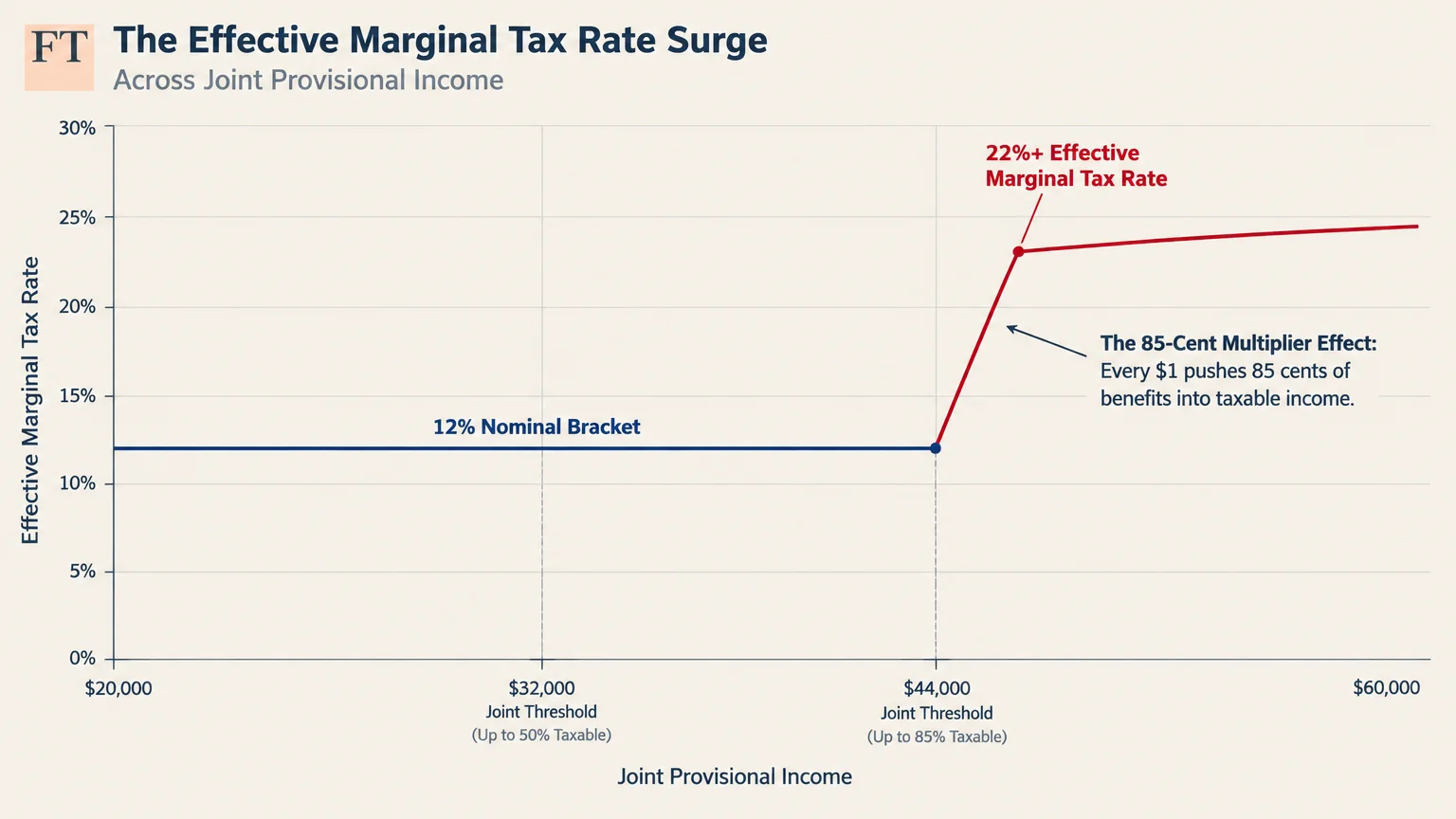
The law does not tax 85 percent of your benefit dollars directly as a flat rate. Instead, the formula exposes up to 85 cents of each benefit dollar to your ordinary income tax rates.
Once your joint provisional income exceeds $44,000, every additional dollar of ordinary income creates a double tax consequence. That single dollar gets taxed while simultaneously pushing another 85 cents of benefits into your taxable income calculation.
This compounding dynamic pushes your effective marginal tax rate far beyond your stated tax bracket. A couple sitting in the nominal 12 percent bracket can face an actual marginal tax bite exceeding 22 percent.
Understanding this mathematical multiplier enables you to plan distributions with precision. Preventing unnecessary exposure to this bracket cliff keeps more income working directly for your family.

Trap 1: The Outdated Static Bracket Freeze
Congress introduced taxation on Social Security benefits in 1983 and created the upper tier in 1993. Lawmakers neglected to attach inflation indexing to either tier over the subsequent four decades.
Because ordinary wage inflation continuously lifts dollar values across the economy, these static thresholds catch more households every year. A joint income of $32,000 represented significant wealth forty years ago, but it represents modest income today.
When your combined income drifts into this taxable territory, you encounter the widely feared tax torpedo. Each supplemental withdrawal from a traditional retirement account accelerates taxation across both of your benefit checks.
Couples often trigger this torpedo by taking innocent distributions to pay for home repairs or family vacations. An extra withdrawal can unleash sudden tax obligations that disrupt your planned annual budget.
You can disarm this trap by timing your withdrawals carefully and utilizing diverse account structures. Ignoring these frozen thresholds guarantees that inflation will steadily erode your real benefit income.
Trap 2: The Married Filing Separately Illusion
Some married couples attempt to outmaneuver the joint tax torpedo by choosing the married filing separately tax status. They assume separate returns will isolate the lower earner’s benefits from the higher earner’s taxable income.
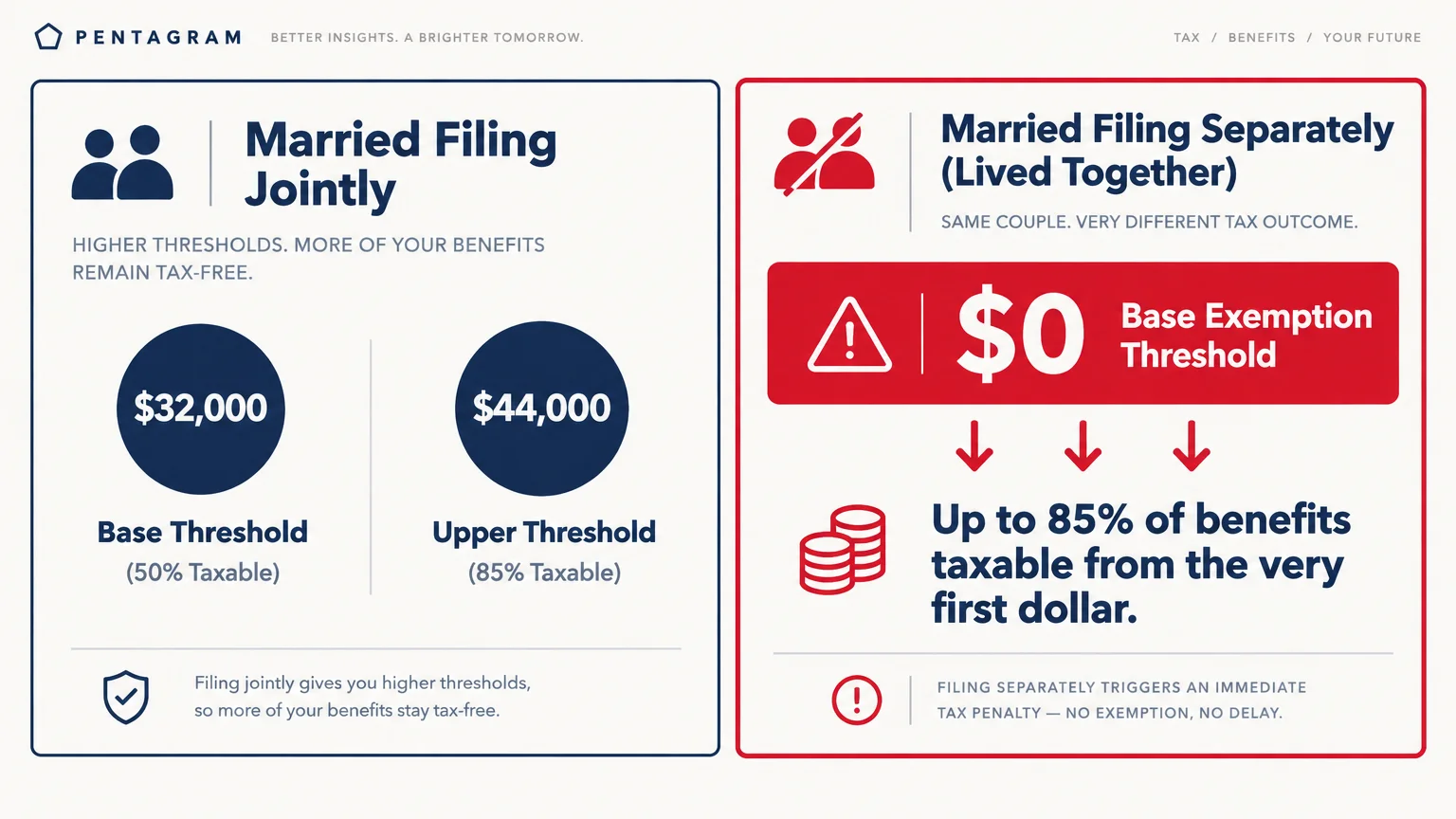
The Internal Revenue Code specifically penalizes this maneuver through a built-in statutory restriction. If you live with your spouse at any time during the tax year and file separately, your provisional income threshold drops to zero dollars.
Under a zero-dollar threshold, up to 85 percent of your very first benefit dollar faces immediate taxation. You surrender all protective income buffers and expose your benefits to the highest possible taxation percentage.
In addition, choosing to file separately disqualifies you from claiming several valuable credits and deductions designed for families. You lose access to education incentives and face strict limitations on contributing to individual retirement accounts.
Fiduciary wealth managers strongly caution couples against using this separate filing tactic to shield retirement benefits. Joint filing almost universally delivers better after-tax outcomes unless distinct legal considerations require separate filings.

Trap 3: The Enhanced Senior Deduction Blindspot
Recent tax legislation established the temporary Enhanced Senior Deduction, offering substantial relief to older taxpayers from 2025 through 2028. Qualifying individuals age 65 and older can deduct an additional $6,000 per person.
A married couple where both spouses reach age 65 can claim a joint $12,000 deduction. You can take this write-off whether you itemize deductions or select the standard deduction.
For the 2026 tax year, the base standard deduction for married couples filing jointly sits at $32,200. Qualifying couples age 65 or older also receive a traditional additional standard deduction of $1,650 per spouse.
When you combine these figures, an eligible couple can deduct more than $47,000 from their taxable income. This substantial total deduction fosters a dangerous sense of false security regarding Social Security taxes.
The critical trap rests in how the tax code orders these calculations during tax preparation. The Enhanced Senior Deduction applies strictly after your Adjusted Gross Income has been determined.
Because the provisional income formula starts with your Adjusted Gross Income, this new senior deduction cannot lower your provisional income. It reduces your bottom-line taxable income but leaves your Social Security benefits fully exposed to taxation.

Trap 4: Working While Claiming Benefits Before Full Retirement Age
Many couples transition gradually into full retirement by blending part-time earnings with an early Social Security claim. If you claim benefits before reaching your Full Retirement Age while working, you encounter the Retirement Earnings Test.
For the 2026 tax year, the statutory earnings limit before Full Retirement Age is $24,480. The government withholds one dollar in benefits for every two dollars you earn above that threshold.
During the calendar year you attain your Full Retirement Age, the earnings ceiling rises significantly to $65,160. In that specific year, the government withholds one dollar for every three dollars earned until the month you reach full age.
You can confirm your specific Full Retirement Age and examine benefit reduction mechanics directly on the Social Security Administration website. Claiming early while earning active wages triggers a severe financial double penalty.
Beyond benefit withholding, your active wages flow directly into your household Adjusted Gross Income. That wage income pushes your joint provisional income above the $44,000 boundary, making your remaining benefits taxable.
Couples often discover that their part-time wages produce negligible net income after accounting for benefit withholding and income taxes. You should evaluate the true after-tax return on your labor before claiming benefits early.

Trap 5: The Impending Widow’s Tax Bracket Collapse
The loss of a marital partner brings deep emotional grief that is frequently compounded by sudden financial hardship. Married couples often overlook the dramatic tax bracket compression that confronts a surviving spouse.
When one spouse passes away, the household loses the smaller of the two Social Security checks. The surviving partner retains the larger benefit check, but household overhead rarely drops by an equivalent proportion.
In the tax year following the spouse’s death, the survivor must file under single tax status. This change instantly cuts the baseline standard deduction from $32,200 in half down to $16,100.
Even worse, the provisional income threshold for 85 percent benefit taxation plummets from $44,000 down to $34,000. The 50 percent taxation threshold drops from $32,000 down to only $25,000.
The surviving partner frequently pays thousands of dollars more in federal taxes despite receiving substantially less household income. Modest investment distributions and pension checks quickly push the surviving spouse into higher single tax brackets.
Caring spouses address this widow’s penalty years ahead of time by reshaping their collective balance sheet. Taking steps today shields your surviving partner from severe financial strain during a period of intense personal transition.
Collateral Damage: Medicare IRMAA Surcharges
Taxes on your monthly benefit checks represent just one component of your total retirement liability. Aggressive portfolio distributions can also trigger expensive Medicare Part B and Part D premium surcharges.
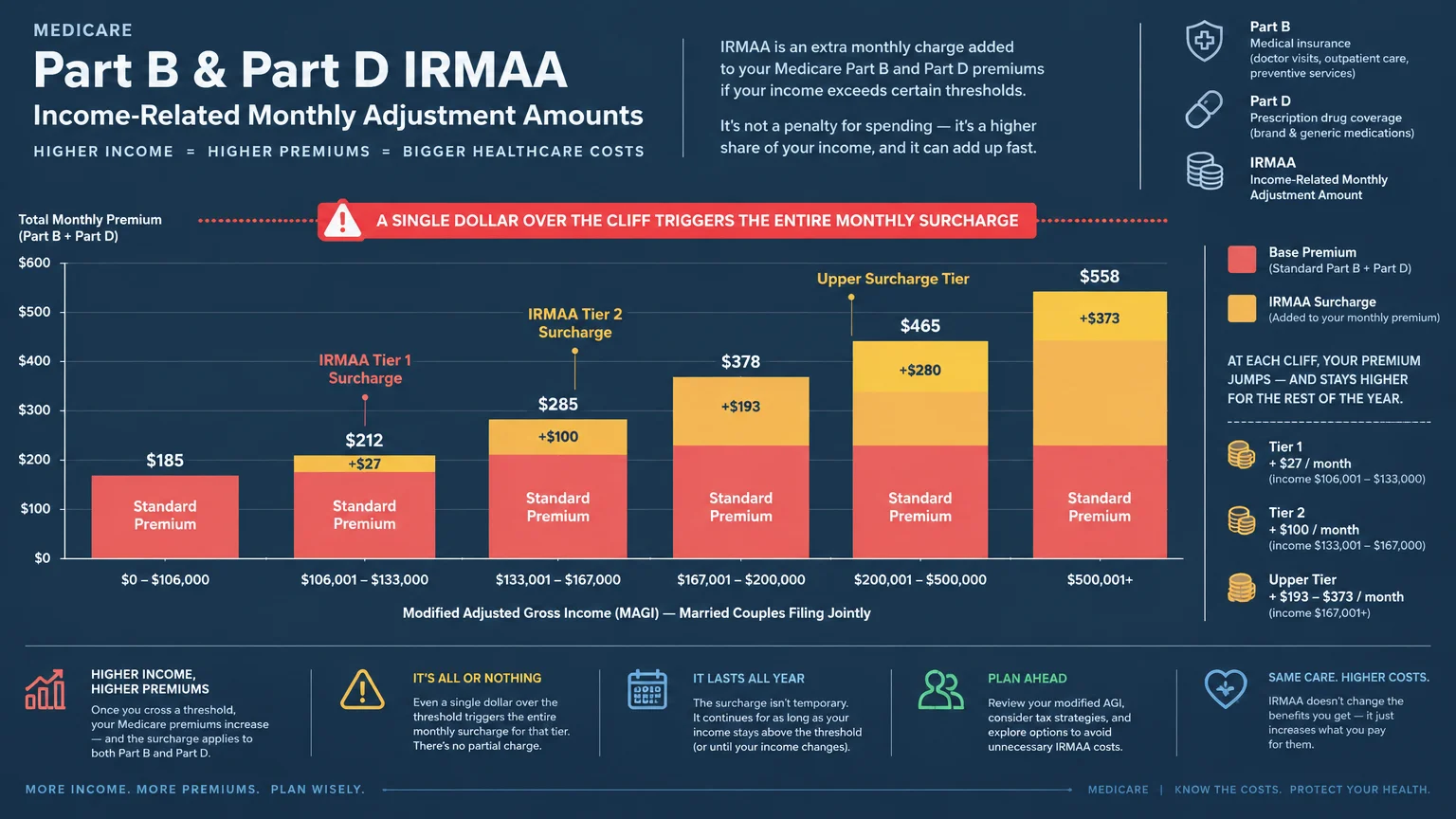
These surcharges carry the formal designation of Income-Related Monthly Adjustment Amounts, commonly known as IRMAA. The government automatically subtracts these premium adjustments directly from your monthly Social Security payment.
For 2026, the standard Medicare Part B monthly premium equals $202.90 per individual. However, joint filers with Modified Adjusted Gross Income exceeding $218,000 face immediate premium increases.
The baseline IRMAA tier increases the monthly Part B premium to $284.10 per spouse and adds a $14.50 monthly Part D surcharge. Crossing this threshold by a single dollar costs a married couple roughly $1,950 in collective annual surcharges.
Single filers face these identical surcharges starting at just $109,000 of income. You can review all current tier structures and enrollment guidelines on the official Medicare website.
Medicare determines your premium surcharges using your federal tax return from two years prior. A large capital gain or retirement withdrawal completed this year will dictate your monthly healthcare premiums two years later.
State Tax Traps: Understanding Regional Variations
The federal government is not the only revenue authority interested in your retirement benefits. State revenue departments across the United States apply widely contrasting tax policies to Social Security income.
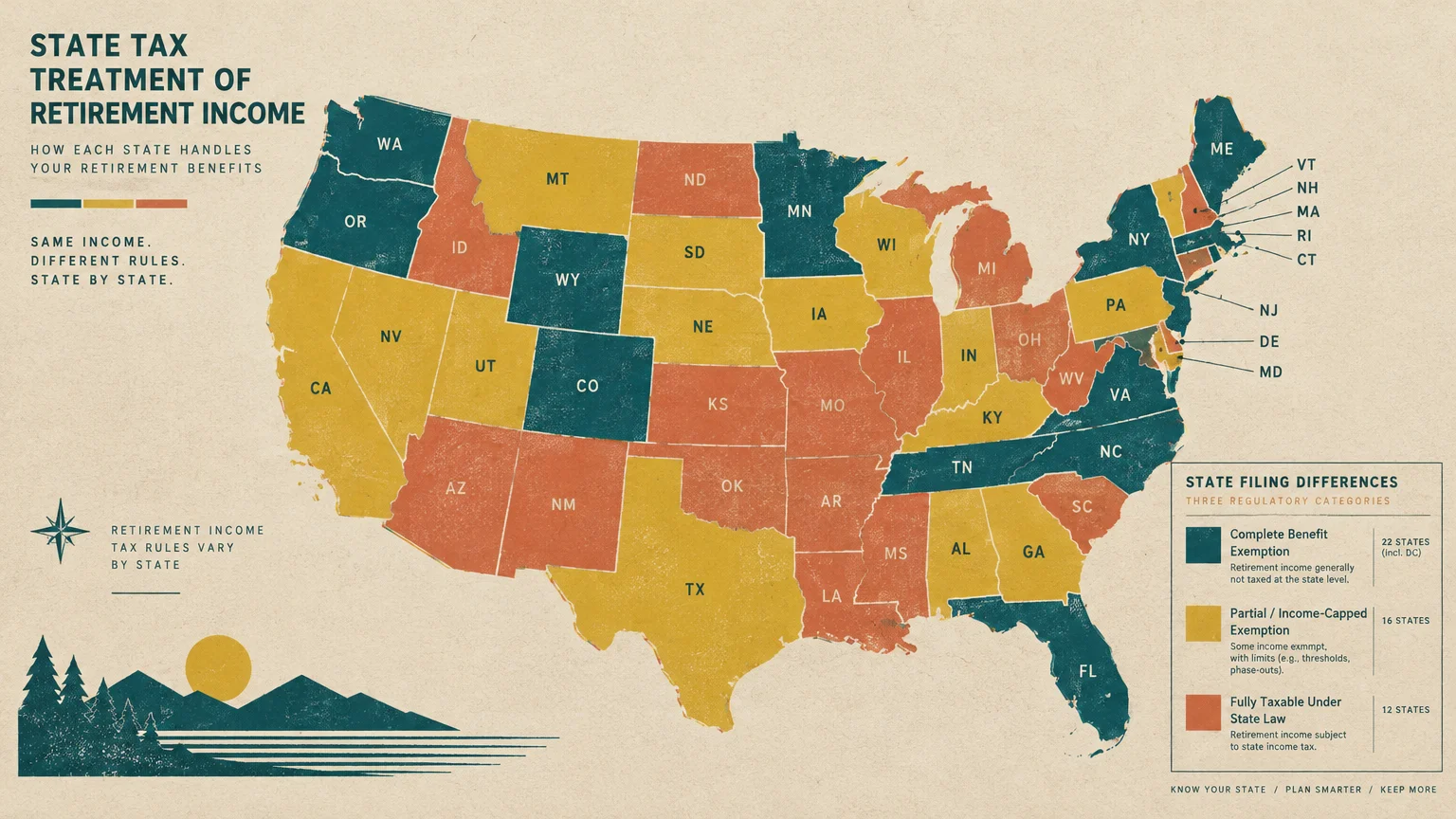
Currently, 42 states and the District of Columbia exempt Social Security benefits entirely from state income taxation. West Virginia finished phasing out its benefit tax at the start of 2026, joining the fully exempt majority.
Only eight states still tax some or all Social Security benefits under specific circumstances. Those states are Colorado, Connecticut, Minnesota, Montana, New Mexico, Rhode Island, Utah, and Vermont.
Most of these eight taxing states provide targeted deductions or exemptions tied to your Adjusted Gross Income. However, higher-earning dual-income couples often exceed these state caps and face significant state-level tax obligations.
You should carefully analyze state tax guidelines before choosing a retirement relocation destination. Moving across state lines can either eliminate your local tax burden entirely or introduce complex new filing requirements.

Strategy Pillar 1: Strategic Income Planning and RMD Management
Managing your lifetime tax liability requires deliberate distribution coordination across all of your financial accounts. Traditional retirement vehicles like 401(k) plans and individual retirement accounts require mandatory distributions later in life.
Under federal legislation, the Required Minimum Distribution starting age is 73 for workers born between 1951 and 1959. Individuals born in 1960 or later will begin their mandatory distributions at age 75 in 2033.
When required distributions begin, every dollar drawn enters your Adjusted Gross Income calculation automatically. Massive mandatory withdrawals frequently shove a couple’s combined provisional income straight past the 85 percent taxation boundary.
You can neutralize this risk by conducting systematic partial Roth conversions during your early retirement years. Converting traditional funds before claiming Social Security reduces your future account balances and cuts upcoming mandatory distributions.
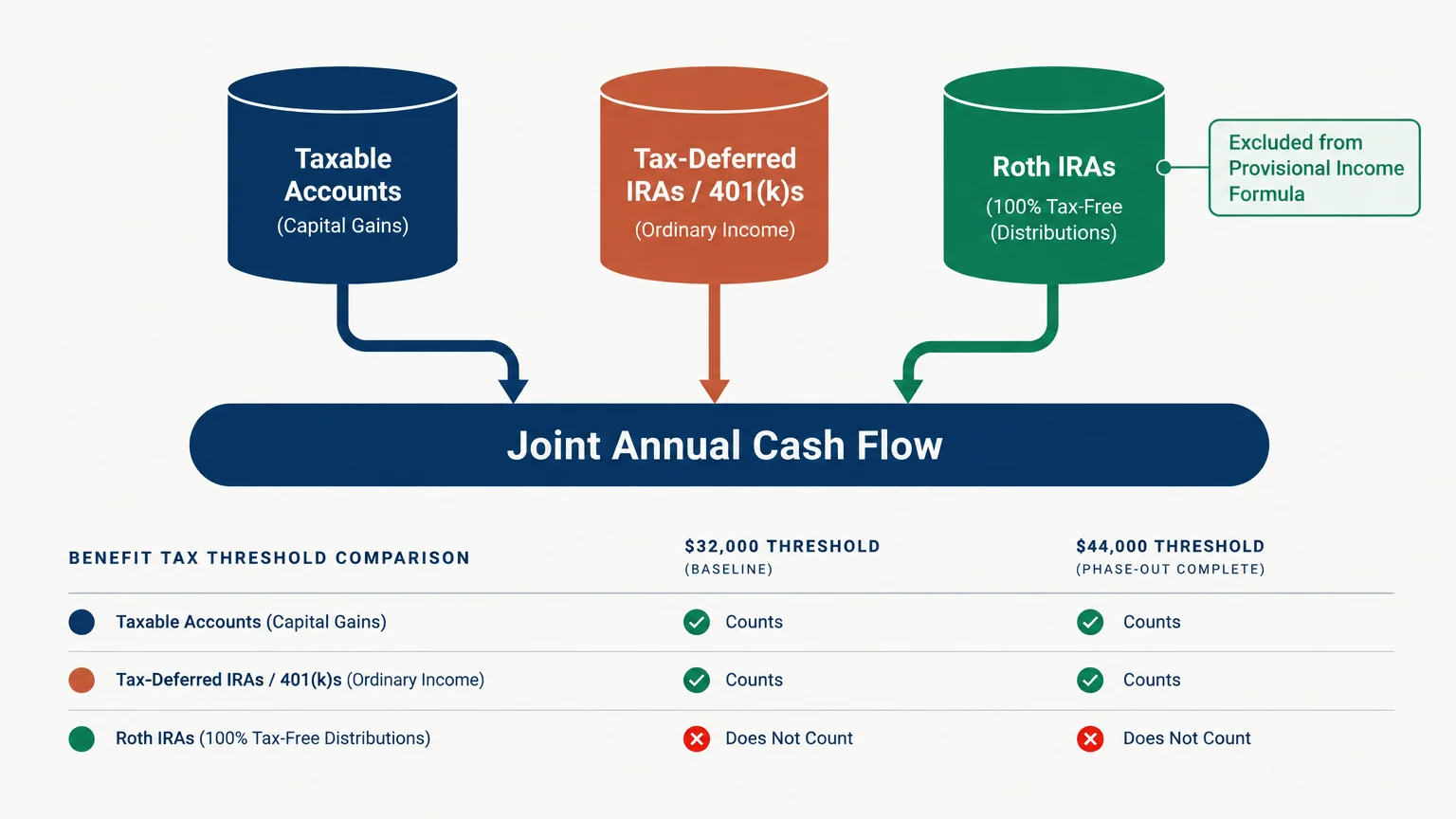
Qualified Roth distributions never count toward your provisional income calculation. Building a healthy Roth reserve gives your household access to tax-free liquidity that keeps your benefits safely unburdened by taxes.
Retirees age 70½ or older can also employ Qualified Charitable Distributions from their traditional individual retirement accounts. For 2026, you can transfer up to $111,000 per person directly to qualifying non-profit organizations.
A married couple where both spouses maintain individual retirement accounts can transfer up to $222,000 annually. These direct transfers satisfy your mandatory distribution requirements without increasing your Adjusted Gross Income or provisional income.
Strategy Pillar 2: Coordinating Asset Location Across Accounts
Asset location involves placing specific investments into taxable, tax-deferred, or tax-free accounts to optimize overall tax efficiency. Proper asset positioning protects your provisional income from unnecessary annual spikes.
Hold dividend-paying stocks and high-yield bond funds inside tax-advantaged retirement accounts whenever possible. When held in taxable brokerage accounts, those dividend distributions flow directly into your Adjusted Gross Income every single year.
Growth-oriented assets that generate minimal ordinary dividends belong primarily in your taxable brokerage accounts. You control capital gain recognition on these holdings by deciding exactly when to sell shares.
Coordinate capital loss harvesting to offset realized gains and reduce your joint Adjusted Gross Income by up to $3,000 annually. Modest income reductions can sometimes keep your provisional income just below critical tax thresholds.
Maintaining financial reserves across all three account categories gives you unmatched tax flexibility. You can customize your annual cash flow to support your lifestyle while keeping your provisional income tightly controlled.

Strategy Pillar 3: Claiming Timeline Coordination and Spousal Protections
Aligning your claiming decisions with your partner’s longevity expectations secures your collective financial future. Choosing when to claim Social Security represents an enduring decision that permanently impacts your household cash flow.
Couples often benefit when the higher-earning spouse delays claiming benefits until reaching age 70. Every year of delay past Full Retirement Age boosts your guaranteed monthly benefit by roughly 8 percent.
This delay maximizes the ultimate survivor benefit for the spouse who outlives the primary earner. Securing a large survivor benefit shields your partner from the severe consequences of the widow’s tax penalty.
While the higher earner delays claiming, the couple can spend down traditional tax-deferred assets to cover routine expenses. This bridge strategy drains taxable balances, lowering future mandatory distributions and reducing future provisional income.
The lower-earning partner can claim benefits earlier to provide foundational cash flow for basic living costs. Staggering your claiming dates balances your immediate income requirements against your long-term tax preservation goals.
Educational non-profit organizations like AARP provide digital tools to help couples compare claiming pathways. Evaluating these pathways together helps you secure maximum lifetime benefits while minimizing aggregate tax payments.

Strategy Pillar 4: Health, Wellness, and Long-Term Care Safeguards
Unanticipated healthcare expenses present a major hazard to your joint retirement security and tax plan. Prioritizing physical wellness protects your body while shielding your financial portfolio from catastrophic emergency withdrawals.
Sudden medical crises often compel couples to pull massive lump sums from traditional retirement accounts. That surge in taxable distributions inflates your Adjusted Gross Income, triggering both Social Security taxes and elevated Medicare premiums.
Engage in regular cardiovascular exercise, functional strength training, and wholesome nutrition alongside your spouse. Maintaining physical stamina reduces your vulnerability to chronic illnesses that require costly continuous interventions.
Investigate hybrid long-term care insurance policies or maintain an earmarked healthcare contingency account. Establishing dedicated funding for potential care needs prevents unexpected healthcare costs from wrecking your distribution strategy.
A disciplined wellness routine preserves your energy for travel, volunteer work, and cherished family relationships. Safeguarding your physical health serves as a vital cornerstone for your long-term wealth preservation.

Expert Voices: Advice from the Wealth Management Frontlines
Experienced financial professionals stress that married couples must avoid managing their retirement portfolios in separate silos. Every distribution decision you make ripples through your tax return, Medicare premiums, and survivor protections.
Certified Financial Planner Sarah Jenkins points out that couples consistently underestimate the strictness of the $32,000 threshold. Modest company pensions paired with standard account withdrawals push most couples into taxable territory quickly.
Gerontological researchers also highlight the significant emotional toll that unexpected tax bills inflict on older adults. Establishing predictable tax outcomes reduces financial friction and allows couples to enjoy their retirement years together.
Arizona retirees Mark and Elena Ramirez experienced this frustration when an unplanned IRA withdrawal triggered a $4,000 tax surprise. They consulted a fiduciary advisor and immediately instituted multi-year Roth conversions to regain control over their income.
Partnering with a fee-only fiduciary advisor allows you to uncover hidden tax interactions before executing large transactions. Professional tax modeling reveals blind spots that generic rules of thumb consistently overlook.

Navigating Financial Scams and Misinformation
Widespread anxiety regarding Social Security taxes creates an ideal opening for dishonest salespeople and predatory promoters. Scammers frequently push high-fee annuities or complex trust structures under the pretext of eliminating benefit taxation.
Always verify third-party financial claims against official government materials and independent consumer protection resources. Genuine financial solutions never require you to surrender complete control over your family assets.
Remain vigilant against deceptive phone calls, text messages, or emails claiming that your benefits face cancellation. Official government agencies correspond primarily via postal mail and will never request payments through wire transfers or gift cards.
Protect your household financial data and review your annual benefit records regularly through your official online accounts. Ongoing diligence protects your identity and preserves your hard-earned retirement assets.
Frequently Asked Questions About Married Couples and Social Security Taxes
Does non-taxable interest increase the tax on our Social Security benefits?
Yes, tax-exempt interest income from municipal bonds flows directly into your provisional income calculation. While you avoid direct federal taxes on the interest itself, that income exposes more of your benefits to taxation.
Many conservative retirees purchase municipal bonds believing they carry zero federal tax impact. You must include this income when projecting your joint provisional income to avoid an unpleasant tax surprise.
Can our required distributions push us over the benefit tax threshold?
Yes, Required Minimum Distributions from traditional retirement plans count fully toward your Adjusted Gross Income. Substantial mandatory withdrawals regularly push married couples past the 85 percent benefit taxation boundary.
If you do not require these distributions for living costs, consider executing Qualified Charitable Distributions instead. That approach satisfies your distribution obligation without increasing your Adjusted Gross Income or provisional income.
How does a spouse working part-time affect joint benefit taxes?
Wages earned by either partner increase your combined Adjusted Gross Income on your joint tax return. Those additional earnings can easily propel your household provisional income past the $32,000 or $44,000 thresholds.
Additionally, if the working spouse claimed benefits before Full Retirement Age, the earnings test might withhold benefit dollars. Model your combined earnings and tax impact carefully before taking on post-retirement employment.
Will moving to another state protect our Social Security benefits?
Relocating to one of the 42 states that exempt benefits will eliminate your state-level benefit tax liability. However, moving between states has no effect on your federal Social Security taxes.
Federal provisional income rules apply equally to all American citizens regardless of where they establish residency. Weigh potential state income tax savings against local property and sales taxes before finalizing a move.
Your 48-Hour Action Plan
You can begin taking command of your retirement tax profile today. Retrieve your most recent joint federal tax return alongside your latest Social Security benefit statements.
Calculate your current household provisional income by adding your Adjusted Gross Income, non-taxable interest, and half of your total benefits. Check whether your combined total exceeds the $32,000 or $44,000 statutory boundaries.
Schedule a focused conversation with your spouse over the next 48 hours to examine your results together. Evaluate whether your current withdrawal pattern leaves you vulnerable to the tax torpedo or the impending widow’s penalty.
Reach out to a fee-only fiduciary advisor to model strategic Roth conversions or Qualified Charitable Distributions for the coming year. Taking decisive action right now preserves your shared financial resources and protects your long-term peace of mind.