
When unexpected expenses arise or living costs climb, liquidating the wrong investments can quietly trigger heavy taxes and higher healthcare premiums. Choosing the right assets to sell first protects your wealth while immediately boosting your spendable cash.
Strategic retirement liquidity is not simply about finding available money in an account. It requires orchestrating your taxable, tax-deferred, and physical holdings to minimize friction and preserve your nest egg.
By prioritizing the six assets outlined below, you can access the cash you need today without compromising your long-term financial security.
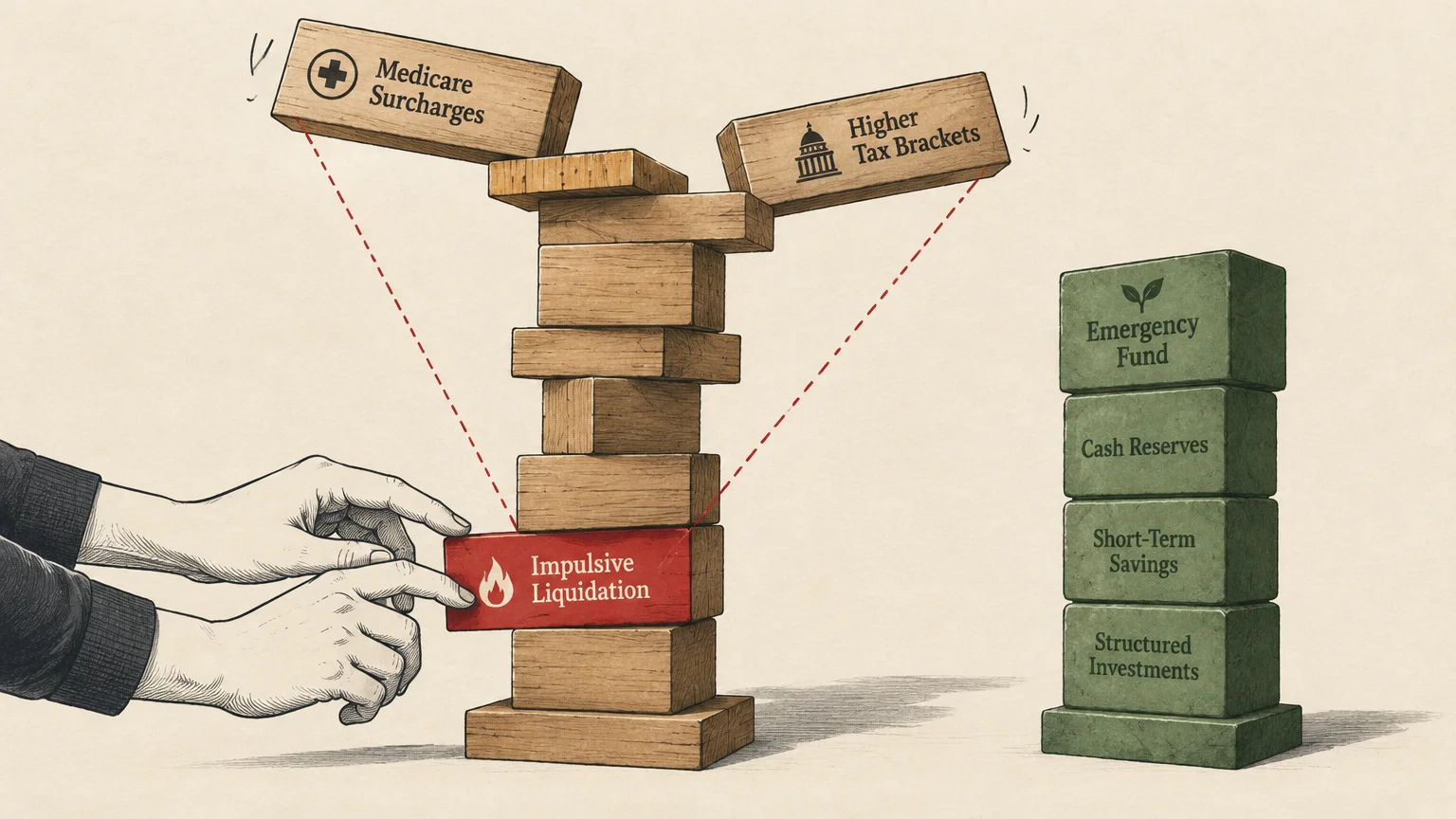
The High Cost of Liquidating the Wrong Assets
Many retirees treat their portfolios like an ordinary savings account. When a roof leaks or medical bills arrive, they pull cash from whichever account feels most convenient.
This reactive approach can create expensive tax consequences. Selling the wrong investment can push you into a higher income tax bracket and compromise your eligibility for key senior deductions.
A sudden spike in income can also trigger steep surcharges on your Medicare coverage. These hidden surcharges can strain your monthly budget for years after the initial sale.
A deliberate withdrawal sequence prevents these unforced financial errors. By liquidating assets in a disciplined order, you keep your money working harder for longer.
Smart liquidity management helps you maintain full control over your tax bill. It also protects your core income-generating investments during broader market downturns.
1. Underperforming Investments in Taxable Accounts
Your taxable brokerage account should almost always serve as your first stop when you need immediate cash. Within that account, you should look closely at securities currently trading at an unrealized loss.
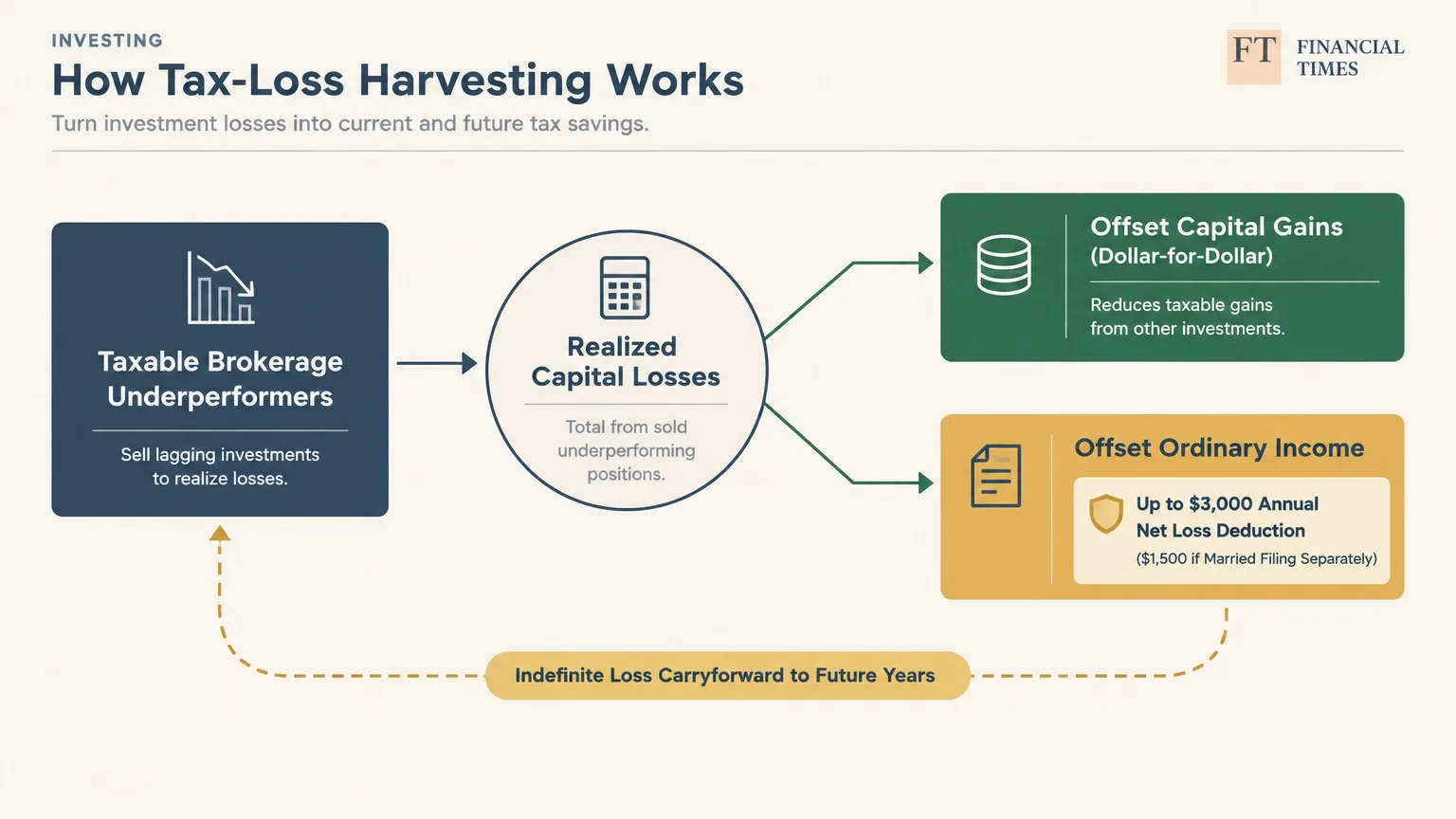
Selling losing positions provides liquid capital right away without generating any federal income tax burden. In fact, doing so actively improves your overall tax posture through tax-loss harvesting.
You can use realized capital losses to offset any capital gains you realized throughout the tax year dollar-for-dollar. This offset applies across your mutual funds, individual stocks, and exchange-traded funds.
If your total capital losses exceed your capital gains, you do not lose that value. You can use the excess to offset ordinary taxable income.
Current IRS guidelines allow you to deduct up to $3,000 of net capital losses against ordinary income each year. If you file as married filing separately, that annual limit is $1,500.
Any remaining net loss does not vanish. You can carry forward unused losses indefinitely to offset taxable gains and ordinary income in future retirement years.
Pruning your portfolio in this manner accomplishes two goals at once. You raise needed liquidity while simultaneously clearing out persistent underperformers from your asset allocation.
This process also removes emotional drag from your investment strategy. You convert stagnant market positions into usable cash without paying a single dime in capital gains taxes.
2. Appreciated Securities in the 0% Capital Gains Bracket
Once you prune your losing positions, examine your winning investments held inside taxable brokerage accounts. Many retirees assume that selling appreciated assets always triggers a punishing tax bill.
Under current tax code rules, long-term capital gains enjoy substantial preferential rates. If you hold an investment for more than one year, your federal tax rate might actually be zero.
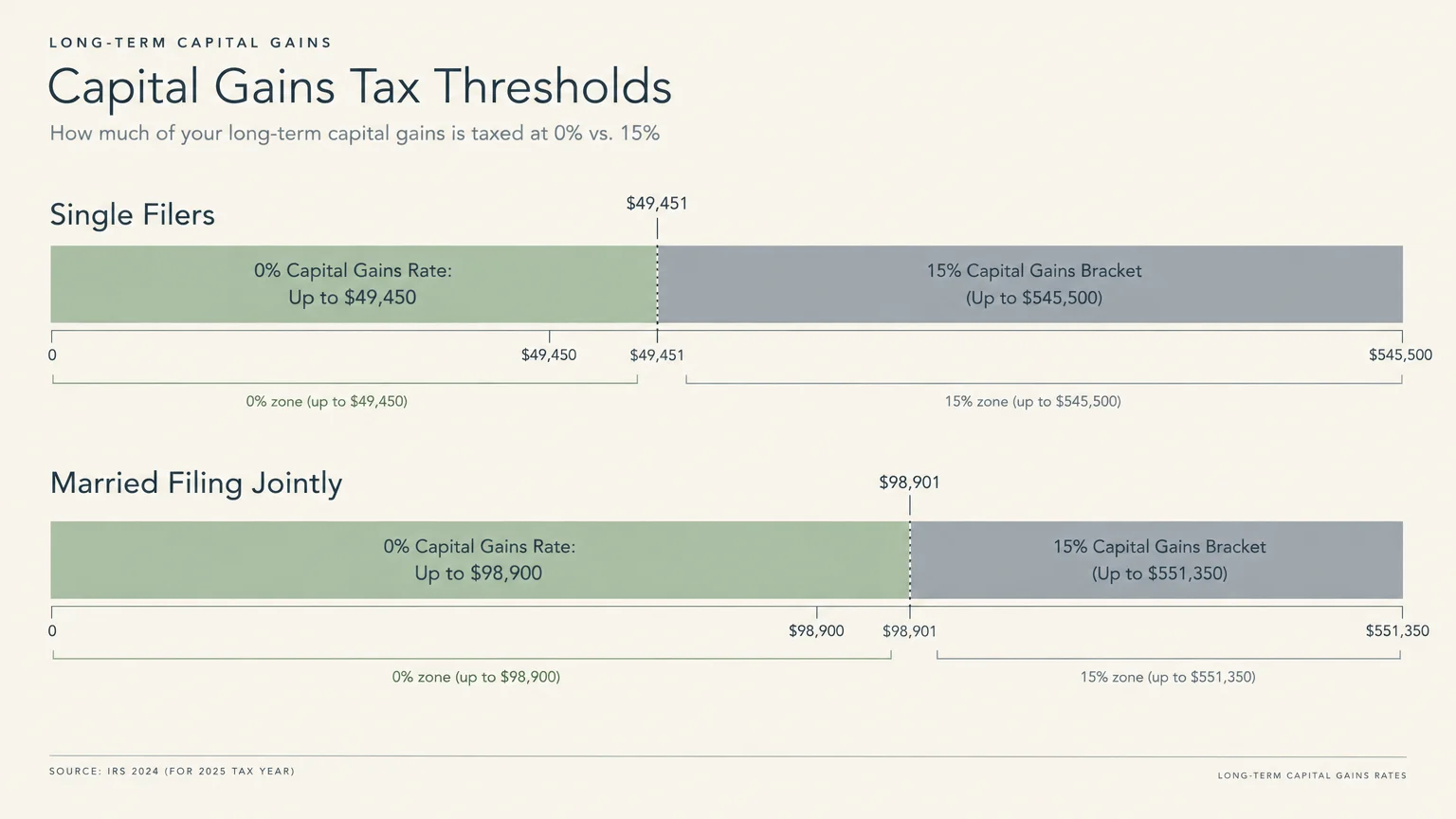
For single filers, the 0% long-term capital gains threshold extends up to $49,450 of total taxable income. For married couples filing jointly, that 0% threshold reaches up to $98,900.
Taxable income between $49,451 and $545,500 for single filers falls into the 15% capital gains bracket. For joint filers, that 15% bracket covers income between $98,901 and $613,700.
If your ordinary retirement income sits comfortably below those baseline thresholds, you can sell appreciated securities tax-free. You gain liquid spending money while locking in profits at a 0% federal rate.
Financial planners refer to this disciplined maneuver as capital gains harvesting. It allows you to reset your investment cost basis higher without paying federal capital gains taxes.
Keep your total income beneath the upper threshold to preserve this zero-percent rate. Pushing your taxable income even slightly beyond the limit exposes the excess gain to the 15% bracket.
Carefully monitor your state tax rules before executing these sales. While the federal government offers a 0% rate, some individual states tax capital gains as ordinary income.

3. Mandatory Required Minimum Distributions (RMDs)
If federal law already requires you to withdraw money from your retirement plans, you should spend that cash first. Leaving required distributions idle while liquidating other accounts creates unnecessary tax friction.
Under current retirement legislation, the RMD starting age is 73 for individuals born between 1951 and 1959. That starting age is scheduled to increase to age 75 in 2033.
You must take these mandatory withdrawals from traditional IRAs, traditional 401(k) plans, and other tax-deferred retirement vehicles. Skipping an RMD triggers harsh financial penalties.
The IRS imposes an excise tax equal to 25% of any shortfall you fail to withdraw on schedule. That penalty drops to 10% if you correct the missed distribution within two years.
Because you must pay ordinary income tax on these mandatory withdrawals regardless, treat them as your primary spending reserve. Never let RMD cash sit unallocated while selling other investments.
Designated Roth accounts inside employer plans no longer require distributions during your lifetime. You do not have to pull mandatory cash from a Roth 401(k) or Roth 403(b).
Direct your required traditional withdrawals straight toward your immediate cash needs. This simple habit satisfies legal mandates while preventing premature liquidations elsewhere in your portfolio.
If you reach age 73 and need cash, calculating and executing your RMD should always precede any discretionary withdrawal. It forms the baseline of your annual liquidity strategy.
4. Tax-Deferred Accounts up to Your Senior Deduction Shield
Conventional retirement advice often instructs retirees to leave traditional tax-deferred accounts untouched for as long as possible. Yet ignoring these accounts completely can cause you to forfeit valuable annual tax shelters.
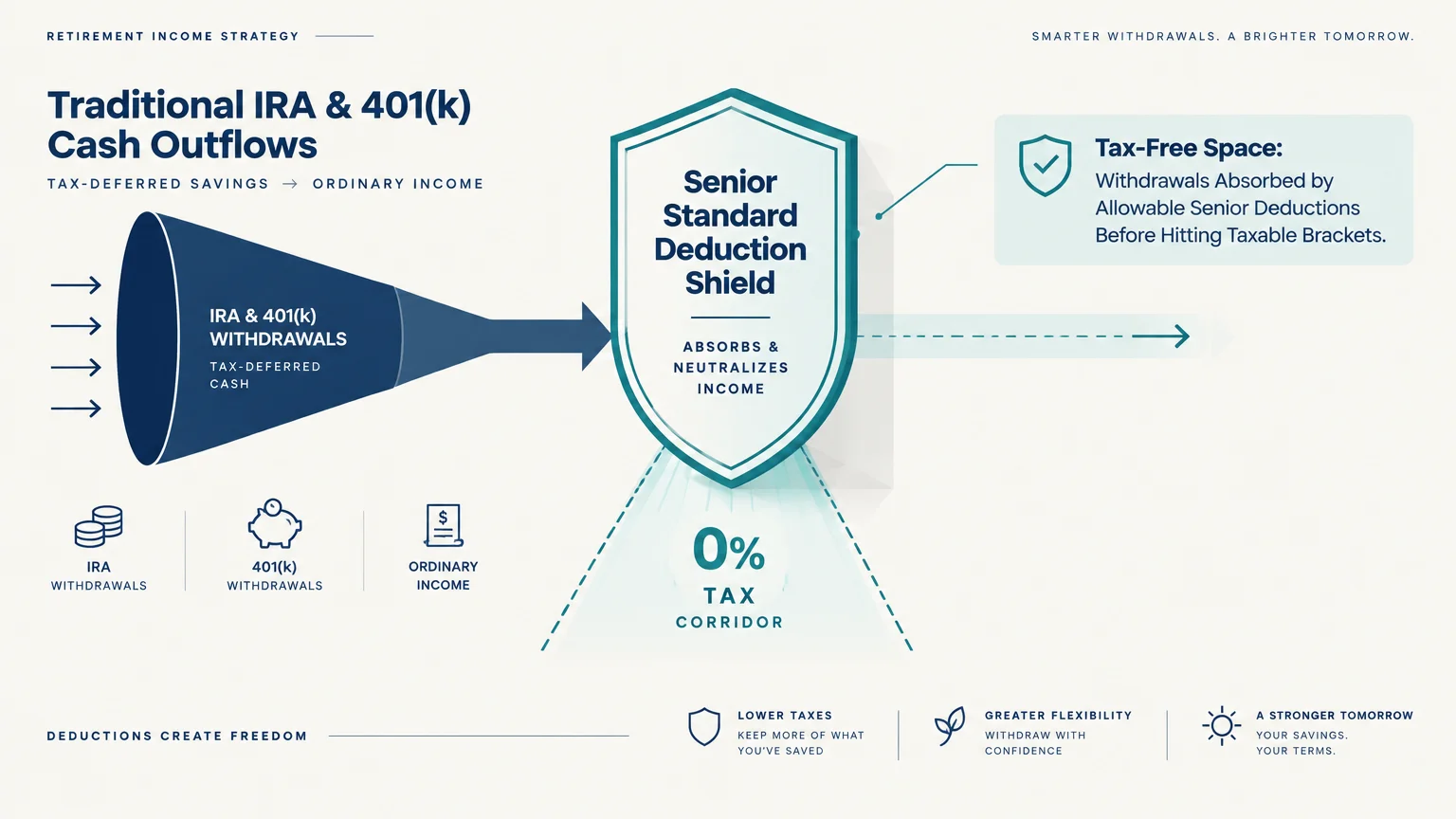
The federal tax code offers generous deduction buffers that shield ordinary income from taxation. When you fail to use these deductions, you permanently lose that year’s tax-free window.
The base standard deduction provides a strong foundation for income protection. Single filers receive a $16,100 standard deduction, while married couples filing jointly receive $32,200.
Retirees age 65 and older qualify for an additional standard deduction. Single seniors receive an extra $2,050, and married seniors receive an extra $1,650 per qualifying spouse.
Current policy under the One, Big, Beautiful Bill Act provides an Enhanced Senior Deduction through 2028. This policy adds another $6,000 deduction per person for taxpayers age 65 and older.
A married couple where both spouses are 65 or older can claim an additional $12,000 deduction. This enhanced deduction begins phasing out at a 6% rate for MAGI over $75,000 for single filers or $150,000 for joint filers.
When you combine these deductions, a single senior age 65 or older can shield up to $24,150 of ordinary income. A qualifying married couple can shield up to $47,500 completely tax-free.
This generous buffer means you can withdraw traditional IRA or 401(k) funds up to your deduction limit without owing federal income tax. You generate vital liquidity from tax-deferred savings at zero tax cost.
If your fixed income does not fully absorb your deductions, tap your traditional retirement accounts to fill the gap. It provides immediate cash while reducing your future mandatory distribution balances.

5. Surplus Personal Property, Vehicles, and Collectibles
Not all retirement liquidity lives inside financial accounts. Many retirees hold substantial wealth trapped in depreciating physical personal property, recreational vehicles, and household items.
Maintaining secondary vehicles, boats, and travel trailers generates ongoing drains on your monthly cash flow. You pay recurring costs for insurance, registration, storage, and routine mechanical maintenance.
Selling these surplus items creates an immediate influx of cash. It also permanently eliminates their ongoing carrying costs, reducing your overall cost of living.
Selling everyday personal belongings at a loss relative to your original purchase price generates no federal tax liability. The proceeds arrive as clean, unencumbered spending money for your budget.
Physical collectibles like rare coins, artwork, precious metals, and antiques require careful tax consideration. The IRS treats these items differently than traditional financial securities.
Net long-term capital gains on physical collectibles held for more than one year are taxed at a maximum federal rate of 28%. That rate is noticeably higher than the standard 15% capital gains rate.
Selling high-value collectibles can trigger substantial tax liabilities if they have appreciated significantly. Prioritize selling non-appreciated personal property and depreciated vehicles before parting with appreciated art or bullion.
Liquidating surplus physical assets also simplifies your living space. Lightening your household footprint reduces maintenance chores and helps you focus your energy on active retirement living.

6. Primary Residential Real Estate via Downsizing Equity
For most American homeowners, home equity represents a massive portion of their total net worth. Leaving this wealth trapped in real estate while liquidating retirement accounts is often inefficient.
Selling a larger family home to downsize into a smaller, accessible property frees up significant cash. It also offers powerful federal income tax exemptions under Section 121 of the Internal Revenue Code.
If you owned and lived in the home as your primary residence for at least two of the past five years, you qualify for generous capital gains exclusions. Single homeowners can exclude up to $250,000 in capital gains.
Married couples filing jointly can exclude up to $500,000 in capital gains from federal income tax. This tax shelter allows you to convert home equity into liquid retirement cash completely tax-free.
Downsizing also delivers significant long-term lifestyle savings. Moving to a manageable footprint lowers your property taxes, utility bills, homeowner insurance premiums, and ongoing repair expenses.
These recurring savings decrease your monthly withdrawal needs from your investment portfolio. Your nest egg lasts longer because your baseline lifestyle costs drop permanently.
You can allocate the cash proceeds from your sale into conservative, liquid investments. This approach creates a reliable cash cushion for future healthcare costs and lifestyle goals.
Downsizing also provides an opportunity to choose housing suited for long-term mobility. Single-level living and accessible designs help you age in place safely and comfortably.
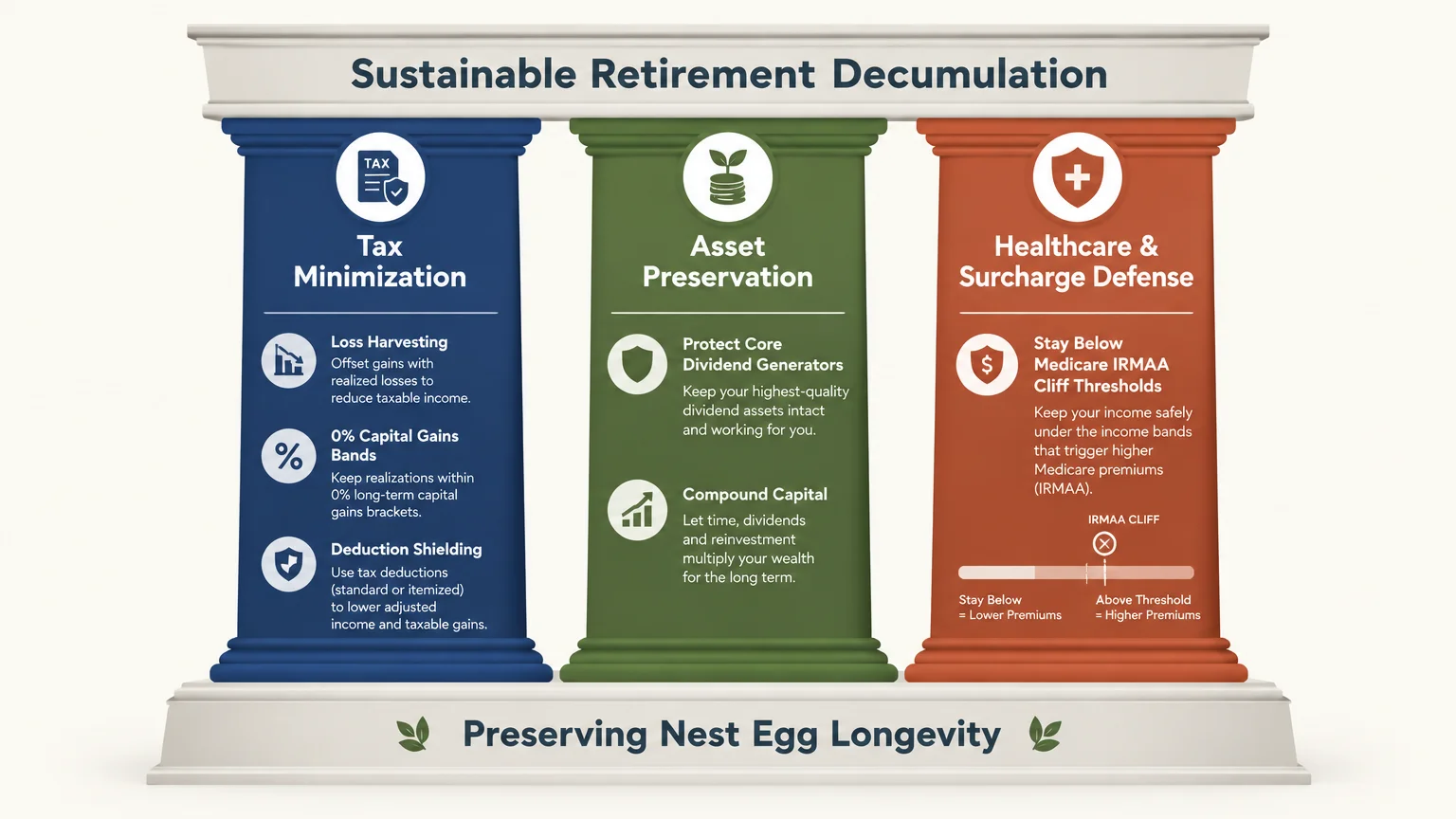
Strategic Framework: Three Pillars for Sustainable Liquidity
Smart decumulation requires balancing immediate financial needs with long-term personal well-being. Using a structured framework prevents panic-driven sales and protects your future independence.
Pillar 1: Income Planning and Withdrawal Sequencing
Withdrawal sequencing is the strategic order in which you tap your various account types. The goal is simple: maximize spending power while minimizing total lifetime taxes.
In general, you should exhaust taxable investments with low tax liability and your required minimum distributions first. This keeps your tax-deferred and tax-free accounts compounding quietly in the background.
Preserve your Roth IRAs for as long as possible. Roth accounts grow tax-free, carry no lifetime distribution mandates, and pass to heirs without income tax liabilities.
Review your position every autumn with a qualified financial professional. Coordinating withdrawals across different tax buckets keeps you in the lowest possible marginal tax bracket each year.
Pillar 2: Lifestyle Design and Asset Utility
Your physical possessions should actively support your daily happiness rather than create unnecessary burdens. Retirement is an ideal stage of life to audit the utility of everything you own.
If an asset demands excessive time, money, or physical energy to maintain, it no longer serves your lifestyle. Selling it frees up capital and eliminates unnecessary administrative strain.
Transitioning toward a simpler lifestyle gives you greater geographic and financial flexibility. It enables you to spend your time traveling, volunteering, or enjoying family instead of maintaining property.
Aligning your possessions with your physical abilities supports healthy aging. Thoughtful decluttering reduces fall risks and makes your home a safer, more functional environment.
Pillar 3: Health and Wellness Cost Buffering
Healthcare expenses remain one of the largest financial wildcards in retirement. Sudden medical events require rapid liquidity, making structured cash reserves essential.
According to research highlighted by AARP, unexpected medical events often force seniors into premature, high-tax asset liquidations. Having an established liquidation hierarchy prevents this problem entirely.
Establish a dedicated health liquidity buffer inside stable, easily accessible accounts. Holding adequate short-term cash shields your long-term equity holdings from forced sales during market corrections.
When you encounter health challenges, clear financial systems eliminate unnecessary panic. You can focus entirely on physical recovery rather than worrying about investment portfolios or complex tax forms.

Expert Perspectives on Strategic Decumulation
Professional advisors emphasize that the decumulation phase of retirement requires a fundamentally different mindset than the accumulation phase. Saving money is passive, but spending money efficiently requires active strategy.
Certified Financial Planner™ professionals frequently warn against the silent hazard of bracket creep. Uncoordinated asset sales can push retirees into higher tax brackets and trigger unexpected phaseouts of key credits.
Financial planners recommend reviewing your adjusted gross income before executing any major asset sale late in the calendar year. A small adjustment in timing can yield thousands of dollars in tax savings.
Gerontologists and aging specialists also highlight the mental health benefits of financial clarity. Knowing precisely which assets to tap during an emergency significantly reduces chronic stress and sleep disruption.
Retirees who establish clear asset sale protocols report higher confidence in their overall retirement security. Structured plans eliminate fear of the unknown and support emotional resilience during market volatility.

Critical Risks, Safeguards, and Tax Traps
Liquidating assets without analyzing the broader tax code can create severe secondary financial shocks. Retirees must remain vigilant regarding stealth taxes, benefit adjustments, and fraudulent predatory schemes.
The most dangerous stealth trap involves Medicare premium surcharges, known as the Income-Related Monthly Adjustment Amount (IRMAA). IRMAA surcharges are based on your tax return from two years prior.
For standard coverage, the base Medicare Part B premium is $202.90 per month, alongside an annual deductible of $283. However, high income pushes you into expensive surcharge tiers.
IRMAA surcharges apply once Modified Adjusted Gross Income exceeds $109,000 for single filers or $218,000 for joint filers. Selling large appreciated assets can trigger these steep healthcare surcharges two years later.
Wealthier retirees must also account for the Net Investment Income Tax (NIIT). This 3.8% tax applies to net investment income for single filers with MAGI over $200,000, or $250,000 for joint filers.
Capital gains can also increase the taxable portion of your Social Security benefits. Guidance from the Social Security Administration details how additional income pushes more of your monthly benefits into taxable territory.
Be cautious when selling personal property, jewelry, or real estate in a hurry. Predatory buyers often target seniors facing cash shortages, offering pennies on the dollar for valuable physical assets.
Always seek independent appraisals before selling high-value jewelry, antiques, or land. Taking time to verify actual market values protects you from exploitative sales during stressful financial moments.
Frequently Asked Questions About Raising Cash in Retirement
Why should I avoid tapping my Roth IRA first when I need cash?
Roth IRAs represent the most versatile and tax-efficient money you own. Your investments grow completely tax-free, and qualified withdrawals carry zero income tax liability.
Unlike traditional accounts, Roth IRAs do not impose required minimum distributions during your lifetime. Leaving your Roth funds intact allows them to compound tax-free for late-life emergencies or legacy goals.
How can selling an asset trigger higher Medicare costs two years later?
The federal government sets your Medicare Part B and Part D premiums using tax data from two years prior. A large capital gain in the current year increases your Modified Adjusted Gross Income on that return.
If that gain pushes your income above the IRMAA threshold of $109,000 for single filers or $218,000 for joint filers, you will face mandatory monthly surcharges two years down the road.
Should I deplete my cash reserves before selling any investment assets?
You should avoid exhausting your emergency cash reserve completely. A healthy cash buffer protects you from having to sell volatile investments during severe market downturns.
Most financial planners recommend keeping three to six months of living expenses in an accessible savings or money market account. Tap this reserve for true emergencies, but replenish it promptly through planned asset sales.
What should I do if all my taxable investments have large capital gains?
If all your holdings show gains, focus on selling positions with the highest cost basis first. This minimizes the net taxable profit generated per dollar of liquid cash raised.
You can also spread your sales across multiple calendar years to avoid crossing into higher tax brackets or triggering IRMAA surcharges. Consulting a tax professional helps you pace these transactions efficiently.
Your 48-Hour Cash Flow Action Plan
Gaining control over your retirement liquidity does not require an overwhelming overhaul of your entire financial life. You can take immediate, manageable steps over the next 48 hours to secure your cash flow.
First, log in to your taxable brokerage accounts and generate an unrealized gain and loss report. Identify any lagging investments currently trading at a loss that you can harvest immediately.
Second, review your year-to-date income against current federal standard deduction thresholds. Calculate how much room you have left to pull traditional retirement funds at a zero-percent tax rate.
Third, walk through your home and take inventory of any surplus physical property or secondary vehicles you rarely use. Choose one underutilized item and research its current resale value on reputable platforms.
Taking these deliberate steps transforms retirement liquidity from an urgent chore into a strategic advantage. You maintain financial flexibility, lower your tax burden, and protect the wealth you worked a lifetime to build.