Determining whether your retirement savings will support your desired lifestyle requires understanding how national averages translate to your home state. A comfortable retirement income depends heavily on where you live, your housing costs, and your healthcare needs.
While national benchmarks provide a helpful baseline, your state tax environment and local living expenses dictate your actual spending power. Evaluating your income against state-specific realities empowers you to make informed decisions about work, savings, and relocation.
Discover where your household stands today and explore actionable strategies to build lasting financial security.
The National Retirement Income Landscape
National benchmarks reveal significant disparities between average earnings and typical retiree realities. Knowing these baselines helps you evaluate your financial readiness without falling into misleading comparisons.
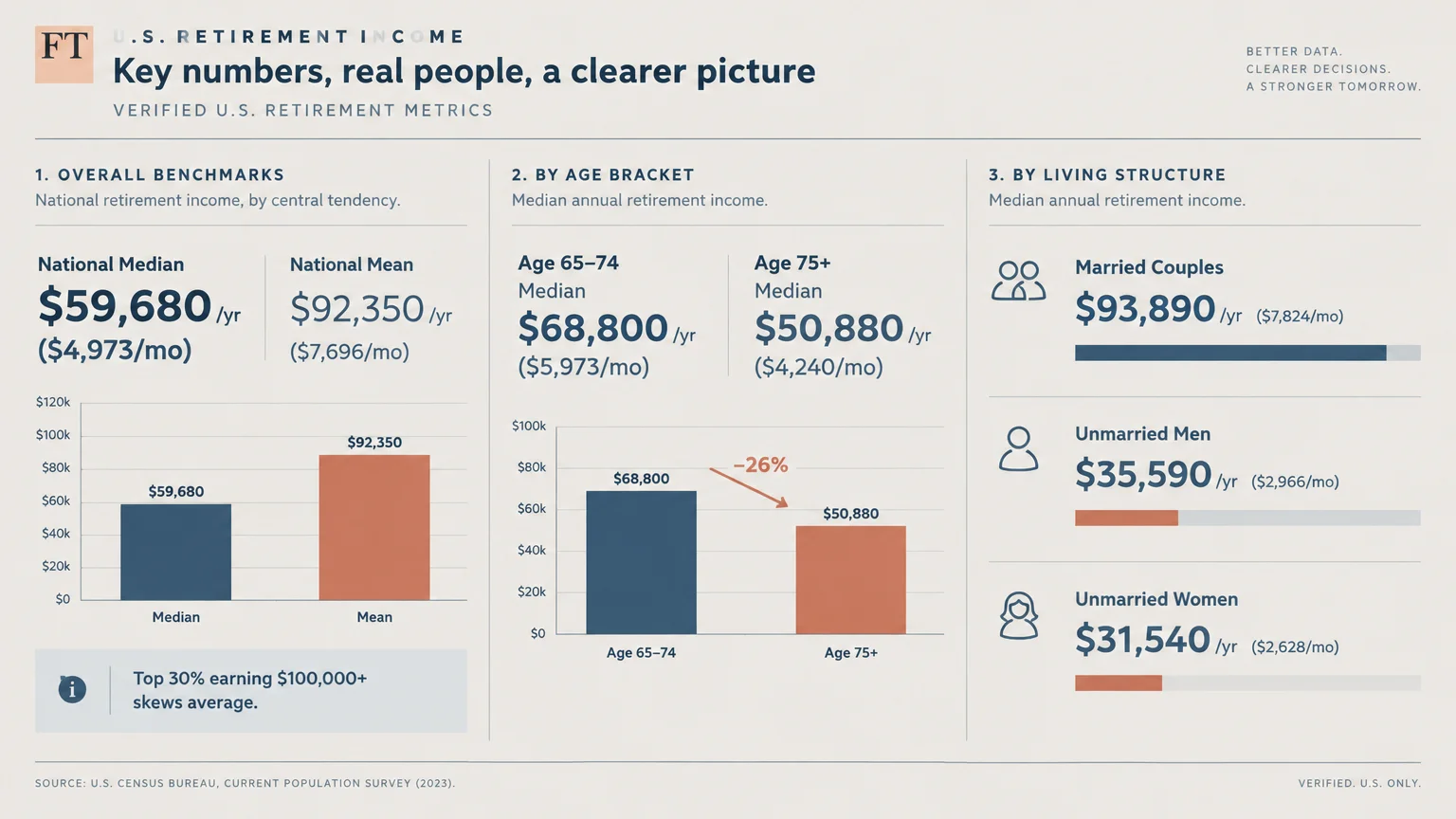
According to Census Bureau data, the national median income for households headed by someone age 65 or older stands at $59,680 per year. That equals roughly $4,973 per month for basic necessities and discretionary spending.
Meanwhile, the national mean income reaches $92,350 per year, or $7,696 per month. A small group of high earners skews this average upward, as roughly 30 percent of older households bring in $100,000 or more annually.
Because top earners inflate the mean, you should track your personal progress against median metrics rather than averages. Medians reflect the true middle point where typical American retirees manage their monthly cash flow.
Income Variations Across Age Brackets
Your earning and spending patterns shift naturally as you move deeper into retirement. The data shows that older households experience measurable income reductions over time.
Households between ages 65 and 74 report a median income of $68,800 per year, which breaks down to $5,733 monthly. Many individuals in this bracket still work part-time or draw down taxable retirement assets aggressively.
For households age 75 and older, median annual income drops to $50,880, or $4,240 per month. Reduced employment income, depleted investment balances, and the loss of a spouse often drive this downward shift.
You must construct your multi-decade financial plan to absorb these predictable income adjustments. Anticipating income changes early protects your independence during your later retirement years.
How Household Structure Impacts Retirement Cash Flow
Your living arrangement profoundly influences your financial security and household budget. Married couples benefit from pooled resources and multiple revenue streams that single retirees often lack.
Married-couple households aged 65 and older maintain a median income of $93,890 per year, providing approximately $7,824 monthly. This shared revenue creates a resilient buffer against rising housing and healthcare costs.
In contrast, seniors living alone face much tighter monthly margins. Unmarried older men report a median income of $35,590 per year, which translates to $2,966 each month.
Single older women face even steeper headwinds, with a median annual income of $31,540, or $2,628 per month. Lower lifetime earnings and caregiving career interruptions frequently reduce their Social Security checks and pension balances.

State-by-State Income Realities: Where Dollars Stretch and Shrink
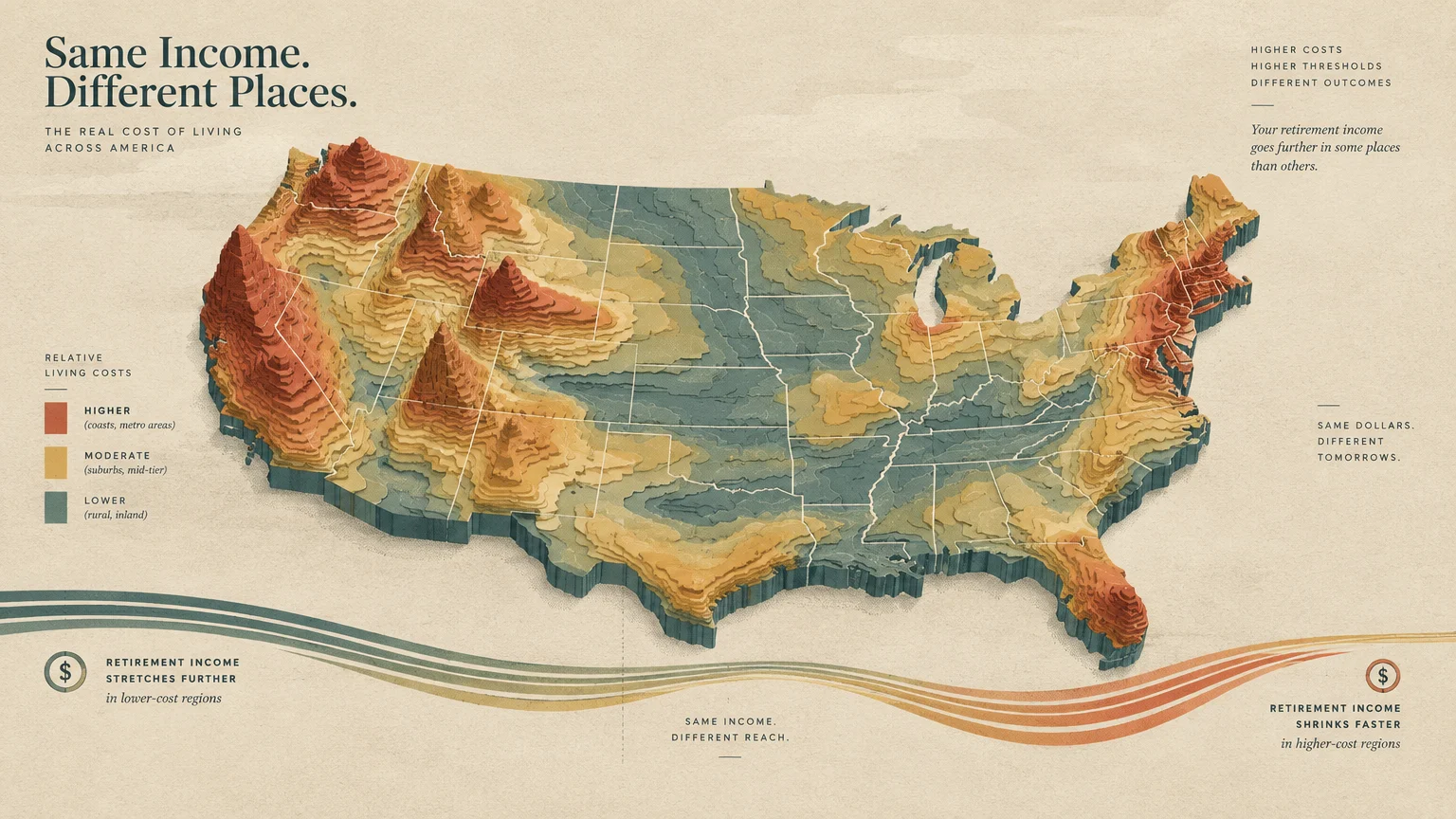
Where you live determines how far your retirement dollars travel each month. Geographic location alters your purchasing power through regional living expenses, municipal utilities, and state taxes.
Actual median senior incomes vary by more than two to one across the country. Hawaii leads the nation with a median senior household income of $91,390 per year, or $7,616 per month.
Maryland, New Jersey, Massachusetts, and Connecticut follow closely behind with elevated senior earnings. These regions reflect higher lifetime wage scales and robust public or private pension systems.
At the opposite end of the spectrum, Mississippi reports a median senior household income of just $44,031 per year. That supplies retirees with roughly $3,669 per month to cover all living expenses.
West Virginia and Arkansas record similarly modest senior incomes. While living costs remain lower in these areas, restricted household earnings demand disciplined budgeting from local retirees.
Comfortable Retirement Income Requirements by State
Earning an average income does not guarantee a comfortable lifestyle. A truly comfortable retirement covers non-negotiable living expenses while leaving room for recreation, travel, and unexpected emergencies.
Adjusting expenditure data from the Bureau of Labor Statistics reveals wide geographic spending requirements. Regional price disparities heavily dictate what you must spend to thrive.
In West Virginia, a comfortable retirement requires approximately $50,954 per year due to its favorable cost-of-living index of 84.8. Your money buys substantially more housing and daily goods here than in neighboring coastal states.
Conversely, maintaining comfort in California demands roughly $86,945 per year against a steep cost-of-living index of 141.6. Sky-high utility rates and housing costs drive these elevated spending targets.
Massachusetts requires $88,627 annually to support a comfortable retirement lifestyle, driven by a 145.1 cost index. Meanwhile, retirees in Hawaii need more than $100,000 annually to maintain reasonable financial ease.
Broader living wage studies indicate that a single adult needs at least $80,000 per year to live comfortably anywhere in 2026. Required amounts range from $81,245 in West Virginia to $129,002 in Hawaii.

Policy Shifts Reshaping Retirement Finances
Keeping pace with federal cost-of-living adjustments and savings regulations preserves your purchasing power. Recent policy updates offer new opportunities to shelter income and boost your monthly benefits.
Social Security checks rose by 2.8 percent under the 2026 cost-of-living adjustment. By August 2026, the average monthly benefit for a retired worker reached $2,087.52, or roughly $25,050 annually.
The median Social Security benefit sits slightly lower at approximately $1,990 per month. These monthly payments supply a critical foundation, but they rarely cover total living expenses on their own.
Looking ahead, the Social Security Administration announced a 3.6 percent cost-of-living adjustment for 2027. That policy update adds approximately $75 per month to the average retired worker’s benefit starting in January 2027.
Retirement Contribution Limits and SECURE 2.0 Rules
Federal guidelines provide powerful incentives for pre-retirees attempting to close savings gaps late in their careers. Maximizing these limits shields your earnings from immediate taxation.
The standard employee contribution limit for 401(k), 403(b), and most 457 plans stands at $24,500. Workers aged 50 and older can contribute an additional catch-up amount of $8,000, reaching $32,500 total.
Under SECURE 2.0 legislation, individuals aged 60, 61, 62, and 63 qualify for a super catch-up limit of $11,250. This provision allows eligible older workers to save up to $35,750 inside workplace plans.
Individual retirement account contribution limits stand at $7,500, with an extra $1,100 catch-up allowance for savers aged 50 and older. This brings the maximum annual IRA contribution to $8,600.
Higher earners must navigate an important structural tax rule from the Internal Revenue Service. Workers aged 50 and older who earned more than $150,000 in FICA wages during 2025 must direct all catch-up contributions into Roth accounts.
Navigating State Taxes on Retirement Income
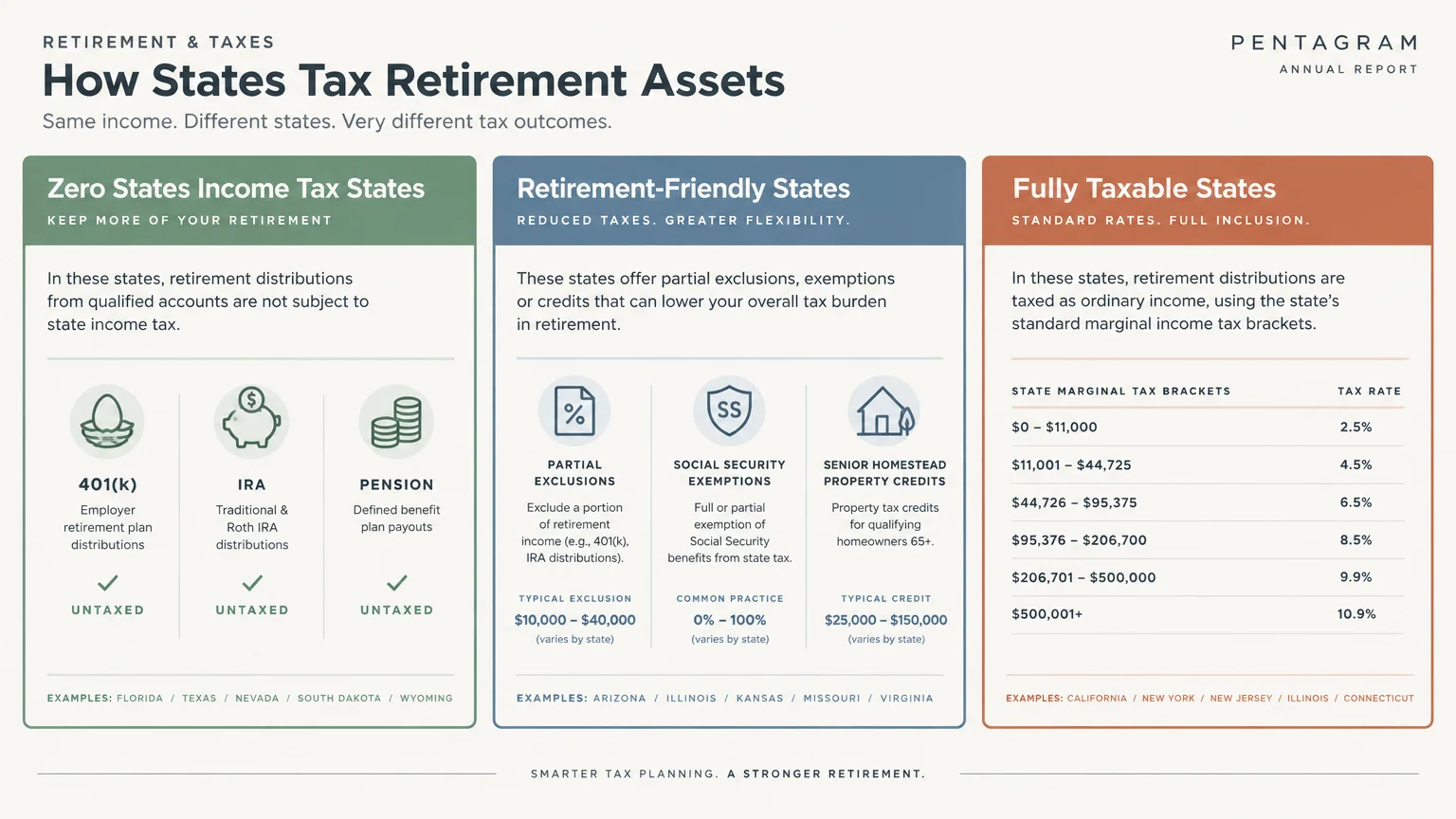
State tax codes significantly influence how much spendable cash remains in your pocket each month. Choosing where to maintain your domicile can either conserve your wealth or trigger unnecessary tax burdens.
Eight states levy no individual state income tax on personal earnings: Alaska, Florida, Nevada, South Dakota, Tennessee, Texas, and Wyoming. New Hampshire joined this group after fully repealing its tax on interest and dividends.
Washington state does not tax wages, pensions, or standard retirement account withdrawals. However, the state levies a 9.9 percent capital gains tax on high earners selling specific investment assets.
State Taxation of Social Security Benefits
The geographic tax treatment of Social Security benefits has evolved rapidly in favor of older Americans. Forty-two states and Washington, D.C., completely exempt Social Security checks from state income taxation.
Only eight states still tax Social Security benefits under certain income thresholds: Colorado, Connecticut, Minnesota, Montana, New Mexico, Rhode Island, Utah, and Vermont. Most of these states offer partial exemptions based on your total adjusted gross income.
West Virginia completed its multi-year tax phase-out, completely eliminating state income taxes on Social Security benefits. This reform followed similar repeals in Kansas, Missouri, and Nebraska.
Before you pack your bags for an income-tax-free state, examine the entire fiscal environment. Jurisdictions without personal income taxes frequently offset their revenue losses with high property taxes or elevated sales taxes.

Pillar One: Strategic Income Planning and Withdrawal Architecture
Sustainable income planning requires orchestrating your various asset pools into an efficient, predictable monthly paycheck. A haphazard withdrawal strategy can accelerate portfolio depletion and generate unnecessary taxes.
Begin by mapping out your guaranteed income floor using Social Security, pensions, and fixed annuities. This predictable revenue should cover your non-negotiable living expenses, including housing, food, and baseline medical care.
Cover discretionary lifestyle spending through disciplined portfolio withdrawals. Coordinate distributions between taxable brokerage accounts, traditional tax-deferred accounts, and tax-free Roth balances to maintain a low marginal tax bracket.
Dynamic withdrawal strategies outperform rigid distribution methods during market downturns. Trimming your discretionary withdrawals during bear markets preserves vital portfolio capital and mitigates sequence of returns risk.
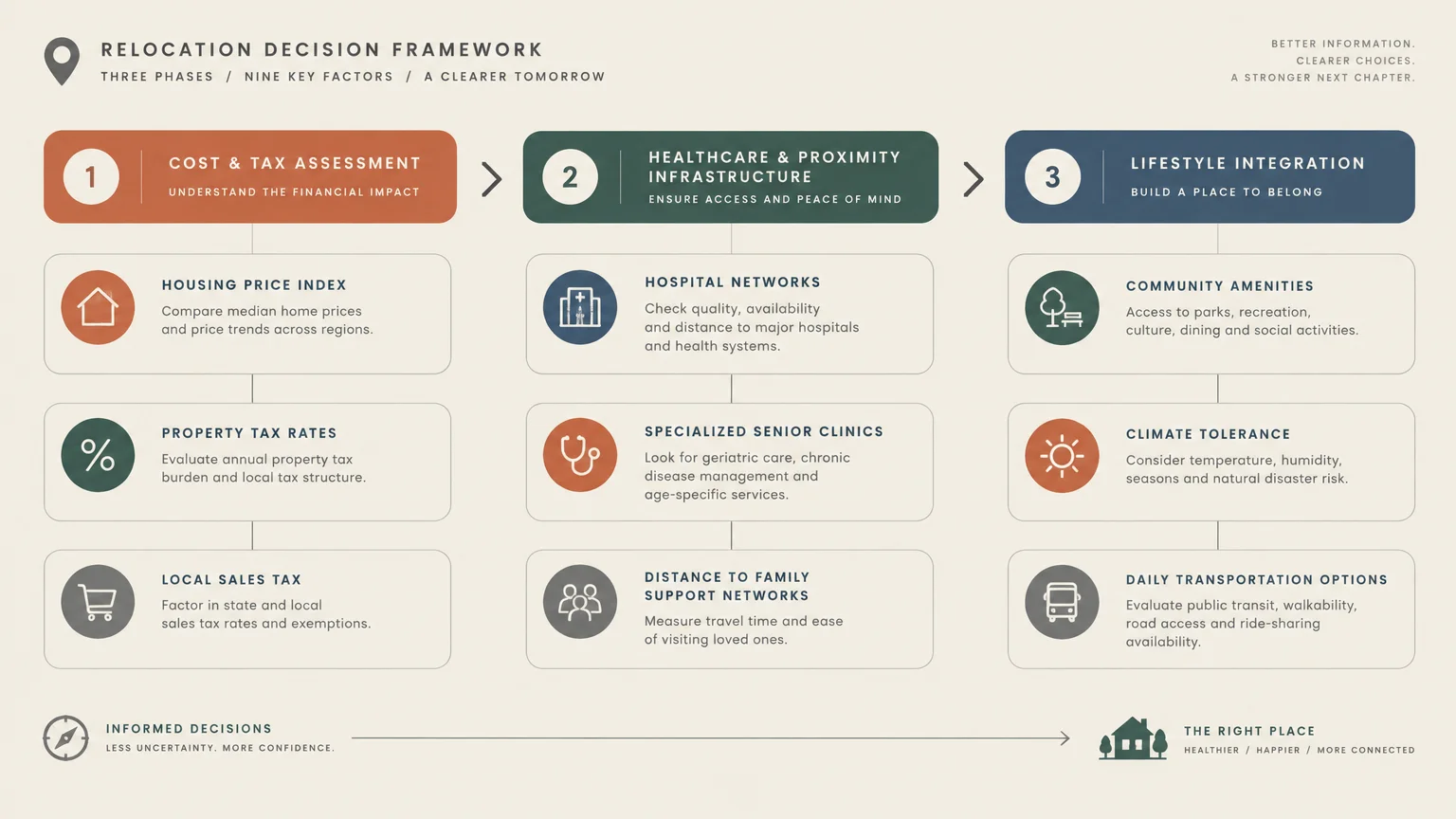
Pillar Two: Intentional Lifestyle Design and Relocation Decisions
Retirement success involves designing daily routines that provide genuine purpose and social connection. Money serves as a tool to support your lifestyle, not the sole measure of retirement satisfaction.
Carefully evaluate potential geographic relocation before committing your financial resources. Visit candidate communities during different seasons to observe local infrastructure, healthcare facilities, and cultural opportunities firsthand.
Downsizing your current home can unlock substantial equity while eliminating maintenance burdens and steep utility bills. Moving into a smaller, single-story residence supports aging in place as your mobility changes.
Prioritize communities that offer walkable neighborhoods, robust public libraries, and active community centers. Research shows that maintaining active social ties supports emotional resilience and reduces the risk of cognitive decline.

Pillar Three: Health, Wellness, and Longevity Planning
Healthcare costs represent one of the largest and most volatile spending categories in your retirement plan. Protecting your physical wellness and establishing comprehensive insurance coverage safeguards your financial assets.
Familiarize yourself with your health coverage choices through the official Medicare portal well before turning age 65. Missing your initial enrollment window can trigger permanent lifetime premium penalties for Part B and Part D.
Evaluate whether Original Medicare paired with a Medigap plan or a Medicare Advantage policy best suits your healthcare needs. Ensure your preferred physicians, specialists, and maintenance medications remain inside your chosen network.
Adopt preventive health habits to protect both your body and your bank account. Regular cardiovascular exercise, strength training, and balanced nutrition reduce the incidence of costly chronic illnesses as you age.
Establish a realistic plan for potential long-term care needs before health crises develop. Research local home health resources, assisted living costs, and adult day programs to avoid placing sudden caregiving burdens on loved ones.

Voices from the Field: Expert Perspectives and Retiree Realities
Professional financial planners emphasize that your retirement spending will fluctuate significantly throughout your post-career life. Most retirees follow a spending smile pattern, spending heavily early on, slowing down, and spending more on late-life medical care.
Certified Financial Planner David Harris notes that retirees often spend more during their initial five years than they projected. Travel, home remodeling, and new hobbies can quickly deplete reserves without clear guardrails.
Gerontologist Elena Martinez highlights that purposeful activity protects personal longevity far better than leisure alone. Retirees who volunteer or mentor experience higher satisfaction than those who disengage from their communities.
Recent Florida retiree Sarah Jenkins shares that local property insurance increases caught her household off guard. She recommends adding a twenty percent cushion to any estimated relocation budget to absorb unexpected municipal and insurance cost spikes.

Financial Risks and Practical Safeguards
Protecting your retirement wealth requires constant vigilance against economic headwinds, policy shifts, and predatory financial schemes. Implementing practical safeguards shields your hard-earned savings from devastating losses.
Financial scams targeting older adults continue to grow in scale and technical sophistication. Fraudsters routinely use artificial intelligence voice cloning, urgent tax imposter messages, and fake tech support warnings to siphon funds.
Protect yourself by establishing a personal rule: never transfer money or share account credentials during an unsolicited call. Contact institutions directly using verified phone numbers from your monthly statements.
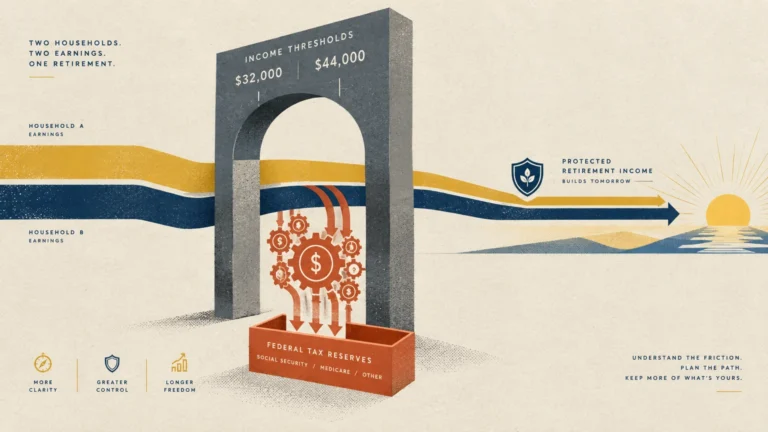
Beware of sudden benefit cliffs when earning supplemental income during retirement. Exceeding specific income thresholds can trigger higher Medicare Part B premiums through income-related monthly adjustment amounts.
Public policy analyses from AARP public policy studies emphasize that even small income increases can compromise eligibility for property tax relief programs. Review your local county tax exemptions annually to ensure your distributions do not forfeit valuable assistance.
Secure your estate by executing updated legal instruments, including durable financial powers of attorney and healthcare proxies. Confirm that your account beneficiary designations accurately reflect your current wishes, as beneficiary forms override language in your will.
Frequently Asked Questions About Retirement Income
What is considered a comfortable retirement income for a single person?
A single retiree generally needs between $50,000 and $88,000 per year, depending on local living costs. Lower-cost states like West Virginia require around $51,000, while expensive states like Massachusetts require nearly $89,000.
Housing expenses and healthcare costs drive the vast majority of this geographic variation. Single retirees must budget carefully because they carry all fixed household expenses without a partner to share costs.
How much can I safely withdraw from my retirement savings each year?
Many advisors recommend starting with a baseline distribution rate between 3.5 and 4 percent of your portfolio. You then adjust subsequent annual withdrawals for inflation to maintain purchasing power throughout your retirement.
Adopting flexible withdrawal rules allows you to take larger distributions during market upturns and smaller distributions during down years. This dynamic adjustment significantly reduces the probability of running out of money.
Should I move to a state with no income tax to lower my expenses?
Relocating solely for tax purposes often fails to produce the financial windfall retirees expect. States without income taxes frequently impose elevated property taxes, higher sales taxes, and costly auto registrations.
Examine the overall cost of living, including homeowners insurance and medical facilities, before relocating. Moving far from family and friends can also create emotional costs that outweigh tax savings.
Will my Social Security benefits be taxed by my state?
Forty-two states and Washington, D.C., exempt Social Security benefits entirely from state income taxation. Only eight states retain taxes on Social Security, and most offer substantial deductions for lower-income households.
At the federal level, up to 85 percent of your Social Security benefits may face taxation. Your combined income, which includes adjusted gross income and half your Social Security benefits, determines your federal liability.
Your 48-Hour Retirement Action Plan
Building a resilient retirement income plan does not require overhauling your life overnight. Small, deliberate actions taken today compound into lasting security and peace of mind.
Take one concrete step in the next 48 hours to gain control over your retirement numbers. Log into your account on the Social Security website and download your most recent earnings statement.
Compare your estimated monthly benefit against your current essential living expenses. Identifying your exact guaranteed income floor today provides the clarity you need to enjoy a confident retirement tomorrow.