
Medicare Open Enrollment runs from October 15 through December 7, 2026, offering your annual window to reset your healthcare coverage. Even modest plan adjustments can save you thousands of dollars while protecting your access to trusted physicians.
Physicians across the country see patients struggle every year with surprise network changes, shifting drug formularies, and unexpected out-of-pocket costs. Choosing the right plan requires looking past zero-dollar premium marketing to understand real-world medical care.
Understanding upcoming regulatory shifts ensures that your medical and financial needs align seamlessly for 2027. Taking decisive action today protects both your ongoing health and your retirement nest egg.
Major Policy Shifts Shaping Medicare in 2027
Significant regulatory adjustments will reshape Medicare coverage starting January 1, 2027. You must understand these updates before choosing your plan for the coming year.
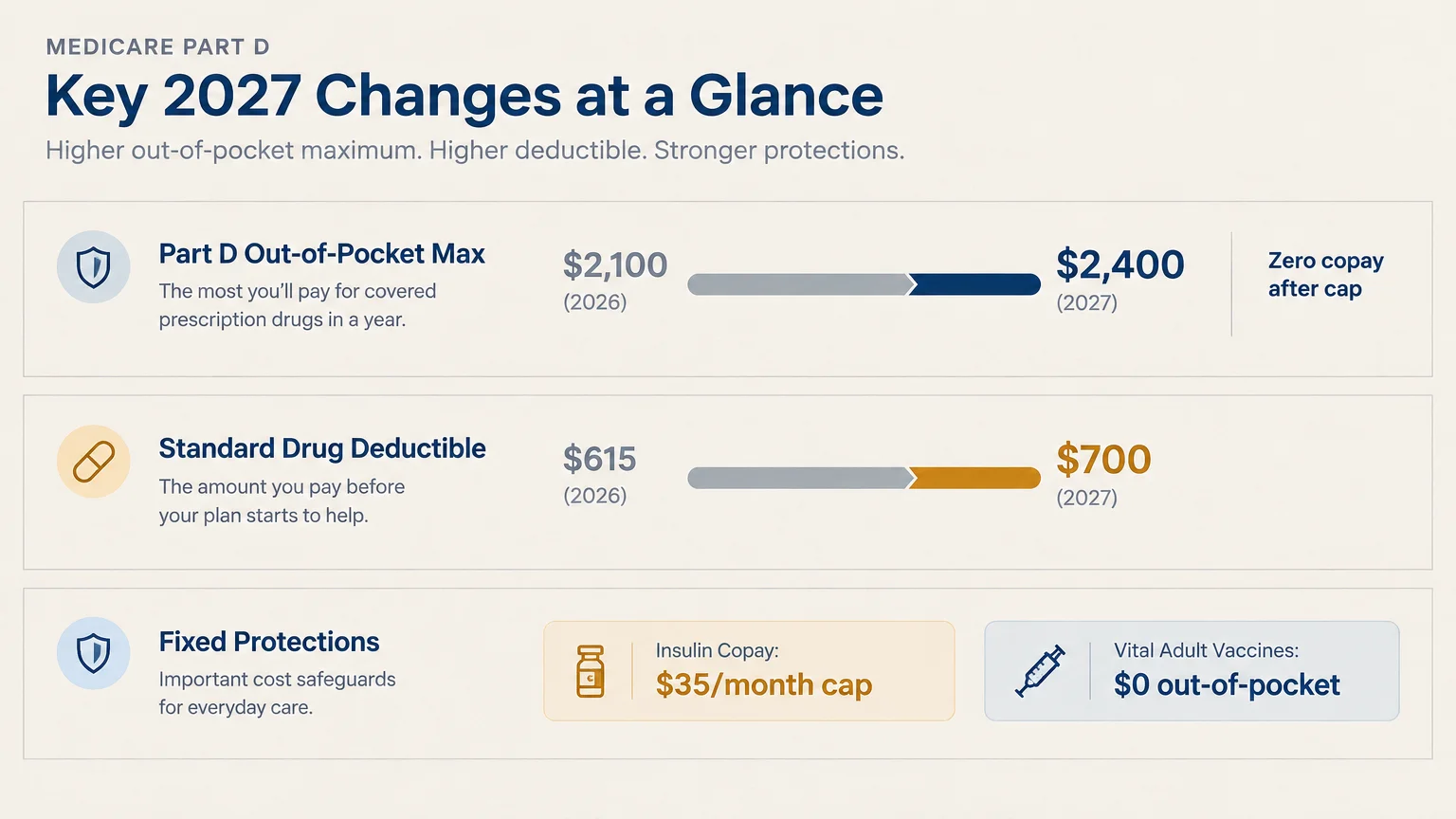
The standard out-of-pocket maximum for Medicare Part D prescription drugs rises to $2,400 in 2027, up from $2,100 in 2026. Once you hit this threshold, you pay zero dollars for covered medications for the remainder of the year.
Meanwhile, the maximum standard drug deductible increases to $700 for 2027, up from $615 in 2026. While some plans charge lower deductibles, you should prepare for higher upfront costs at the pharmacy counter.
The Centers for Medicare & Medicaid Services projects the average stand-alone Part D premium will reach $36.00 per month in 2027. The statutory base beneficiary premium used to calculate late penalties sits at $41.33.
Federal subsidies that stabilized stand-alone prescription premiums throughout 2025 and 2026 expire at the end of 2026. Consequently, many standalone Part D insurers are redesigning their formularies and shifting copayment structures.
Fortunately, federal legislation continues to shield retirees from volatile drug prices. Covered insulin copayments remain capped at $35 per month per prescription, and vital adult vaccines cost zero dollars out-of-pocket.
You can also opt into the Medicare Prescription Payment Plan. This program lets you spread out-of-pocket prescription drug costs into manageable, capped monthly installments throughout the entire calendar year.
Historic Drug Price Negotiations and GLP-1 Coverage
A major milestone arrives on January 1, 2027, as negotiated prices take effect for 15 high-cost Part D drugs. This expansion follows the first round of ten negotiated medications that launched in 2026.
The 2027 list includes widely prescribed treatments such as Ozempic, Rybelsus, Wegovy, Trelegy Ellipta, and Xtandi. Patients taking Linzess, Janumet, and Otezla will also benefit from these lower negotiated prices.
For retirees struggling with weight management and metabolic health, Medicare is introducing the GLP-1 Bridge program for 2027. Qualifying enrollees can access selected GLP-1 medications for a $50 monthly copayment if their plan lacks coverage.
Discuss these specific medications with your physician during this enrollment window. Your doctor can help determine whether your current prescriptions qualify under these updated cost-saving rules.
The Medicare Advantage Landscape for 2027
Medicare Advantage, or Part C, presents a contrasting financial picture for 2027. CMS landscape data reveals that average monthly premiums will drop 16.5% to $12.00 per month, down from $14.37 in 2026.
For plans combining medical and drug benefits, the average monthly drug premium drops to $7.00. Roughly 70% of these combined plans offer a zero-dollar additional premium beyond your standard Part B cost.
Market choice remains exceptionally broad across the country. Over 99% of beneficiaries have access to at least one Medicare Advantage option, and 97% can choose among ten or more plans.
However, private insurers are raising cost-sharing thresholds to balance these lower upfront premiums. The median in-network out-of-pocket maximum across Medicare Advantage plans increases from $6,500 in 2026 to $7,100 in 2027.
Furthermore, average drug deductibles within Medicare Advantage plans rise from roughly $434 to $525. You must weigh these potential backend medical bills against the appeal of a low monthly premium.
Part B Projections and Social Security Relief
For baseline medical insurance, the standard monthly Part B premium in 2026 stands at $202.90, alongside a $283.00 annual deductible. Federal trustees project the 2027 premium will increase to $209.50, with a $292.00 deductible.
Some private healthcare economists warn that the monthly premium could approach $221.00 depending on final calculations. CMS will announce the official 2027 Part B figures in November.
To cushion rising healthcare expenses, the federal government issued a one-time $90 rebate in October 2026 to roughly 20.8 million Original Medicare beneficiaries. This payment, drawn from the Medicare Improvement Fund, directly offsets Part B expenses.
Relief also arrives through the Social Security Administration, which announced a 3.6% Cost-of-Living Adjustment for 2027. This boost adds roughly $75 per month to the average retirement benefit check.
That average benefit increase comfortably offsets the projected Part B monthly increase for most retirees. Nonetheless, you should budget carefully to accommodate shifting copayments and deductibles across your entire plan.

What Doctors Want You to Keep in Mind
While insurance commercials highlight zero-dollar gym memberships, healthcare providers view coverage choices through the lens of patient care. Doctors frequently treat patients who delayed treatment due to confusing plan restrictions or narrow provider networks.
Your health status can shift without warning during retirement. Selecting a plan based solely on your current good health creates serious medical and financial vulnerabilities.
Prior Authorization and Treatment Delays
Primary care physicians repeatedly warn that aggressive prior authorization requirements delay necessary clinical care. Medicare Advantage plans frequently require formal administrative approval before approving advanced imaging, specialized surgeries, or skilled rehabilitation stays.
These bureaucratic hurdles force clinical teams to spend valuable hours submitting appeals rather than treating patients. If an insurer delays or denies coverage, your treatment stalls while your physical condition potentially worsens.
In contrast, Original Medicare rarely mandates prior authorizations for medically necessary treatments. You and your physician retain primary control over diagnostic schedules and procedural timelines.
Provider Networks and Specialist Access
An insurance plan is only as reliable as the clinicians who accept it. Medicare Advantage plans rely on localized networks of contracted hospitals, specialists, and outpatient diagnostic facilities.
Private insurers modify their provider networks regularly from year to year. Your long-term oncologist, cardiologist, or physical therapist might drop out of your network on January 1 without advance personal notification.
Call your doctor’s billing office directly to confirm their network participation for 2027 before changing plans. Never rely solely on marketing materials or online directories, which often contain outdated clinical listings.
Drug Formularies and Medication Tiers
Physicians express continuous frustration when pharmacy benefit managers quietly reassign vital medications to higher cost tiers. A maintenance drug that cost $20 monthly last year might require 40% coinsurance under new plan rules.
Insurers also enforce step therapy protocols, requiring you to try and fail cheaper alternative medications before approving your prescribed therapy. This practice can disrupt stable chronic disease regimens and trigger adverse clinical side effects.
Compare your complete medication inventory using the official Medicare.gov Plan Finder tool during open enrollment. Pay close attention to quantity limits, pre-authorization flags, and tier rankings.

Strategy Pillar 1: Health and Wellness Optimization
Designing your Medicare strategy around proactive wellness produces better clinical outcomes and lowers long-term spending. Healthcare in retirement functions best as an active collaboration between you, your physicians, and your insurance plan.
Schedule your annual wellness visit as early in the calendar year as possible. This comprehensive appointment establishes clinical baselines, identifies emerging risks, and updates your personalized preventive screening schedule.
Leveraging the New 2027 ACCESS Model
Starting January 1, 2027, Original Medicare introduces the ACCESS model to support beneficiaries who manage chronic conditions. This program targets prevalent illnesses such as diabetes, hypertension, and depression.
Participating physician groups connect you with low-cost or no-cost virtual visits, wearable biometric monitoring devices, and lifestyle coaches. Continuous biometric tracking helps your medical team identify warning signs before acute medical crises develop.
Ask your primary care doctor if their clinical practice participates in this innovative care model. Embracing remote monitoring tools empowers you to manage chronic health conditions from the comfort of home.
Maximizing Covered Preventive Care
Federal regulations require Medicare plans to cover an extensive roster of preventive services at zero out-of-pocket cost. These services include mammograms, colonoscopies, bone mass measurements, and cardiovascular disease screenings.
Take full advantage of no-cost adult immunizations, including vaccinations for influenza, COVID-19, pneumonia, RSV, and shingles. Vaccines protect you from severe respiratory illnesses that frequently trigger costly hospitalizations among seniors.

Strategy Pillar 2: Retirement Income and Healthcare Budgeting
Healthcare spending represents one of the largest and most volatile budget categories in retirement. Successful wealth management requires aligning your insurance policy with your cash reserves and overall risk tolerance.
Financial advisors suggest calculating your total annual healthcare exposure rather than focusing strictly on monthly premium savings. A plan featuring a zero-dollar premium can easily generate higher total costs if you need intensive care.
Comparing Medigap Predictability with Advantage Risk
Original Medicare paired with a Medigap supplemental policy offers unmatched financial predictability. While you pay a higher monthly premium, comprehensive Medigap plans pay nearly all deductibles and coinsurance charges.
With Medigap, you face virtually no surprise expenses regardless of how many hospital stays or specialist visits you require. This stability benefits retirees on fixed incomes who cannot absorb unexpected four-figure medical bills.
Conversely, Medicare Advantage plans require you to pay copayments until you hit your annual out-of-pocket limit. With median limits rising to $7,100 in 2027, an unexpected medical crisis can severely strain your liquid emergency savings.
Budgeting for the Part D Deductible and Cap
If you take specialty prescriptions, prepare for the higher $700 Part D standard deductible early in the year. Many retirees experience front-loaded expenses in January and February before their coverage covers significant costs.
Opt into the Medicare Prescription Payment Plan if large initial pharmacy bills strain your monthly household budget. Spreading that $2,400 cap into predictable monthly payments prevents cash flow crunches during winter months.
Certified financial planners suggest reserving at least one year of maximum out-of-pocket medical expenses in a high-yield savings account. That liquidity ensures that sudden copayments never force you to liquidate retirement investments prematurely.

Strategy Pillar 3: Lifestyle Design and Geographic Freedom
Your retirement lifestyle should dictate your healthcare coverage choices, not the other way around. If you travel frequently or split your year between different regions, plan architecture becomes your primary consideration.
Original Medicare allows you to visit any doctor or hospital across the United States that accepts Medicare. This nationwide portability offers seamless care for snowbirds, travelers, and retirees who maintain multi-state residences.
Navigating Regional Network Boundaries
Most Medicare Advantage plans operate within localized service areas defined by specific counties. Outside of emergency rooms, these managed plans rarely cover non-emergency treatment beyond their regional geographic borders.
If you spend winters in southern states while maintaining your primary home up north, an HMO plan will leave you without routine coverage. Even PPO plans charge significantly higher cost-sharing for out-of-network care.
Review your realistic travel plans for 2027 before committing to a geographically restricted managed care plan. Choosing nationwide coverage prevents frustrating logistical hurdles and unexpected out-of-network bills when you are away from home.
Planning for Changing Mobility and Cognitive Needs
Aging brings inevitable changes in physical mobility and cognitive stamina. Choosing a plan that minimizes administrative hurdles protects your quality of life as your care needs grow more complex.
Managed care plans require navigating referral networks, disputing claim denials, and obtaining prior authorizations. In contrast, Original Medicare significantly reduces paperwork, easing the caregiving burden on your family members.
Designate a trusted healthcare proxy who holds legal medical power of attorney and authorized access to your Medicare account. Establishing legal safeguards today guarantees continuous, reliable advocacy if serious health challenges arise later.

Expert Perspectives: Clinical and Financial Realities
Healthcare providers and financial planners see the direct consequences of plan selection every single day. Their real-world observations highlight critical factors that commercial advertisements routinely overlook.
Geriatric physician Dr. Marcus Vance notes that care continuity directly determines patient outcomes following major health events. Sudden network exclusions disrupt the vital doctor-patient relationships necessary for successful chronic disease recovery.
When a patient suffers a stroke or joint fracture, immediate access to high-quality rehabilitation facilities is paramount. Restrictive insurance networks frequently deny admission to preferred recovery centers, forcing families into stressful appeals.
Wealth advisor Sarah Jenkins, CFP®, warns against prioritizing convenience perks over core medical coverage. She observes that zero-dollar gym memberships and minor grocery allowances distract seniors from catastrophic cost-sharing exposure.
High out-of-pocket maximums can quickly wipe out the modest financial benefit of supplemental wellness cards. Jenkins advises clients to calculate their worst-case annual medical expenses before enrolling in any managed plan.

Critical Risks and Pitfalls to Avoid This Fall
Open enrollment attracts aggressive sales pitches and sophisticated fraudulent schemes targeting older adults. Protecting your health benefits and finances requires skepticism toward unsolicited offers and misleading commercial promotions.
The AARP routinely warns retirees about deceptive television ads featuring famous celebrities. These commercials frequently promise dramatic benefit increases that apply only to specific, low-income regional plans.
Identifying Telemarketing Scams and Identity Theft
Never share your Medicare number, Social Security number, or banking details with unsolicited telephone callers. Legitimate Medicare representatives will never phone you unexpectedly to demand personal information or issue new cards.
Criminals frequently spoof official government caller ID displays to make fraudulent inquiries appear authentic. Hang up immediately if a caller claims your Medicare benefits will lapse unless you verify your identity.
Report suspicious sales tactics or impersonation attempts directly to federal authorities. Reporting fraudulent calls protects other retirees in your community from predatory financial exploitation.
The Medigap Underwriting Benefit Cliff
Switching from Original Medicare to a Medicare Advantage plan is simple, but reversing that choice carries hidden risks. Federal law guarantees your right to purchase a Medigap policy only during your initial enrollment period.
If you drop Medigap to try Medicare Advantage and later want to return, supplemental insurers in most states can review your health history. Existing chronic conditions can lead to exorbitant premium surcharges or outright policy denials.
Evaluate these permanent underwriting consequences before surrendering an existing Medigap policy. Once you surrender your supplemental coverage, you may never qualify for comprehensive private supplemental insurance again.
Step-by-Step Enrollment Action Plan
Navigating open enrollment successfully requires a methodical, organized approach. Completing a structured review prevents rushed decisions before the December 7 deadline closes your options.
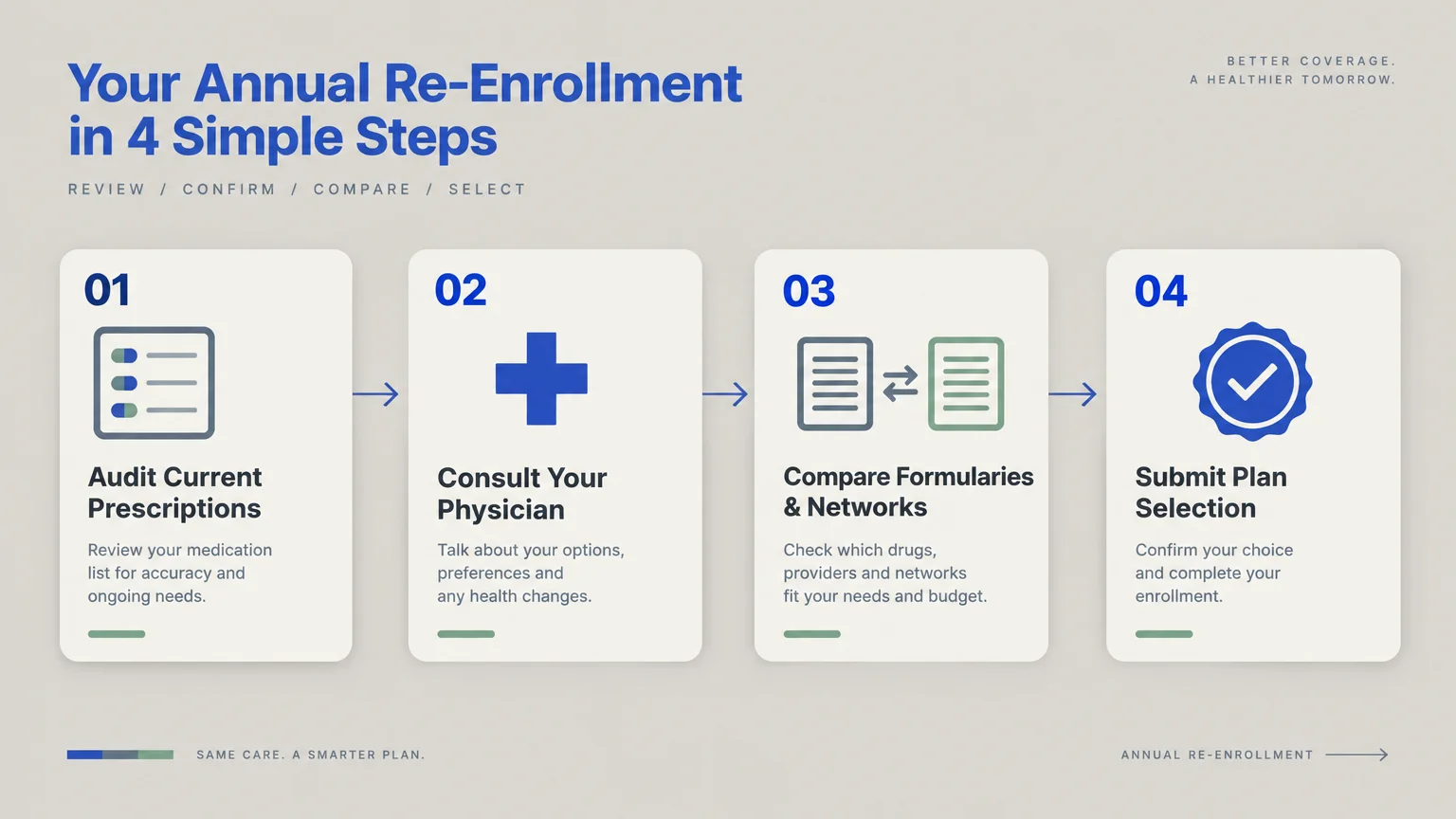
Begin by creating an exhaustive inventory of your medical care over the past twelve months. Include all current prescription drugs, exact daily dosages, monthly refill frequencies, and preferred neighborhood pharmacies.
Next, compile a complete roster of every doctor, specialist, therapist, and hospital system you visited this year. Accurate clinical records ensure you evaluate plan networks with complete precision.
Locate the Annual Notice of Change letter mailed by your current insurance plan in late September. Review this document carefully to identify upcoming premium adjustments, formulary deletions, and cost-sharing increases for 2027.
Enter your complete prescription list into the official online federal plan finder tool. Running this comparison calculates your estimated total annual drug and healthcare expenses across all available local plans.
If you find plan comparison overwhelming, contact your local State Health Insurance Assistance Program for guidance. These state-funded counselors offer free, objective advice without earning insurance sales commissions.
Critical Enrollment Deadlines You Must Track
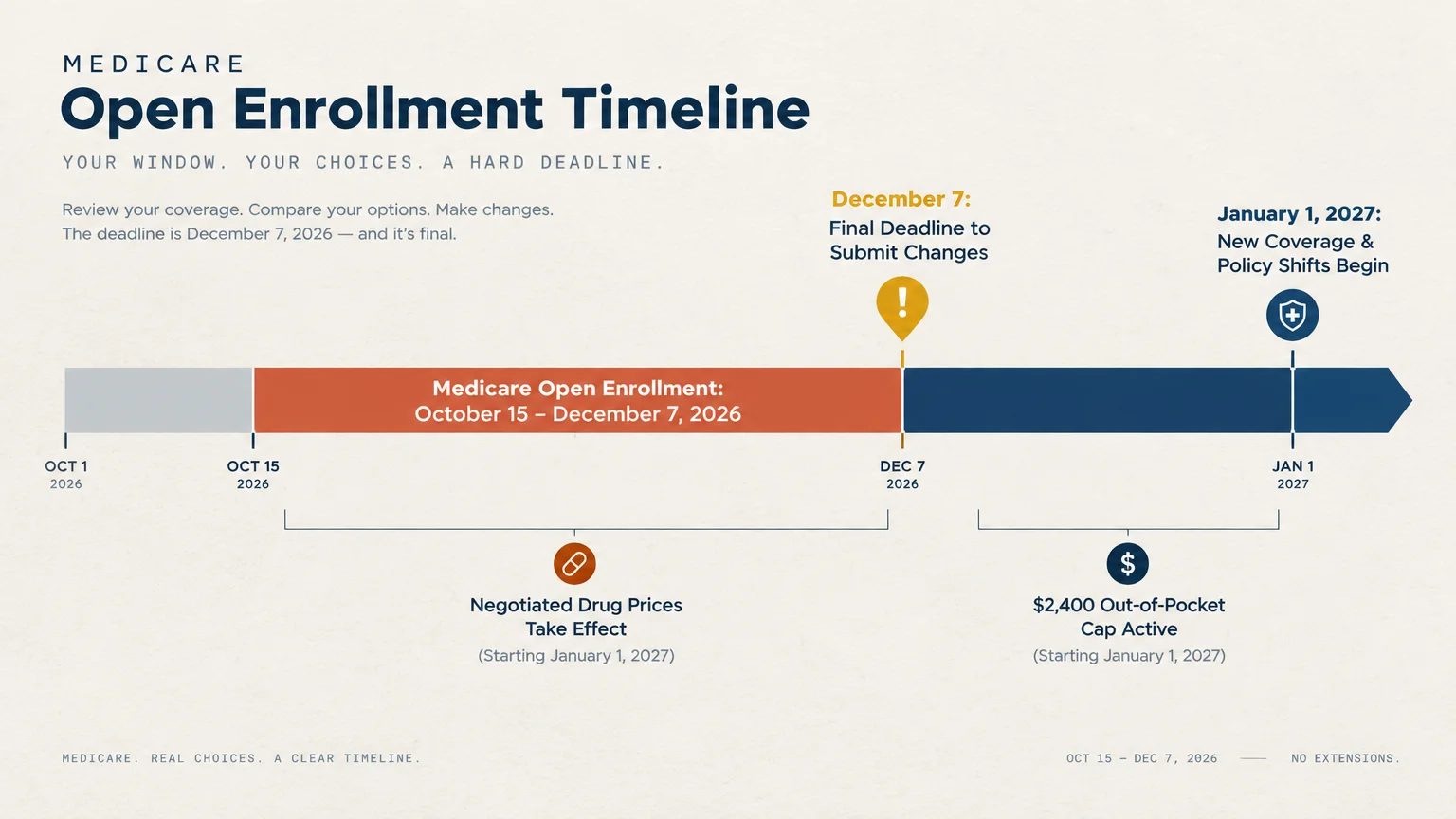
The general open enrollment period runs from October 15 through December 7, 2026. Any plan adjustments you finalize during this window will take effect on January 1, 2027.
If you select a Medicare Advantage plan that disappoints you, take advantage of the secondary enrollment period. The Medicare Advantage Open Enrollment Period runs from January 1 through March 31, 2027.
During that three-month window, you can switch to another Medicare Advantage plan or return to Original Medicare. Missing these strict enrollment deadlines locks your healthcare arrangements in place for the entire calendar year.
Frequently Asked Questions
Can I return to Original Medicare if my Medicare Advantage plan disappoints me?
Yes, you can switch back to Original Medicare during the open enrollment window ending December 7, 2026. You can also make this switch between January 1 and March 31, 2027.
However, leaving Medicare Advantage does not guarantee you can purchase a Medigap supplemental policy. Unless you qualify under special guaranteed issue circumstances, private insurers can decline your application based on medical underwriting.
How does the new $2,400 Part D spending cap affect my prescriptions?
The $2,400 out-of-pocket maximum limits your total annual spending on covered Part D medications for 2027. Once your deductible and copayments reach $2,400, you pay zero dollars for covered drugs for the rest of the year.
This spending cap provides critical protection for seniors who take expensive specialty drugs for chronic conditions. It effectively eliminates catastrophic coinsurance charges that historically overwhelmed retiree healthcare budgets.
Who qualifies for the new $50 GLP-1 Bridge program in 2027?
The GLP-1 Bridge program aids qualifying Part D enrollees whose insurance plans exclude weight-loss or metabolic medications. Eligible individuals can receive covered GLP-1 prescriptions for a fixed $50 monthly copayment.
Program qualification depends on specific medical criteria and clinical documentation submitted by your physician. Speak with your healthcare provider to determine whether your medical diagnosis meets federal guidelines.
Will the 2027 Social Security COLA cover my higher Medicare costs?
The 3.6% Social Security Cost-of-Living Adjustment provides an average increase of about $75 per month for retired workers. This benefit boost comfortably exceeds the projected $6.60 monthly Part B premium increase.
However, rising out-of-pocket limits and higher prescription deductibles may still strain your household finances if you require substantial care. Prudent budgeting ensures your net retirement income remains resilient against unexpected medical bills.
Take Control of Your Coverage in the Next 48 Hours
Navigating Medicare open enrollment requires focused attention, but you can accomplish your review in small steps. Taking simple, decisive actions over the next 48 hours will protect your health and finances throughout 2027.
Start today by collecting your current prescription bottles and listing their exact medication names and dosages. Having this clinical information readily accessible makes plan comparisons fast and straightforward.
Tomorrow, phone your primary doctor and key specialists to verify their network status for 2027. Confirming participation directly with clinic staff prevents surprise network disruptions in the coming year.
Finally, log into the federal Medicare portal to evaluate your total out-of-pocket expenses across competing plans. Choosing your coverage with clear medical facts provides lasting financial security and genuine peace of mind.