
Picture yourself sipping morning coffee on a breezy porch just blocks from gentle surf, knowing your monthly housing costs stay comfortably low. In 2027, smart planning lets you trade high-cost suburbs for sun-drenched coastal living without straining your nest egg.
While national home prices remain steep, nine welcoming shoreline towns still offer homes well below the U.S. median. You can protect your retirement savings, trim state tax bills, and build an active seaside routine.
Discover which coastal markets fit your budget, how 2027 Medicare and tax rules shape your cash flow, and how to test-drive beach life today.

Why Coastal Living Fuels Purpose and Longevity in 2027
Moving near the water does far more than upgrade your view; it reshapes your daily habits around movement, sunlight, and neighborhood connection. Flat coastal boardwalks and mild winters encourage daily walks long after freezing northern sidewalks would keep you indoors.
Strong social ties and regular outdoor activity sit at the heart of evidence-based healthy aging strategies that support mobility and mental clarity. Coastal communities naturally spark casual conversations at farmers markets, fishing piers, and morning coffee counters.
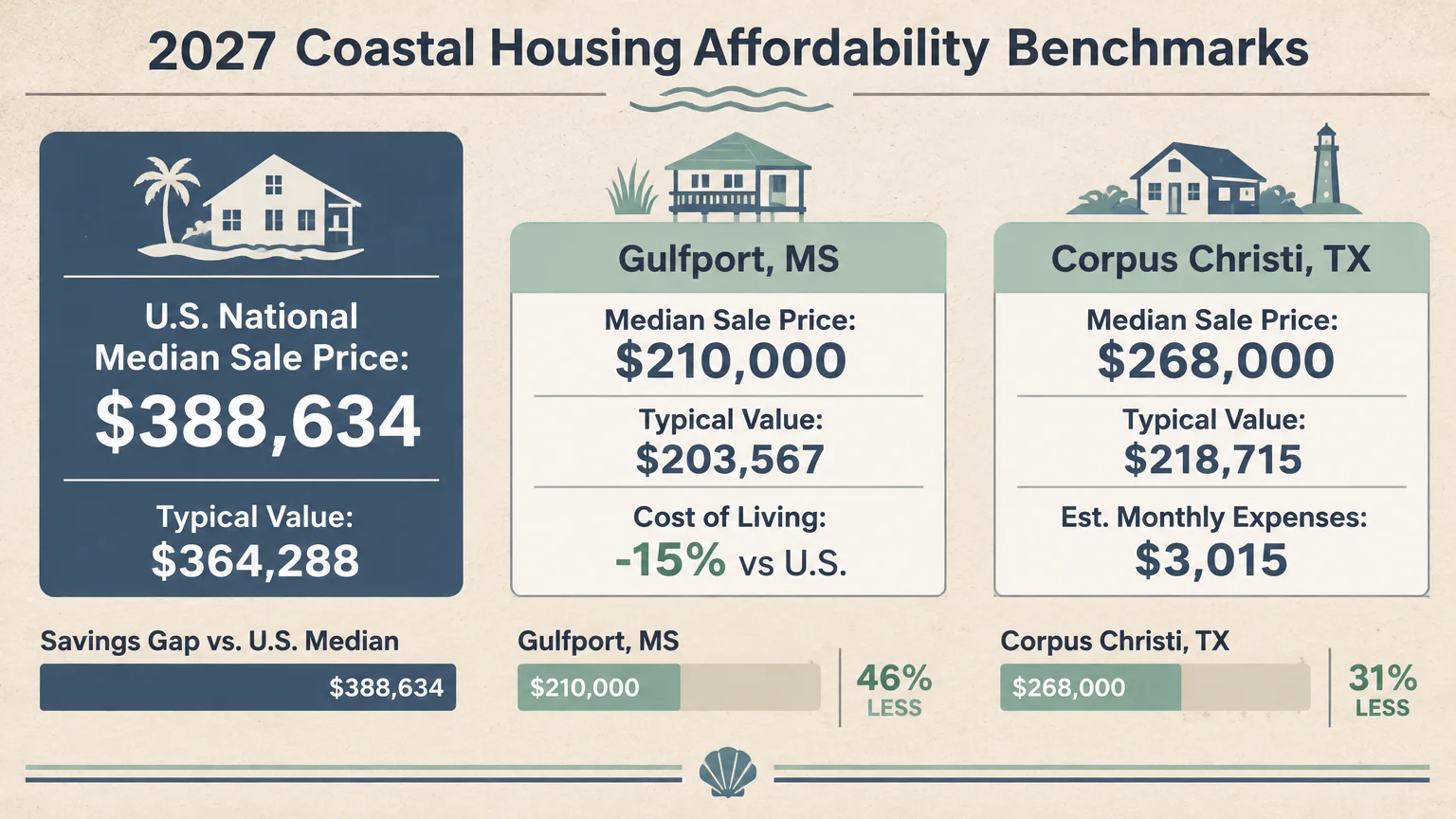
Affordability protects that peace of mind just as much as salt air does. Nationally, the median home sale price sits at $388,634, while the typical home value reaches $364,288 and average rent climbs to $1,913 per month.
With 30-year fixed mortgage rates averaging 7.28% and 15-year rates sitting near 6.66%, overpaying for a coastal zip code can quickly erode your discretionary travel fund. Choosing an affordable beach town frees up cash for hobbies, dining out, and family visits.
Nine Affordable Beach Towns Where Your 2027 Budget Goes Further
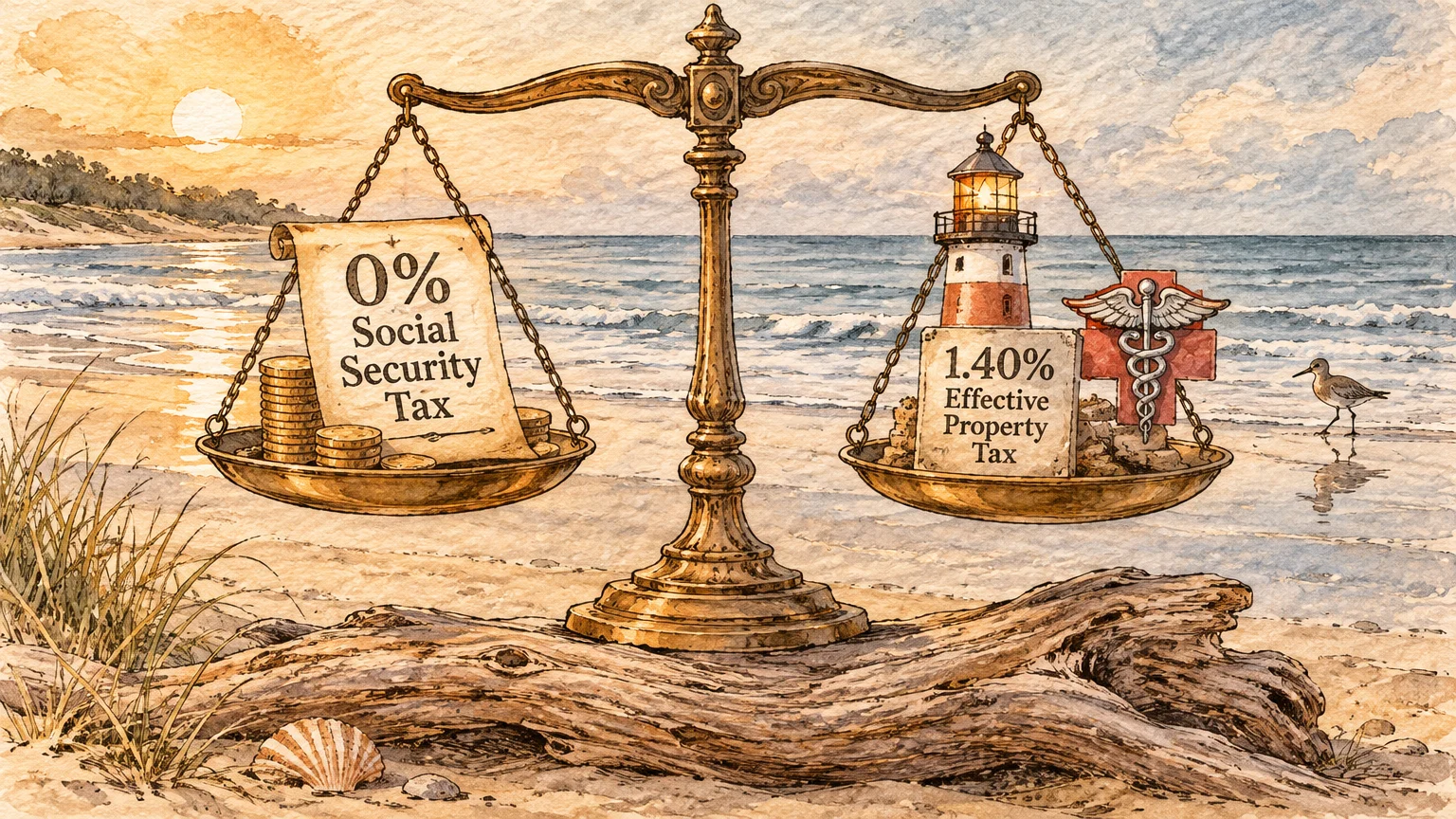
Every town on this list keeps housing costs well under the $388,634 national median sale price while delivering distinct coastal character. Better yet, none of the states featured here—Alabama, Florida, Georgia, Mississippi, South Carolina, Texas, or Washington—tax your Social Security benefits.
1. Gulfport, Mississippi
Gulfport delivers genuine beachfront value along a stretch of sandy shoreline overlooking the Mississippi Sound. Its typical home value sits at $203,567, and the median sale price is $210,000, with homes averaging 55 days on the market.
Your everyday dollars stretch remarkably far here; Gulfport’s overall cost of living runs 15% below the national average, and groceries cost 5% less. Mississippi also earns top marks for retiree tax friendliness and keeps effective property taxes at just 0.72%.
Level paved paths along Jones Park and the Gulfport Harbor make waterfront strolls accessible whether you walk briskly or use a mobility scooter. You can spend afternoons browsing local galleries, taking a ferry to Ship Island, or joining community symphony events.
2. Corpus Christi, Texas
If you want warm Gulf breezes paired with big-city medical centers, Corpus Christi offers the lowest estimated monthly retirement expenses among major beach cities at roughly $3,015 per month. Typical home values sit at $218,715, while median sale prices average $268,000.
Texas charges zero personal income tax on your wages, pensions, 401(k) withdrawals, or IRA distributions. Keep one tradeoff in mind before making an offer: Texas relies heavily on property taxes, carrying an effective rate of 1.40%—the seventh-highest in the nation.
Retirees with varied mobility levels appreciate Padre Island’s accessible boardwalks, bayside seawall walkways, and birding platforms along the Great Texas Coastal Birding Trail. You can fish off Bob Hall Pier at dawn and explore waterfront museums before dinner.
3. Daytona Beach, Florida
Daytona Beach proves you do not need half a million dollars to retire on Florida’s Atlantic coast. Typical home values here stand at $245,732—down 1.0% year over year—while average house prices sit at $294,000 and average rents run $1,995 per month.
Looking just north or south of pricier beachfront enclaves unlocks serious savings; neighboring Daytona Beach Shores carries a typical value of $369,852 and a $375,000 average price. Choosing mainland Daytona neighborhoods keeps you minutes from the ocean at a fraction of the cost.
Florida charges no state personal income tax, and its effective property tax rate sits below the U.S. average at 0.76%. Wide, hard-packed sand and paved oceanfront promenades welcome beach wheelchairs, bicycles, and brisk morning walkers alike.
4. Brunswick, Georgia
Tucked along Georgia’s Golden Isles corridor, Brunswick blends historic charm, marsh views, and effortless access to Jekyll Island and St. Simons Island beaches. Typical home values sit at $254,042, giving you entry into coastal Georgia well below national benchmarks.
Georgia pairs generous retirement income exclusions with an effective property tax rate of 0.77%, making it exceptionally friendly to fixed budgets. Even better, average homeowners insurance for $300,000 of dwelling coverage runs $2,496 per year—less than half Florida’s average rate.
Oak-shaded downtown squares invite slow afternoon walks past antique shops, seafood cafes, and lively weekend markets. Short drives across scenic causeways bring you to flat coastal bike trails and quiet state park beaches.
5. Pensacola, Florida
Pensacola pairs sugar-white Gulf beaches with a deeply established retiree community—roughly 21% of local residents are already retired. Its typical home value of $261,308 sits far below Florida’s statewide typical value of $375,056.
Renters save substantially here as well, with Pensacola’s average rent at $1,750 per month compared to the $2,300 statewide average. Estimated monthly retirement expenses hover near $3,226, making Pensacola a standout choice for budget-conscious snowbirds and year-round residents.
You can tour historic brick forts, cheer on Blue Angels practice flights, or attend outdoor concerts in Seville Square without paying big-city ticket prices. Major regional hospitals also sit within easy reach of most neighborhoods.
6. Port Charlotte, Florida
Positioned between Sarasota and Fort Myers along Charlotte Harbor, Port Charlotte offers quiet canal-lined streets and laid-back Gulf Coast living. Typical home values sit at $269,098, and average house prices recently dipped 5.8% year over year to $259,000.
Because Port Charlotte sits slightly inland from barrier islands, you avoid steep island price premiums while keeping boat ramps, bayfront parks, and Gulf beaches within a short drive. Golfers, kayakers, and spring-training baseball fans stay busy all winter without battling dense tourist traffic.
Before signing a contract in Port Charlotte or anywhere in Florida, verify property elevation and wind-mitigation credits carefully. Those steps protect you from sudden insurance surprises once you settle in.
7. Ocean Springs, Mississippi
Known locally for its vibrant arts scene and canopy of live oaks, Ocean Springs feels like an intimate coastal village. Typical home values sit at $270,795, with median sale prices at $275,758—roughly $159 per square foot.
If you want an even lower entry point nearby, neighboring Biloxi carries a typical home value of $241,021. Both towns let you tap into Mississippi’s favorable retirement tax rules and low 0.72% effective property tax rate.
Ocean Springs’ walkable downtown puts pottery studios, independent bookstores, bakeries, and Front Beach within an easy stroll. Flat sidewalks and shaded benches allow you to pace yourself comfortably on warm Gulf afternoons.
8. Foley, Alabama
Located just inland from Gulf Shores and Orange Beach, Foley gives you quick beach access without paying beachfront real estate prices. Typical home values sit at $300,796, and median sale prices average $330,000, with listings spending around 80 days on the market.
Alabama boasts the second-lowest effective property tax rate in the country at just 0.37%, dramatically trimming annual carrying costs. Your pensions are exempt from state tax, and at age 65 or older your first $6,000 of 401(k) or IRA distributions is exempt too.
Foley’s Antique Rose Trail, neighborhood parks, and nearby Gulf State Park offer paved, accessible trails through coastal pine forests and dunes. You can shop local farm stands in the morning and catch sunset over Perdido Bay by evening.
9. Myrtle Beach, South Carolina
Myrtle Beach continues drawing retirees in droves, ranking among the top ten U.S. metros for net inbound migration with 3,700 new residents arriving in a single spring quarter. Typical home values sit at $319,700, while median sale prices stand at $285,000.
South Carolina backs up that popularity with the fifth-lowest effective property tax rate nationwide at 0.49% and generous retirement income deductions. Wide sandy coastline means you can pick quiet northern residential stretches away from amusement boardwalks.
Retirees thrive on abundant golf leagues, oceanfront state parks, performing arts venues, and expansive medical networks. Strong community clubs make it simple to find bridge partners, walking groups, or pickleball leagues during your first week in town.
A Pacific Coast Alternative: Ocean Shores, Washington
If humid southern summers do not appeal to you, look northwest to Ocean Shores on Washington’s scenic Olympic Peninsula. Typical home values sit at $327,704—down 3.8% year over year—and average house prices stand at $349,000.
Washington imposes zero personal income tax on wages, Social Security, pensions, 401(k)s, or IRAs, though it does tax capital gains income. Effective property taxes remain below the national average at 0.81%.
Expect misty mornings, storm-watching from cozy cafes, clam digging, and flat lakeside canals rather than tropical heat. Paved coastal paths and quiet wildlife refuges reward retirees who love rugged Pacific scenery.

Your Coastal Experience Playbook: Travel, Volunteering, and Learning
Buying an affordable home is only half the equation; designing days filled with curiosity and purpose turns a new address into home. Before you pack a moving truck, invest modest travel dollars into testing how a town feels during everyday life.
Test-Driving Towns Through Seasonal Stays and Educational Travel
Book a two-week or month-long stay in your top two towns during both peak season and quiet shoulder months. Cooking in a rental kitchen, driving to grocery stores during rush hour, and visiting local clinics reveal details no brochure shows.
You can also combine coastal scouting with structured educational travel programs for older adults that bundle lodging, regional history walks, and built-in social groups. Group trips let you sample unfamiliar coastlines safely while keeping transportation and itinerary logistics simple.
If you plan to work part-time remotely or pick up seasonal coastal work before reaching full retirement age, watch the 2027 Social Security earnings limits. Before full retirement age, $1 in benefits is withheld for every $2 earned above $25,560 per year, or $2,130 monthly.
During the calendar year you reach full retirement age, that threshold rises to $67,920 annually—with $1 withheld for every $3 earned above the limit. Knowing those numbers lets you take a part-time museum docent or harbor shop job without surprise benefit reductions.
Purpose-Driven Volunteering and Creative Community Ties
Coastal towns rely heavily on passionate retirees to keep beaches, libraries, and cultural nonprofits thriving. Volunteering gives your week gentle structure while introducing you to neighbors who share your values.
Explore national senior volunteer networks to match your background with local schools, disaster-preparedness teams, or companion programs. Many coastal counties also welcome volunteers for sea turtle nest monitoring, botanical garden upkeep, and maritime museum tours.
Creative pursuits flourish beside the ocean without demanding expensive memberships. Look for municipal art guilds in Ocean Springs, community theater crews in Pensacola, or plein-air watercolor groups meeting at sunrise along Georgia marshes.
Accessible Recreation for Every Mobility Level
You do not need marathon stamina to enjoy coastal living every day. Many public beaches across Florida, South Carolina, and Texas provide free balloon-tire beach wheelchairs through lifeguards or park offices when reserved ahead.
Choose hobbies that scale smoothly with your energy levels—from shaded pier fishing and birdwatching to aquatic fitness classes at municipal recreation centers. Regional colleges near Myrtle Beach, Corpus Christi, and Pensacola also host lifelong learning institutes with low-cost daytime lectures.
Protecting Your Health, Taxes, and Coastal Budget in 2027
True retirement freedom comes from knowing your healthcare, insurance, and tax numbers will hold steady even when storms or medical bills arrive. Understanding 2027 federal benchmarks ensures your coastal budget stays resilient year after year.
Stretching Your 2027 Social Security Raise and Medicare Coverage
Starting in January 2027, Social Security beneficiaries receive a 3.6% cost-of-living adjustment, lifting the average retired worker’s monthly check by roughly $75—from $2,095 to $2,170. Maximum benefits at full retirement age rise to $4,188 per month.
However, standard Medicare Part B premiums increase by $6.50 per month—or 3.2%—from $202.90 to $209.40 in 2027, while the annual Part B deductible climbs $9 to $292. That premium uptick absorbs about 9% of the average raise, leaving $68.50 net per month.
Hospital costs also edge upward, with the 2027 Part A inpatient deductible reaching $1,776 per benefit period. Roughly 9% of Part B enrollees with modified adjusted gross income above $112,000 individually—or $224,000 filing jointly—also face income-related surcharges reaching up to $711.80 monthly.
Prescription coverage warrants a careful autumn review using official Medicare plan comparison tools before open enrollment closes. Average standalone Part D premiums are projected at $36 per month overall, though staying in the same plan could push average premiums to $51 monthly.
Two new 2027 Medicare enhancements can also support your coastal health routine. Qualifying Part D enrollees gain access to a $50 monthly copay under the Medicare GLP-1 Bridge, while Original Medicare introduces the ACCESS chronic-care support model.
Factoring Taxes, Insurance, and Storm Contingencies Into Your Offer
Low home prices tell only part of the affordability story on the coast; insurance premiums can reshape your monthly outlay dramatically. Nationwide, homeowners insurance for $300,000 in dwelling coverage averages $2,772 per year, while Alabama averages $3,408 and Georgia averages $2,496.
Florida carries the highest homeowners insurance cost in the nation at $6,324 per year, shaped in part by 94 billion-dollar weather disasters recorded between 1980 and 2024. Always request binding homeowners and windstorm quotes during your home inspection period before waiving contingencies.
Flood protection requires equal scrutiny because federal Risk Rating 2.0 prices policies around each property’s elevation, distance to water, foundation type, flood frequency, and rebuilding cost. Under that overhaul, premiums fell for roughly 23% of policyholders while holding steady or climbing for others.
High-risk A and V flood zones carry at least a 26% chance of flooding over a 30-year mortgage, and federally backed loans require coverage there. Active federal flood policies average $1,114 per year in high-risk zones versus $745 annually in moderate- and low-risk B, C, or X zones.
Standard residential federal policies range from $800 to $3,500 per year in Zone AE and $1,500 to $8,000 in coastal storm-surge Zone VE, capped at $250,000 for building structure and $100,000 for contents. Run address-specific projections through federal flood risk and insurance estimators before making an offer.
If you are still working in 2027 to pad your coastal storm reserve and moving fund, take advantage of higher contribution limits. Employee 401(k), 403(b), and 457 limits rise to $25,500—plus an $8,500 catch-up at age 50 or older, totaling $34,000—while IRAs allow $7,500 plus a $1,100 catch-up.
Build a simple storm-season safety net alongside your financial cushion. Keep digital copies of insurance policies, three days of medications, battery packs, and a pre-planned inland hotel route ready every summer.
Frequently Asked Questions About Affordable Beach Retirement
How can I explore coastal towns safely as a solo retiree?
Start by booking centrally located rentals in walkable neighborhoods—such as downtown Ocean Springs or central Pensacola—where cafes, parks, and urgent care clinics sit nearby. Join daytime walking tours, library workshops, or volunteer shifts during your stay to meet locals naturally.
Share your itinerary and rental address with a trusted friend or adult child back home, and check in regularly while exploring unfamiliar beaches. Group educational trips also let you preview new coastal regions with built-in companionship and vetted accommodations.
How do I balance coastal living with caregiving duties for a spouse or parent?
Prioritize towns with full-service regional medical centers and reliable highway access, such as Pensacola, Myrtle Beach, or Corpus Christi, rather than remote barrier islands. Short drives to specialists, pharmacies, and physical therapy clinics save hours of weekly stress.
Look for single-story floor plans near ground-level parks so outings remain simple for both of you. Ask local aging agencies about adult day programs and in-home respite services, and check whether Original Medicare’s 2027 ACCESS chronic-care model supports your family’s health needs.
What aging-in-place upgrades matter most in a coastal home?
Focus first on step-free entries, zero-threshold walk-in showers, lever door handles, and sturdy grab bars that keep daily routines safe for decades. Wide hallways and first-floor primary suites protect your independence if stairs ever become difficult.
On the coast, pair accessibility updates with storm resilience—such as impact-rated windows, moisture-resistant vinyl plank flooring, and backup power stations for medical devices. Remember that standard federal flood policies cap building coverage at $250,000, so smart material choices reduce potential out-of-pocket repairs.
How do I budget for travel and hobbies without draining my nest egg?
Locking in fixed housing costs well below the $364,288 national typical value leaves natural breathing room in your monthly cash flow. Pair a modest mortgage or cash purchase with low-property-tax states like Alabama at 0.37% or South Carolina at 0.49%.
Track your net Social Security income after your $209.40 Part B premium and Part D costs, and dedicate a set monthly slice exclusively to enrichment. Stretching that fund with free municipal beach access, off-peak travel discounts, and local senior center classes keeps life vibrant without overspending.

Take One Concrete Step Toward Your Shorefront Routine
Coastal retirement does not belong only to multimillionaires; it belongs to anyone willing to match realistic numbers with clear priorities. Across towns from Gulfport and Foley to Brunswick and Ocean Shores, affordable seaside neighborhoods are ready to welcome your next chapter.
Open your calendar today and schedule one small, tangible action for this week. Book a four-day shoulder-season scouting trip, pull a real flood and homeowners insurance quote on a sample listing, or compare two towns’ property tax bills side by side.
One focused afternoon of planning turns a vague daydream into dates, figures, and plane tickets. Your mornings by the water are closer—and far more affordable—than you think.