
You can generate meaningful extra cash flow and rekindle your professional passions without risking your nest egg on hefty startup expenses. Launching a low-cost venture allows you to control your schedule, maintain cognitive vitality, and buffer your monthly budget against persistent inflation. Today, thousands of older adults earn hundreds of dollars each month through accessible ventures requiring less than a hundred-dollar bill in initial capital. Whether you want to fund bucket-list travel, offset rising healthcare costs, or share your lifelong expertise, inexpensive micro-businesses offer total autonomy. With minimal overhead and flexible hours, these lean side pursuits deliver immediate financial breathing room while protecting your hard-earned retirement savings.
The Modern Retirement Landscape and the Rise of Micro-Venture Income
Retirement no longer represents a sudden withdrawal from productive work; instead, it offers a transition into intentional, self-directed engagement. Data from the Bureau of Labor Statistics reveals that labor force participation among older Americans continues to rise steadily as people seek flexible ways to supplement their pensions, annuities, and investment portfolios. Rather than returning to rigid corporate schedules, modern retirees increasingly favor micro-ventures that leverage their existing skills, personal interests, and community connections.
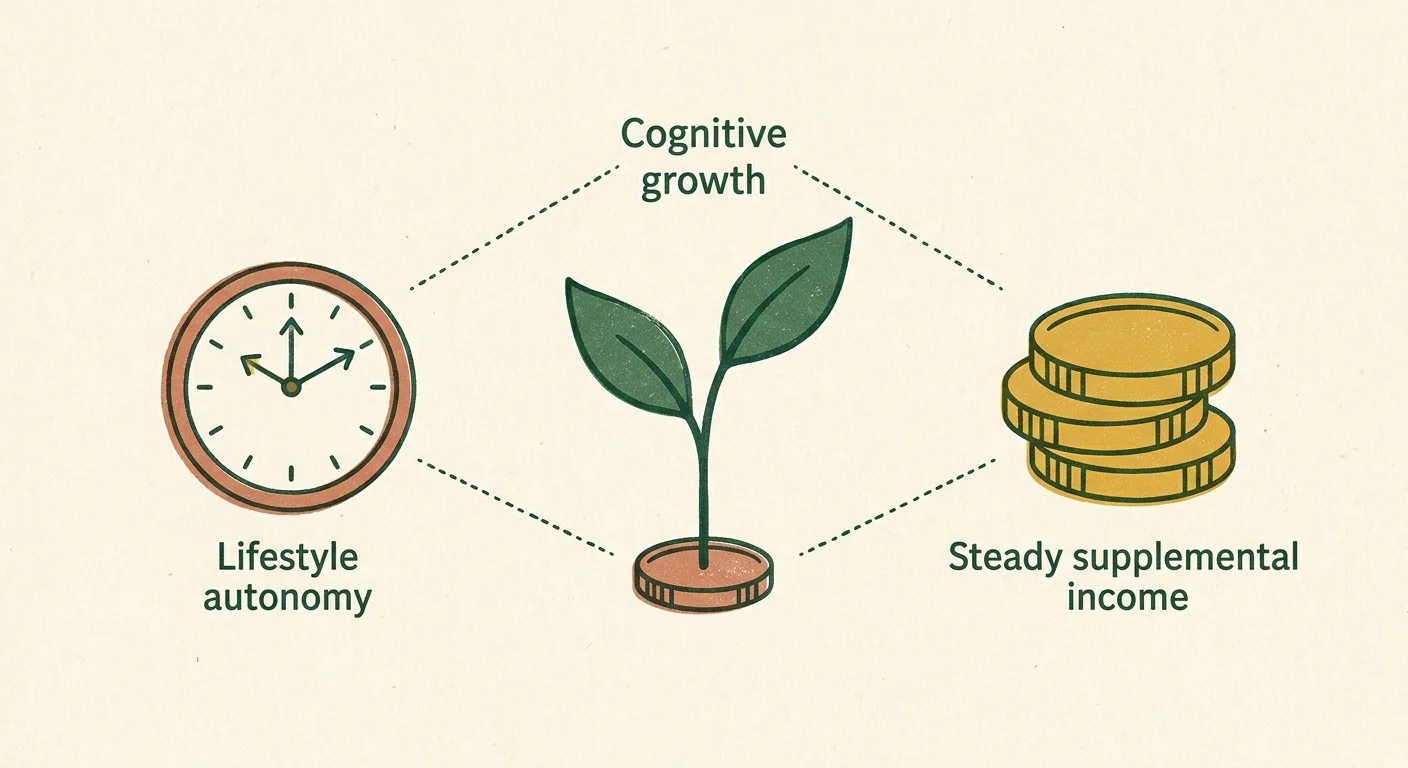
A well-chosen side gig addresses three critical pillars of a healthy retirement: strategic income planning, lifestyle autonomy, and cognitive wellness. Financially, generating even $400 to $800 in monthly net profit can dramatically reduce the rate at which you must draw down your retirement accounts during market downturns. From a lifestyle perspective, running your own low-overhead enterprise gives you complete authority over your calendar, ensuring you never sacrifice family visits or leisure travel. Furthermore, peer-reviewed aging research consistently demonstrates that engaging in purposeful, problem-solving tasks strengthens neuroplasticity, preserves memory, and reduces the risk of social isolation.
9 Accessible Retirement Side Gigs Under $100
Starting a profitable side business does not require substantial financial risk. The following nine ventures require less than $100 in initial out-of-pocket capital, draw on skills you already possess, and offer immediate income opportunities.
1. Mobile Notary Public and Loan Signing Agent
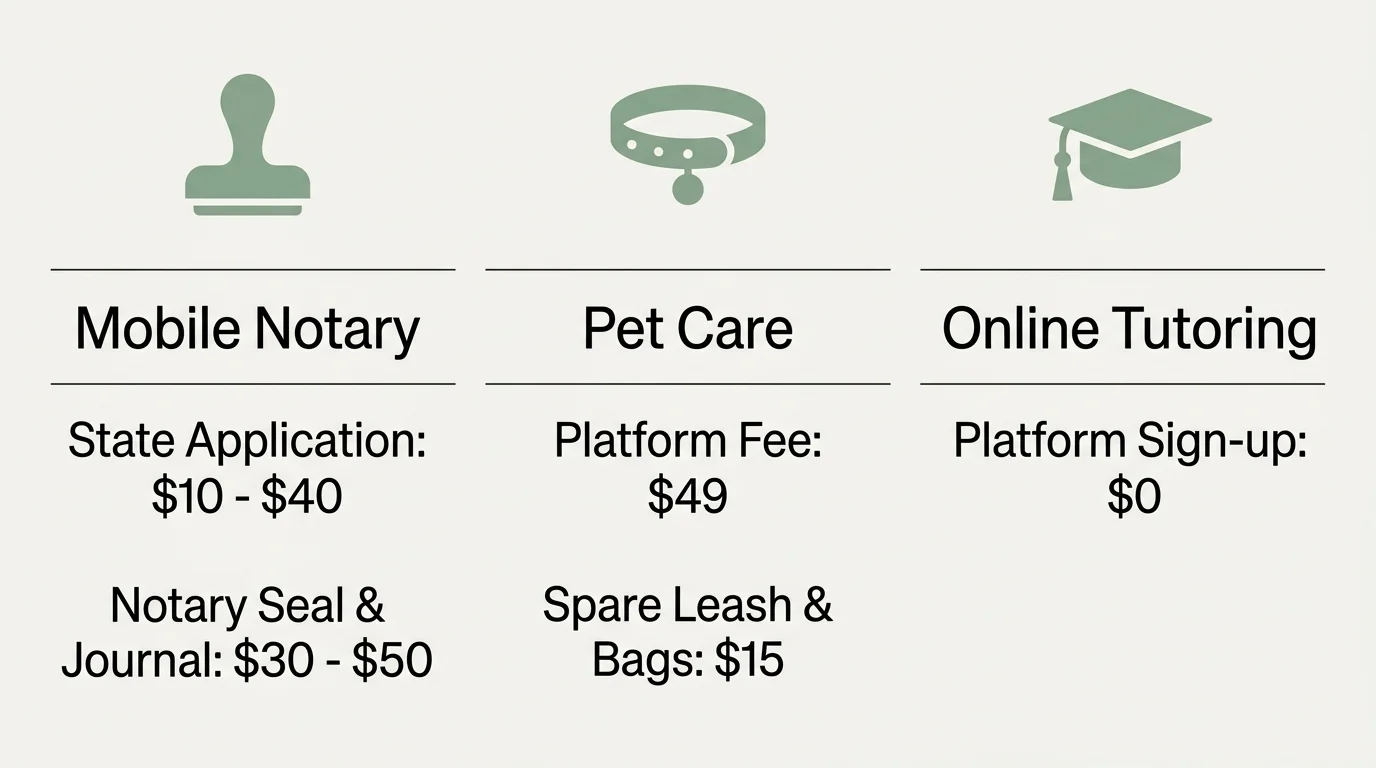
Serving as a notary public allows you to provide an essential legal service to your local community while setting your own appointments. In states such as Texas, Florida, and Ohio, basic state application fees range from $10 to $40, while official notary seal stamps and record journals cost between $30 and $50. Your total initial investment stays comfortably below the $100 mark. You can charge state-mandated fees of $10 to $15 per signature, with substantial additional income generated through travel and convenience fees when visiting client homes, hospitals, and real estate offices.
2. In-Home Pet Sitting and Dog Walking
Pet care offers steady demand, flexible scheduling, and built-in physical exercise. Platforms like Rover allow you to connect directly with local pet owners for a one-time profile review and background check fee of $49. A basic investment in a durable spare leash and waste bags consumes another $15, leaving you well under budget. While Rover retains a 20% platform fee on completed bookings, providers routinely earn $20 to $35 for a brisk 30-minute neighborhood walk and $50 to $90 per night for overnight house sitting.
3. Online Academic and Professional Tutoring
Decades of accumulated knowledge in mathematics, literature, foreign languages, or corporate management can translate directly into a lucrative remote tutoring business. Platforms such as Wyzant and Outschool charge zero upfront fees to create an instructor profile, monetizing instead by retaining a revenue share of 25% to 30% from student bookings. Because you utilize your existing home computer, webcam, and internet connection, your startup cost is literally zero dollars. Experienced tutors typically set their rates between $30 and $75 per hour.
4. Digital Printables and Template Design
If you prefer creative projects that generate passive revenue without physical inventory or shipping logistics, selling digital printables provides an ideal avenue. You can use the free tier of graphic design software to create retirement planning checklists, budget sheets, meal planners, or garden tracking logs. Setting up a storefront on Etsy requires a $15 one-time shop setup fee, alongside listing fees of $0.20 per item for four months. Once published, your products can sell repeatedly, with the platform deducting a 6.5% transaction fee and a 3% plus $0.25 payment processing fee per sale.
5. Local Neighborhood Walking Tour Guide
Turn your deep familiarity with your city’s architecture, historical landmarks, food scene, or nature trails into an engaging guided experience. You can list your curated walking tours on platforms like Airbnb Experiences at no initial cost, or market them through local historical societies and community boards with $20 in printed brochures. Guides regularly charge $25 to $45 per participant for a 90-minute stroll. This gig allows you to remain physically active, meet travelers from around the world, and operate strictly on days when weather and personal schedules align.
6. Downsizing and Home Organization Consultant
Many seniors and busy families feel completely overwhelmed by accumulated possessions and require compassionate, experienced guidance to streamline their living spaces. You can launch a downsizing consulting service with a $35 marketing budget devoted to business cards and flyers distributed at local community centers, senior living facilities, and real estate offices. Your primary tools are organizational patience, empathy, and spatial planning. Organizers regularly earn $35 to $60 per hour helping clients categorize belongings, prepare for estate sales, or optimize living areas.
7. Curated Vintage Reselling and Thrift Flipping
If you enjoy hunting for unique items at estate sales, garage sales, and thrift stores, reselling offers both recreation and profit. Allocate an initial $50 sourcing budget to purchase undervalued vintage home goods, collectibles, solid-wood decor, or branded outdoor gear. You can list these finds on free-to-use platforms like Facebook Marketplace or eBay, paying standard marketplace fees only after an item sells. High-quality smartphone photos taken in natural light and detailed descriptions will help you turn modest secondhand purchases into solid profit margins.
8. Plant Sitting and Small-Space Garden Consultant
Houseplant collections and container gardens represent significant financial investments for homeowners who travel frequently. You can launch a specialized plant-sitting and container-gardening advisory service for roughly $35, which covers a basic soil moisture meter, pruning shears, and printed neighborhood flyers. You can charge $25 to $40 per home visit to water, trim, and inspect indoor plants or assist suburban neighbors in setting up high-yield patio herb and vegetable planters.
9. Freelance Proofreading and Editorial Polishing
If you have an eye for precision, grammar, and syntax, freelance proofreading offers an intellectually stimulating, fully remote income stream. You can review self-published book manuscripts, corporate newsletters, academic dissertations, and local business marketing materials from your home desk. A standard updated reference manual costs under $40, representing your only necessary startup expense. Freelance proofreaders commonly command $25 to $50 per hour through professional platforms, direct networking, and local author groups.
Financial Safeguards: Taxes, Social Security, and Healthcare Rules
Earning extra income during retirement provides wonderful flexibility, but you must structure your earnings intentionally to protect your overall financial picture. Understanding federal tax rules, entitlement thresholds, and benefit limits ensures that your new income builds wealth rather than triggering unexpected financial penalties.
First, independent contractor and sole proprietorship income carries federal tax obligations. The Internal Revenue Service requires individuals with net business earnings of $400 or more in a calendar year to report their profits on Schedule C and pay self-employment tax via Schedule SE. The standard self-employment tax rate of 15.3% covers Medicare and Social Security contributions. Setting aside 25% to 30% of your net profits in a dedicated high-yield savings account prevents any unpleasant surprises when quarterly estimated taxes come due.
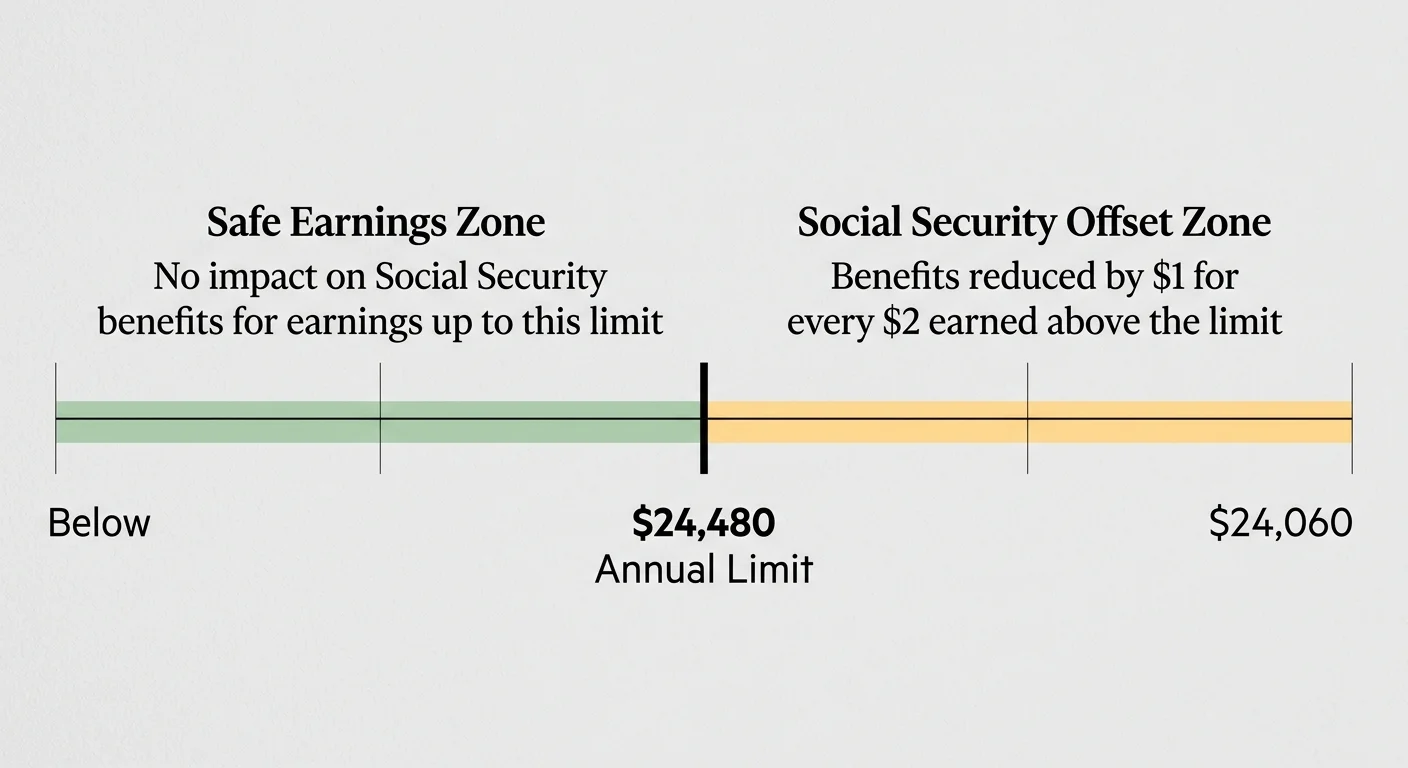
Second, retirees collecting early retirement benefits must monitor federal earnings caps carefully. The Social Security Administration enforces specific earnings limits for beneficiaries who have not yet reached their Full Retirement Age (FRA). In 2026, the annual earnings limit for workers under FRA is $24,480; the agency withholds $1 in benefits for every $2 earned above that ceiling. In the calendar year you reach your FRA, the limit increases to $65,160, with $1 withheld for every $3 earned above the threshold until your birth month. Once you attain your Full Retirement Age, all earnings limits disappear entirely, allowing you to earn unlimited side income with zero benefit reductions.
Third, be mindful of Modified Adjusted Gross Income (MAGI) thresholds that govern Medicare Part B and Part D premiums. If substantial business income pushes your total earnings across the Income-Related Monthly Adjustment Amount (IRMAA) tiers, your monthly Medicare premiums could rise two years later. Keeping your micro-venture lean and writing off legitimate business expenses—such as mileage, supplies, and platform fees—keeps your net taxable profit within your desired financial bracket.
Finally, safeguard your personal information against predatory employment scams. The AARP routinely warns older adults about counterfeit check schemes, mystery shopping scams, and fraudulent work-from-home offers that demand substantial upfront payment for equipment or training. Stick exclusively to reputable platforms, verify all client payments before delivering goods, and never send money to secure a job.

Expert Perspectives: Balancing Cash Flow with Peace of Mind
Financial planners emphasize that modest side business revenue can fundamentally change the durability of a retirement portfolio. A Certified Financial Planner (CFP®) often views non-portfolio income as a defensive buffer; generating $6,000 annually through a relaxed side venture equates to preserving roughly $150,000 of capital that would otherwise need to generate withdrawals under a standard 4% retirement distribution rule.
Gerontologists and occupational psychologists reinforce that the non-monetary rewards of micro-entrepreneurship are equally significant. Maintaining an active enterprise creates structured routines, prompts continuous learning, and fosters meaningful social connections. When you design a micro-business that aligns with your passions, work ceases to feel like an obligation and becomes an energizing component of your daily life.
Frequently Asked Questions
How do I report side gig earnings if I do not receive a Form 1099-NEC?
Federal tax law requires you to report all earned income regardless of whether a platform or client issues a formal tax document. Companies only generate Form 1099-NEC when total non-employee compensation reaches or exceeds $600 in a calendar year. You must track your gross receipts and business expenses accurately using a spreadsheet or basic bookkeeping software, reporting the final net profit on IRS Form 1040 Schedule C during your annual tax filing.
Will side hustle earnings cause my Medicare premiums to increase?
Your Medicare Part B and Part D premiums will only increase if your side business profits elevate your Modified Adjusted Gross Income above specific statutory thresholds. The standard premium applies to the vast majority of beneficiaries; only high earners exceeding these federal limits encounter IRMAA surcharges. Deducting valid startup and operational expenses lowers your net business profit, minimizing any risk of triggering an adjustment tier.
What happens to the Social Security benefits withheld under the earnings test?
Benefits withheld under the Social Security Administration’s earnings test are not permanently lost. When you reach your Full Retirement Age, the agency recalculates your monthly benefit upward to account for the payments that were withheld during your working months. Over time, this adjustment permanently increases your monthly check, effectively returning the withheld sums across your remaining lifetime.
How can I prevent a retirement side gig from consuming too much of my free time?
Establishing strict operational boundaries protects your leisure hours. Set predefined working hours on your digital calendar, specify minimum advance notice requirements for client bookings, and cap the total number of weekly clients you accept. Remember that the ultimate goal of a retirement micro-venture is lifestyle enhancement, not corporate expansion; choose projects that bring genuine satisfaction and decline requests that threaten your personal peace.
Take Action: Launch Your $100 Venture Within 48 Hours
Building an enjoyable, profitable retirement venture does not require complex business plans or substantial financial risk. The most successful micro-entrepreneurs start small, test their concepts quickly, and build momentum through simple, practical execution.
Select one idea from this guide that aligns with your existing skills and personal lifestyle goals. Over the next 48 hours, dedicate two hours to setting up your foundation: draft your service offerings, purchase any required low-cost supplies, and create your initial platform profile or local marketing flyer. By taking this single, low-stakes step today, you can unlock a fulfilling stream of supplemental income that enriches both your wallet and your retirement lifestyle.





Looking to get back into work. I have been laid off, but never stop looking! No Bites!
Assist with device provisioning, builds, configuration, deployment and decommissioning of IT equipment.
Maintain accurate asset records, ensuring all IT and broadcast related equipment is correctly tracked and audited.
Support routine system checks, monitoring activities and proactive maintenance tasks as directed.
Follow defined incident, problem and change processes,etc!!!! IT Project Management experience. Let me know if you can fit me in a project.
Looking to get back to work- IT Specialist and Site Project Management experience