
Filing your 2026 tax return in 2027 brings new senior deductions, mandatory electronic refunds, and stricter identity checks. One overlooked detail can freeze your cash for months instead of weeks.
When you live on Social Security, pensions, and portfolio withdrawals, delayed money disrupts your monthly budget. Spotting seven common filing mistakes early helps you protect your refund timeline and keep your retirement plan on track.
Reviewing your withholding, tax forms, and banking details before the April 15, 2027 deadline puts you back in control. A few targeted checks can safeguard every dollar you expect back.
How Filing Mistakes Disrupt Your Retirement Income Alignment
Your tax return does more than settle last year’s bill with the IRS. It directly governs how smoothly your Social Security benefits, pension checks, annuity payouts, and portfolio withdrawals support your lifestyle.
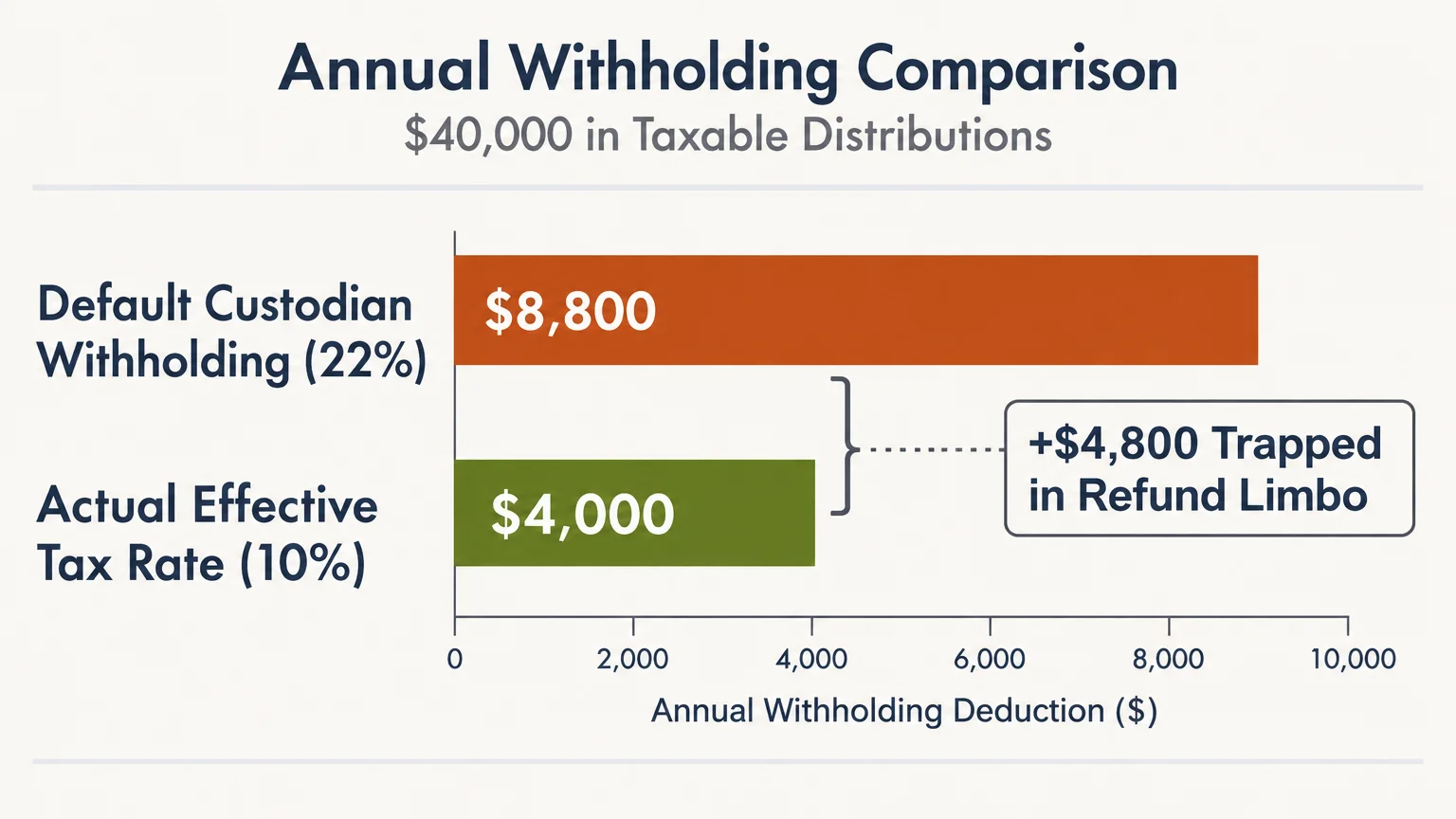
Many retirees send too much tax to the Treasury during the year through automatic pension or IRA withholding. That habit creates an artificial cash shortfall that leaves you waiting for a spring refund to cover property taxes, travel, or home repairs.
Consider a retired couple receiving a combined $40,000 in taxable pension and annuity distributions alongside Social Security. If their custodian withholds 22% by default when their effective federal rate is closer to 10%, they lock up roughly $4,800 unnecessarily.
Reclaiming that money on time matters when you coordinate withdrawals from taxable brokerage accounts and retirement accounts. Remember that every household’s bracket and state tax picture differs, so confirm withholding changes with a licensed tax or financial professional.
You can test your current withholding balance across pensions, part-time wages, and retirement distributions using the IRS Tax Withholding Estimator. Pairing that check with your claiming timeline on the Social Security Administration website helps prevent both underpayment penalties and oversized refunds.
Whether you claim Social Security early, wait until full retirement age, or delay to maximize monthly checks, tax withholding should match your actual income mix. Even a small adjustment in January keeps more spending power in your checking account all year.
The Seven Tax Refund Mistakes Costing Retirees Time in 2027
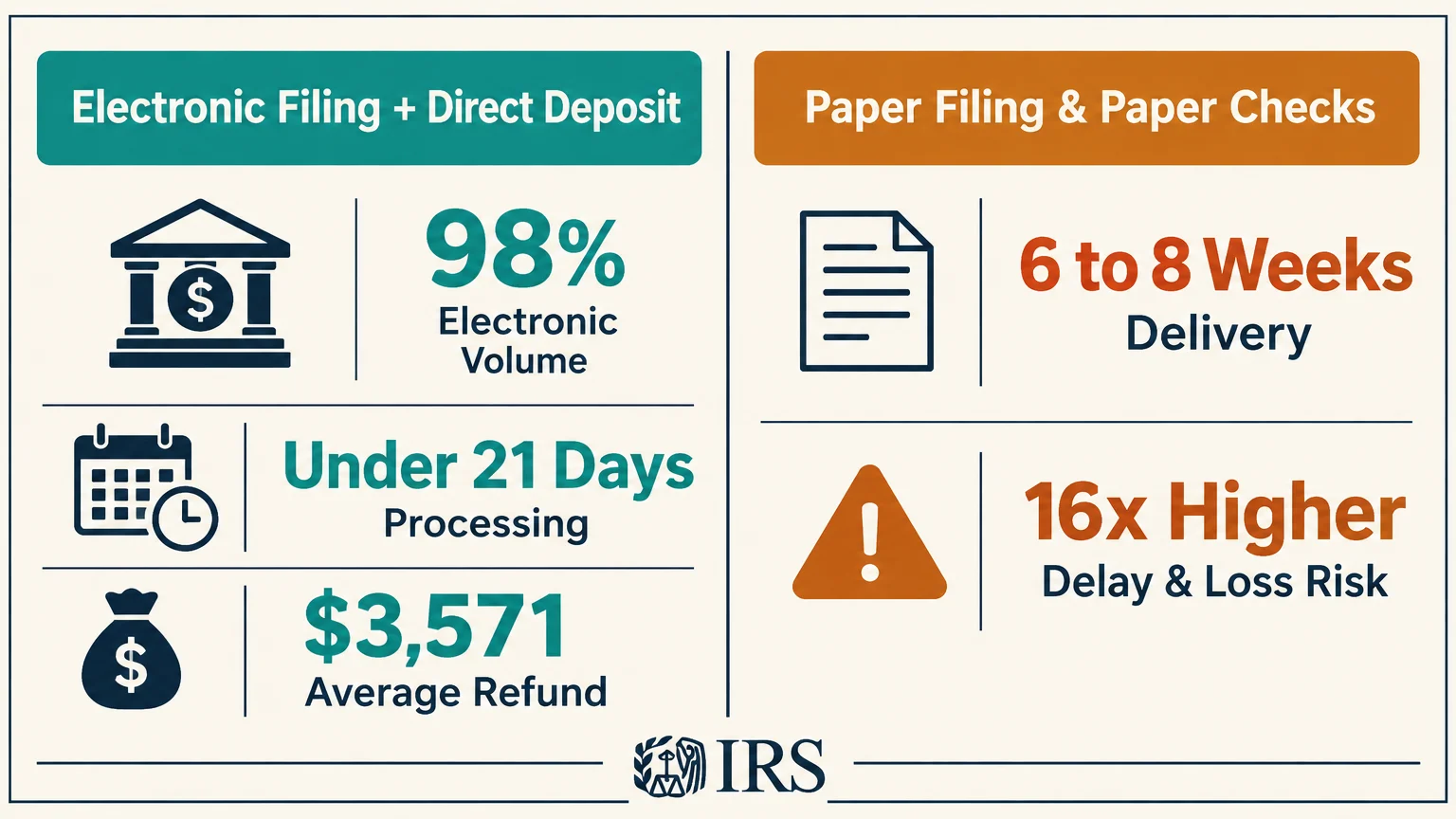
According to IRS benchmarks from the 2026 filing season through March 20, 2026, over 80% of refunds arrived in under 21 days, averaging $3,571. Over 98% of both returns and refunds moved electronically.
Retirees who run into multi-month delays usually trip over predictable processing bottlenecks rather than complex audits. Eliminating these seven errors keeps your return in the fast electronic lane.
1. Relying on Paper Checks or Entering Mismatched Bank Details
Under Executive Order 14247, signed in March 2025, the Treasury and IRS began phasing out paper tax refund checks for individual taxpayers on September 30, 2025. Most filers must now provide direct deposit routing and account numbers, or use a compatible prepaid debit card, digital wallet, or IRA.
The IRS warns that paper checks are more than 16 times as likely to be lost, stolen, altered, or delayed compared with electronic payments. Paper returns also slow processing to six weeks—and sometimes up to eight weeks—versus under 21 days for e-filed returns with direct deposit.
Even e-filers face sudden freezes when bank information is missing, transposed, or rejected by a financial institution. One common retiree error happens when a married couple files jointly and directs the refund into a bank account titled in only one spouse’s name.
When a deposit fails, the IRS issues Notice CP53E. Data cited from the House Ways and Means Committee showed an estimated 1.4 million taxpayers—roughly 1% of filers—received CP53E notices by March 2026.
You have strictly 30 days from the date on Notice CP53E to update your banking details inside your IRS Individual Online Account. Phone representatives cannot take routing or account numbers over the phone.
If you update your account online within that 30-day window, the IRS typically releases your refund within seven days. Taking no action forces a six-week wait for a fallback paper check.
Be alert for fraud tied to this notice. The Taxpayer Advocate Service warns taxpayers never to scan QR codes or click links on CP53E letters, and instead to log in directly at IRS.gov to confirm any pending refund.
2. Filing Before Final 1099-B, 1099-R, and SSA-1099 Forms Arrive
Filing in late January or early February feels productive, yet rushing often backfires for retirees with investment accounts. Brokers and custodians have until February 16, 2027—shifted from February 15 due to Presidents’ Day—to deliver Form 1099-B and consolidated brokerage statements for 2026 trades.
Investment firms routinely request extensions or issue corrected 1099 statements well into March as mutual funds reclassify dividends and capital gains. Submitting your return before final numbers arrive invites an IRS mismatch notice.
IRS computers also automatically cross-check Form 1099-R, issued for pension, annuity, and retirement distributions over $10, alongside Form SSA-1099 for Social Security. Substituting estimated figures on Form 4852 pushes your return into manual verification and stalls your refund.
Watch for another 2026 reporting shift if you consult or teach part-time. Companies no longer have to send Form 1099-NEC unless your payments reach $2,000, yet you still must report every dollar of taxable self-employment earnings.
Once an early error forces you to file an amended return on Form 1040-X, patience becomes mandatory. The IRS advises waiting 8 to 12 weeks—and up to 16 weeks in some cases—for amended processing.
3. Missing Schedule 1-A for the New Senior Bonus Deduction
Tax year 2026 offers generous baseline relief for older Americans, starting with higher base standard deductions. For 2026 returns filed in 2027, the base standard deduction sits at $16,100 for single filers, $24,150 for heads of household, and $32,200 for married couples filing jointly.
If you were born before January 2, 1962, you also earn the regular additional standard deduction for age or blindness. That adds $2,050 per condition for unmarried filers who are not surviving spouses, or $1,650 per qualifying spouse or condition on joint returns.
On top of those amounts, legislation enacted for 2025 through 2028 created an Enhanced Deduction for Seniors worth $6,000 per eligible person age 65 or older by year-end. Married joint filers who are both 65 or older can claim $12,000, whether they itemize or take the standard deduction.
Here is where retirees lose time and money: the IRS does not grant this $6,000 or $12,000 bonus automatically when you check the age-65 box on Form 1040 or Form 1040-SR. You must complete Schedule 1-A, Part V, and carry the total to line 13b.
Both qualifying spouses must also include valid Social Security numbers, because Individual Taxpayer Identification Numbers do not qualify, and married taxpayers must file jointly to claim it. Missing Schedule 1-A forces math corrections or amended returns that postpone your payout.
Keep an eye on the income phaseout, which trims the senior bonus at a 6% rate once modified adjusted gross income exceeds $75,000 for single filers or $150,000 for joint filers. The deduction disappears completely at $175,000 and $250,000, so unplanned capital gains or Roth conversions can change your refund math.
4. Overlooking Qualified Charitable Distributions on Form 1099-R
Charitable giving directly from an IRA remains one of the sharpest tax tools for retirees age 70 and a half or older. For 2026, you can transfer up to $111,000 tax-free through Qualified Charitable Distributions, or $222,000 for married couples using separate IRAs.
Eligible donors can also execute a one-time transfer of up to $55,000 to a charitable remainder trust or charitable gift annuity. These gifts satisfy required withdrawals while keeping the transferred dollars out of adjusted gross income.
The reporting trap sits right on Form 1099-R. Custodians still report your entire IRA withdrawal in Boxes 1 and 2a, and IRS instructions for 2026 forms issued in 2027 keep the new Code Y identifier optional.
If you forget to manually subtract the charitable portion and note the exclusion on your return, IRS software assumes the full payout is taxable. Overpaying taxes or filing a subsequent Form 1040-X to recover that money easily costs you months.
5. Forgetting Your Identity Protection PIN
Identity theft protections work only when you keep track of your credentials. If the IRS assigned you a six-digit Identity Protection PIN, submitting an e-file without that number triggers an immediate rejection.
Mailing a paper return without your PIN does not bypass the check either. The IRS reroutes incomplete paper filings into manual identity verification, which freezes your refund until your identity is confirmed.
Many retirees expect a paper CP01A reminder letter in January and panic when nothing arrives in the mailbox. Anyone who opted into the PIN program online after 2019 does not receive mailed letters and must retrieve the current code inside their IRS Individual Online Account.
Plan your calendar carefully around annual maintenance windows. The online PIN portal shuts down from November 16, 2026, until mid-January 2027, so wait until the portal reopens rather than guessing an old number.
Avoiding identity verification queues matters more than ever given IRS service backlogs. According to the Taxpayer Advocate Service 2026 Mid-Year Report to Congress, the Taxpayer Protection Program phone line received roughly 2.4 million calls and answered only about 19% of them.
That same report noted over 500,000 identity-theft victim cases remained stuck in inventory at the end of the filing season, often taking close to two years to resolve. Protecting your six-digit PIN keeps you out of that queue.
6. Miscalculating Required Minimum Distributions and Extensions
Required Minimum Distributions generally start at age 73, rising to age 75 for people born in 1960 or later. If you turn 73 in 2026, you have until April 1, 2027, to take your first distribution, though you still must take your second by December 31, 2027.
Missing a required distribution carries a steep 25% excise tax on the shortfall. You can reduce that penalty to 10% by correcting the withdrawal within two years and filing Form 5329 with your return.
Retirees sometimes confuse filing extensions with payment extensions when waiting on delayed tax forms or RMD calculations. Submitting Form 4868 by April 15, 2027, gives you an automatic six-month extension to file until October 15, not an extension to pay.
Any unpaid tax balance after April 15 still collects penalties and interest, eroding any refund you hoped to claim from over-withholding elsewhere. Estimate and remit any balance due on time even if you plan to file in autumn.
7. Ignoring Treasury Offsets and Refund Verification Tools
Sometimes a smaller or missing refund has nothing to do with filing errors. Under the Treasury Offset Program, the Bureau of the Fiscal Service reduces refunds automatically to cover unpaid federal or state tax debts, federal agency non-tax debts, or past-due child support.
Simple arithmetic mistakes also slow things down without requiring an amendment. The IRS corrects math errors internally, yet manual review pauses processing while the agency issues an adjustment notice.
Instead of calling crowded phone lines, track your return through the official IRS refund tracking portal. Status updates appear 24 hours after e-filing a current-year return, three days after e-filing a prior-year return, and four weeks after mailing a paper return.
If complex forms overwhelm you, take advantage of reputable free preparation options before submitting errors. IRS Tax Counseling for the Elderly and VITA serve adults age 60 and older, people with disabilities, and households earning $70,244 or less.
You can also look into AARP Foundation Tax-Aide sites at local libraries and senior centers, or use IRS Free File software if your adjusted gross income is $95,000 or less. Free File Fillable Forms remain open at any income level for confident self-filers.
Coordinating Tax Strategy With Medicare, RMDs, and HSAs
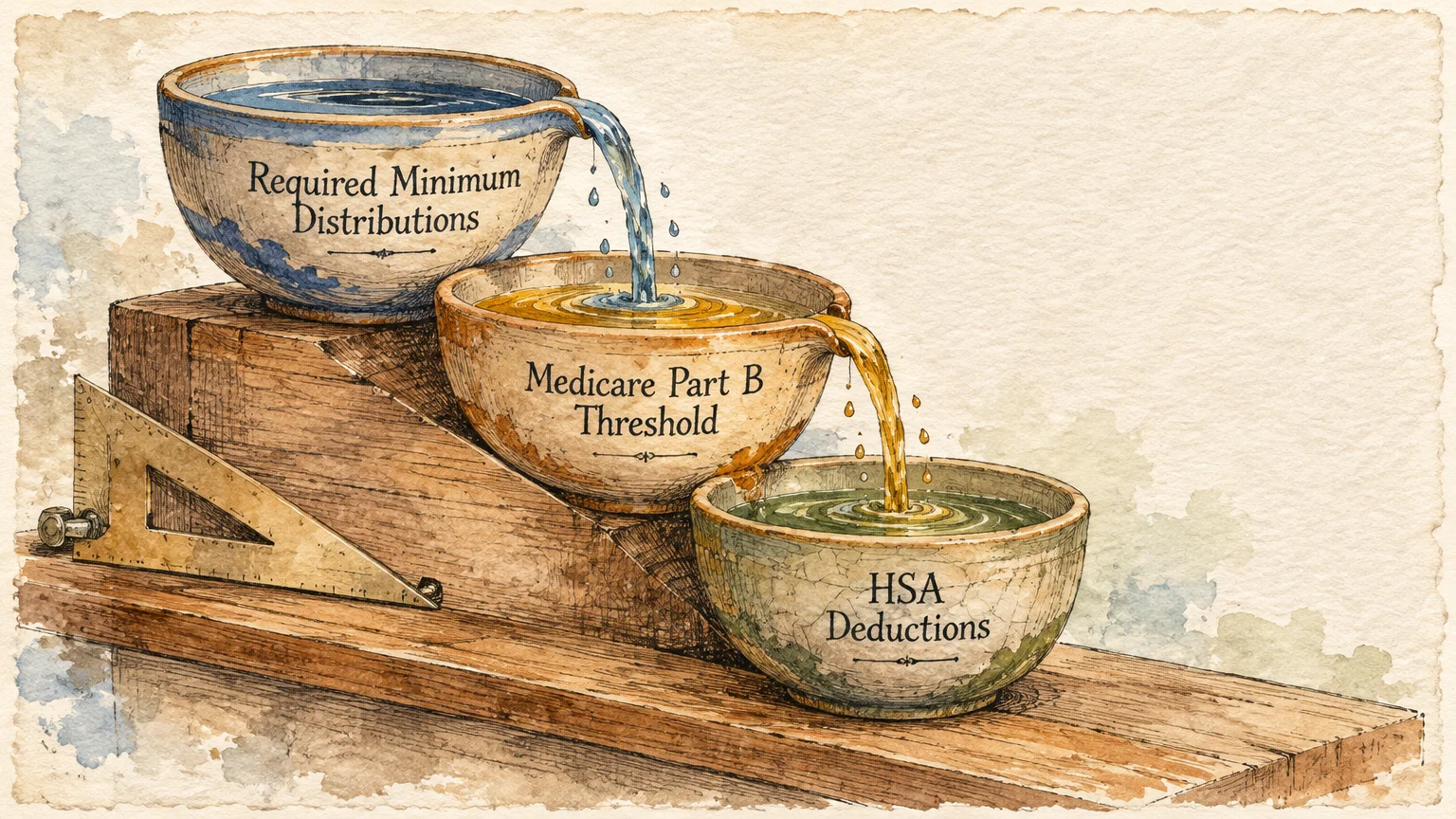
Your 2026 tax return echoes well beyond your spring refund because Medicare relies on a two-year lookback to price Part B and Part D coverage. Higher income reported on your 2027 filing can trigger Income-Related Monthly Adjustment Amounts on Medicare premiums two years later.
Consider what happens if you turn 73 in 2026 and delay your first IRA withdrawal until April 1, 2027. Stacking two distributions inside calendar year 2027 pushes up your modified adjusted gross income for that return.
As a simplified example, suppose a married couple normally reports $145,000 of income, keeping their full $12,000 senior bonus deduction intact. If an extra $35,000 distribution lifts their income to $180,000, they pass the $150,000 phaseout threshold by $30,000.
At the 6% phaseout rate, that extra income shaves $1,800 off their senior bonus deduction while potentially lifting their future Medicare premiums. Because marginal brackets, state rules, and Social Security taxation interact differently for every family, consult a CPA or fiduciary planner before bunching withdrawals.
Health Savings Accounts also deserve careful timing once you approach age 65 and enroll in Medicare. You must stop contributing to an HSA before Medicare coverage takes effect, including retroactive Part A coverage if you apply after age 65, to avoid excess-contribution penalties.
Even after contributions end, existing HSA funds remain a tax-free reserve for qualified medical bills, dental care, and eligible long-term care premiums. Spending HSA dollars instead of taking extra taxable IRA withdrawals keeps your adjusted gross income lower, protects your senior deduction, and guards against future Medicare surcharges.
Review official enrollment rules and premium appeal options for life-changing events such as retirement on the Medicare official guide. Coordinating tax withdrawals with healthcare coverage saves far more over a decade than any single filing-season trick.

Protecting Your Cash Flow, Identity, and Legacy
Tax efficiency means little if fraud, long-term care costs, or outdated estate paperwork drain your savings. Building strong administrative habits around your annual return safeguards both your monthly budget and your family’s future.
First, plan ahead for long-term care expenses before a health crisis forces rapid asset sales. Liquidating appreciated stocks or large IRA balances in a single year to pay assisted-living bills can distort your tax bracket unless you track offsetting medical deductions.
Second, harden your financial identity well before tax season opens. Set up your IRS Individual Online Account early, verify your direct deposit details inside your own banking portal, and treat unsolicited texts, calls, or QR-coded refund letters as fraud attempts.
Third, inspect beneficiary designations across every IRA, workplace retirement plan, annuity, and bank account once a year. Beneficiary forms override your will, so outdated names after a marriage, divorce, or loss can send assets to the wrong person and snarl estate administration.
Finally, double-check bank account titling if you file a joint return with your spouse. Adding both spouses as joint owners on the checking account receiving your tax refund avoids automatic electronic rejections and prevents a CP53E freeze.
You can verify investment firm registrations, check advisor disciplinary records, and review fraud alerts using SEC Investor.gov. Taking an hour each winter to confirm these protections brings lasting peace of mind.
Frequently Asked Questions for Retirees Filing in 2027
How does part-time consulting or gig work affect my 2027 refund?
Part-time consulting, board stipends, or seasonal work remain subject to federal income tax and self-employment tax even after you begin Social Security. Starting in 2026, businesses no longer must issue Form 1099-NEC unless payments hit $2,000, yet you still must report every dollar earned.
If your side income carries no withholding, make quarterly estimated payments or raise withholding on a pension or IRA payout to cover the tax. Otherwise, your April balance due will erase your expected refund and may add underpayment penalties.
Which inflation hedges belong in a tax-efficient retirement portfolio?
Treasury Inflation-Protected Securities, Series I Savings Bonds, and dividend-paying equities can help your purchasing power keep pace with rising living costs. Where you hold those assets matters just as much as which ones you buy.
Inflation adjustments added to principal on Treasury Inflation-Protected Securities held in a taxable brokerage account generally create taxable income each year even before you receive the cash at maturity. Holding those bonds inside an IRA shields you from surprise taxable income that could chip away at senior tax deductions.
How should I evaluate financial advisor fees before hiring tax or retirement help?
Compare fee structures carefully before signing an engagement letter. Fee-only fiduciary planners charge transparent flat fees, hourly rates, or a percentage of managed assets without earning commissions on product sales.
If your return involves basic retirement forms and standard deductions, IRS free programs or AARP Foundation Tax-Aide may cover your needs at zero cost. When you manage Roth conversions, multi-state moves, or complex estate questions, ask any prospective advisor to put their fiduciary duty and total annual fee in writing.
What tax and refund changes should a surviving spouse prepare for?
If your spouse passed away during 2026, you can generally still file a joint return for that tax year if you did not remarry. For the following two years, eligible widows and widowers with a dependent child may qualify for surviving spouse status, preserving the $32,200 standard deduction level for 2026.
Update bank account ownership promptly so electronic refunds are not bounced back by mismatched names under Notice CP53E. Remember that dropping from joint to single brackets in future years alters your senior deduction phaseout at $75,000, and you can file Form SSA-44 to ask Social Security to reassess Medicare premiums after a spouse’s death.
Your Pre-Filing Action Plan for a Smooth 2027 Refund
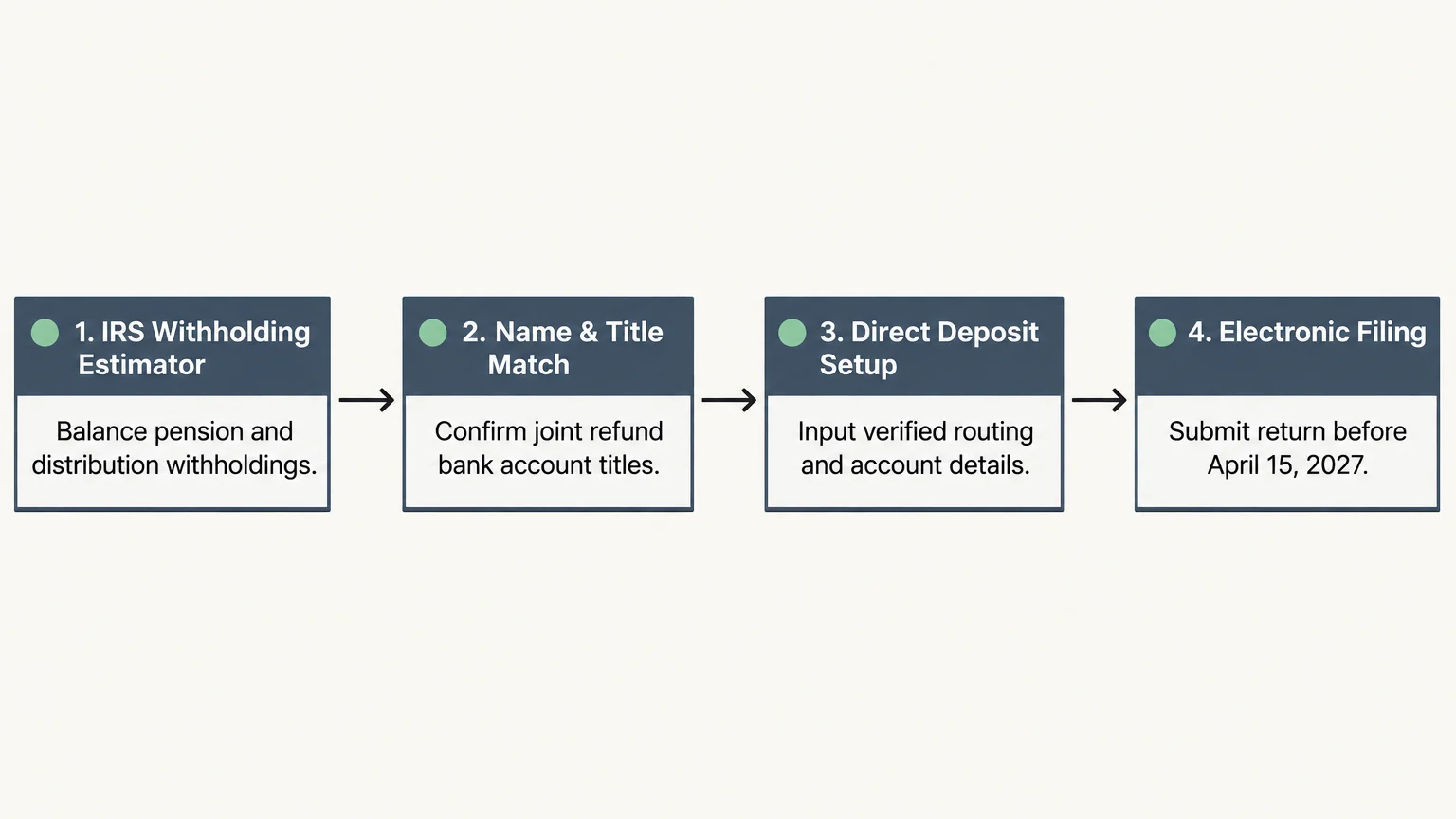
Give yourself a clear runway before submitting your 2026 return in early 2027. Wait until after February 16, 2027, to confirm every 1099-B, 1099-R, and SSA-1099 has arrived in final form.
Log into your IRS Individual Online Account once mid-January maintenance ends to retrieve any required six-digit IP PIN. Double-check your bank routing number, account number, and joint ownership status so your refund arrives electronically without triggering Notice CP53E.
Confirm that Schedule 1-A captures your Enhanced Deduction for Seniors if you qualify, and verify that any Qualified Charitable Distributions are properly excluded from taxable IRA payouts. Review your beneficiary forms and HSA records at the same time so your broader financial house stays orderly.
Pull your year-end statements together this week and schedule a spring check-in with a trusted CPA or fiduciary retirement planner. Matching your withholding, RMD schedule, and Medicare plan to current tax rules turns tax season from a stressful waiting game into a steady piece of your retirement strategy.