Rising everyday expenses and higher Medicare premiums are pushing many Americans past age 60 to rethink full retirement. Stepping into a flexible remote role lets you bring in steady cash without enduring a daily commute.
Working from home after 60 does more than pad your checking account. Extra earned income can help you delay Social Security for larger lifetime checks and reduce withdrawals from your investment portfolio during market dips.
You need the right job fit and a clear tax plan before sending your first application. These ten legitimate remote careers and retirement coordination strategies show you how to keep more of every dollar you earn.
Why Remote Work After 60 Fits Today’s Retirement Math
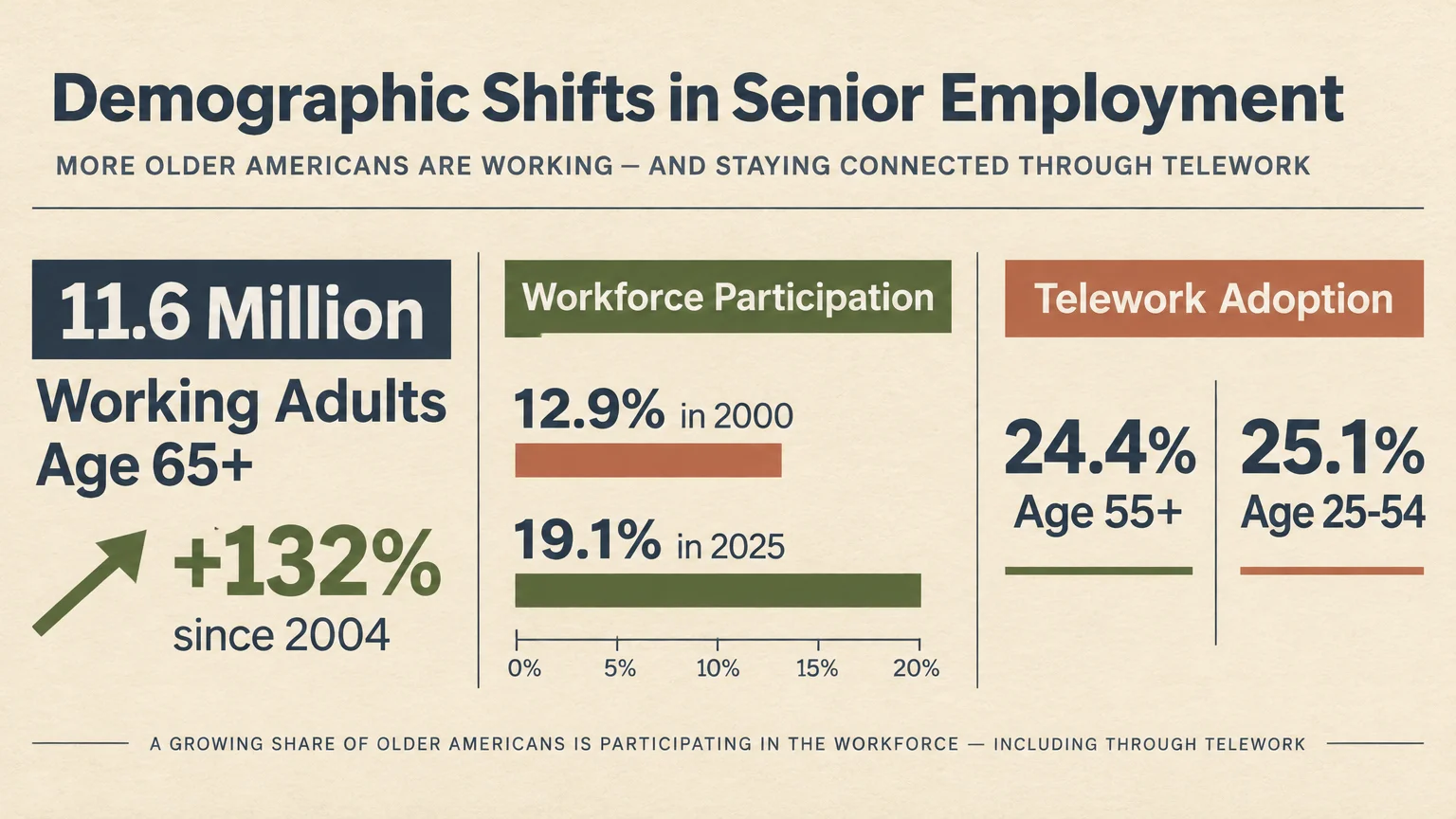
Older Americans are staying active in the labor market at historic scale. According to the U.S. Bureau of Labor Statistics (BLS), cited by AARP, more than 11.6 million adults age 65 and older are working or seeking work—a 132% jump since 2004.
In 2025, 19.1% of Americans age 65 and older remained in the workforce, up sharply from 12.9% in 2000, BLS data shows. Rather than clocking full weeks, 38.3% of employed workers age 65 and older chose part-time schedules in 2024.
Financial pressure drives much of that shift. AARP Research reports that 7% of retirees have returned to work, with 48% citing money as their primary motive and 41% of workers age 50 and older pointing to everyday living costs.
Telework makes those extra working years far more sustainable. U.S. Census Bureau data shows 13.8% of all U.S. workers usually worked from home by 2023, more than double the 5.7% recorded in 2019.
Older adults have adopted remote schedules just as quickly as younger peers. U.S. telework demographic data shows workers age 55 and older teleworked at 24.4% in early 2024, nearly matching the 25.1% rate for ages 25 to 54.
Research from the Center for Retirement Research at Boston College also notes that remote workers appear less likely to retire than comparable on-site workers. Eliminating commute fatigue allows you to keep earning on your own terms.
Job searches still require patience, even though the 55-and-older unemployment rate stood at just 2.8% in October 2026 compared with 4.1% overall, per BLS and AARP data. Because older applicants often face longer searches, targeting high-turnover remote fields improves your odds.
10 Legit Work-From-Home Jobs That Hire Older Adults
The national median annual wage across all U.S. occupations stood at $50,980 in May 2025, according to BLS wage statistics. Many remote roles pay near or above that benchmark while rewarding experience, reliability, and clear communication.
1. Customer Service Representative
Healthcare systems, insurance carriers, and major retailers regularly hire remote representatives to answer billing, claims, and product questions by phone or chat. Many offer structured part-time shifts and ship company laptops after paid virtual training.
BLS wage data shows customer service representatives earn a median $21.53 per hour, or $44,770 per year. Although overall employment is projected to dip 5% between 2025 and 2035, turnover and retirements still generate roughly 289,500 openings annually.
Highlight decades of calm conflict resolution and clear phone etiquette on your resume. Target established W-2 employers directly on their official career portals rather than relying on unverified third-party call center ads.
2. Bookkeeping, Accounting, and Auditing Clerk
Small businesses, nonprofits, and CPA firms depend on remote bookkeepers to reconcile bank statements, process payroll, and track receivables. Your real-world business judgment helps prevent costly errors that automated software easily misses.
According to BLS figures, bookkeeping, accounting, and auditing clerks earn a median $50,670 per year, or $24.36 per hour, with about 144,100 annual openings despite a 5.6% projected automation decline. Some college coursework without a degree often satisfies hiring requirements.
If you already hold an accounting degree or CPA credential, senior opportunities pay considerably more. BLS reports a median $83,680 per year—$40.23 per hour—for accountants and auditors, backed by 5% projected growth and 115,300 yearly openings.
3. Virtual or Medical Administrative Assistant
Executives, solo attorneys, and telehealth practices rely on remote administrative assistants to manage calendars, coordinate logistics, draft correspondence, and handle patient scheduling. Reliability and discretion matter far more than flashy tech skills in these roles.
BLS reports a median annual wage of $48,310 across secretaries and administrative assistants, with general administrative roles at $47,540 and medical secretaries at $45,930. Employers are projected to fill roughly 314,400 openings per year from 2025 through 2035.
Refresh your familiarity with cloud spreadsheets, digital scheduling tools, and electronic health record basics before applying. Emphasize experience managing confidential files or multi-person calendars to stand out quickly.
4. Seasonal or Year-Round Tax Preparer
National tax chains, regional CPA practices, and virtual tax platforms hire remote preparers and reviewers every winter. Seasonal schedules let you earn concentrated income during filing months while keeping the rest of your year open.
Tax preparers earn a median $54,920 per year, or $26.40 per hour, with pay spanning from $16.23 at the 10th percentile to $47.72 at the 90th percentile, per BLS data. The field shows 4.7% projected growth and roughly 9,400 annual openings.
Entry typically requires a high school diploma, an active IRS Preparer Tax Identification Number, and commercial tax software training. Earning an Enrolled Agent credential can unlock higher hourly rates and year-round advisory projects.
5. Medical Records and Coding Specialist
Hospitals, outpatient clinics, and health insurers hire remote medical coders to translate clinical notes into standardized billing codes and audit electronic charts. Because work is measured by accuracy and chart volume, schedules are often flexible.
BLS data places median pay for medical records specialists at $51,140 per year, or $24.59 per hour, with top earners at the 90th percentile making $81,150. Projected employment growth of 7.8% outpaces the 3.5% average across all jobs, creating 14,000 annual openings.
Most employers ask for a postsecondary certificate and an industry coding credential, which you can complete online. Related medical transcriptionists earn a lower median of $40,410 per year, so coding generally offers stronger pay and growth.
6. Online Tutor or Academic Coach
Retired educators, engineers, and fluent language speakers can turn subject mastery into steady remote income through online tutoring platforms or private video sessions. You choose which grade levels, test-prep exams, or adult learners you want to teach.
Tutors earn a median $43,350 per year, with roughly 34,200 openings projected annually through 2035, according to BLS benchmarks. Setting your own hourly availability protects your retirement lifestyle from burnout.
Focus on high-demand subjects such as algebra, science, reading intervention, or standardized test prep to command stronger hourly rates. Building a small roster of private clients also lets you keep more of every fee.
7. Technical Writer
Software firms, contractors, manufacturers, and healthcare organizations hire experienced professionals to write user manuals, compliance guides, and standard operating procedures. Turning complex processes into plain English is a skill that improves with career maturity.
Technical writers earn a median $90,390 per year, or $43.46 per hour, with 1% projected growth and roughly 3,200 openings annually, BLS figures show. Most roles require a bachelor’s degree alongside deep industry expertise.
Assemble crisp writing samples—such as a training manual, process checklist, or safety brief—before applying. Even part-time consulting contracts at senior rates can replace a substantial share of portfolio withdrawals.
8. Remote Editor or Communications Specialist
Publishing houses, trade associations, universities, and corporate marketing teams hire part-time editors and communications specialists to polish reports, grant proposals, and member newsletters. Good judgment, clean grammar, and deadline discipline remain difficult to automate.
BLS data shows editors earn a median $77,920 per year, while public relations specialists earn a median $74,750 per year. Both roles translate smoothly into project-based remote contracts or part-time salaried arrangements.
Reach out to former employers, industry associations, or nonprofits you already know for initial freelance retainers. Warm professional networks often convert far faster than cold online job boards.
9. Remote Interpreter or Translator
Telehealth providers, school districts, legal services, and customer-care centers contract remote bilingual specialists to handle live video and phone interpretation. Working from a quiet home office lets you serve clients nationwide without leaving your desk.
Interpreters and translators earn a median $60,170 per year, or $28.93 per hour, according to BLS wage statistics. Many language-service vendors allow contractors to log into on-demand queues during specific shifts.
Verify whether a prospective employer expects medical or court certification before investing in specialized credentials. Demonstrating fluency in specialized healthcare or financial terminology typically leads to higher pay.
10. General Office and Records Support Specialist
Insurance agencies, title companies, logistics firms, and municipal offices hire remote support clerks to verify documentation, update customer records, and audit compliance files. These roles favor steady concentration and organized digital habits.
General office clerks earn a median $45,010 per year, while specialized information and record clerks earn $49,500 per year, per BLS wage data. Look for titles involving client verification, compliance support, or scheduling coordination.
Avoid chasing pure typing or basic form-filling gigs, however. BLS projects employment for pure data entry keyers to fall 25.5% between 2025 and 2035 due to automation, making broader records-management roles a far safer bet.
Aligning Remote Pay With Social Security, Pensions, and Portfolio Withdrawals
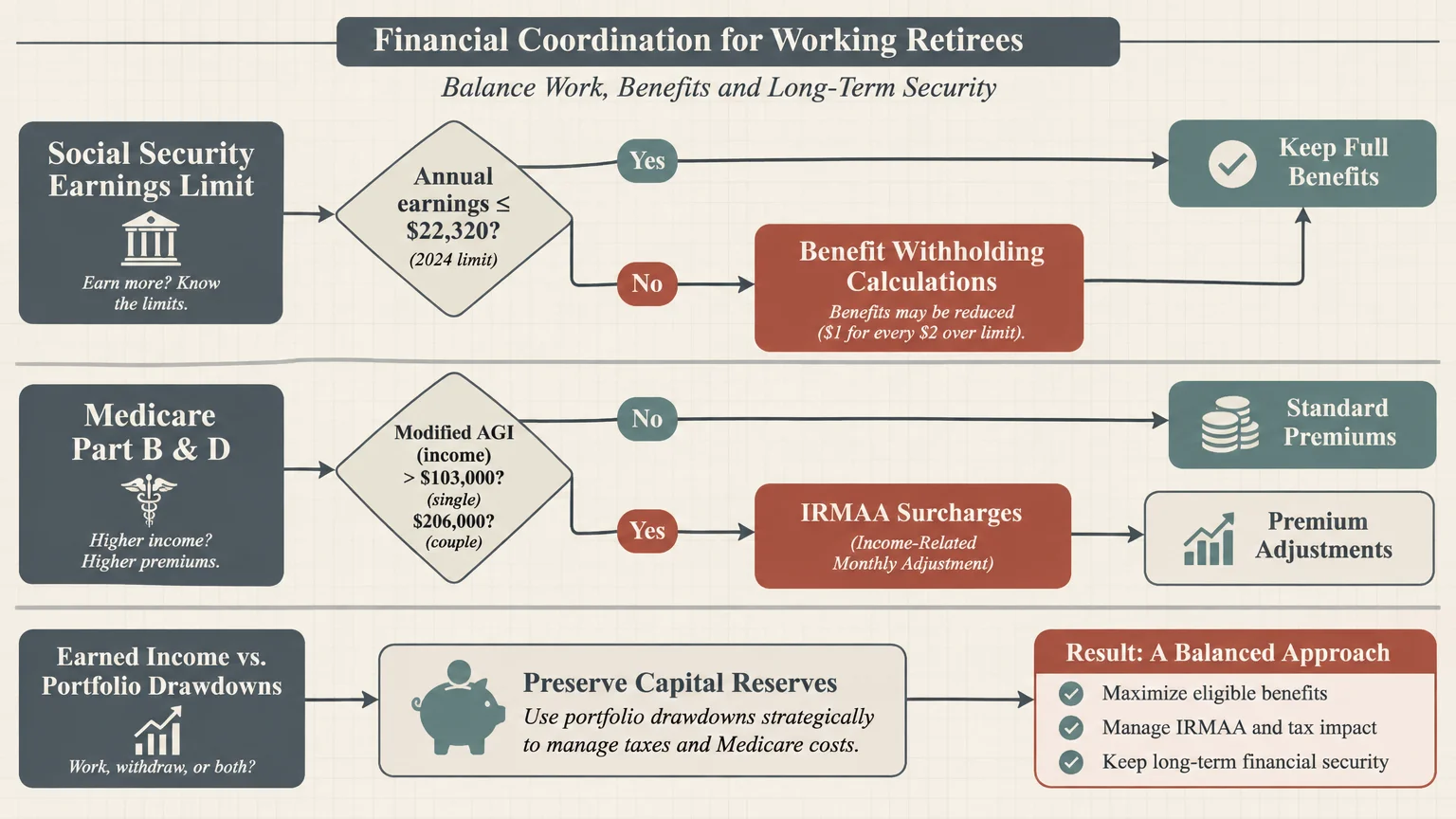
Social Security Timing and the Earnings Test
Under Social Security Administration (SSA) rules, Full Retirement Age (FRA) is 66 years and 10 months for people born in 1959, and 67 for anyone born in 1960 or later. Claiming early at age 62 permanently reduces your benefit by up to 30%.
Waiting past FRA earns delayed retirement credits of 8% per year up to age 70, lifting your check to 124% of your full benefit. Earning remote income during your sixties can help you bridge that gap without claiming early.
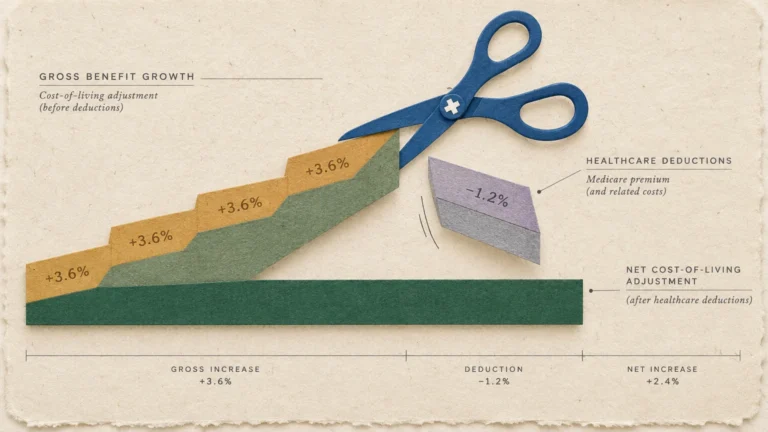
Higher base checks also amplify annual cost-of-living adjustments (COLAs). SSA delivered a 2.8% COLA in 2026—putting the average retired worker benefit at $2,071 per month—and announced a 3.6% COLA for 2027, adding roughly $75 per month on average.
If you claim benefits before FRA while working, watch the Social Security earnings test closely. In 2026, workers under FRA all year can earn up to $24,480 ($2,040 monthly) before SSA withholds $1 in benefits for every $2 earned above the cap.
That exempt limit rises to $25,560 ($2,130 monthly) in 2027. During the calendar year you reach FRA, the higher limit is $65,160 ($5,430 monthly) in 2026 and $67,920 ($5,660 monthly) in 2027, with $1 withheld per $3 over.
Once the month you reach FRA arrives, no earnings limit applies at all. Before accepting a remote offer, review official Social Security Administration guidance on working while receiving benefits so you avoid surprise benefit reductions.
Freelancers face an extra first-year rule when claiming early. SSA withholds monthly checks if you exceed the monthly dollar cap or perform substantial self-employment services—more than 45 hours monthly, or 15 to 45 hours in skilled roles.
Coordinating Pensions, Annuities, and Portfolio Withdrawals
Every dollar of remote pay you spend on groceries or utilities is a dollar you do not have to sell from stocks or bonds. Reducing portfolio withdrawals during market downturns helps protect your savings from permanent sequence-of-returns damage.
Steady part-time wages can also improve your pension and annuity math. Rather than starting a fixed annuity early at a lower payout rate, remote cash flow lets you defer annuity income until payout factors rise with age.
If you hold a traditional workplace pension, check whether working part time for a former employer affects your monthly checks. Before making irreversible pension or annuity elections, run personalized cash-flow projections with a licensed fee-only financial planner.
Tax Strategy and Healthcare Rules for Working Retirees
W-2 Employment vs. 1099 Freelance Taxes
Remote jobs come in two distinct tax structures: W-2 employee roles and 1099 independent contractor gigs. Knowing which classification you accept prevents an unwelcome April tax bill.
W-2 employers split Social Security and Medicare payroll taxes with you and withhold federal income taxes automatically. By contrast, 1099 contractors pay the full 15.3% self-employment tax once net earnings reach $400 for the year, IRS rules show.
That 15.3% covers 12.4% for Social Security—up to a $184,500 wage base in 2026 and $192,300 in 2027—plus 2.9% for Medicare on all net earnings, with an extra 0.9% Medicare surtax above $200,000 single or $250,000 joint.
Fortunately, you can deduct half of your self-employment tax when calculating adjusted gross income. Qualifying 1099 workers can also claim a home office deduction—either actual expenses or the IRS simplified rate of $5 per square foot up to 300 square feet, or $1,500.
W-2 remote employees cannot claim a federal home office deduction. Also note that starting in 2026, Form 1099-NEC and 1099-MISC thresholds rose from $600 to $2,000, while Form 1099-K reverted to more than $20,000 and more than 200 transactions.
Every dollar of freelance profit remains taxable even if a client does not issue a tax form. Plan quarterly estimated payments through the IRS Self-Employed Individuals Tax Center and confirm deductions with a certified public accountant.
The $6,000 Senior Deduction, RMDs, and Tax-Efficient Withdrawals
For tax years 2025 through 2028, taxpayers age 65 and older qualify for an extra $6,000 senior tax deduction per person, or $12,000 for married couples when both spouses are 65 or older. That stacks atop standard and existing senior deductions.
However, this deduction phases out once modified adjusted gross income (MAGI) exceeds $75,000 for single filers or $150,000 for joint filers, according to IRS guidance and Peter G. Peterson Foundation analysis. Earning high remote wages can shrink or erase that tax break.
Coordinate your part-time paycheck with Required Minimum Distributions (RMDs) and retirement account withdrawals. For example, earning $24,480 in remote pay could push total income past the $75,000 phaseout when stacked onto pre-tax IRA withdrawals or Roth conversions.
In years you work remotely, consider funding living expenses from taxable brokerage cash or Roth accounts rather than traditional IRAs. A qualified tax advisor can map out your exact bracket room before year-end.
Medicare Part B Premiums, IRMAA Surcharges, and HSAs
Adding earned income can also raise future Medicare premiums through Income-Related Monthly Adjustment Amount (IRMAA) surcharges. Centers for Medicare & Medicaid Services (CMS) figures put the standard Part B premium at $202.90 monthly in 2026 and $209.40 in 2027.
The annual Part B deductible rises from $283 in 2026 to $292 in 2027 as well. IRMAA uses a two-year lookback, starting above $109,000 MAGI for single filers and $218,000 for joint filers in 2026 based on 2024 returns.
Crossing an IRMAA cliff by even a small margin triggers a higher monthly surcharge for the entire year. Review Medicare Part B cost and IRMAA details alongside your projected earnings before taking on extra contracts.
Finally, watch Health Savings Account (HSA) rules if you return to work with employer benefits. Once you enroll in any part of Medicare, including Part A, you cannot make new HSA contributions, though existing balances remain tax-free for qualified medical expenses.
Protecting Your Paycheck, Rights, and Legacy
Spotting Remote Job Scams Before You Apply
Fraud targeting older adults has surged alongside remote hiring. Americans age 60 and older reported roughly $3 billion in fraud losses in 2025—a fivefold jump since 2020—with the Federal Trade Commission (FTC) estimating total losses could reach $119.5 billion due to underreporting.
Separately, the FBI logged $7.7 billion in 2025 losses reported by adults 60 and older, according to AARP. Job scams alone topped $500 million between 2020 and 2023 and exceeded $220 million in the first half of 2024.
Better Business Bureau data shows fake task scams jumped 400% in 2024 and carried a $2,300 median loss in 2025. Scammers often text victims or message them on WhatsApp or Telegram offering easy pay to rate products or click apps.
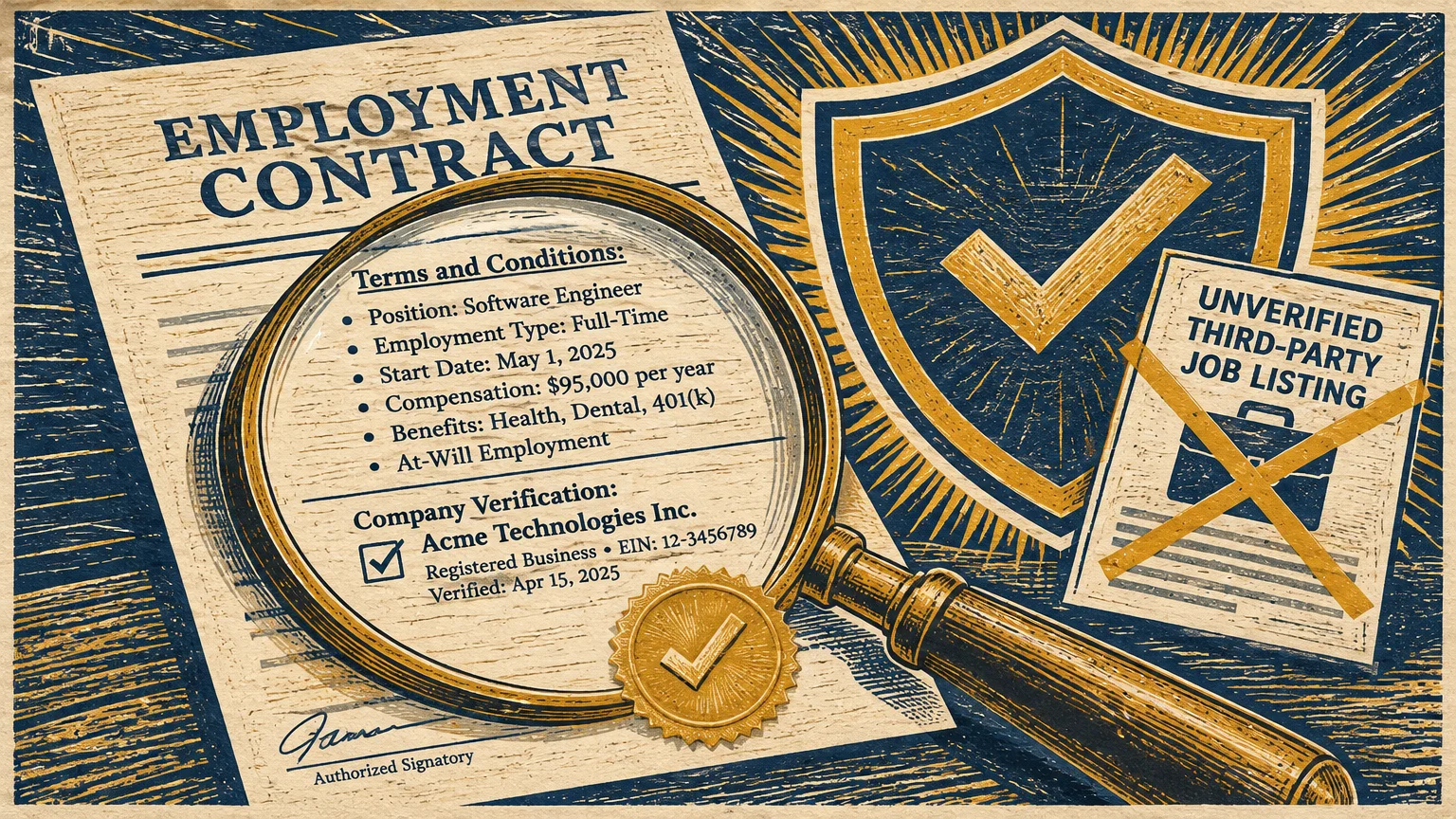
Real employers never recruit via unsolicited texts, demand crypto or gift cards to unlock wages, or ask you to reship home packages. Even legitimate boards face impersonation, as FlexJobs warned in July 2026 regarding fake Telegram and WhatsApp outreach.
Always verify openings directly on a company’s official website and check Federal Trade Commission guidance on avoiding job scams before sharing your Social Security number or banking details.
Age Discrimination Protections
Federal law gives older remote applicants clear legal footing during hiring. Under the Age Discrimination in Employment Act (ADEA), employers with 20 or more workers cannot discriminate against job seekers or employees age 40 and older, with no upper age cap.
The law bars age limits in most job postings and protects pay, promotions, and benefits. Review the U.S. Equal Employment Opportunity Commission overview of age discrimination protections, and note you generally have 180 days—or longer in some states—to file a charge.
Long-Term Care, Estate Basics, and Beneficiary Updates
Treat remote earnings as protection for your later years rather than an excuse to raise fixed living expenses. Direct a portion of each paycheck toward a dedicated long-term care cash reserve or review hybrid care coverage with a licensed specialist.
If you open a solo 401(k) or SEP IRA with freelance income, name primary and contingent beneficiaries immediately. Confirm that your durable power of attorney, will, and digital account inventory stay current so family members can manage affairs smoothly.
Frequently Asked Questions
How much can I earn part time without hurting my Social Security check?
Before reaching FRA, you can earn up to $24,480 in 2026 or $25,560 in 2027 without any withholding. In your FRA calendar year, the higher threshold is $65,160 in 2026 and $67,920 in 2027 before your FRA month arrives.
Starting the month you reach FRA, no earnings cap applies at all. Any benefits withheld before FRA are not lost permanently—SSA recalculates your monthly check upward at FRA—though you should verify your numbers with SSA or a financial planner.
Does working remotely after 60 act as an inflation hedge?
Yes, part-time wages adjust with market pay rates far faster than fixed pensions or bonds. Working flexibly lets your income reflect current economic conditions while reducing pressure on fixed retirement accounts.
Remote earnings also hedge inflation indirectly by helping you delay Social Security. Waiting past FRA locks in 8% annual credits, giving future COLAs—like 2026’s 2.8% and 2027’s 3.6% increases—a larger permanent base to compound from.
How should I evaluate financial advisor fees when integrating part-time work?
Look for a fiduciary advisor who puts your interests first in writing and discloses every cost clearly. Fee-only planners charge flat project fees, hourly rates, or transparent asset percentages rather than earning sales commissions on annuities or funds.
Ask exactly how coordinating 1099 taxes, RMDs, and IRMAA cliffs fits into their service scope. Always verify an advisor’s credentials, disciplinary history, and registration before paying a retainer.
How does working longer affect surviving spouse planning?
When the higher-earning spouse delays Social Security up to age 70, the permanent survivor benefit rises alongside their retirement check. Remote work makes that delay much easier to afford without draining joint savings.
Extra earnings can also cover life insurance premiums or rebuild cash reserves dedicated to a surviving partner. Review pension survivor options and spousal IRA beneficiaries together with an estate attorney or fee-only planner.

Your Next Steps for a Stronger Retirement Paycheck
Pull your latest Social Security statement and last year’s tax return to check your FRA, earnings thresholds, and IRMAA headroom. Knowing your exact numbers turns a vague job search into a targeted retirement strategy.
Pick two remote roles that fit your background and apply strictly through verified employer websites. Before signing any W-2 or 1099 contract, schedule a check-in with your CPA or fiduciary advisor to align taxes, Social Security, and Medicare.