Starting January 1, 2027, workers ages 60 to 63 can defer up to $37,250 into a 401(k) plan under IRS Notice 2026-66. That ceiling gives you $3,250 more in annual tax-advantaged room than other savers age 50 and older.
A 2026 MetLife study cited by SHRM found that 58% of pre-retirees fear running out of money. Using this four-year savings window can meaningfully strengthen your future retirement paycheck.
However, strict age cutoffs, employer opt-in rules, and mandatory Roth requirements apply in 2027. Here is how to capture every dollar while aligning your taxes, healthcare, and income streams.
Why the 2027 Super Catch-Up Window Matters Now
Late-career anxiety is widespread, and the same MetLife research reported that 51% of current retirees also worry about depleting their accounts. Pre-retirees now expect their savings to last an average of 15 years, down from 19 years four years earlier.
Against that backdrop, the IRS announced the 2027 retirement plan limits on November 12, 2026, in News Release IR-2026-136 and Notice 2026-66. Those inflation-adjusted thresholds take effect on January 1, 2027, and include the super catch-up enacted under Section 109 of the SECURE 2.0 Act of 2022.
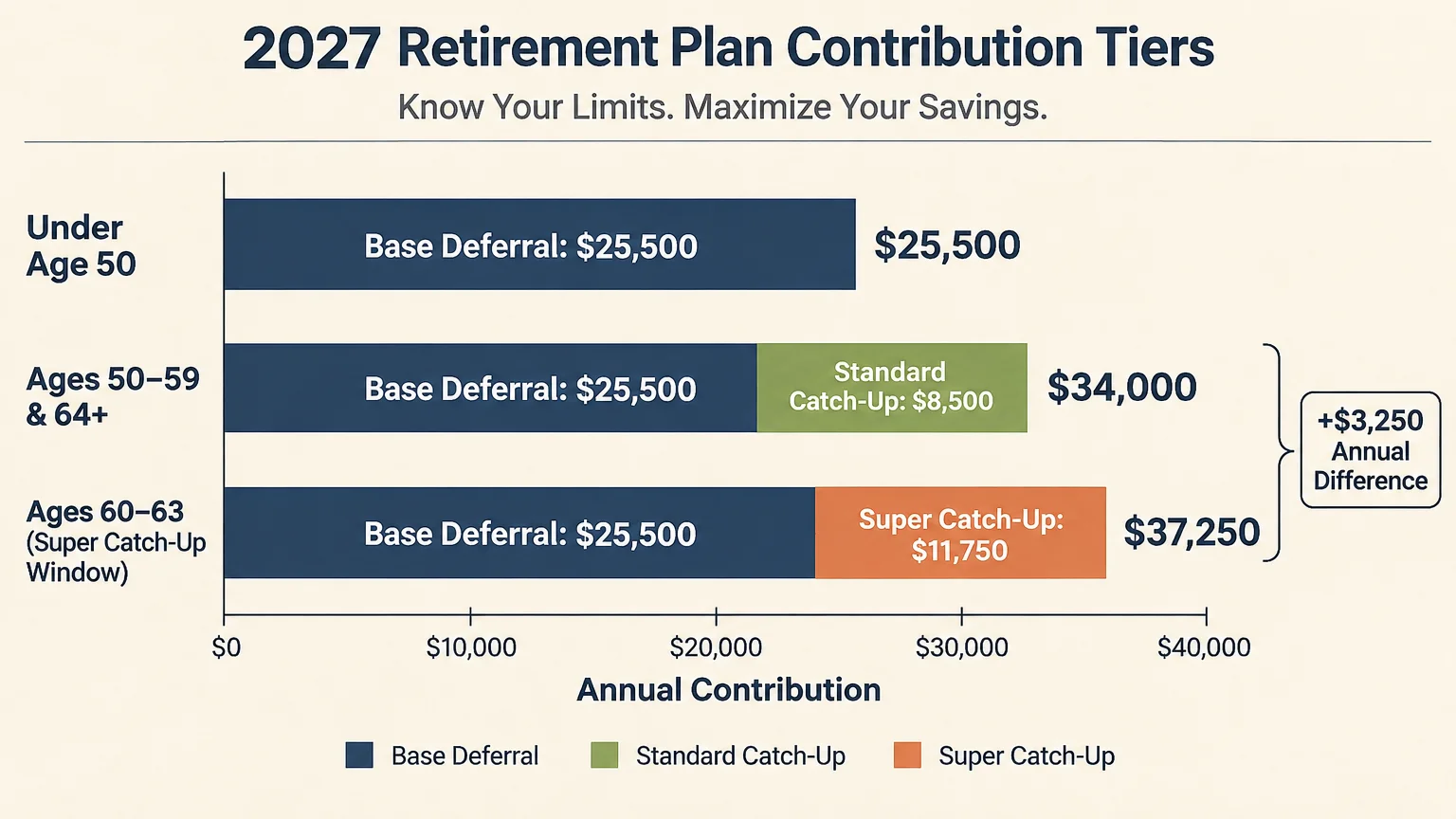
For 2027, the base employee deferral limit climbs by $1,000—roughly 4.1%—to $25,500, up from $24,500 in 2026. That base limit applies across 401(k), 403(b), most 457 plans, and the federal Thrift Savings Plan.
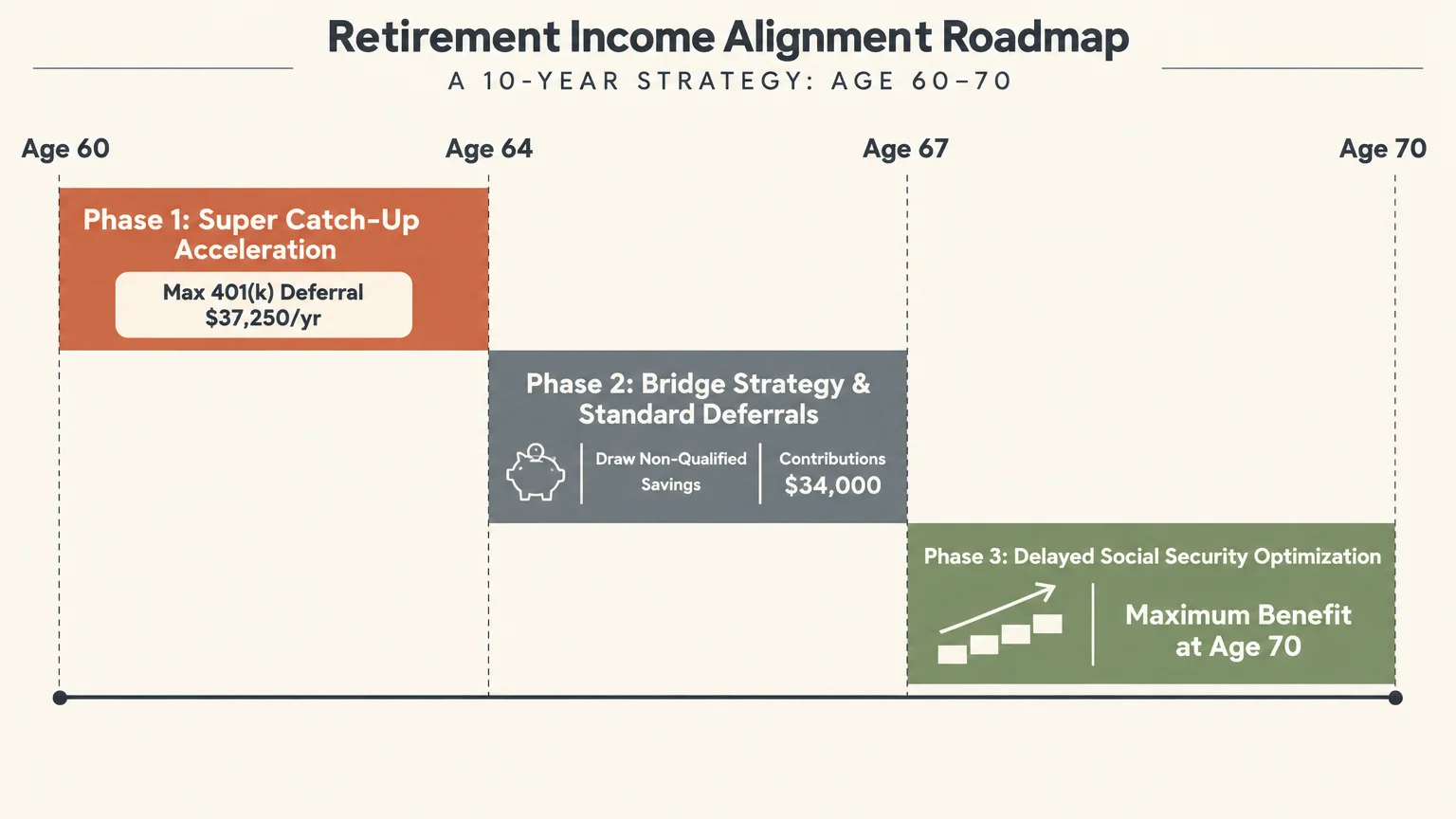
If you qualify for the age 60 to 63 super catch-up, your extra deferral limit rises by $500 to $11,750 in 2027. Combined with the $25,500 base cap, your total employee deferral ceiling reaches $37,250, up $1,500 from $35,750 in 2026.
By comparison, savers ages 50 to 59 and 64 or older receive a standard 2027 catch-up limit of $8,500, up from $8,000 in 2026. Their combined deferral limit sits at $34,000, up from $32,500 the prior year.
You cannot stack the super catch-up on top of the standard $8,500 catch-up. Instead, the $11,750 allowance replaces the standard catch-up solely during the calendar years you fall into the 60-to-63 age bracket.
Many savers in this age group are already taking advantage of the expanded room. According to Vanguard’s How America Saves 2026 report, 91% of Vanguard-administered defined contribution plans adopted the super catch-up by the end of 2025.
Among participants ages 60 to 63 in those plans in 2025, 21% maxed out the base deferral limit, and more than 90% of those maximizers made catch-up contributions. Two-thirds of catch-up contributors exceeded the standard catch-up limit, while 9% hit the full super catch-up maximum.
Qualification Rules, Age Cutoffs, and Plan Exceptions
Reaching the $37,250 ceiling requires more than updating your payroll percentage. You must verify how the IRS counts your age, whether your employer’s plan permits the higher cap, and how overall contribution ceilings apply.
The Calendar-Year Age Rule and the Age-64 Drop-Off
Eligibility depends on the age you attain at any point during calendar year 2027. If you turn 60, 61, 62, or 63 at any time between January 1 and December 31, 2027, you qualify for the full $11,750 super catch-up.
That calendar-year rule also creates a sudden cliff when you reach age 64. Anyone turning 64 at any point in 2027—even on December 31—reverts to the $8,500 standard catch-up and a $34,000 total limit.
If you used the $35,750 ceiling in 2026 at age 63, turning 64 in 2027 reduces your maximum employee deferral by $1,750. Update your payroll elections before January so excess withholding does not trigger corrective distributions.
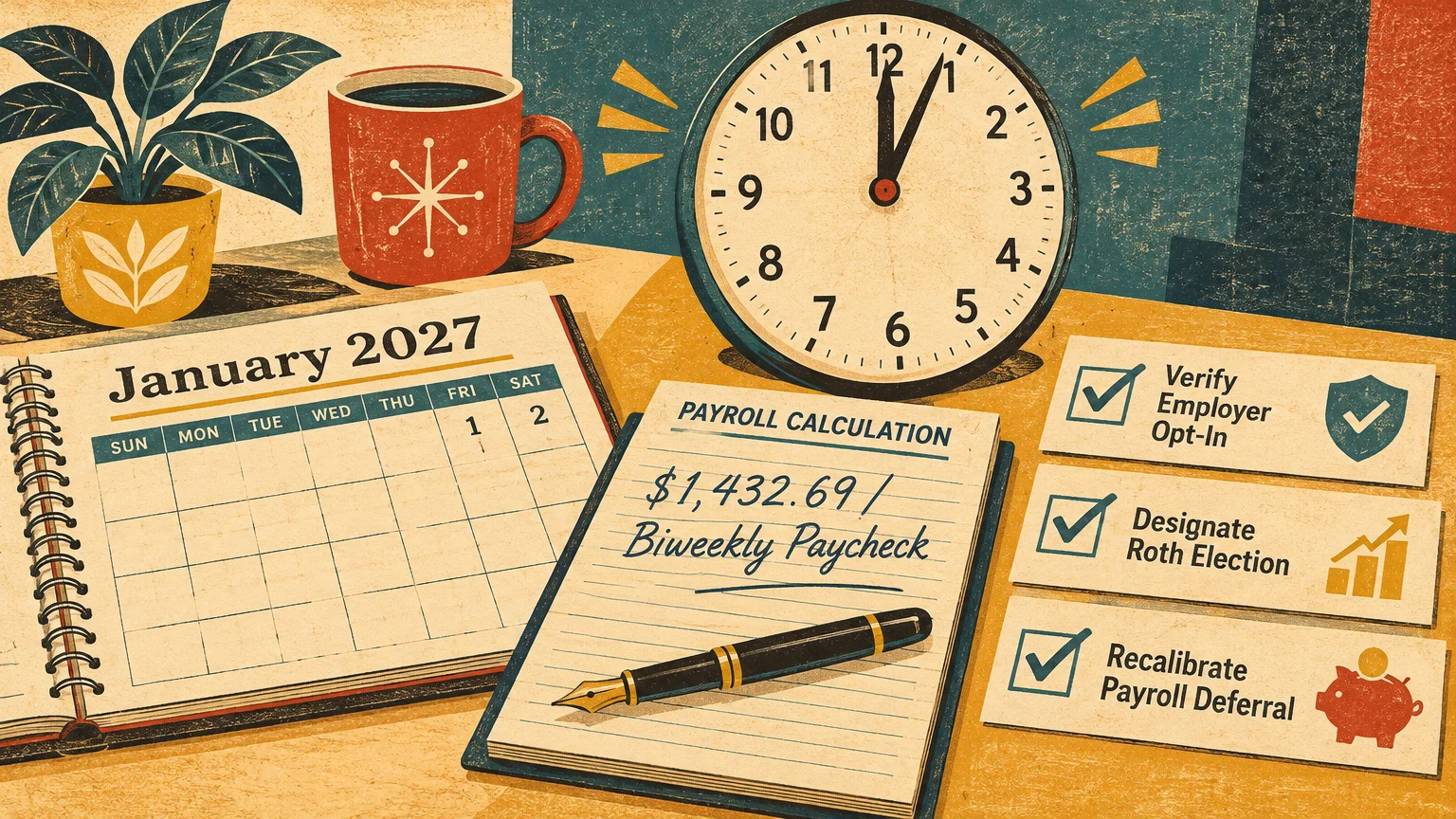
If you receive 26 biweekly paychecks in 2027, hitting $37,250 requires deferring about $1,432.69 per pay period. On a 24-paycheck semimonthly schedule, that target rises to roughly $1,552.08 per check.
Some employers separate base deferrals from catch-up elections in their payroll portals, while others automatically spill over once you cross $25,500. Confirm how your payroll system tracks the threshold so you do not stop short or miss an employer match.
Employer Plan Adoption and Account Type Limits
The $11,750 super catch-up applies to standard 401(k), 403(b), governmental 457(b), and federal Thrift Savings Plan accounts. However, workplace plans for smaller employers operate under completely separate math.
SIMPLE IRA and SIMPLE 401(k) plans carry a 2027 base deferral limit of $17,500, or $19,100 for certain eligible small plans. Their 2027 catch-up limits are $4,000 for workers age 50 and older and $5,250 for ages 60 to 63.
Even if you participate in a traditional 401(k), your employer must opt in to the higher limit. Under IRS final regulations in T.D. 10033, published September 16, 2025, plans offering standard catch-ups are not legally required to offer the super catch-up.
Your company’s plan document must explicitly authorize the age 60 to 63 provision before you can exceed $34,000. Check your Summary Plan Description or contact your benefits administrator before budgeting around the extra $3,250.
You should also track total employer and employee additions under Internal Revenue Code Section 415(c). For 2027, that overall defined contribution limit increases to $75,000, up from $72,000 in 2026.
Because catch-up contributions sit outside the $75,000 cap, total 2027 additions can reach $86,750 for ages 60 to 63. Savers ages 50 to 59 and 64 or older face a combined ceiling of $83,500.
That $86,750 figure includes employee deferrals, employer matching contributions, profit-sharing deposits, and permitted after-tax contributions. Still, total contributions cannot exceed 100% of your compensation, and eligible pay is capped at $375,000 under IRC Section 401(a)(17).
Review the official IRS 401(k) contribution limit guidance before splitting deferrals across multiple employers during the year. Multiple employers share one $37,250 employee limit, though each unrelated employer maintains its own $75,000 overall additions cap.
Navigating the 2027 Mandatory Roth Catch-Up Rule
Finding room in your budget is only half the equation for 2027. If you are a higher earner, federal tax law dictates whether your $11,750 super catch-up lowers today’s tax bill or goes into a Roth bucket.
How the $155,000 Wage Test Works
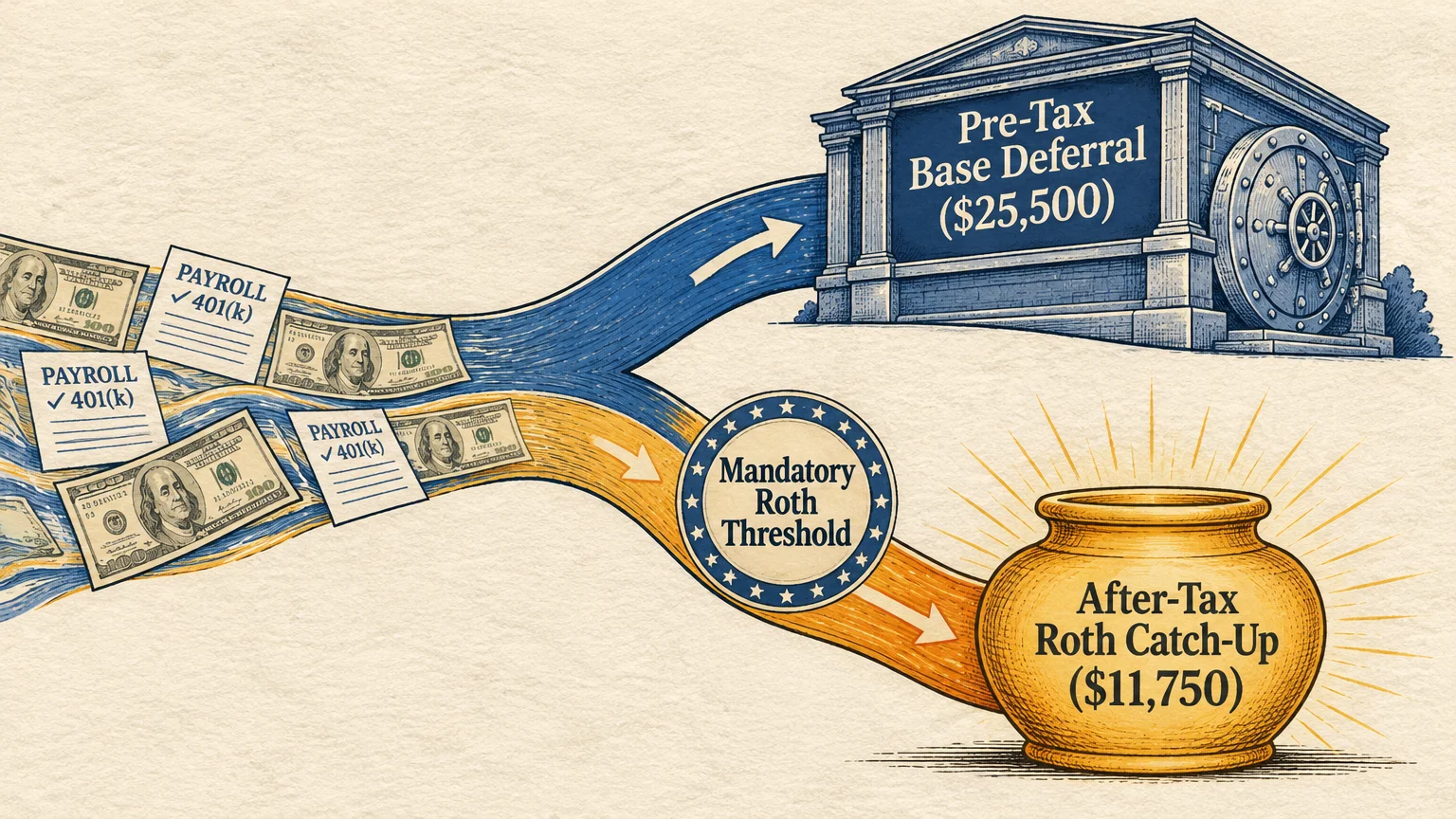
Under SECURE 2.0 Section 603, codified as IRC Section 414(v)(7), high earners must direct catch-up dollars into a designated Roth account. Although earlier transition relief delayed enforcement, IRS final regulations under T.D. 10033 apply in full starting January 1, 2027.
For 2027, the income threshold rises to $155,000 in prior-year FICA wages, up from $150,000 for 2026 catch-ups. If your 2026 wages from your plan-sponsoring employer exceeded $155,000, 100% of your 2027 catch-up contributions must be Roth.
You can still put your $25,500 base deferral into traditional pre-tax savings if you prefer. Only the $11,750 catch-up portion loses pre-tax eligibility once you cross the prior-year threshold.
Pay close attention to which wage box the IRS checks under the final rules. The test relies strictly on Form W-2 Box 3—Social Security wages—from your sponsoring employer, rather than Box 1 taxable wages or Box 5 Medicare wages.
That distinction creates specific planning quirks for people who switched jobs or own a business. If you earned $120,000 at one employer in 2026 and $120,000 at a new employer that same year, neither employer’s Box 3 exceeded $155,000.
Similarly, sole proprietors and partners without W-2 FICA wages from a sponsoring corporation are not subject to the mandatory Roth rule on self-employment income. Ask a qualified tax professional to verify your 2026 Box 3 figure before finalizing 2027 elections.
What Happens If Your Plan Lacks a Roth Option
The mandatory Roth rule carries a sharp trap if your employer’s 401(k) offers only traditional pre-tax contributions. Without a designated Roth feature in the plan, employees whose 2026 Box 3 wages topped $155,000 cannot make any catch-up contributions in 2027.
In that situation, your 2027 employee deferral ceiling drops from $37,250 back down to the $25,500 base limit. That restriction applies even though you are age 60 to 63 and otherwise eligible.
Check your 2026 W-2 Box 3 total as soon as you receive it in January 2027. If you exceed $155,000, confirm right away that your plan supports designated Roth 401(k) contributions.
Shifting $11,750 from pre-tax to Roth also raises your 2027 taxable income compared with a purely pre-tax strategy. Adjust your federal and state tax withholding if needed so you do not face an unexpected balance next spring.
Stacking IRAs, HSAs, and the 2027 Saver’s Match
Once you map out your workplace 401(k) contributions, you can layer additional tax-advantaged accounts on top. Combining accounts widens your tax flexibility before retirement begins.
Pairing Your 401(k) with an IRA or HSA
For 2027, Traditional and Roth IRA contribution limits remain unchanged at $7,500, plus a $1,100 catch-up for savers age 50 and older. That $8,600 IRA ceiling pairs with a $37,250 401(k) deferral to shelter $45,850 in one year.
Income limits still govern direct Roth IRA contributions and Traditional IRA tax deductions. In 2027, Roth IRA phase-outs rise to $158,000–$173,000 for single or head-of-household filers and $250,000–$260,000 for married couples filing jointly.
If you participate in a workplace retirement plan, Traditional IRA deduction phase-outs sit at $83,000–$93,000 for single filers and $133,000–$153,000 for joint filers. High earners above those thresholds often use after-tax contributions or evaluate Roth conversions with a tax advisor.
If you enroll in an eligible high-deductible health plan and have not yet enrolled in Medicare, consider funding a Health Savings Account. For 2027, HSA limits are $4,500 for self-only coverage and $9,000 for family coverage, plus a $1,000 catch-up for ages 55 and older.
Unlike retirement plans, HSAs offer triple tax advantages when spent on qualified medical care. Contributions lower taxable income, balances grow tax-free, and eligible healthcare withdrawals escape federal taxes completely.
Using the New 2027 Saver’s Match
Lower- and moderate-income households ages 60 to 63 gain a brand-new incentive starting January 1, 2027. Under IRS IR-2026-89 and Notice 2026-48, the federal Saver’s Match replaces the older nonrefundable Saver’s Credit.
The program provides up to a 50% federal match on up to $2,000 in qualifying retirement plan or IRA contributions, yielding up to $1,000 per eligible person. Rather than reducing your tax bill directly, the Treasury deposits the match into your retirement account after you file 2027 taxes in 2028.
Phase-out ranges run from $20,500 to $35,500 for single filers and $41,000 to $71,000 for married couples filing jointly. Semi-retired workers or couples where one spouse works part-time may qualify even if the household already holds significant savings.
To project how these combined deposits grow over your remaining working years, run scenarios with the SEC Investor.gov compound interest calculator. Seeing even conservative growth projections helps clarify how much extra income your 60-to-63 push can generate.
Aligning Income Streams Before Retirement
Aggressive saving between ages 60 and 63 directly alters your household cash flow. Coordinating those deferrals with Social Security, pensions, annuities, and portfolio withdrawals keeps your retirement launch smooth.
Coordinating Social Security Timing and Cash Reserves
Directing $37,250 into a 401(k) noticeably shrinks your take-home paycheck. Before maxing out your deferral, confirm that your household budget covers living expenses without forcing credit card debt or premature withdrawals.
If you hold ample cash reserves in taxable accounts, you can live partly off those savings while routing paycheck dollars into your 401(k). That swap effectively shifts taxable cash into tax-advantaged retirement accounts during your peak earning years.
Staying employed and maxing out your 401(k) through age 63 can also make delaying Social Security easier. Claiming Social Security at age 62 permanently locks in a reduced monthly benefit compared with waiting until your full retirement age of 67 or delaying to age 70.
Compare claiming ages and survivor impacts using the Social Security Administration retirement planning tools before setting a retirement date. Strong 401(k) balances give you a bridge to fund ages 63 to 67 or 70 while larger guaranteed benefits accrue.
Weighing Pensions, Annuities, and Portfolio Withdrawals
If you hold a traditional defined benefit pension, review your payout options alongside your 401(k) strategy. Deciding between a single-life annuity, a joint-and-survivor payout, or a lump-sum rollover affects your entire retirement income floor.
A larger 401(k) balance built during ages 60 to 63 reduces the percentage you must withdraw from investments in early retirement. Lower initial withdrawal pressure helps shield your portfolio from sequence-of-returns risk if markets dip right after you stop working.
Some retirees use a slice of 401(k) savings to build a short-term bond ladder covering three to five years of spending. Others pair Social Security with a low-cost immediate annuity or deferred income annuity to cover fixed essentials like housing and utilities.
Because pension elections and annuity contracts are often irrevocable, compare quotes and surrender terms carefully. Consult a licensed, fee-transparent fiduciary advisor before committing retirement capital to any insurance product.

Tax and Healthcare Strategy for Ages 60 to 63
Every pre-tax or Roth dollar you defer between ages 60 and 63 ripples into your tax brackets and Medicare premiums later. Planning both together avoids costly surprises in your late 60s and 70s.
RMD Planning Under the Age-75 Rule
Under SECURE 2.0, anyone born in 1960 or later faces a Required Minimum Distribution starting age of 75. That birth-year rule covers everyone who falls into the 60-to-63 age window in 2027.
Wait until age 75 with a massive pre-tax balance, however, and mandatory withdrawals can push you into higher tax brackets. Deferring $25,500 pre-tax while adding $11,750 in Roth catch-ups creates useful tax diversification.
Remember also that designated Roth 401(k) accounts carry no lifetime RMDs, following rule changes that took effect in 2024. Building Roth 401(k) balances during ages 60 to 63 lets that money compound untouched throughout your lifetime if you do not need it.
If you fall under the $155,000 mandatory Roth threshold, weigh your current marginal tax bracket against your expected retirement bracket. Savers in peak earning years often favor pre-tax base deferrals, whereas savers expecting steep RMDs at 75 often lean toward voluntary Roth contributions.
In the years between retirement and age 75, low-income windows can also open room for partial Roth conversions. A certified public accountant or enrolled agent can model multi-year bracket thresholds tailored to your filing status.
Managing Medicare IRMAA and HSA Eligibility
Healthcare expenses and tax planning collide directly at age 63. Medicare Part B and Part D apply Income-Related Monthly Adjustment Amounts—known as IRMAA—based on your Modified Adjusted Gross Income from two years prior.
That two-year lookback means the income reported on your age-63 tax return helps determine your Medicare premiums when you enroll at age 65. Pre-tax 401(k) and HSA deferrals lower your Adjusted Gross Income, potentially keeping you below higher surcharge tiers.
Conversely, mandatory or voluntary Roth 401(k) contributions do not reduce your current Adjusted Gross Income. Check Medicare cost and premium resources if you are weighing pre-tax base deferrals against Roth conversions at age 63.
If you continue working past age 65 with employer health coverage, watch your HSA timing carefully. Once you enroll in any part of Medicare—including premium-free Part A—you can no longer contribute to an HSA.
Because Medicare Part A coverage can apply retroactively up to six months when you sign up after age 65, stop HSA contributions six months before applying. Pro-rate your final-year HSA limit based on the eligible months you were not enrolled in Medicare.
Protecting Your Nest Egg and Legacy
As your 401(k) grows by up to $37,250 per year—or up to $86,750 with full employer and after-tax additions—protecting that wealth becomes just as urgent as accumulating it. Risk management keeps medical events, scams, or outdated paperwork from derailing your plan.
Long-Term Care and Fraud Safeguards
Extended caregiving needs remain one of the largest unbudgeted threats to late-life portfolios. While your income is still strong in your early 60s, evaluate whether dedicated long-term care coverage, hybrid life policies, or earmarked portfolio reserves fit your health history and net worth.
Larger retirement balances also attract sophisticated financial scammers targeting seniors. Lock down your 401(k) portal with hardware or app-based multi-factor authentication, place credit freezes at the major bureaus, and never grant remote screen access to unsolicited callers.
Before taking rollover or investment advice from anyone, verify their registration, licensing, and disciplinary history through the FINRA BrokerCheck verification database. Independent verification takes minutes and protects decades of disciplined saving.
Updating Beneficiaries and Estate Basics
Many savers overlook how 401(k) assets transfer at death. Beneficiary designation forms on file with your 401(k) custodian override instructions written in your will or revocable trust.
Log into your retirement account each year to confirm both primary and contingent beneficiaries reflect your current wishes. Under federal rules for most 401(k) plans, naming someone other than your spouse requires your spouse’s written, notarized consent.
Review your durable financial power of attorney and healthcare directives alongside those beneficiary checks. If illness sidelines you during ages 60 to 63, an updated power of attorney ensures a trusted family member can manage payroll elections, investments, or urgent distributions.
Frequently Asked Questions
Can I make the $37,250 contribution if I work part-time in my early 60s?
Yes, you can contribute up to $37,250 in 2027 if you are age 60 to 63, your employer’s plan covers part-time employees, and your eligible pay covers the deferral. Remember that total additions cannot exceed 100% of your compensation, and check whether lower part-time income qualifies you for the 2027 Saver’s Match.
How can my 401(k) investments help hedge against inflation?
Maintaining an age-appropriate allocation to diversified equities provides long-term growth potential that historically outpaces rising consumer prices. You can also pair Treasury Inflation-Protected Securities or short-duration bonds inside your 401(k) to steady near-term spending without sacrificing all purchasing power.
How much should I expect to pay an advisor to review my 2027 plan?
Advisory costs vary depending on whether a planner charges an hourly rate, a flat project fee, or an annual percentage of managed assets. Some 401(k) plans include basic guidance at no extra cost, so ask for a written fee breakdown and confirm fiduciary status in writing before hiring anyone.
What happens to my catch-up dollars and 401(k) if my spouse passes away?
A surviving spouse named as primary beneficiary generally receives flexible options, including rolling the 401(k) into their own IRA or keeping an inherited account. Review both spouses’ beneficiary forms and pre-tax versus Roth balances together now, because single-filer tax brackets after a spouse’s death are typically narrower.
Your Next Steps Before 2027 Begins
Capturing the $37,250 super catch-up requires timely action before the first paycheck of 2027 arrives. Review your 2026 W-2 Box 3 wages, confirm with human resources that your plan supports both the $11,750 catch-up and Roth contributions, and inspect your current beneficiary designations.
Because math examples vary with tax brackets, Medicare thresholds, and pension elections, schedule a year-end review with a licensed fiduciary advisor or qualified tax professional. A coordinated plan helps turn your age 60 to 63 savings surge into reliable retirement income.