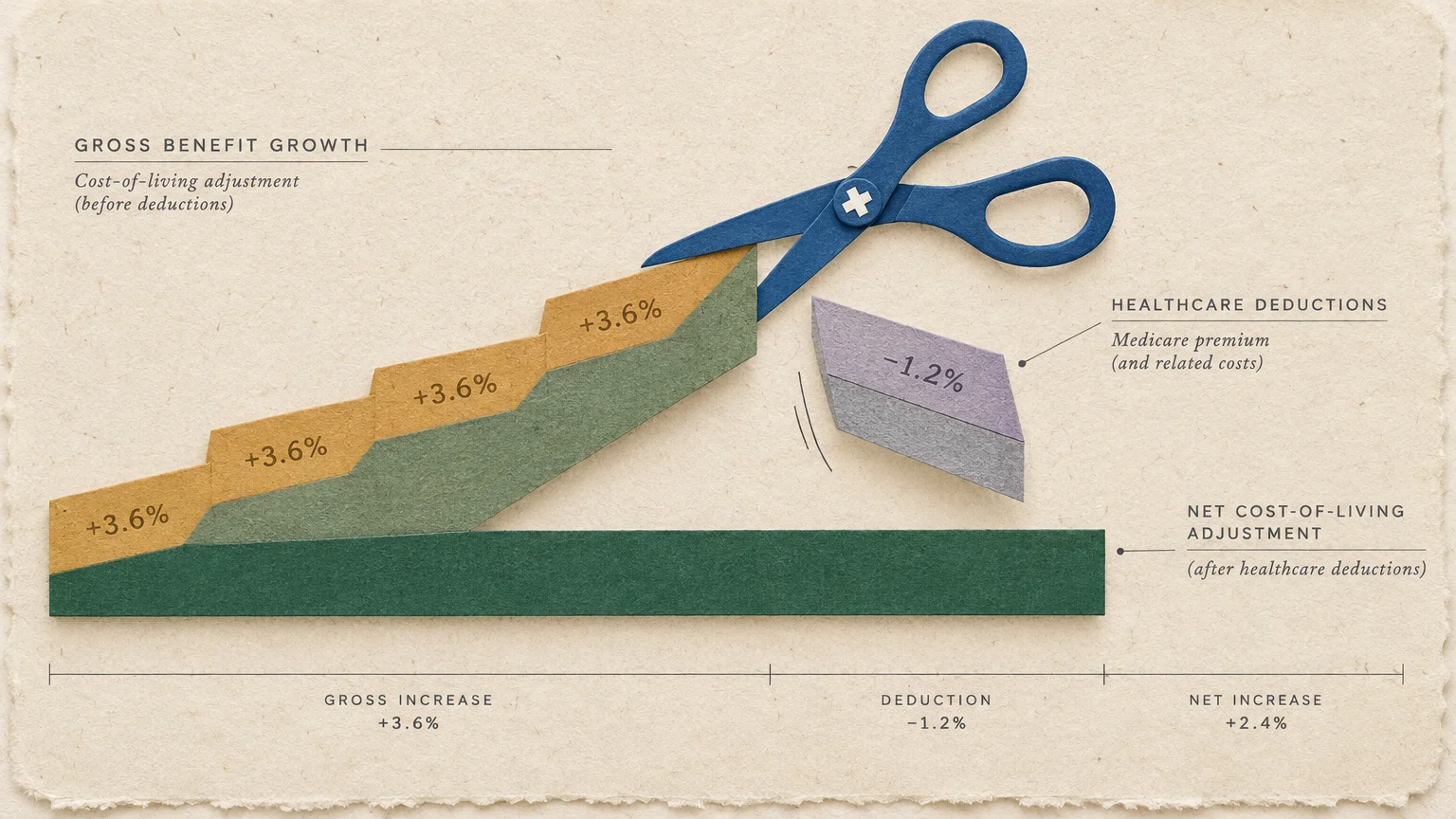
Your 2027 Social Security benefits will rise by 3.6%, adding roughly $75 a month to the average retirement check. Yet Medicare deductions, higher drug deductibles, and tax rules will determine how much extra cash actually reaches your bank account.
Because Medicare Part B premiums come straight out of your monthly payment, even modest healthcare increases shrink your net raise. Understanding these overlapping deductions now helps you protect your 2027 retirement budget before January arrives.
Here is how the 2027 adjustments interact with your income streams, tax brackets, and long-term financial security.
The Math Behind Your 2027 Social Security Raise and Medicare Deductions
What the 3.6% 2027 COLA Actually Adds to Your Check
Confirmed on October 14, 2026, the Social Security Administration set the 2027 cost-of-living adjustment at 3.6% based on inflation data from the third quarter of 2025 through the third quarter of 2026. Roughly 76 million Americans will receive higher payments.
Nearly 72 million Social Security beneficiaries will see the increase starting in January 2027. Around 7.3 million Supplemental Security Income recipients will receive their higher checks a day early, on December 31, 2026.
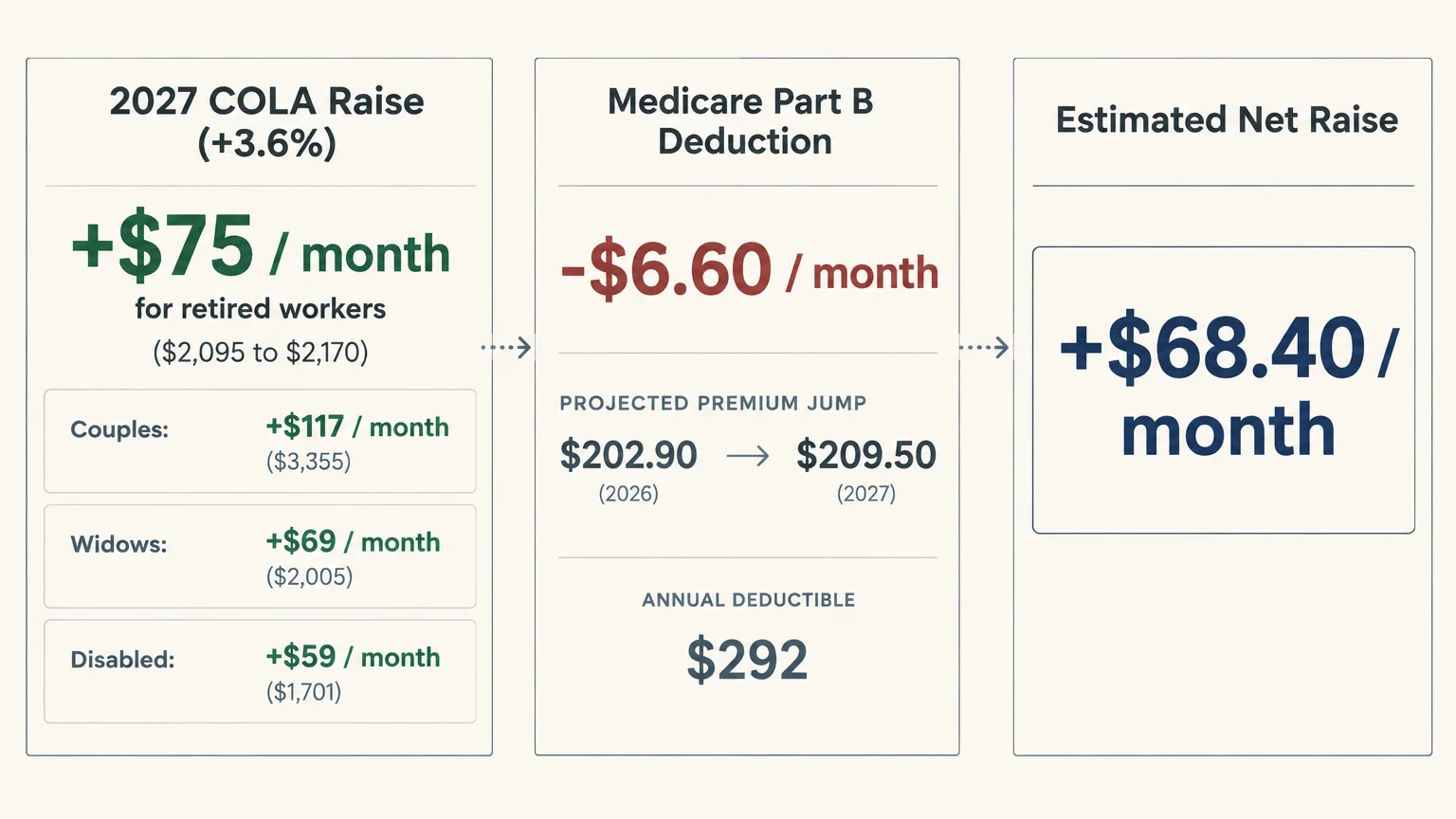
For retired workers, the average monthly benefit rises by $75, moving from $2,095 to $2,170 before deductions. If your gross monthly benefit currently sits at $2,000, a 3.6% raise adds $72 each month.
Other household types see proportional increases under the 2027 Social Security raise. Aged couples who both receive benefits move from $3,238 to $3,355 per month, adding $117 to their combined household budget.
Aged widows and widowers living alone see average checks climb from $1,936 to $2,005, a $69 monthly bump. Disabled workers average a $59 increase, moving from $1,642 to $1,701 per month.
You can view your exact dollar increase online in late November 2026 if you opted into paperless notices by November 18, 2026. Paper statements arrive by mail throughout December 2026 via the Social Security Administration online account portal.
How Medicare Part B 2027 Projections Chip Away at Your Raise
While your gross 2027 COLA is locked in, the Medicare Part B 2027 premium remains pending as of mid-November 2026. The Centers for Medicare and Medicaid Services has not yet finalized next year’s Part A, Part B, or surcharge brackets.
Looking at the 2026 baseline shows why those delayed numbers matter so much to your cash flow. In 2026, the standard Part B monthly premium jumped $17.90 to $202.90, while the annual deductible rose $26 to $283 with 20% coinsurance.
That $17.90 premium increase absorbed roughly 32% of the average $56 monthly raise from the 2.8% COLA in 2026. Fortunately, early federal forecasts suggest a gentler deduction for 2027.
The June 2026 Medicare Trustees Report projects the standard 2027 Part B premium at $209.50 per month, a $6.60 increase. It also estimates the annual Part B deductible will climb by $9 to roughly $292.
If that $6.60 projection holds, Part B would absorb about 8.8% of an average $75 raise, leaving roughly $68.40 per month before drug plan premiums or income taxes. However, official Medicare premiums do not always match midyear forecasts.
For example, the Trustees projected a $206.50 premium for 2026 before regulators finalized it lower at $202.90. Conversely, the 2022 premium was projected at $158.50 but landed significantly higher at $170.10.
You also should not count on temporary relief repeating next year. In October 2026, federal officials issued a one-time $90 Part B rebate to 20.8 million Original Medicare enrollees, excluding 36.1 million Medicare Advantage members and dual-eligibles.
That one-time payment covered less than half of one month’s $202.90 premium and will not lower your recurring 2027 bill. Treat your projected $68.40 net Social Security increase as a flexible estimate until final rates post.
Part D Deductibles, Advantage Shifts, and the Hold Harmless Rule
Unlike Part B, Medicare Part D prescription drug costs for 2027 are already confirmed and rising faster than inflation. The maximum allowable Part D deductible increases 13.8%, jumping $85 from $615 in 2026 to $700 in 2027.
The annual Part D out-of-pocket spending cap also climbs by $300, moving from $2,100 in 2026 to $2,400 in 2027. Meanwhile, the national base beneficiary premium rises 6%, adding $2.34 to reach $41.33 per month.
Federal subsidies totaling $9.8 billion under the Part D Premium Stabilization Demonstration also expire at the end of 2026. Although regulators project average standalone drug premiums will rise under $1 monthly, individual plans could experience sharp price swings.
One bright spot arrives on January 1, 2027, when negotiated Medicare prices take effect for 15 additional Part D drugs. Medications on that list include Ozempic, Rybelsus, Wegovy, Trelegy Ellipta, Xtandi, and Ibrance.
If you carry a Medicare Advantage plan, weighted average monthly premiums are projected to drop over 16%, from $14.37 to $12.00. Still, insurer exits mean roughly 3 million Advantage enrollees must pick new coverage before Open Enrollment closes December 7, 2026.
Compare every drug tier and provider network now using the official Medicare Plan Finder tool. Switching plans before December 7 can save far more than your 3.6% raise adds.
Many retirees assume the federal hold harmless rule guarantees their full raise stays intact. In reality, that provision only prevents your net Social Security check from shrinking below last year’s dollar amount due to standard Part B hikes.
Hold harmless does not shield new Part B enrollees, people billed directly, Medicaid dual-eligibles, or high earners paying income surcharges. It also offers zero protection against Part D hikes, late-enrollment penalties of 10% per year delayed, or higher deductibles.
Aligning Your Income Streams to Protect Your Net Social Security Increase
Coordinating Social Security Timing With Cash Flow Needs
Every annual cost-of-living adjustment compounds on top of your base Social Security benefit. Claiming earlier permanently locks in a smaller foundation, which means future percentage raises yield fewer dollars over a multi-decade retirement.
If you have not yet filed for benefits, test how waiting each additional year boosts both your starting check and future COLA dollars. Delaying past full retirement age grows your baseline and gives Medicare deductions less leverage over your budget.
Married couples gain extra flexibility by coordinating when each spouse files. Having the higher earner delay claiming often builds a larger survivor benefit that receives stronger annual COLA dollar increases for decades.
Once you are already collecting benefits, your focus shifts from timing to cash-flow coordination. Match your Social Security deposit date against your fixed utility, housing, and healthcare bills so automatic Part B deductions never trigger bank overdrafts.
Blending Pensions, Annuities, and Portfolio Withdrawals
Most private-sector pensions pay a fixed monthly dollar amount with no annual inflation adjustment. Even when your Social Security check grows by 3.6%, a stagnant pension quietly loses purchasing power whenever Part B and Part D deductibles rise.
Treat Social Security as your inflation-adjusted income floor and pair it carefully with fixed pension checks. If fixed guarantees fall short of essential living expenses, evaluate whether a modest single-premium immediate annuity fills the remaining gap cleanly.
Avoid locking too much of your nest egg into rigid annuity contracts that charge steep surrender fees. Keeping ample liquid reserves ensures you can absorb a sudden $700 Part D deductible or a $2,400 annual drug cap without stress.
Your investment portfolio should serve as the flexible shock absorber between rising medical bills and static pension income. Instead of taking uniform monthly withdrawals, pull extra cash only when out-of-pocket costs spike in January or February.
Rebalance your stock and bond mix annually so market rallies fund your near-term cash bucket. Because everyone’s pension terms and liquidity needs differ, review these withdrawal math scenarios with a licensed fiduciary financial planner before changing your income mix.
Building a Dedicated Healthcare Cash Buffer
Many retirees experience a sharp cash-flow crunch every January when annual medical deductibles reset simultaneously. Paying both a projected $292 Part B deductible and up to $700 for Part D prescriptions can erase several months of your net 2027 raise.
Open a separate high-yield savings bucket dedicated strictly to annual healthcare out-of-pocket ceilings. Setting aside a small fixed transfer from investment dividends keeps surprise pharmacy bills from disrupting your everyday grocery budget.
Keep at least the $2,400 Part D spending cap plus your Medigap or Advantage out-of-pocket maximum accessible in cash. Separating medical liquidity from long-term investments prevents you from selling stocks during a temporary market downturn.
Tax and Healthcare Strategies That Stop Silent Benefit Erosion
Avoiding the Two-Year Medicare IRMAA Cliff
Higher-income retirees face an Income-Related Monthly Adjustment Amount, known as IRMAA, on both Part B and Part D coverage. Regulators calculate your 2027 surcharge using your Modified Adjusted Gross Income from your 2025 federal tax return.
Based on the confirmed 2026 schedule, surcharges start once income exceeds $109,000 for single filers or $218,000 for married couples filing jointly. Crossing into Tier 1 pushes 2026 Part B premiums from $202.90 to $284.10 per month.
At the top Tier 5 bracket of $500,000 single or $750,000 joint, monthly Part B premiums reach $689.90 per person. High earners also pay an extra $14.50 to $91.00 monthly for Part D coverage.
Unlike ordinary tax brackets, IRMAA operates as a brutal dollar-for-dollar cliff. Exceeding a threshold by even $1 triggers the entire surcharge jump, adding an estimated $1,233.60 to $7,452 per person annually across combined 2027 tiers.
If your 2025 tax return reflected a one-time spike from selling property or earning final pre-retirement wages, you may qualify for relief. File Form SSA-44 with the Social Security Administration after a qualifying life-changing event.
Qualifying events include work stoppage, reduced work hours, marriage, divorce, or the death of a spouse. Submitting Form SSA-44 promptly lets regulators recalculate your 2027 Medicare premiums using your lower current-year income estimate.
Managing Unindexed Benefit Taxes and the $6,000 Senior Deduction
Federal income taxes can shrink your net Social Security increase even if your income sits well below IRMAA brackets. Up to 50% of benefits become taxable once combined income tops $25,000 for single filers or $32,000 for joint filers.
Up to 85% of your benefits face federal tax once combined income passes $34,000 single or $44,000 joint. Combined income equals your adjusted gross income, plus tax-exempt municipal bond interest, plus half of your annual Social Security checks.
Because Congress never indexed those thresholds to inflation after 1983, every 3.6% COLA pushes more middle-income retirees across the taxable line. Check your federal withholding early using the IRS Tax Withholding Estimator to prevent an April surprise.
Fortunately, recent legislation delivers temporary relief for many taxpayers age 65 and older from 2025 through 2028. Eligible seniors can claim an extra $6,000 deduction per person, or $12,000 for joint couples when both spouses are 65 or older.
You can claim this senior deduction whether you take the standard deduction or itemize expenses. However, the benefit phases out by 6% of Modified Adjusted Gross Income above $75,000 for single filers and $150,000 for joint filers.
The extra deduction disappears completely at $175,000 single or $250,000 joint, and it is not indexed for inflation. Keeping your taxable retirement withdrawals below those phaseout ceilings lets you stack the senior deduction alongside lower benefit taxation.
Sequencing RMDs, Roth Conversions, and HSAs
Required Minimum Distributions from traditional IRAs and 401(k) plans directly inflate your adjusted gross income each year. A large mandatory distribution can simultaneously trigger the 85% Social Security tax rate, erode your $6,000 senior deduction, and trip an IRMAA cliff.
Before mandatory distributions begin, consider shifting modest amounts from traditional pre-tax accounts into Roth IRAs during lower-income years. Paying taxes strategically on smaller Roth conversions today shrinks future Required Minimum Distributions and creates tax-free income later.
Qualified Roth withdrawals do not count toward combined income or Modified Adjusted Gross Income. Using Roth dollars for an unexpected home repair or vacation keeps your 2027 income safely beneath Medicare surcharge cliffs and senior deduction phaseouts.
If you built a Health Savings Account before enrolling in Medicare, treat it as a stealth medical buffer. Once you turn 65, HSA funds pay tax-free for Part B premiums, Part D premiums, deductibles, and copays without raising MAGI.
Never make new HSA contributions once Medicare coverage begins, including retroactive Part A enrollment, or you will face IRS excess-contribution penalties. Because tax brackets and phaseout rules interact tightly, ask a CPA to model your withdrawal order before acting.

Protection, Risk Management, and Legacy Planning
Planning for Long-Term Care Without Derailing Retirement Cash Flow
Rising Part D out-of-pocket caps and 20% Part B coinsurance represent predictable annual expenses, yet long-term care poses a far bigger threat. Original Medicare covers limited short-term skilled rehabilitation, not ongoing custodial help with daily living activities at home or in facilities.
Relying solely on your 3.6% Social Security raise cannot fund extended home care or memory care services. Decide deliberately whether you will self-insure using earmarked investments, purchase traditional long-term care coverage, or explore hybrid life-and-care policies.
Review policy elimination periods, daily benefit caps, and inflation riders carefully before signing any contract. Addressing care preferences with family members while you remain healthy prevents rushed financial liquidations during a medical crisis.
Guarding Against Medicare and COLA Fraud
Major policy updates like the 2027 COLA notice rollout and the October 15 through December 7 Medicare Open Enrollment window attract aggressive scammers. Fraudsters routinely call or text claiming you must verify your bank routing number to unlock your 3.6% raise.
Others impersonate federal agents offering to fast-track your $90 Part B rebate or sell fake drug discount cards ahead of the $700 deductible change. Remember that government agencies never demand gift cards, wire transfers, or sensitive logins over unsolicited phone calls.
Before sharing financial details with any new advisor or insurance broker pitching annuities or Medicare switches, verify their credentials independently. You can check disciplinary histories and registrations in seconds using FINRA BrokerCheck.
Enable two-factor authentication on your banking, brokerage, and government portals before December notices arrive. Freezing your credit reports at major credit bureaus adds another sturdy barrier against identity theft at zero cost.
Updating Estate Basics and Beneficiary Designations
Optimizing every dollar of your net Social Security increase means little if outdated paperwork stalls your family’s access to accounts. Confirm that your will, revocable trust, durable financial power of attorney, and healthcare directive reflect your current wishes.
Many retirees forget that beneficiary forms on IRAs, 401(k) plans, annuities, and bank accounts override instructions written inside a will. Audit every primary and contingent beneficiary designation annually, especially after a spouse passes away, divorces occur, or grandchildren arrive.
Adding payable-on-death or transfer-on-death designations to non-retirement checking and brokerage accounts helps cash pass smoothly outside probate. Keep an organized list of account institutions and trusted contacts in a secure location your executor can easily access.
Frequently Asked Questions About Your 2027 Raise and Retirement Planning
How does part-time work affect my 2027 Social Security check and Medicare premiums?
If you collect Social Security before reaching full retirement age, earning wages above annual earnings limits temporarily reduces your monthly benefit. Once you reach full retirement age, Social Security withholds zero dollars regardless of how much part-time income you earn.
However, part-time wages still flow directly into your Adjusted Gross Income and combined income calculations. Extra earnings can push more of your 3.6% COLA into the 85% taxable tier, phase out your $6,000 senior deduction, or trigger future IRMAA brackets.
On the upside, paying payroll taxes on part-time work can replace lower-earning years in your lifetime earnings record, nudging future Social Security checks higher. Run the tax math with an accountant before picking up seasonal hours.
What are practical inflation hedges if healthcare costs outpace the 3.6% COLA?
Protecting your purchasing power requires assets that grow faster than consumer prices over time. Holding a diversified allocation of quality dividend-paying equities alongside short-term Treasury Inflation-Protected Securities helps offset years when Part D deductibles jump 13.8%.
Shop your prescription coverage every autumn using Medicare’s comparison tool rather than letting an old plan auto-renew. Switching to a plan covering the 15 newly negotiated drugs taking effect January 1, 2027 can beat inflation more reliably than portfolio tweaks.
Maintaining an emergency cash reserve also keeps you from carrying high-interest credit card balances when medical bills cluster in winter. Consult a licensed investment advisor to size your equity exposure appropriately for your age and risk tolerance.
How should I evaluate advisor fees when looking for retirement tax and income help?
Look closely at how a planner gets paid before trusting them with your retirement tax or Social Security strategy. Fee-only fiduciaries charge transparent flat retainers, hourly rates, or a stated percentage of managed assets without earning product commissions.
By contrast, commission-based brokers may earn hefty payouts when selling annuities or loaded mutual funds, creating potential conflicts of interest. Ask any prospective advisor to sign a written fiduciary pledge confirming they act solely in your best financial interest.
Review regulatory filings, fee schedules, and Form ADV brochures directly through the SEC Investment Adviser Public Disclosure database. Comparing two or three fiduciary planners ensures you pay a fair fee for coordinated tax and Medicare guidance.
What should surviving spouses know about Social Security COLAs and tax brackets?
Losing a spouse triggers an immediate drop in household Social Security income because the smaller monthly check stops. Aged widows and widowers living alone average $2,005 per month in 2027, making every dollar of the $69 average raise vital.
At the same time, the surviving spouse transitions from married filing jointly to single tax status the year after the spouse’s death. Single brackets cut your IRMAA threshold in half, dropping from $218,000 down to $109,000 under 2026 standards.
Your $6,000 senior deduction phaseout also tightens from $150,000 down to $75,000, while traditional IRA Required Minimum Distributions stay just as large. Filing Form SSA-44 for the death of a spouse can help lower immediate Medicare surcharges.
Review your income mix and consider partial Roth conversions during the final joint tax year while wider brackets still apply. Working closely with an estate attorney and CPA protects a surviving spouse from sudden tax and Medicare shocks.
Your Next Steps Before January Payments Arrive
Log into your online Social Security account in late November 2026 to download your personalized 2027 COLA notice. Watch for official announcements from Medicare finalizing your exact 2027 Part B premium and deductible.
Compare your prescription drugs and Advantage network options before Open Enrollment ends on December 7, 2026. If you retired recently or experienced a qualifying life event, prepare Form SSA-44 using your current income figures.
Pull out your 2025 tax return to check your distance from IRMAA cliffs, benefit tax thresholds, and senior deduction phaseouts. Scheduling a year-end check-in with your fiduciary planner or CPA turns these numbers into a resilient 2027 cash-flow plan.