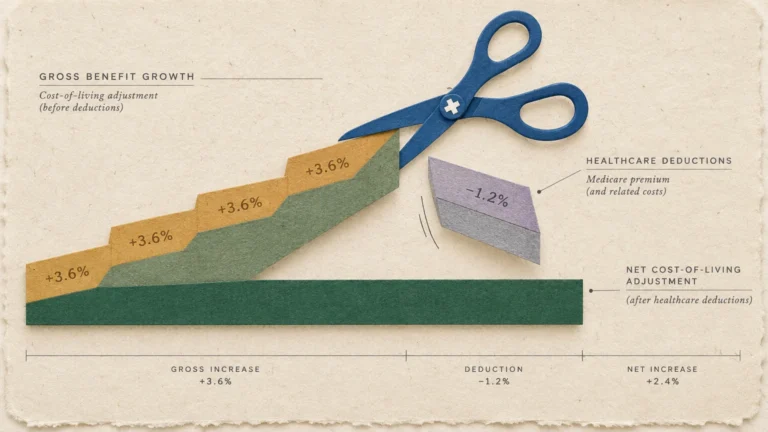
Your household Social Security income gets a meaningful raise in January 2027 through a confirmed 3.6% cost-of-living adjustment. This increase pushes the average spousal benefit above $1,000 per month for the first time.
Higher checks help cover rising living expenses, yet they also create hidden planning traps for married retirees. Unindexed tax thresholds and projected Medicare Part B premium increases can quietly erode your net gain.
Understanding how the 2027 adjustment interacts with claiming rules, taxes, and healthcare costs protects your purchasing power. Use this guide to align your spousal benefits with a resilient retirement income plan.
How the 3.6% COLA Reshapes Spousal Benefits in 2027
Breaking Down the 2027 Payment Increase
On October 14, 2026, the Social Security Administration (SSA) confirmed a 3.6% cost-of-living adjustment for 2027. That figure outpaces the 2.8% increase from 2026 and sits well above the 20-year historical average of 2.6%.
Roughly 76 million Americans will receive this boost, including nearly 72 million Social Security beneficiaries starting in January 2027. About 7.3 million Supplemental Security Income (SSI) recipients see their higher payments begin on December 31, 2026.
By law, the adjustment reflects the third-quarter rise in the Consumer Price Index for Urban Wage Earners and Clerical Workers from the Bureau of Labor Statistics. SSA multiplies your gross monthly check by 1.036 and rounds down to the next lowest dime.
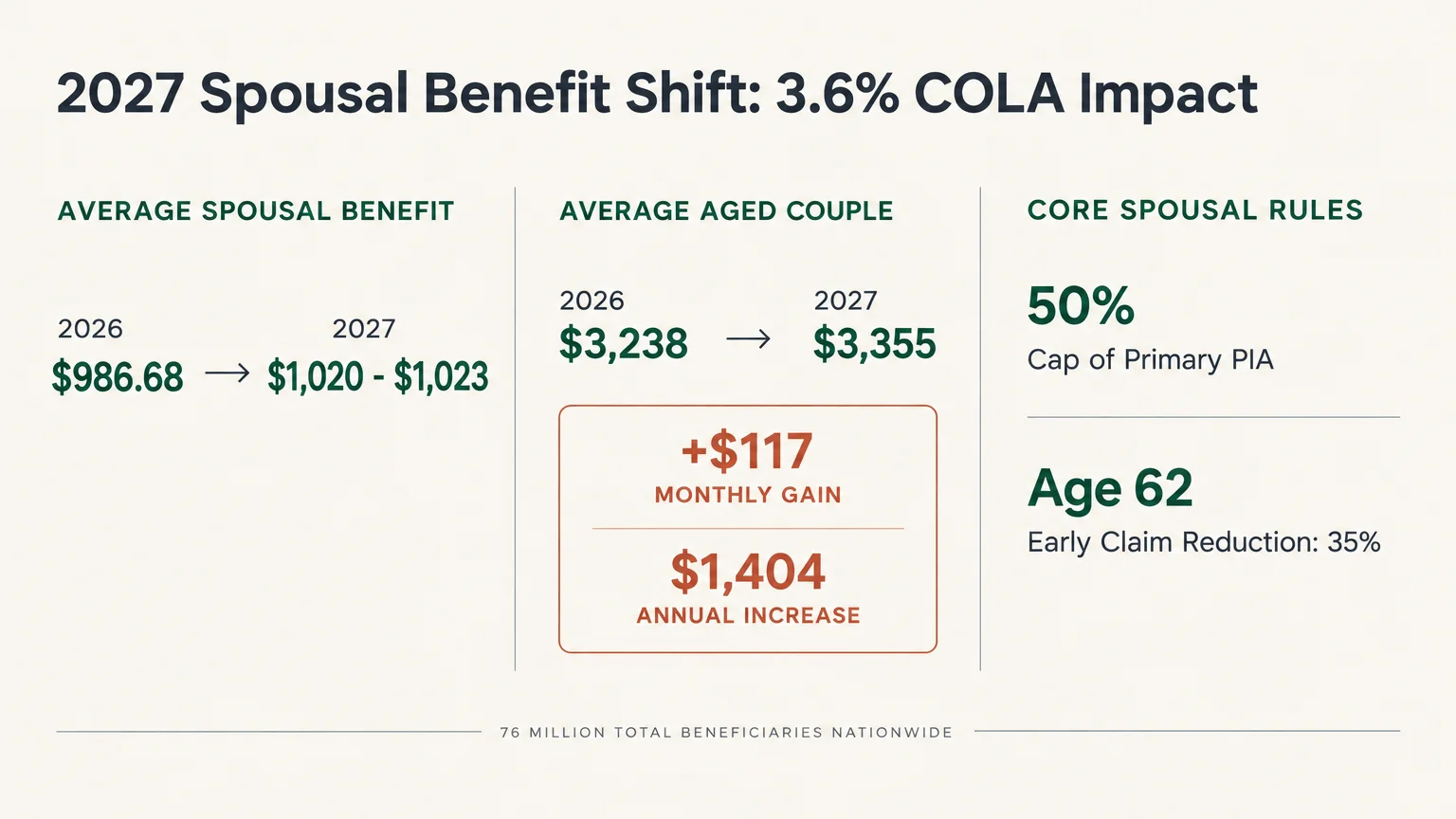
For an average aged couple where both partners receive benefits, gross monthly income climbs from $3,238 in 2026 to $3,355 in January 2027. That $117 monthly gain delivers an extra $1,404 in annual household cash flow before deductions.
According to SSA data from September 2026, nearly 2.1 million spouses of retired workers collected an average check of $986.68 per month. Applying the 3.6% raise lifts the average spousal benefit past $1,000, reaching roughly $1,020 to $1,023 monthly.
Other benchmark averages move higher as well, with all retired workers gaining $75 monthly to reach $2,170. Aged widows and widowers living alone rise from $1,936 to $2,005 per month, while the maximum benefit at full retirement age climbs from $4,152 to $4,188.
Federal SSI payment standards also increase from $994 to $1,029 monthly for eligible individuals and from $1,491 to $1,544 for eligible couples. Families receiving disabled worker, spouse, and child benefits see their average monthly package climb from $2,970 to $3,077.
If you opted into paperless alerts by November 18, 2026, you can view your exact 2027 statement inside the official Social Security online portal starting in late November. Everyone else receives a mailed notice during December 2026.
The 50% Cap, Early Reductions, and Deemed Filing Rules
Before banking on a higher check, confirm how spousal benefit math works under federal rules. A spousal benefit maxes out at 50% of the primary earner’s Primary Insurance Amount, which is the benefit earned at full retirement age.
Delaying your spousal claim past your own full retirement age will not push your payment above 50%. Even if your working spouse delays until age 70 for delayed credits, your spousal cap remains anchored at 50%.
Claiming a spousal benefit never reduces the primary worker’s own retirement check, subject to family maximum limits. Full retirement age is 66 and 10 months for 1959 births, and 67 for anyone born in 1960 or later.
Spouses can claim at age 62 if they hold that age for the entire first month. Early filing permanently cuts payments by 25/36 of 1% monthly for the first 36 months, plus 5/12 of 1% for each earlier month.
A spouse with a full retirement age of 67 who files at 62 takes a permanent 35% reduction. That drops your payment to 32.5% of the worker’s full benefit, unless you care for a qualifying minor or disabled child.
Suppose a worker’s full benefit equals $3,000 monthly in 2027. A spouse claiming at full retirement age collects $1,500, while filing at 62 pays $975—a $525 monthly gap that widens with every future adjustment.
Because claiming choices lock in permanent reductions, test multiple filing ages before submitting paperwork. Consult a licensed financial advisor or Social Security specialist to model how these numbers fit your household longevity and cash needs.
Eligibility rules also depend on marital history and filing status. Current spouses generally must remain married for at least one year, and the working spouse must already receive retirement or disability benefits.
Divorced spouses aged 62 or older can claim on an ex-spouse’s record if the marriage lasted at least 10 years. In most cases, a qualifying divorced spouse does not need to wait for the former partner to file before claiming.
Remember that deemed filing rules govern anyone born on or after January 2, 1954. When you apply for either your own retirement benefit or a spousal benefit, SSA automatically files you for both programs at once.
SSA pays your own earned retirement benefit first, then adds a spousal top-off equal to the difference if the spousal amount is higher. Congress eliminated legacy loopholes like restricted applications and file-and-suspend in 2015, ending those strategies for new filers.
New Relief for Public Pension Spouses After the GPO Repeal
Many public-sector families reach an important 2027 milestone following the repeal of the Government Pension Offset. Signed into law on January 5, 2025, the Social Security Fairness Act eliminated both the Government Pension Offset and the Windfall Elimination Provision.
Previously, spouses receiving non-covered public pensions saw their Social Security spousal benefits cut by two-thirds of their government pension. That penalty frequently wiped out spousal checks entirely for retired teachers, firefighters, police officers, and federal Civil Service Retirement System workers.
The repeal applies to benefits payable for January 2024 and later, restoring full spousal and survivor eligibility. Equally important, the 3.6% COLA for 2027 applies to your full eligible benefit rather than a reduced fraction.
If you never applied for spousal benefits earlier because the offset reduced your expected check to zero, file a claim now. Keep in mind that retroactive payments on newly submitted applications generally cap at six months.
Aligning Social Security Timing With Your Broader Income Streams
Coordinating Spousal Claims With Primary Worker Timing
Rather than viewing the 2027 COLA in isolation, treat it as one building block inside a coordinated couple’s income plan. When one spouse earned substantially more during their career, staggering your claiming dates often unlocks higher lifetime household cash flow.
A common approach has the lower earner claim their own earned benefit early to bring immediate income into the household. Meanwhile, the higher earner delays filing up to age 70 to maximize both their own check and the eventual survivor benefit.
Once the higher earner files, the lower earner collects any available spousal top-off toward the 50% threshold. Delaying the larger check also gives future COLAs a bigger base to compound upon for both partners.
Still, delaying does not fit every couple, especially if health issues or immediate cash needs shorten your break-even horizon. Review your personal earnings records and run joint break-even scenarios with a qualified planner before locking in a claiming sequence.
Evaluating Pensions, Annuities, and Portfolio Withdrawals
Your 2027 Social Security raise also changes how hard your investment portfolio and private pensions must work. An average couple gaining $117 monthly from the 3.6% COLA needs $1,404 less in annual withdrawals from retirement accounts to cover the same budget.
When evaluating workplace pension payout options, compare single-life checks against joint-and-survivor elections alongside your Social Security projection. Because Social Security provides built-in inflation adjustments and automatic survivor protection, it pairs well with pensions that lack cost-of-living raises.
If you hold or are shopping for commercial annuities, examine how fixed payouts interact with your inflation-adjusted Social Security floor. Relying heavily on non-indexed fixed annuities can leave you vulnerable over a long retirement, even when Social Security keeps pace with consumer prices.
Using guaranteed Social Security income to cover core monthly bills also protects your stock and bond holdings from sequence-of-returns risk. During market downturns, your higher 2027 spousal and worker checks help you pause or trim equity sales until prices recover.
Before purchasing an annuity or shifting portfolio allocations, review federal investor education resources for seniors to verify fee structures and surrender terms. Independent guidance ensures any income product genuinely fills a gap rather than duplicating Social Security’s built-in guarantees.
Tax Strategy and Healthcare Costs That Can Shrink Your Raise
Navigating Unindexed Benefit Tax Tiers and the Senior Deduction
A bigger Social Security check in 2027 does not automatically translate into tax-free spending money. Under Internal Revenue Code Section 86, federal benefit taxation relies on combined income, which adds adjusted gross income, nontaxable interest, and 50% of your Social Security benefits.
For married couples filing jointly, up to 50% of Social Security benefits become taxable once combined income crosses $32,000. Above $44,000 in combined income, up to 85% of your benefits face federal income tax.
Single filers face tighter thresholds of $25,000 and $34,000, and none of these statutory tiers adjust for inflation. As a result, a 3.6% COLA can push modest-income couples across those frozen lines, creating a subtle tax hike on your raise.
Fortunately, the 2025 One Big Beautiful Bill Act provides temporary relief for older households. From 2025 through 2028, taxpayers aged 65 or older can claim a bonus senior deduction of up to $6,000 per person.
A qualifying married couple filing jointly where both spouses are 65 or older can deduct up to $12,000 in extra income. This bonus deduction phases out once modified adjusted gross income exceeds $150,000 for joint filers or $75,000 for single taxpayers.
Understand how these two rules interact on your return. The senior bonus reduces your final taxable income after the combined-income calculation occurs, rather than raising the $32,000 and $44,000 thresholds themselves.
Check the federal tax guidance for retirees and work with a certified public accountant to project your 2027 tax bill. Modeling your exact tax bracket early prevents unpleasant surprises when filing next spring.
Required Minimum Distributions, Roth Conversions, and Tax-Efficient Withdrawals
Required Minimum Distributions from traditional IRAs and 401(k) plans feed directly into your combined income and modified adjusted gross income. Large mandatory withdrawals can simultaneously trigger 85% benefit taxation and erode your eligibility for the $12,000 joint senior deduction.
To manage these thresholds in 2027, blend withdrawals across taxable brokerage accounts, traditional pre-tax accounts, and tax-free Roth buckets. Pulling cash from Roth accounts or selling taxable assets with minimal capital gains keeps your reportable income below key phaseout cliffs.
Couples who have not yet reached their Required Minimum Distribution age can evaluate partial Roth conversions during lower-income retirement years. Converting pre-tax dollars strategically shrinks future mandatory distributions, though you must balance today’s conversion tax against tomorrow’s Social Security tax savings.
Because Roth conversions raise modified adjusted gross income in the year executed, time them carefully around the $150,000 joint phaseout for the bonus senior deduction. A fiduciary tax planner can calculate the exact conversion ceiling that optimizes your multi-year tax outlook.
Medicare Part B Projections, Part D Caps, and IRMAA Risks
Healthcare deductions also determine how much of your 3.6% COLA actually lands in your checking account. SSA deducts Medicare Part B premiums straight from monthly Social Security payments before the remaining cash reaches your bank.
As of mid-November 2026, the Centers for Medicare & Medicaid Services had not yet finalized official 2027 Part B rates. In 2026, the standard Part B premium stands at $202.90 per month alongside a $283 annual deductible.
The 2026 Medicare Trustees Report projects the 2027 standard Part B premium will climb $6.60 to $209.50 monthly, with a $292 deductible. For two spouses paying standard rates, that $13.20 combined increase trims your net COLA gain.
The federal hold-harmless rule prevents standard Part B hikes from cutting your net Social Security payment year-over-year. However, that shield does not cover new enrollees or high-income couples paying Income-Related Monthly Adjustment Amounts.
Income surcharges rely on tax returns from two years earlier, so 2025 income shapes 2027 brackets. Checking the Medicare cost overview helps you anticipate both base premiums and potential surcharges when budgeting for 2027.
Prescription drug coverage brings notable shifts in 2027 as well. Under rules from the Centers for Medicare & Medicaid Services, the maximum standard Part D drug deductible increases from $615 in 2026 to $700 in 2027.
In addition, the annual Part D out-of-pocket spending cap moves from $2,100 up to $2,400 in 2027. Couples managing chronic prescriptions should compare drug plans during open enrollment so higher deductibles do not wipe out their spousal COLA gains.
If you built a Health Savings Account before enrolling in Medicare, use those funds strategically in 2027. Tax-free withdrawals reimburse Part B premiums and Part D copays without raising your taxable income or Medicare surcharge tier.

Risk Management, Fraud Prevention, and Legacy Protection
Planning for Long-Term Care Without Derailing Spousal Security
While a 3.6% COLA helps cover groceries and utilities, Social Security alone cannot absorb extended long-term care expenses. Assisted living, memory care, or round-the-clock home health aides can rapidly exhaust shared retirement savings if left unaddressed.
Married couples must plan so one partner’s health crisis does not leave the healthy spouse financially stranded. Evaluate whether existing savings, standalone long-term care insurance, or hybrid life-and-care policies provide the right safety net for your household.
Look closely at how your combined Social Security income would shift if one spouse enters a facility while the other stays home. A licensed insurance specialist and fiduciary planner can stress-test your care budget alongside Medicaid spousal impoverishment rules.
Guarding Against Social Security and COLA Scams
Every autumn COLA announcement triggers a predictable wave of impersonation scams targeting older adults. Fraudsters send urgent texts, emails, or spoofed calls claiming you must pay a fee or verify banking details to activate your 3.6% raise.
Ignore any message demanding gift cards, cryptocurrency, or wire transfers to unlock your 2027 payment increase. Your cost-of-living adjustment processes automatically with zero application fees, and legitimate officials never threaten arrest over benefit updates.
Always log directly into your verified online account rather than clicking links inside unsolicited messages. You can also strengthen account security by reviewing independent fraud prevention guidance and enabling two-factor authentication on every financial profile.
Estate Basics, Beneficiary Audits, and Incapacity Readiness
Use your annual 2027 COLA review as a prompt to audit legal documents and beneficiary designations across all retirement accounts. Remember that beneficiary forms on IRAs, 401(k) plans, and annuities legally override instructions written inside a will.
Confirm that both primary and contingent beneficiaries reflect your current wishes, especially if you experienced a divorce, remarriage, or family loss. Checking payable-on-death designations on joint bank accounts also prevents unnecessary probate delays for a surviving partner.
Finally, verify that durable financial powers of attorney and advance healthcare directives are signed and easily accessible. If cognitive decline or sudden illness strikes, having proper legal authority lets your spouse manage investments and Social Security affairs smoothly.
Frequently Asked Questions About 2027 Spousal Benefits
How does part-time work affect my spousal benefit in 2027?
Working part-time before full retirement age triggers the 2027 Retirement Earnings Test. If you stay under full retirement age all year, the annual exempt limit rises from $24,480 to $25,560, or $2,130 monthly.
Above that $25,560 limit, SSA withholds $1 in benefits for every $2 you earn from work. Notice that investment income, pensions, and IRA withdrawals do not count toward this earnings test.
During the calendar year you reach full retirement age, a higher exempt threshold rises from $65,160 to $67,920, or $5,660 per month. For earnings above that ceiling in months before your milestone birthday, SSA withholds $1 for every $3 earned.
Once you reach full retirement age, the earnings limit disappears completely regardless of how much you earn. Any benefits withheld earlier return gradually, as SSA recalculates your monthly check upward once you reach full retirement age.
Working spouses also pay 6.2% payroll taxes up to the 2027 taxable wage cap of $192,300, up from $184,500 in 2026. Higher recent earnings can even lift your future benefit if they replace lower earning years.
Is the 3.6% COLA enough to serve as my primary inflation hedge?
While a 3.6% raise outperforms the 20-year average of 2.6%, it does not guarantee full protection against senior-specific expenses. Because the formula tracks urban wage earners rather than retirees, it can understate faster-rising medical, insurance, and property tax bills.
For example, seeing the maximum Part D drug deductible jump from $615 to $700 and the out-of-pocket cap rise to $2,400 hits household budgets hard. Treating Social Security as your sole inflation defense leaves you exposed to healthcare and housing surges.
Pair your COLA-adjusted benefits with a diversified investment mix designed for long-term growth above inflation. Holding Treasury Inflation-Protected Securities, dividend-paying equities, and an adequate cash reserve ensures your purchasing power endures over decades.
What should we look for in advisor fees when reviewing our claiming plan?
Look for transparent, fee-only fiduciary advisors who owe you a legal duty to put your household’s best interests first. Verify whether a planner charges a flat project fee, an hourly rate, or a clear percentage of managed assets before sharing sensitive statements.
Be cautious of free Social Security workshops that steer couples toward high-commission annuities or complex insurance contracts. A trustworthy planner delivers objective claiming math and tax coordination without tying their advice to product sales.
Ask prospective advisors to outline their total annual compensation in writing, including underlying fund expense ratios. Checking professional credentials and disciplinary histories through official regulatory portals helps protect your retirement savings from conflicts of interest.
How should married couples plan ahead for a surviving spouse?
When one spouse passes away, the smaller of your two monthly Social Security checks stops, leaving the survivor with the larger benefit. Across all aged widows and widowers living alone, the 3.6% COLA lifts average monthly benefits from $1,936 to $2,005 in 2027.
Because the higher earner’s check becomes the survivor’s lifeline, delaying that primary benefit up to age 70 provides powerful longevity insurance. Remember that while delayed credits never boost a living spouse’s 50% cap, they do transfer directly to a surviving spouse.
Surviving spouses also face the widow’s tax penalty when shifting from married filing jointly to single tax status. Combined-income thresholds drop to $25,000 and $34,000, and the bonus senior deduction phases out at $75,000 instead of $150,000.
Building Roth reserves and life insurance coverage while both partners are alive helps cushion that sudden drop in household cash flow. Review survivor projections annually so neither partner faces unexpected income shocks later in life.
Taking Action Before Your January 2027 Check Arrives
Treat the 3.6% COLA announcement as your cue to run a complete household financial checkup before January 2027 arrives. Download your official benefit notice, confirm your net payment after Medicare Part B deductions, and verify your tax withholding elections.
If you were previously affected by the Government Pension Offset, confirm that your restored benefit reflects the full 2027 increase or submit a fresh claim. Small administrative checks today prevent months of missed income tomorrow.
Schedule a winter planning session with a trusted fiduciary advisor and tax professional to align your 2027 withdrawals, Roth conversions, and Medicare choices. Proactive coordination turns a routine annual cost-of-living raise into lasting retirement security for both you and your spouse.