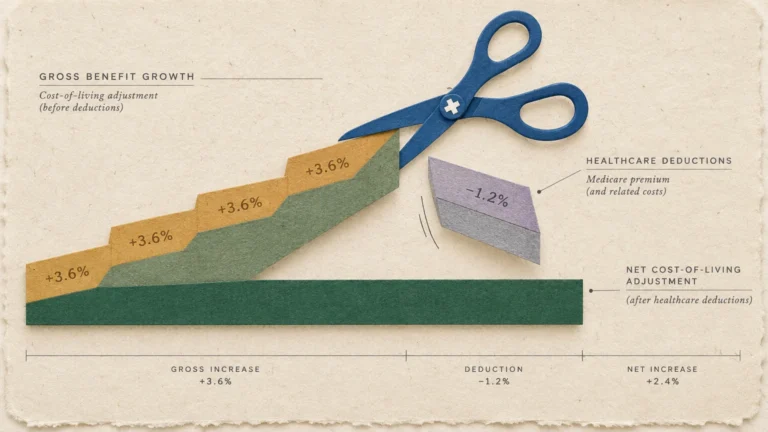
Your federal pension gets a boost in 2027, though the exact raise depends on your retirement system. Civil Service Retirement System (CSRS) retirees receive a 3.6% cost-of-living adjustment, while eligible Federal Employees Retirement System (FERS) annuitants receive 2.6%.
Rising healthcare premiums and Medicare deductions will claim a noticeable slice of that increase before it reaches your checking account. Understanding how your federal pension increase compares—and how taxes and healthcare costs interact with it—helps you protect your purchasing power all year.
How the 2027 Federal Retiree COLA Stacks Up
The annual inflation adjustment sets the baseline for millions of household budgets across the country. On October 14, 2026, the Social Security Administration (SSA) announced a 3.6% COLA for 2027, matching the full inflation benchmark.
That 3.6% increase reaches roughly 76 million Americans—nearly 72 million Social Security beneficiaries and about 7.3 million Supplemental Security Income (SSI) recipients. Average Social Security retirement benefits climb by $75 per month, moving from roughly $2,095 to $2,170.
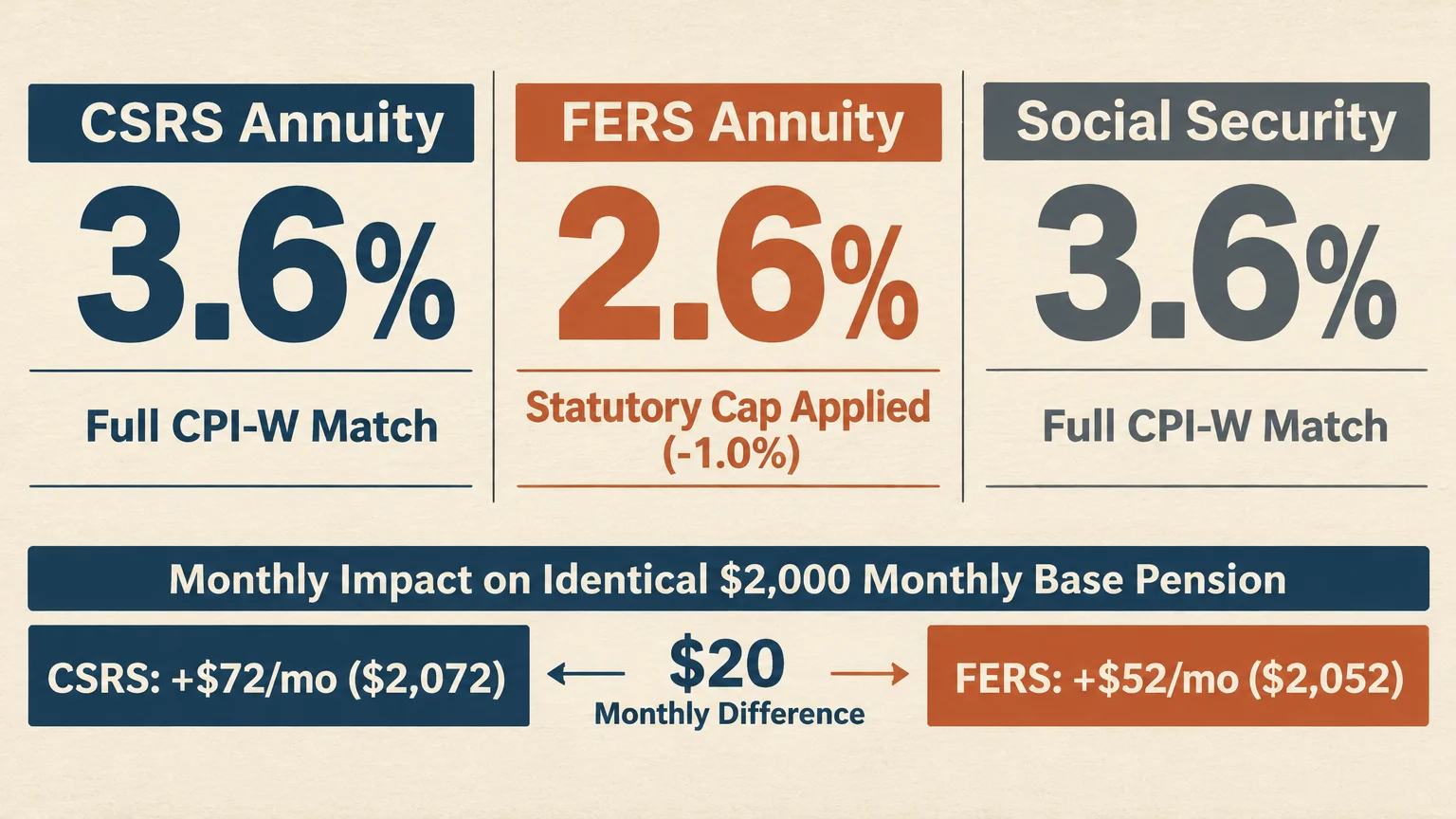
Federal civilian pensions follow the same inflation timeline, though payout formulas split into two tracks. According to the U.S. Office of Personnel Management (OPM), CSRS annuitants capture the full 3.6% raise, while eligible FERS and FERS Special retirees receive 2.6%.
Military retirees, Survivor Benefit Plan annuitants, and veterans receiving VA disability compensation or pensions also receive the full 3.6% adjustment in 2027. That leaves regular FERS retirees as the primary federal group facing a statutory cap.
The CSRS vs. FERS Math and Payment Timeline
Both Social Security and federal civilian COLAs rely on data from the Bureau of Labor Statistics (BLS). Specifically, agencies measure the third-quarter average change in the Consumer Price Index for Urban Wage Earners and Clerical Workers (CPI-W) from 2025 to 2026.
When the September 2026 CPI-W reading hit 330.654, it locked in the 3.6% benchmark for 2027. CSRS annuities pass along 100% of that CPI-W jump, preserving full inflation parity on your monthly pension check.
FERS annuities operate under a three-tier statutory cap written into federal law under 5 U.S.C. section 8462. Whenever CPI-W rises 2.0% or less, FERS annuitants receive the full inflation percentage.
When inflation lands between 2.0% and 3.0%, the FERS COLA freezes at a flat 2.0%. Whenever CPI-W exceeds 3.0%—as it did for 2027—FERS reduces the inflation rate by one full percentage point, turning 3.6% into 2.6%.
To translate percentages into household cash flow, consider how OPM processes your monthly adjustment. OPM applies the COLA to your gross monthly annuity before deductions and rounds down to the next whole dollar, with a minimum $1.00 increase.
A retiree collecting a $4,000 monthly CSRS pension sees a $144 monthly raise, lifting gross pay to $4,144. By comparison, a $3,000 monthly FERS pension increases by $78 per month, moving to $3,078 before health insurance and tax withholdings.
Even on identical $2,000 base pensions, the one-point gap creates an immediate $20 monthly difference. A CSRS retiree gains $72 per month at 3.6%, whereas a FERS retiree gains $52 per month at 2.6%.
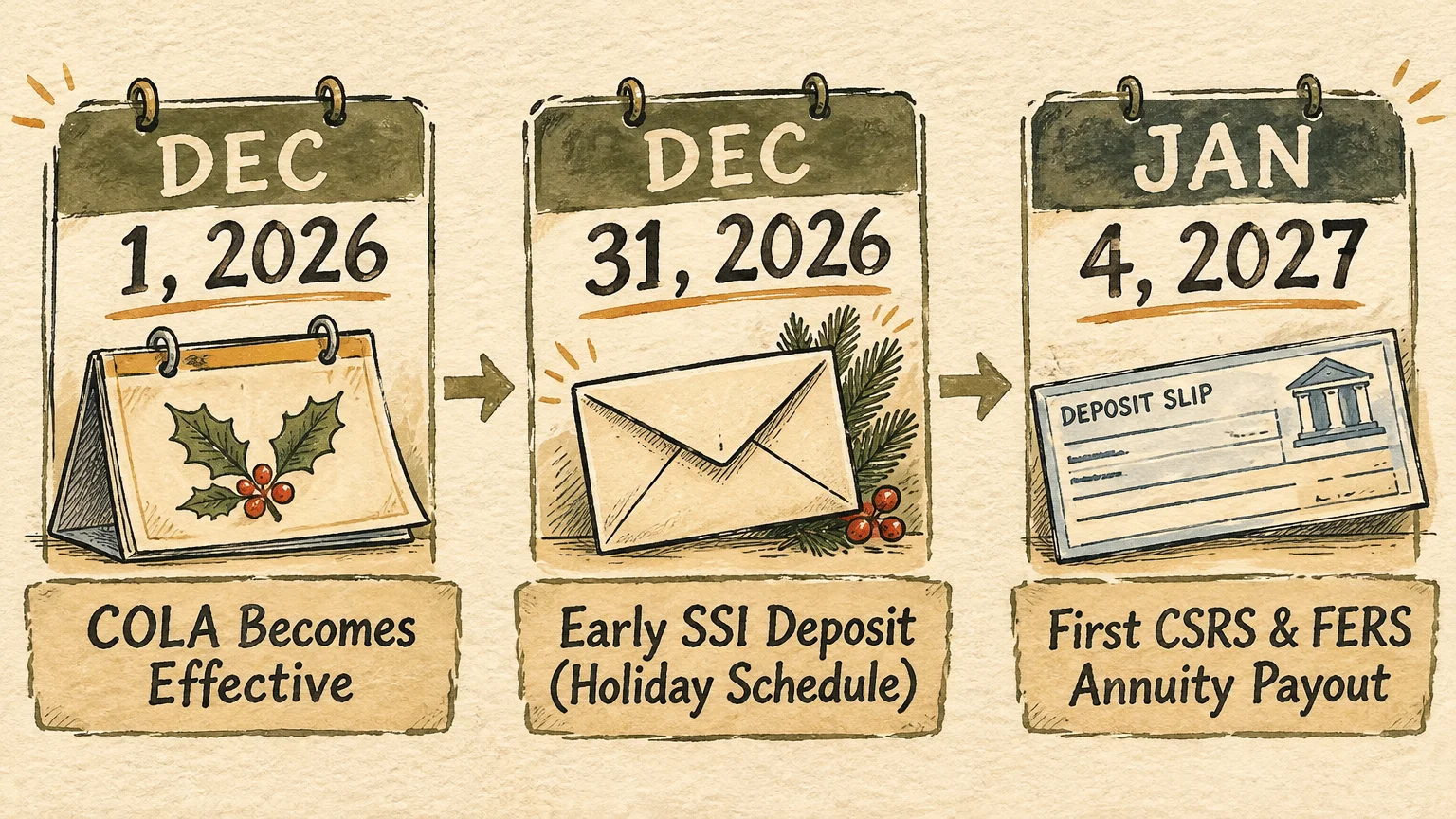
Mark your calendar so you can verify your deposit when the new year begins. Both CSRS and FERS adjustments take effect December 1, 2026, and arrive in your January 4, 2027 payment—the first business day of the month.
Increased Social Security checks also begin arriving on your regular January 2027 payment schedule. Meanwhile, higher SSI payments arrive one day early on December 31, 2026, because of the New Year’s Day holiday.
How Your Raise Compares to Private and State Pensions
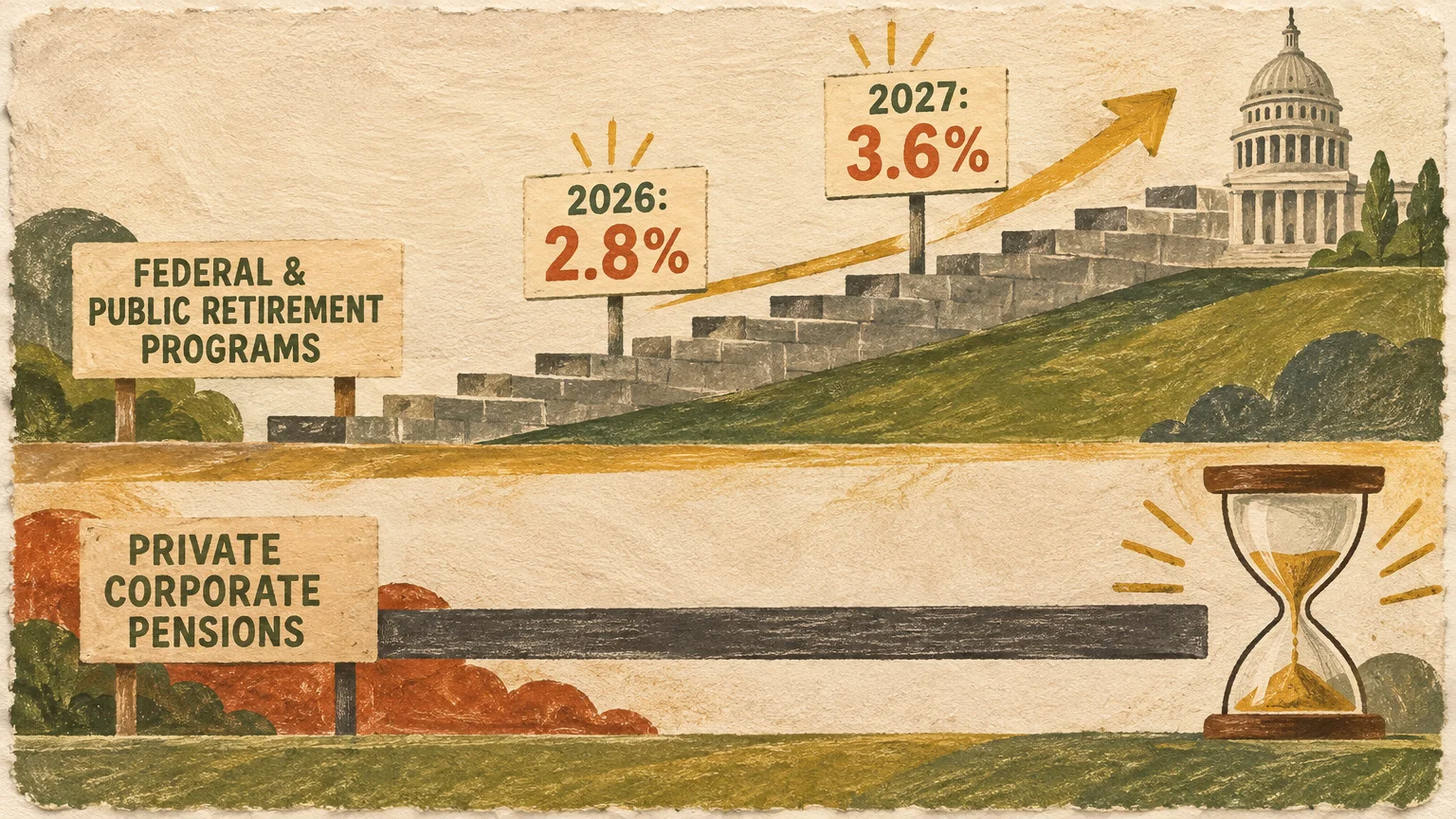
The 2027 adjustments top the 2026 COLAs of 2.8% for CSRS and Social Security and 2.0% for FERS. Still, the recurring one-point penalty for FERS retirees adds up quickly over a multi-decade retirement.
From 2018 through 2027, CSRS and Social Security COLAs averaged 3.44% annually, compared with 2.83% for eligible FERS retirees. Looking specifically at 2019 through 2027, compounded increases total roughly 37.2% for CSRS versus 29.4% for FERS.
That 7.8-percentage-point cumulative gap means FERS pensions gradually lose ground against everyday expenses like groceries, utilities, and property taxes. Lawmakers introduced the Equal COLA Act in the 119th Congress—H.R. 491 and S. 624—to eliminate that cap.
However, neither bill has advanced out of committee or become law as of November 2026. You should build your retirement budget around current law rather than counting on pending legislation to close the gap.
Even with that cap, federal government retiree benefits remain remarkably resilient compared with private-sector retirement plans. By 2025, only about 9% of private-sector wage and salary workers participated in a defined benefit pension, down from 38% in 1980.
Broader private-sector access sits around 15%, and automatic inflation adjustments are virtually nonexistent in corporate pensions. Historically, only about 4% of private-sector pension participants receive automatic CPI-linked COLAs, compared with 54% of public-sector pension participants.
Without any COLA at all, a fixed private pension loses 26% of its purchasing power over just 10 years of 3% annual inflation. Your FERS or CSRS pension insulates you from that steep erosion, even if FERS trails inflation slightly.
State and local government workers fare better than corporate employees, with roughly 86% participating in defined benefit plans. Still, many state systems enforce fixed or capped annual increases between 2% and 3%.
For example, most California CalPERS state and school agencies cap annual COLAs at 2%, paid starting in May. When inflation runs above 3%, FERS retirees receiving 2.6% actually outperform many state and municipal retirees locked at 2%.
Aligning Your Income Streams Around the 2027 Increase
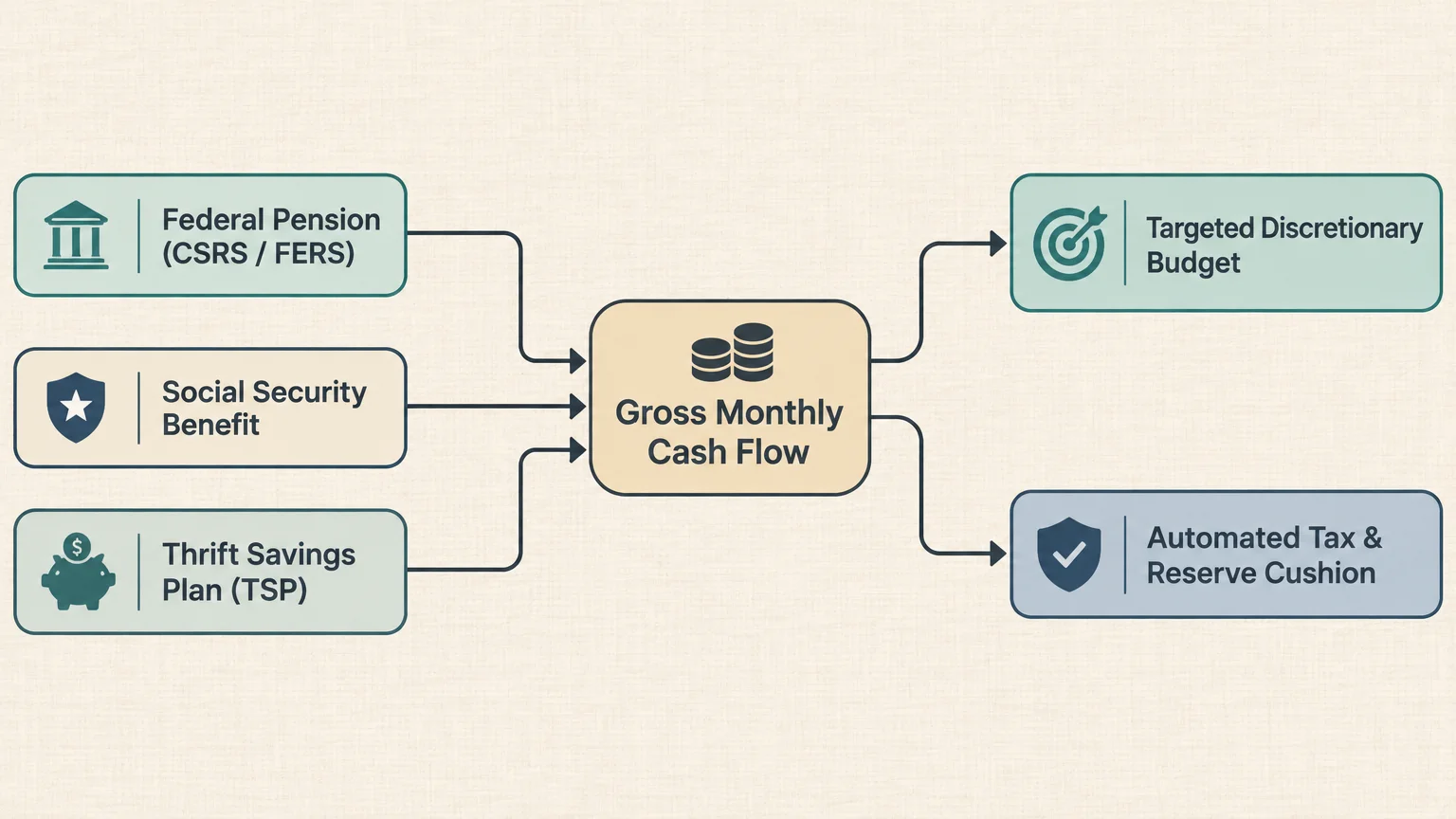
A pension raise only helps your lifestyle when it coordinates cleanly with Social Security, Thrift Savings Plan (TSP) withdrawals, and personal savings. You can review official pension calculation rules anytime through the Office of Personnel Management Retirement Center.
Start by separating your guaranteed income streams into full-inflation buckets and capped-inflation buckets. Knowing which checks keep full pace with the CPI-W helps you decide when to claim benefits and how aggressively to tap investments.
Timing Social Security Alongside CSRS or FERS
Unlike CSRS, which historically replaced Social Security for career civil servants, FERS was designed as a three-legged stool. FERS pairs a smaller basic pension and TSP account with full Social Security coverage.
That structure creates built-in dual-income protection once you reach age 62 and begin collecting Social Security. While your FERS pension grows by 2.6% in 2027, your Social Security check captures the full 3.6% COLA.
Timing when you claim Social Security directly magnifies the dollar value of future inflation raises. Delaying Social Security past age 62—and up to age 70—permanently increases your monthly base benefit.
Every future 3.6%-style COLA then compounds on top of a substantially larger Social Security check. Before claiming early, run projections using the official Social Security Administration COLA information page and benefit calculators.
You also need to account for strict eligibility timing rules inside FERS itself. Most regular FERS retirees do not receive any pension COLA until they reach age 62, regardless of when they retired.
Several key exceptions bypass the age-62 waiting period. Survivor annuitants and special provision retirees—including law enforcement officers, firefighters, and air traffic controllers—receive COLAs immediately regardless of age.
FERS disability retirees also qualify for COLAs at any age, except during their first year on the disability roll when receiving the initial 60% of high-three salary rate. Meanwhile, CSRS retirees never face an age minimum for COLAs.
If you transferred into FERS with prior CSRS service, check your annuity statement carefully. You receive the full 3.6% CSRS COLA on your CSRS pension component right away, without waiting until age 62.
Watch out for the FERS Annuity Supplement if you retired under regular FERS rules before age 62. That bridge payment receives zero COLA adjustments while it bridges the gap to Social Security, though survivor supplements do receive COLAs.
Newly retired federal employees also experience first-year proration on their initial COLA. If you retired for less than a full year before December 1, 2026, OPM pays one-twelfth of the full COLA for each month on the roll.
For instance, a CSRS annuity that began in November 2026 earns one-twelfth of 3.6%, resulting in a 0.3% increase. Benefits paid to children of deceased annuitants are never prorated and always receive the full CSRS rate.
Balancing Portfolio Withdrawals, TSP, and Annuities
Once your guaranteed federal checks are mapped out, look at how much cash you pull from your TSP or Individual Retirement Accounts (IRAs). Your portfolio’s primary job is filling the spending gap left by FERS COLA caps and living expenses.
When your pension and Social Security rise by $120 to $200 a month combined, resist the urge to automatically inflate your lifestyle. Instead, reduce your monthly TSP withdrawal by that net raise if your current budget already covers your bills.
Leaving extra dollars invested in your TSP or IRA reduces sequence-of-returns risk during choppy market years. It also extends the lifespan of your portfolio if healthcare expenses climb later in retirement.
Keep one to two years of expected portfolio withdrawals in cash equivalents, money market funds, or short-term Treasury bills. Having a liquid buffer stops you from selling stock funds during a market downturn just to cover routine expenses.
If you are considering buying a commercial fixed annuity to supplement your pension, compare its inflation protection carefully. Most standard private immediate annuities pay a flat nominal dollar amount for life with zero COLA.
Before locking up TSP money in an irrevocable insurance contract, weigh it against delaying Social Security or investing conservatively. Always consult a licensed fiduciary financial planner before moving lump sums out of low-cost federal plans.
Tax Strategy and Healthcare Offsets That Shrink Your Net Raise
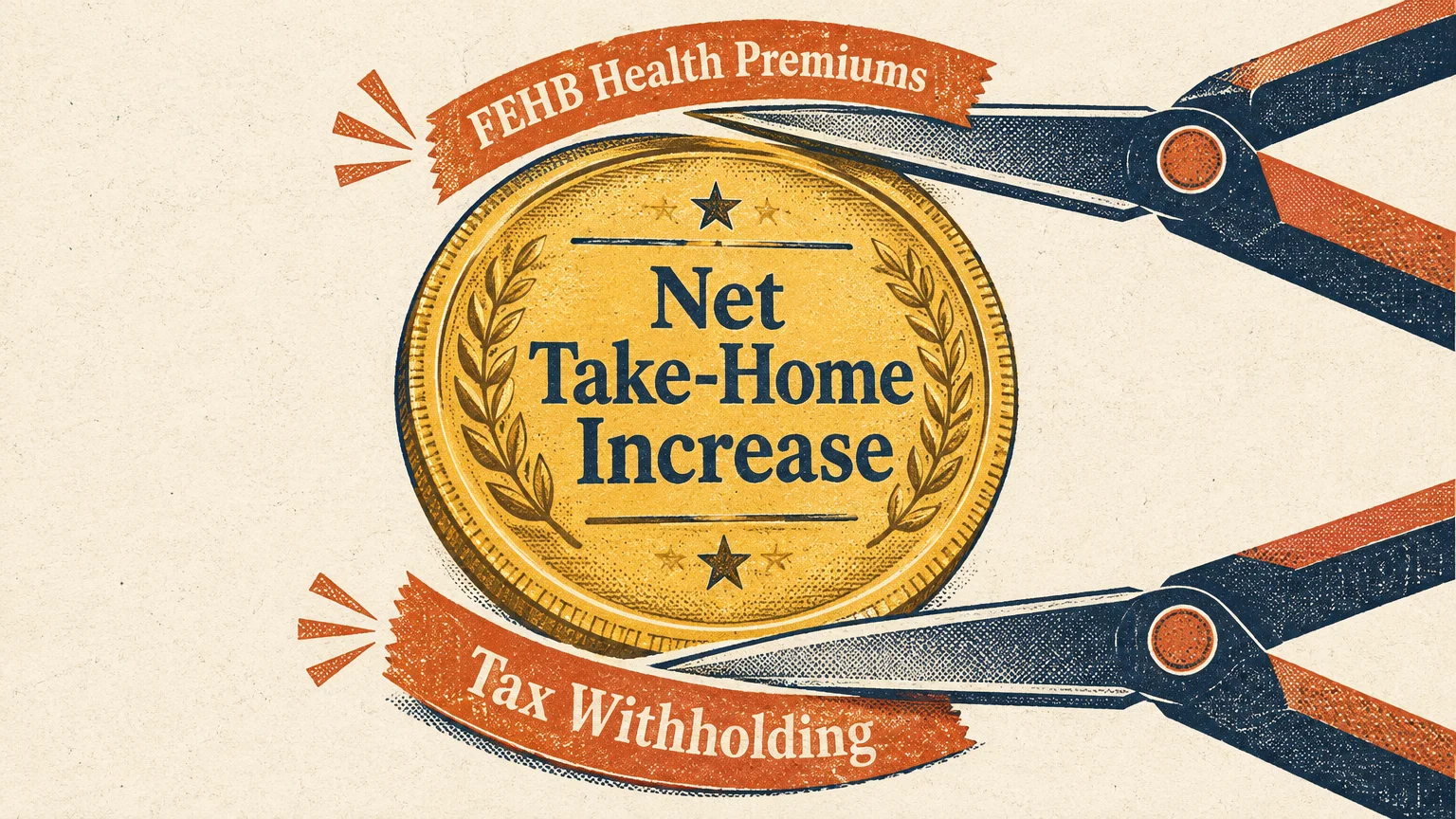
Gross COLA headlines rarely match the net deposit hitting your bank account in January. Federal retirees face steep health insurance adjustments and rising Medicare premiums that absorb part—or sometimes all—of the 2027 raise.
Evaluating these deductions alongside your tax bracket keeps you from overestimating your true spending power. Proactive adjustments during fall enrollment and tax planning protect every available dollar.
Accounting for FEHB, PSHB, and Medicare Increases
For plan year 2027, the enrollee share of Federal Employees Health Benefits (FEHB) premiums climbs by an average of 10.9%. While slightly lower than the 12.3% hike in 2026, double-digit premium growth outpaces both federal COLAs.
Postal retirees enrolled in the Postal Service Health Benefits (PSHB) program face an average enrollee premium increase of 8.2% for 2027. Dental and vision coverage under FEDVIP rises more modestly, averaging 1.0% for dental and 1.6% for vision.
Because FEHB and PSHB deductions come straight out of your monthly OPM annuity, a steep premium jump can swallow a 2.6% FERS raise. Reviewing competing plans during Federal Benefits Open Season—running November 9 through December 14, 2026—can save hundreds annually.
Medicare costs are moving upward as well for 2027. On November 17, 2026, the Centers for Medicare & Medicaid Services (CMS) set the standard 2027 Medicare Part B monthly premium at $209.40, up $6.50 or 3.2% from $202.90 in 2026.
Because Social Security automatically deducts Part B premiums from monthly benefits, that $6.50 increase trims your $75 average Social Security COLA down to $68.50 before taxes. You can verify plan options and coverage rules directly on Medicare.gov.
Out-of-pocket Medicare cost-sharing is edging higher too. CMS raised the annual Part B deductible by $9—from $283 in 2026 to $292 in 2027—and increased the Part A inpatient hospital deductible by $40, from $1,736 to $1,776.
Suppose your FERS pension rises by $78 per month and your Social Security check rises by $75, giving you $153 in combined gross COLA gains. If your FEHB self-plus-one premium climbs $65 a month and Part B adds $6.50, your real net gain shrinks by nearly half.
Check your individual 2027 plan brochure rather than relying on national averages. Switching from a high-option plan to a standard or consumer-driven FEHB option paired with Medicare often slashes monthly premiums without sacrificing hospital protection.
Managing RMDs, Medicare IRMAA, HSAs, and Tax Withholding
Higher pension and Social Security checks also push your adjusted gross income upward, creating subtle tax ripple effects. Up to 85% of your Social Security benefits can become federally taxable once your combined income crosses statutory thresholds.
Your CSRS or FERS pension is largely taxable as ordinary income, aside from the small portion representing your after-tax employee contributions. Adding traditional TSP or IRA withdrawals on top of higher COLAs can nudge you into a higher tax bracket.
Pay special attention to Medicare’s Income-Related Monthly Adjustment Amount (IRMAA) if you have substantial TSP balances or pension income. Medicare looks back at your tax return from two years earlier to assess Part B and Part D surcharges.
IRMAA operates as a strict cliff rather than a gradual phase-in. Exceeding a threshold by even a single dollar triggers hundreds or thousands in extra annual Medicare premiums for the entire year.
Required Minimum Distributions (RMDs) from traditional TSP and IRA accounts compound this risk once you reach your mandatory distribution age. Coordinating partial Roth conversions in lower-income years before RMDs start can shrink future mandatory withdrawals.
If you enrolled in a High Deductible Health Plan before turning 65 and built a Health Savings Account (HSA), treat it as a stealth retirement healthcare shield. Once you enroll in Medicare, you can no longer contribute new money to an HSA, but existing funds stay tax-free.
You can withdraw HSA dollars tax-free to reimburse yourself for Medicare Part B premiums, deductibles, dental work, and prescription copays. Best of all, qualified HSA distributions do not count toward taxable income or trigger Medicare IRMAA surcharges.
Finally, check your federal tax withholding once your new January annuity and Social Security figures arrive. You can update your paycheck and pension withholding accuracy using the IRS Tax Withholding Estimator.
Every retiree’s tax return combines different state exemptions, filing statuses, and deductions. Always verify RMD schedules, Roth conversion math, and IRMAA cliffs with a certified public accountant or licensed tax professional.

Protecting Your Assets, Health, and Legacy
Optimizing your 2027 COLA goes beyond monthly cash flow and tax brackets. A durable retirement plan shields your spouse and savings from catastrophic health bills, financial scams, and outdated paperwork.
Planning for Long-Term Care and Inflation Risk
Medical and assisted-living costs historically climb faster than the general CPI-W index used to calculate federal COLAs. A 2.6% FERS increase will not absorb the cost of home health aides or memory care if a health crisis strikes.
Audit how you would fund two to three years of long-term care without forcing your healthy spouse to downsize immediately. Some retirees earmark dedicated home equity or a specific TSP bucket strictly as a self-insurance care reserve.
If you already hold a Federal Long Term Care Insurance Program (FLTCIP) policy, review your inflation protection rider and premium schedule carefully. Compare any future premium notices against your cash flow before deciding whether to keep benefits as-is or adjust daily coverage limits.
Avoid reacting emotionally to rising insurance costs by dropping coverage altogether without a backup plan. Review hybrid life-and-care options or Medicaid asset rules with an elder law attorney or fee-only planner tailored to your state.
Fraud Prevention, Estate Basics, and Beneficiary Updates
Every annual COLA announcement and Medicare Open Season triggers a fresh wave of impersonation scams targeting government retirees. Fraudsters frequently call, text, or email claiming you must verify your bank routing number or pay a processing fee to unlock your 2027 raise.
Neither OPM nor SSA ever charges a fee, threatens suspension, or requests gift cards or wire transfers to activate a COLA. Your 2027 federal pension increase and Social Security raise happen automatically with zero action required on your part.
Protect your accounts by logging directly into official portals rather than clicking links inside unexpected emails or text messages. Enabling two-factor authentication on your OPM Services Online, my Social Security, and TSP accounts adds vital protection.
While reviewing your finances for 2027, verify every beneficiary form across your federal and private accounts. Beneficiary designations on your TSP, Federal Employees’ Group Life Insurance (FEGLI), and IRAs override whatever you wrote in your will.
Ensure your survivor annuity elections with OPM accurately reflect your current marriage, divorce, or widowhood status. If a divorce decree or remarriage changed your household, file updated documentation with OPM promptly so benefits do not stall later.
Active federal employees and their families should also note how the 2027 adjustment protects spousal death benefits. Under FERS, the spousal Basic Employee Death Benefit adjusts by the full 3.6% CSRS rate, rising from $43,800.53 in 2026 to roughly $45,377.34 in 2027.
Keep your durable financial power of attorney, healthcare proxy, and living will current in your state of residence. Storing copies where your trusted spouse or adult child can access them prevents costly court delays during a medical emergency.
Frequently Asked Questions About 2027 Government Retiree Benefits
Will Part-Time Work Reduce My Federal Pension or Social Security COLA?
Working part-time in the private sector does not reduce your CSRS or FERS basic pension, nor does it strip away your annual COLA. However, if you return to federal civil service as a reemployed annuitant, your federal salary is typically offset by your annuity unless a waiver applies.
Part-time wages can temporarily reduce your Social Security check—and your pre-62 FERS Annuity Supplement—if you claim before Full Retirement Age. For 2027, the Social Security Retirement Earnings Test exempt limit rises from $24,480 per year ($2,040 monthly) to $25,560 per year ($2,130 monthly).
If you are under Full Retirement Age all year, SSA withholds $1 in benefits for every $2 you earn above $25,560. In the calendar year you reach Full Retirement Age, the exempt threshold increases from $65,160 in 2026 to $67,920 in 2027, with softer withholding rules.
Note that the same earnings test limit also governs the FERS Annuity Supplement for retirees under age 62. Meanwhile, for workers still paying payroll taxes, the 2027 Social Security taxable earnings cap increases from $184,500 to $192,300.
What Inflation Hedges Help Close the FERS COLA Gap?
Your strongest built-in inflation hedge under FERS is maximizing your future Social Security check, since Social Security pays the full 3.6% COLA without the FERS cap. Delaying Social Security until age 67 or 70 boosts the portion of your retirement paycheck that tracks inflation dollar for dollar.
Inside your TSP or personal brokerage account, Treasury Inflation-Protected Securities (TIPS) and Series I Savings Bonds offer direct principal adjustments tied to consumer inflation. Maintaining an age-appropriate allocation to diversified equities—such as the TSP C, S, and I Funds—also helps your portfolio outgrow inflation over long horizons.
Reducing fixed monthly obligations acts as a practical expense hedge as well. Paying off a high-interest mortgage or auto loan before retirement lowers the baseline income your FERS pension must cover each month.
Because every retiree has a distinct risk tolerance and pension-to-portfolio ratio, test asset allocation changes carefully. Consult a qualified investment advisor before shifting large chunks of your TSP or savings into inflation-linked bonds or stocks.
How Do Advisor Fees Affect My Net Pension and Portfolio Income?
Advisory fees directly erode the net purchasing power of your investments, especially when paired with a capped FERS COLA. Paying a 1% annual management fee on a portfolio compounds alongside the 1% annual FERS COLA reduction during high-inflation years.
Before hiring a planner, ask clearly whether they operate as a fee-only fiduciary bound to act in your best interest at all times. Compare flat-retainer or hourly planning fees against percentage-of-assets models, especially if most of your retirement income comes from OPM and SSA rather than managed accounts.
Always confirm an advisor’s registration, fee disclosures, and disciplinary history using independent public databases such as FINRA BrokerCheck. Steer clear of high-commission products or unnecessary TSP rollovers that add hidden annual expenses without delivering genuine tax or planning value.
How Should I Plan for a Surviving Spouse’s Income and COLA?
When one spouse passes away, household income almost always drops while fixed housing and utility expenses stay nearly the same. Under CSRS and FERS, electing a full or partial survivor annuity at retirement ensures your spouse receives ongoing monthly pension income and keeps vital FEHB eligibility.
Crucially, FERS survivor annuitants do not wait until age 62 to receive COLAs on their survivor pension. Even though FERS survivor benefits receive the capped FERS COLA rate, the adjustment starts immediately regardless of the survivor’s age.
Social Security survivor rules also shape your couple’s claiming strategy. When one spouse dies, the surviving spouse keeps whichever Social Security benefit is larger, while the smaller benefit stops.
Having the higher earner delay Social Security maximizes the survivor check that receives full 3.6%-style inflation adjustments for life. Review your survivor elections, life insurance coverage, and liquid emergency savings together so neither partner faces a sudden cash crunch.
Your Next Steps Before January Payments Arrive
Take 30 minutes before Federal Benefits Open Season closes on December 14, 2026, to compare your current FEHB or PSHB plan against lower-cost alternatives. Confirming whether a different plan saves more than your 2027 premium increase protects your real take-home pay.
When your OPM notice of annuity adjustment and Social Security COLA letter arrive, compare the new gross and net figures side by side. Verify your Medicare Part B deduction of $209.40 and update your federal tax withholding if your combined income crossed a new threshold.
Check your TSP, FEGLI, and IRA beneficiary designations before the calendar turns to January 4, 2027. Finally, schedule an annual check-in with a fee-only fiduciary financial planner or CPA to align your 2027 withdrawals, taxes, and healthcare spending with your long-term goals.