Five Overlooked Senior Property Tax Breaks
1. Refundable State Circuit Breaker Credits
Circuit breaker programs halt real estate tax bills before they overwhelm your annual retirement budget. When your property taxes exceed a designated percentage of household income, the state offsets the excess.
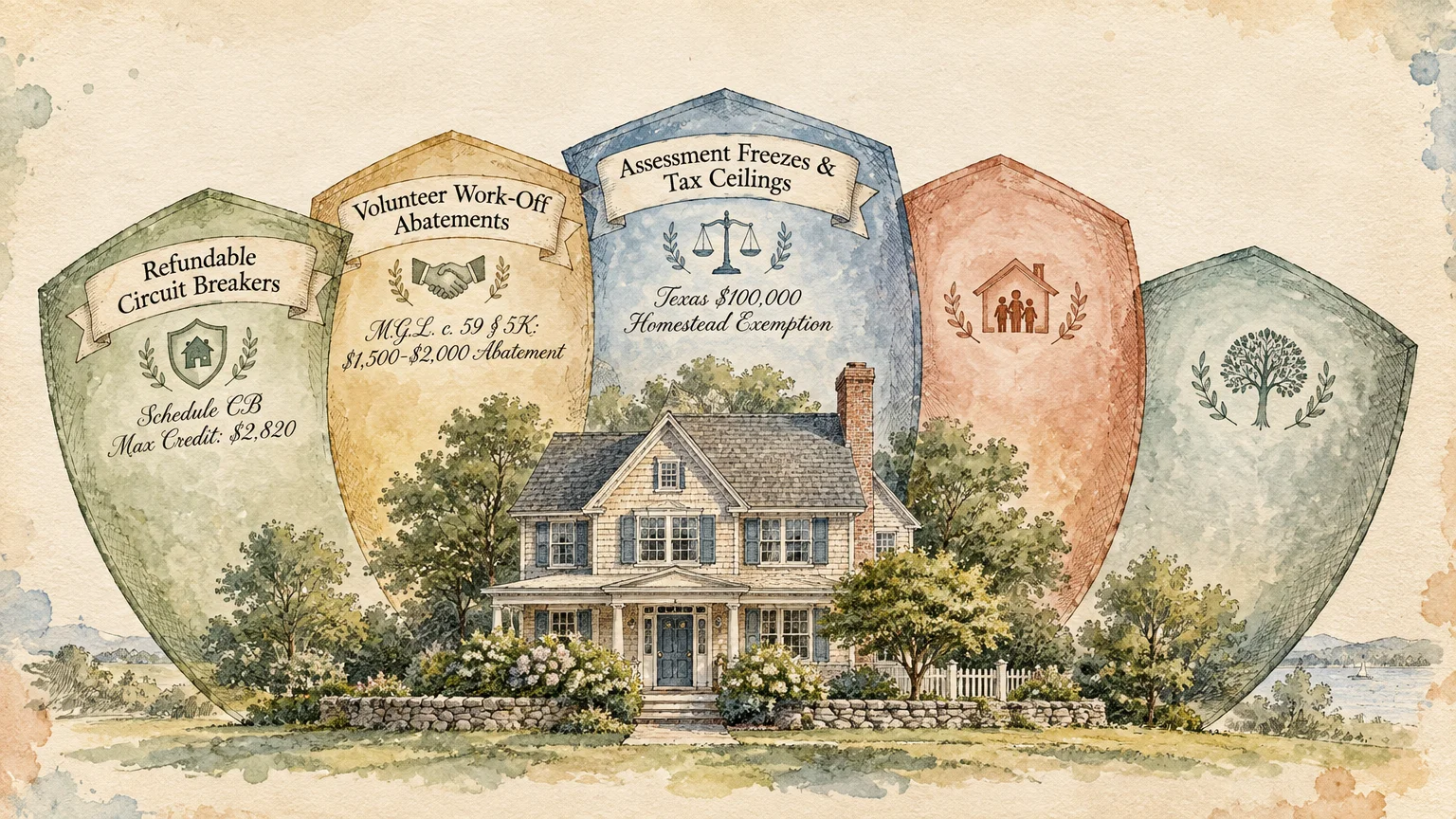
Massachusetts provides a leading model through its Schedule CB tax credit. Eligible homeowners and renters aged 65 and older can claim a refundable credit worth up to $2,820 this year.
You qualify if your real estate tax and half your water/sewer bills exceed 10% of total income. The state caps eligible home valuations at $1,298,000 for this relief.
Because Schedule CB is refundable, you receive a direct payment even if you owe no state taxes. Multiple other states offer comparable circuit breaker relief on state income returns.
2. Municipal Volunteer Work-Off Abatements
Municipalities frequently allow senior homeowners to trade volunteer service for direct reductions on their real estate taxes. These local initiatives help towns fill community roles while providing meaningful tax abatements.
Under Massachusetts General Laws Chapter 59 Section 5K, participating communities allow residents aged 60 and older to earn property tax reductions. Qualifying participants can earn abatements up to $1,500 to $2,000 annually.
Participants complete clerical or support projects in public libraries, municipal archives, senior centers, or local parks. The municipality calculates earned credits using local minimum wage rates and credits the sum directly against your bill.
Towns in Colorado, New Hampshire, and Pennsylvania operate comparable senior volunteer abatement programs. Contact your local tax assessor or town clerk to explore available volunteer tax credit positions.
3. County Assessment Freezes and School Ceilings
Assessment freezes protect seniors from market-driven valuation surges that produce sudden property tax hikes. These statutes lock in your home value or tax levy at a fixed baseline year.
Missouri enacted powerful protection under Senate Bill 190 and Senate Bill 756 for homeowners aged 62 and older. Multiple counties, including St. Louis and Jackson, now actively freeze county property taxes on primary residences.
Texas combines a $100,000 homestead exemption with a mandatory $10,000 senior exemption for school taxes. Texas law also imposes an absolute constitutional tax ceiling on school district taxes for homeowners aged 65 and older.
This constitutional ceiling locks the dollar amount of your school taxes for as long as you occupy the home. Even if your market valuation doubles over time, your school tax levy remains permanently frozen.
4. Expanded Medical and Auxiliary Deductions
Many senior tax relief programs enforce strict income caps that exclude households earning modest pension income. Emerging statutory updates in 2026 resolve this barrier by establishing generous allowable deductions before calculating eligibility.
Washington State expanded senior property tax relief under ESSB 6162, taking effect June 11, 2026. The statute establishes an automatic standard medical expense deduction of $7,500 per applicant when calculating Combined Disposable Income.
Married couples filing jointly claim a combined $15,000 standard medical deduction against their qualifying income. The law also permits an allowable deduction of up to $6,000 for rental income generated from auxiliary dwelling spaces.
These deductions allow thousands of middle-income seniors to qualify for complete or partial property tax exemptions. Documenting qualified medical and housing expenses helps bring your net income under strict statutory thresholds.
5. State-Backed Property Tax Deferral Programs
Senior property tax deferral programs allow cash-constrained retirees to postpone real estate tax payments indefinitely. The state treasury pays your county tax collector directly, preventing delinquent tax sales.
The California State Controller’s Office manages the Property Tax Postponement program for seniors aged 62 and older meeting equity and income standards. Oregon and Washington offer similar state-backed postponement options.
The state secures deferred payments by placing a lien against your residential property at modest statutory interest rates. The deferred balance becomes due only when you sell the property, refinance, or pass away.
Deferrals provide an essential financial lifeline for older homeowners experiencing temporary or chronic cash shortages. They allow you to stay in your home without the fear of municipal tax foreclosure.





We live in California county if Kern and we visited the Assessor’s office to inquire about senior exemption and was told that there is NO exemption for seniors at all. Please help.