
Rising healthcare premiums quietly erode a fixed retirement budget when prescription rules shift each January. In 2027, standard Medicare drug deductibles climb to $700, while zero-premium stand-alone plans disappear for enrollees without federal subsidies.
Securing Extra Help for prescription drugs shields your retirement cash flow from these increases. The Social Security Administration estimates this program saves eligible retirees an average of $5,700 per year.
Understanding the updated 2027 asset caps and income rules helps you protect both your medicine cabinet and your nest egg. Careful income planning ensures you do not accidentally disqualify yourself from thousands in annual relief.

The 2027 Prescription Landscape and Program Value
Standard Part D drug costs jump in 2027 as temporary federal premium stabilization expires after 2026. The base beneficiary premium hits $41.33, and the annual out-of-pocket cap rises to $2,400 across all plans.
Retirees without subsidies face a Part D deductible up to $700 in 2027, compared with $615 in 2026. Qualifying for the Medicare Part D Low-Income Subsidy eliminates that deductible completely, even in non-benchmark plans.
Your monthly premium drops to $0 in a regional benchmark stand-alone plan. Depending on your state, benchmark premiums run from $6.27 to $45.51, and you only pay the difference if you choose a pricier plan.
Standard full-subsidy enrollees pay no more than $5.80 for generics and $14.40 for brand-name medications at participating pharmacies. Copayments remain predictable throughout the entire calendar year.
Full-benefit dual eligibles at or below 100% of the Federal Poverty Level pay up to $1.65 for generics and $5.00 for brands. Institutionalized enrollees and those receiving home-based waiver services pay $0 for covered drugs.
Extra Help permanently waives Part D late enrollment penalties while you remain eligible. Once total drug spending—including federal subsidy payments—hits $2,400, covered prescriptions cost $0 for the rest of 2027.
Who Qualifies Automatically vs. Applying
You qualify automatically if you live in the 50 states or D.C., have Medicare, and receive Supplemental Security Income or full Medicaid. Medicare Savings Programs such as QMB, SLMB, or QI also grant automatic eligibility.
Newly eligible beneficiaries without a drug plan receive temporary LI NET coverage for up to two months at a $0 premium. Everyone else applies using the Social Security Administration Extra Help application, Form SSA-1020.
Filing Form SSA-1020 triggers an automatic referral to your state Medicare Savings Program unless you opt out on the form. You can also get free, unbiased enrollment guidance through your local State Health Insurance Assistance Program.
2027 Income and Resource Limits You Must Clear
Federal rules test both annual income and countable savings for prescription assistance. Because lawmakers eliminated partial subsidies in 2024, anyone clearing both caps receives full benefits.
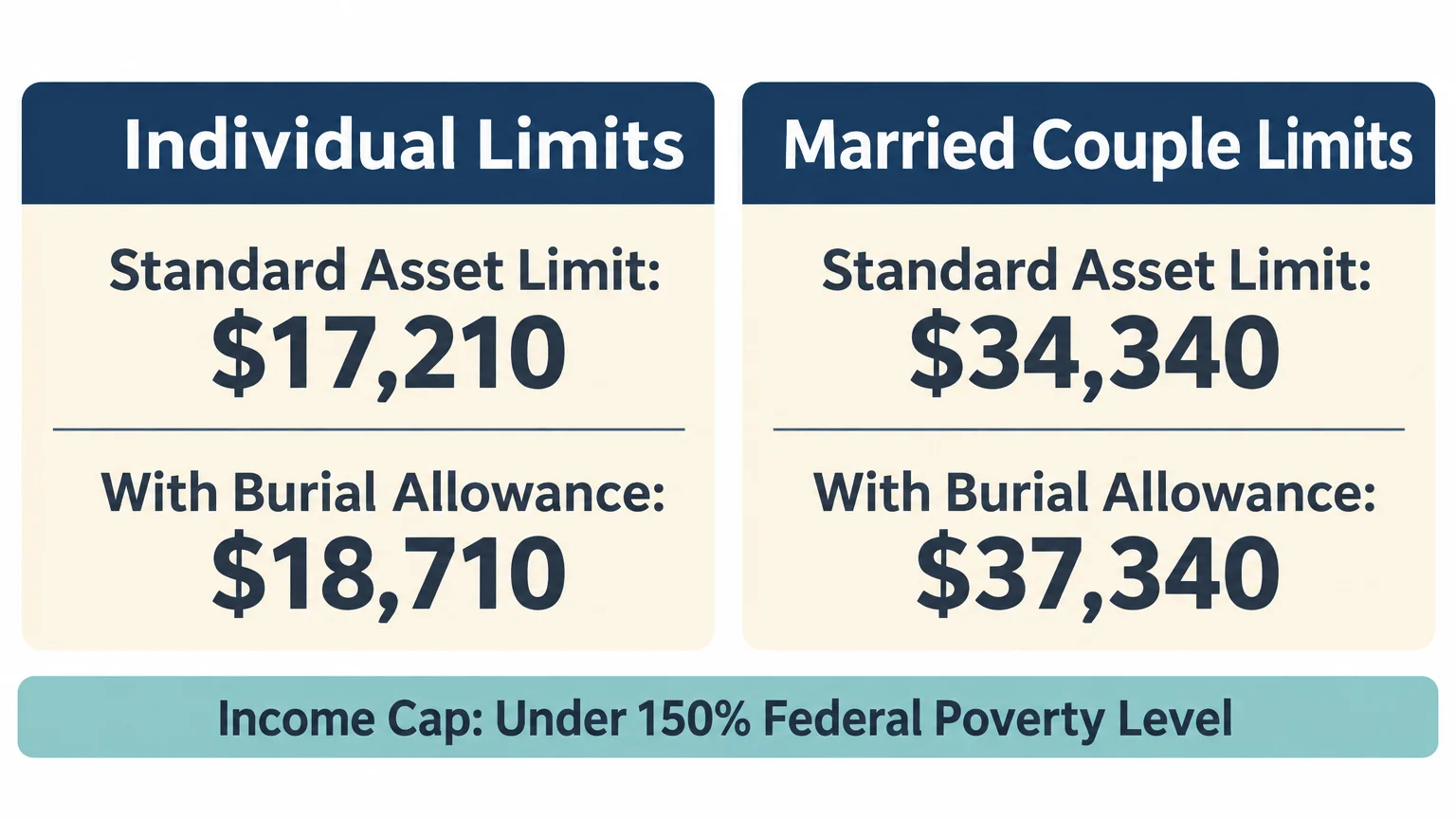
For 2027, the Centers for Medicare and Medicaid Services raised countable asset limits by 3.74% to reflect inflation. Individuals can hold up to $17,210 in countable resources, while married couples living together can hold $34,340.
Notifying Social Security of expected burial expenses adds $1,500 per person to your cap. That pushes the 2027 asset limit to $18,710 for an individual and $37,340 for a married couple.
Countable income must stay below 150% of the Federal Poverty Level for your state and family size. Federal 2027 poverty updates arrive in early 2027, so initial applicants use existing baseline figures.
In the 48 contiguous states and D.C., that baseline sits under $23,940 yearly for singles and $32,460 for married couples living together. Limits are higher in Alaska, Hawaii, and households supporting dependent relatives.
What Counts Toward Your Asset and Income Caps
Countable assets include checking and savings accounts, certificates of deposit, stocks, bonds, mutual funds, and cash. IRAs and retirement accounts also count because they convert to cash within 20 days.
Real estate beyond your primary home counts toward your asset cap as well. Social Security excludes your primary residence, vehicles, personal possessions, life insurance policies, and burial plots from the calculation.
Social Security disregards the first $20 monthly—or $240 yearly—of unearned income. The program also excludes interest and dividends from countable income, though principal balances still count as assets.
Aligning Income Streams Without Losing Eligibility
Because Extra Help uses a hard cliff instead of a gradual phase-out, exceeding either cap by one dollar costs you thousands. Coordinating your retirement paychecks requires reviewing every income stream together.
Review the Medicare prescription cost assistance guide before locking in pension or annuity elections. A licensed fiduciary planner can model your cash flow before benefit start dates become irreversible.
Social Security, Pensions, and Annuity Timing
Delaying Social Security increases your guaranteed monthly check, which can push borderline retirees past the 150% poverty threshold. For single retirees relying solely on Social Security, gross checks near $2,015 monthly approach the baseline cap.
Pensions create a similar trade-off between monthly income and lump-sum assets. Monthly pension payouts increase countable income, whereas rolling a lump sum into an IRA adds to your countable asset ledger.
Immediate annuities convert liquid cash into steady monthly checks, lowering countable resources while raising countable income. Modeling both numbers with a qualified advisor protects you from trading an asset problem for an income disqualification.
Managing Portfolio Withdrawals
Large IRA or brokerage withdrawals do not automatically vanish from your asset test. Unspent cash sitting in checking on your application date counts toward the $17,210 or $18,710 limit.
Paying down mortgage debt on your primary home or funding burial arrangements converts countable cash into exempt assets. Never gift assets away carelessly, because Medicaid applies separate look-back rules if you later need long-term care.

Tax and Healthcare Strategy: RMDs, IRMAA, and HSAs
Once you reach the age for Required Minimum Distributions, mandatory withdrawals from traditional IRAs and 401(k) plans flow into taxable income. Review the IRS required minimum distribution rules carefully, because larger distributions can disrupt subsidy eligibility.
Most retirees who qualify for Extra Help sit below the high-income thresholds for Medicare Income-Related Monthly Adjustment Amount surcharges. Still, a large one-time Roth conversion or property sale could trigger unexpected Medicare premium surcharges two years later.
Health Savings Accounts provide tax-free money for qualified medical expenses, including Part D copayments and Medicare premiums. However, HSA balances sit inside liquid accounts that can affect asset-tested programs, so coordinate withdrawals with a tax professional.
Once Extra Help approves your coverage for a given year, benefits remain active through December 31 even if finances shift mid-year. Use that calendar stability to time necessary taxable transactions carefully.

Protection, Legacy Planning, and Fraud Defense
Safeguarding your eligibility means watching your mailbox for official color-coded Medicare notices between September and November. A gray notice warns that you are losing automatic Extra Help, while a tan notice flags plans exceeding the 2027 benchmark.
If Social Security mails an eligibility review form in August, return it within 30 days so updates take effect smoothly on January 1. Extra Help enrollees can switch stand-alone drug plans once per calendar month using a Special Enrollment Period.
Guard your Medicare number and Social Security details against aggressive marketing calls during Medicare Open Enrollment from Oct. 15 through Dec. 7, 2026. Federal agencies will never demand gift cards or wire transfers to process prescription assistance.
Keep beneficiary designations current on all retirement accounts, life insurance policies, and bank accounts. Proper estate paperwork ensures a surviving spouse inherits exempt protections smoothly without probate delays disrupting household cash flow.
Frequently Asked Questions
How does part-time work affect Extra Help qualification?
Wages from part-time employment count toward your annual income cap, though Social Security applies earned-income exclusions that treat work pay more favorably than pension income. Report new jobs promptly and verify projections with an advisor or SHIP counselor.
Are there inflation hedges that protect Extra Help eligibility?
Because the program excludes interest and dividends from countable income, Treasury inflation-protected bonds or high-yield savings will not raise your monthly income calculation. However, their principal value still counts toward the $17,210 individual or $34,340 married resource limits.
When should I pay for professional financial advice?
If your assets sit within a few thousand dollars of the threshold, hiring a fee-only fiduciary for a one-time retirement review can protect $5,700 in annual drug savings. Verify any advisor’s credentials and fee structure through the SEC investor education portal.
What happens to Extra Help if a spouse passes away?
Losing a spouse shifts your household status from married to single, cutting your resource limit roughly in half. Because Extra Help stays active through December 31 once approved, the surviving spouse has until year-end to restructure accounts and update beneficiaries.

Your Next Steps for 2027
Gather your latest bank statements, IRA balances, and Social Security award letter today to check your standing against 2027 limits. Even if you fell slightly above prior caps, the 3.74% asset limit increase may open the door.
Schedule a check-in with a licensed retirement planner, tax advisor, or local SHIP counselor before Medicare Open Enrollment closes on December 7. Taking action now protects both your prescription access and your long-term retirement security.