
A series of 2027 Social Security and Medicare changes could quietly cost certain retirees nearly $1,000 or more. Higher payroll tax caps, automatic Medicare deductions, and strict income surcharges eat directly into your monthly raise.
Even with a 3.6% cost-of-living adjustment arriving in January, your net buying power depends on your earnings, tax bracket, and filing strategy. Knowing where these financial traps sit helps you protect your cash flow before 2027 begins.
You can avoid unnecessary clawbacks by adjusting your work income, tax deductions, and healthcare elections this fall. Here is how each 2027 rule works and what steps keep more money in your pocket.
The 2027 Social Security Shifts Behind the Nearly $1,000 Hit
Most headlines focus only on the annual cost-of-living boost, which hides how other statutory adjustments pull cash back out of senior households. Looking at your gross benefit increase without checking payroll limits, earnings caps, and healthcare deductions creates an expensive blind spot.
Why High-Earning Working Seniors Face a Nearly $1,000 Tax Jump
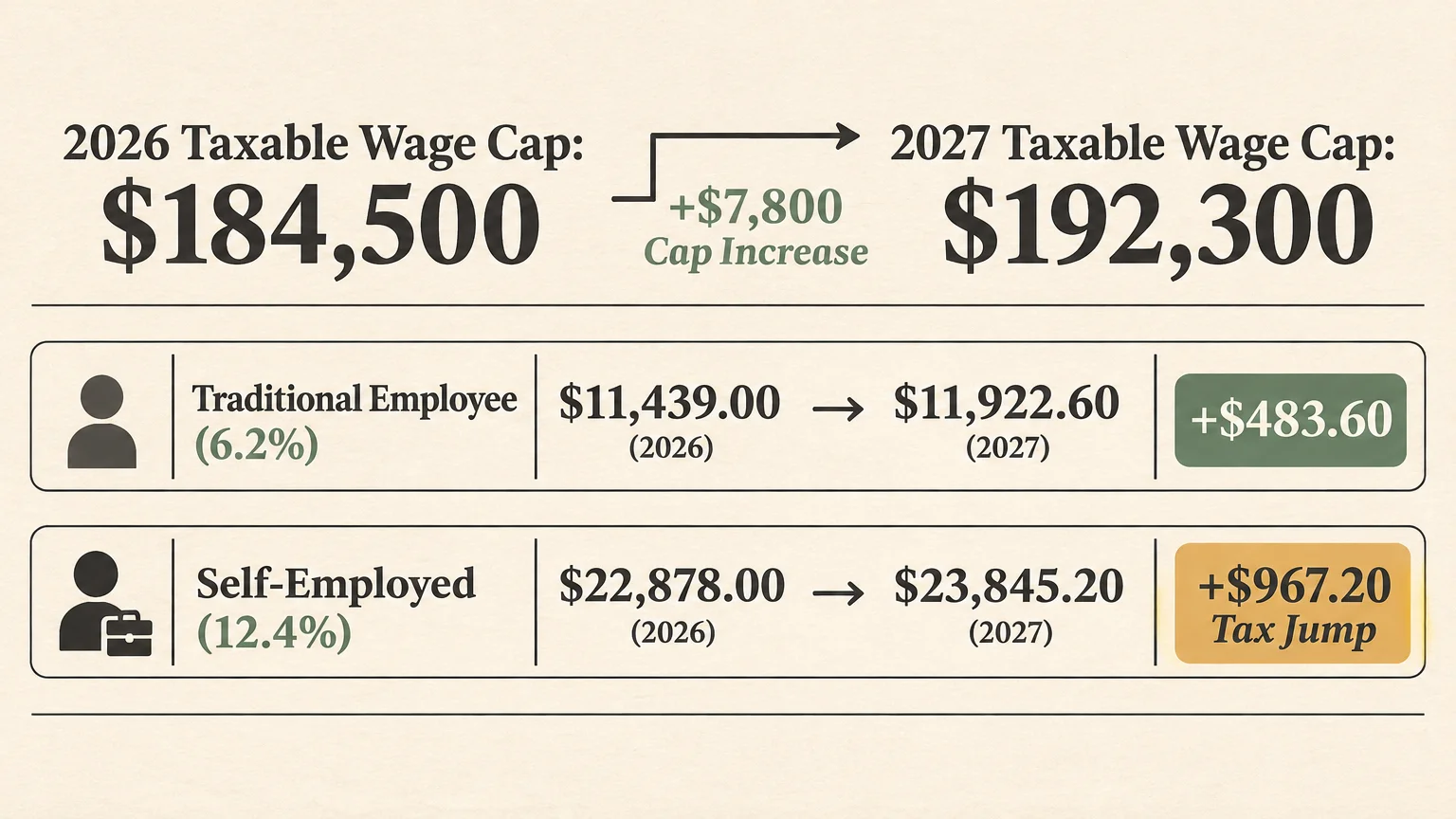
If you continue working in retirement—especially as a consultant, contractor, or business owner—your payroll tax bill rises sharply in 2027. On October 14, 2026, the Social Security Administration raised the 2027 taxable wage cap by $7,800, moving it from $184,500 to $192,300.
Traditional employees pay a 6.2% Social Security payroll tax on wages up to that ceiling. That adjustment raises your maximum employee tax from $11,439.00 in 2026 to $11,922.60 in 2027, costing high-earning workers an extra $483.60.
Self-employed retirees bear an even heavier burden because you pay both the employer and employee shares at 12.4%. Your maximum Social Security payroll tax jumps from $22,878.00 to $23,845.20, creating an added $967.20 bill—nearly $1,000 disappearing directly from your business cash flow.
You can soften this blow by reviewing your business deductions and retirement plan contributions with a certified public accountant before January. Shifting income into tax-advantaged workplace plans or structuring consulting hours carefully may preserve part of your net profit.
The 2027 Cost-of-Living Adjustment Versus Your Real Raise
On the income side, Social Security and Supplemental Security Income payments rise by 3.6% in 2027, up from the 2.8% boost in 2026. The adjustment reflects inflation measured between the third quarter of 2025 and the third quarter of 2026, impacting roughly 76 million Americans.
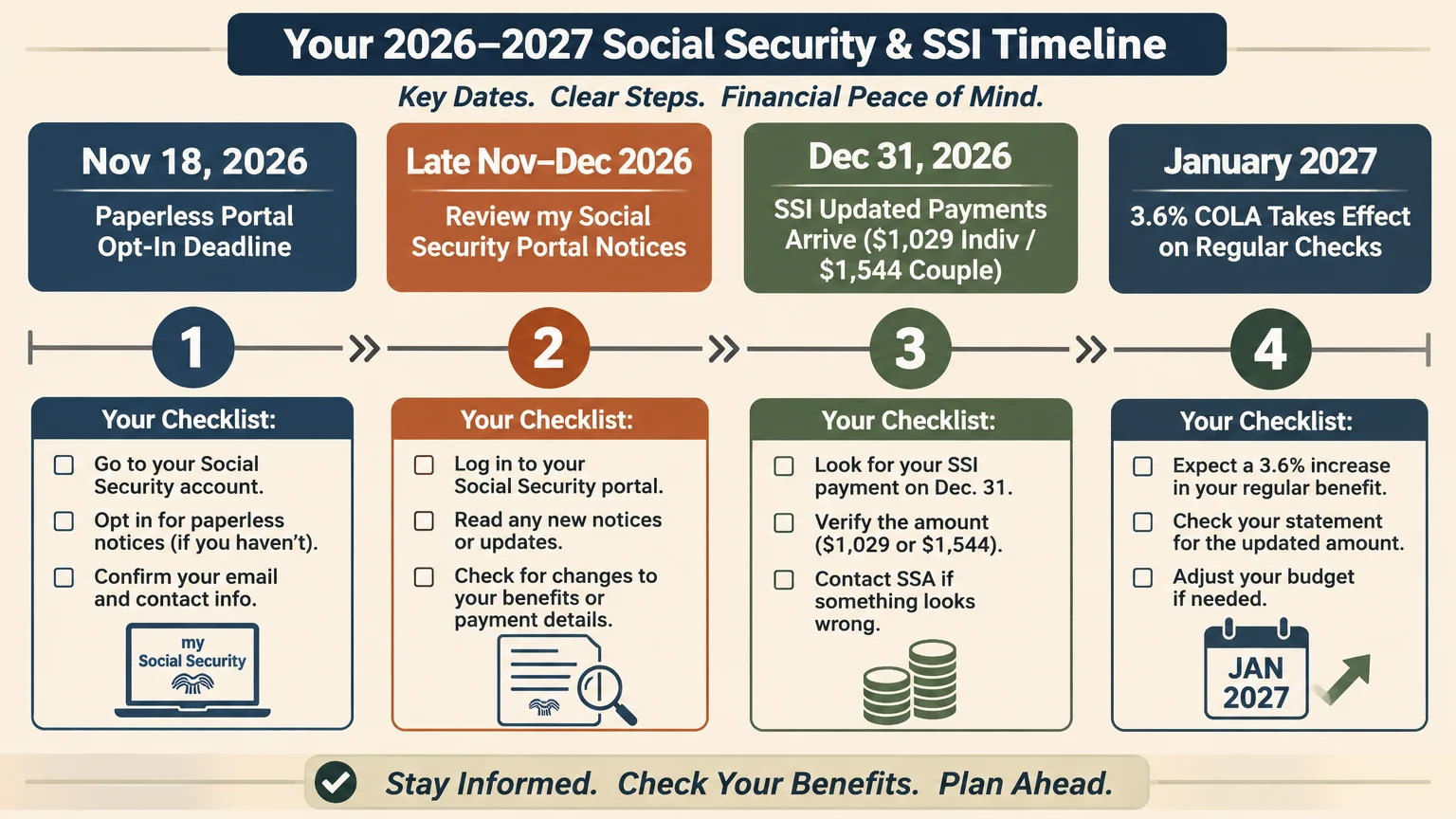
Higher checks arrive in January 2027 for nearly 72 million Social Security beneficiaries. Roughly 7.3 million SSI recipients see their updated deposits slightly earlier on December 31, 2026.
According to the Social Security Administration, the average retired-worker benefit climbs by about $75 per month, rising from $2,095 to $2,170 before deductions. Workers claiming at Full Retirement Age see the maximum benefit edge up from $4,152 to $4,188 per month.
Federal SSI maximums also cross a milestone in 2027, climbing from $994 to $1,029 per month for individuals and from $1,491 to $1,544 for couples. While that increase helps cover everyday groceries and utilities, rising medical deductions quickly shrink what actually lands in your bank account.
You can check your exact gross and net figures inside your my Social Security portal in late November or early December 2026 if you opted for paperless notices by November 18, 2026. Paper letters arrive by mail throughout December 2026.
The Retirement Earnings Test Trap Before Full Retirement Age
Working part-time while collecting early benefits introduces another hidden reduction if you have not yet reached Full Retirement Age. Anyone born in 1960 or later faces a Full Retirement Age of 67 under Social Security rules.
If you remain under Full Retirement Age for all of 2027, your annual earnings limit rises to $25,560, or $2,130 per month, up from $24,480 in 2026. Earn above that mark, and the agency withholds $1 in benefits for every $2 you earn over the cap.
Seniors reaching Full Retirement Age during 2027 get a higher threshold of $67,920, or $5,660 per month, compared with $65,160 in 2026. That higher limit applies only to months prior to your Full Retirement Age birthday month, with $1 withheld for every $3 earned above the threshold.
Once you reach Full Retirement Age, the earnings test vanishes completely, and any withheld benefits get recalculated upward in future monthly checks. Still, losing half of your excess earnings temporarily can disrupt a tight household budget if you do not plan ahead.
Overpayment Clawbacks and Long-Term Trust Fund Risks
Administrative errors can trigger an even steeper shock than routine tax increases or earnings withholdings. Under an April 25, 2025 emergency policy replacing earlier clawback swings, the Social Security Administration withholds 50% of monthly Title II retirement or survivor checks by default when recovering an overpayment.
SSI overpayment recoveries remain capped at 10%, yet a sudden 50% cut to a standard retirement check can derail rent and prescription budgets overnight. Always open agency mail immediately so you can file a timely waiver or request a lower repayment rate before withholding starts.
You also need to monitor long-term program solvency when building a multi-decade retirement income strategy. The 2026 OASDI Trustees Report released on June 9, 2026 projects that the Old-Age and Survivors Insurance Trust Fund will deplete its reserves in the fourth quarter of 2032—one quarter earlier than previously estimated.
Without congressional reform, incoming payroll taxes in late 2032 would cover only 78% of scheduled retirement benefits, creating an automatic 22% benefit cut. On a combined basis including disability insurance, reserves deplete in the third quarter of 2034, leaving enough revenue to pay 83% of scheduled payouts.

Aligning Your Social Security, Pension, and Portfolio Income
When Social Security faces deduction pressure today and potential cuts in the early 2030s, relying on a single paycheck leaves your lifestyle exposed. Coordinating your claiming age, pension elections, and investment withdrawals protects your spending power across shifting policy environments.
Timing Your Social Security Claim Without Leaving Money Behind
Deciding when to start benefits between age 62 and age 70 shapes your lifetime guaranteed income and your survivor protection. Claiming early permanently locks in a reduced monthly check and exposes your wages to the 2027 earnings test if you keep working.
Delaying your claim past Full Retirement Age earns delayed retirement credits that boost your baseline payment permanently and amplify every future cost-of-living adjustment. A higher baseline benefit also strengthens the survivor check left behind if you pass away before your spouse.
Before locking in a claiming date, test multiple age combinations with a fiduciary financial planner who can model your life expectancy, tax bracket, and marital age gap. Running personalized math prevents you from sacrificing tens of thousands of dollars in lifetime household income.
Evaluating Pension Payouts and Annuity Contracts
If you earned a traditional workplace pension, your payout election affects both your monthly security and your tax exposure. Choosing a single-life payout produces a larger monthly deposit, while a joint-and-survivor option preserves steady income for your spouse after your death.
Taking a lump-sum pension rollover gives you investment flexibility, yet it transfers market risk and longevity risk onto your shoulders. Fixed monthly pension checks stack directly on top of your taxable income, which can push your modified adjusted gross income over Medicare surcharge cliffs.
Retirees considering commercial annuities to replace lost pension income should inspect surrender charges, mortality fees, and inflation riders closely. Use SEC Investor.gov resources to review plain-language guidance on annuity structures and confirm that any salesperson holds proper registration before signing a contract.
Sequencing Portfolio Withdrawals to Bridge Income Gaps
Holding a dedicated cash and short-term Treasury reserve allows you to delay Social Security without feeling squeezed by monthly bills. Drawing from taxable brokerage accounts first can fund your early retirement years while keeping your future Social Security check growing.
Once Social Security begins, blending withdrawals from taxable accounts, traditional retirement accounts, and tax-free Roth balances lets you control your taxable income year by year. That flexibility helps you avoid selling equities during a market downturn just to cover basic living expenses.
Review your withdrawal sequence annually with a licensed tax professional or fiduciary advisor, because even a modest extra distribution from a traditional IRA can trigger higher taxes on your benefits. Proactive planning keeps your portfolio working smoothly alongside guaranteed government income.

Tax and Healthcare Strategies to Protect Your Net Check
For most retirees who are no longer paying payroll taxes, the biggest threat to their 2027 income comes from healthcare deductions and hidden tax cliffs. Managing your Modified Adjusted Gross Income gives you direct control over how much of your raise you actually keep.
How Medicare Part B Deductions Erode Your Raise
On November 17, 2026, the Centers for Medicare & Medicaid Services set the standard 2027 Medicare Part B premium at $209.40 per month, or $2,512.80 per year. That represents a $6.50 monthly increase—a 3.2% jump totaling $78 annually—over the $202.90 rate in 2026.
Because most enrollees have Part B deducted straight from Social Security, that hike cuts right into your 3.6% raise. An average retiree gaining $75 per month nets $68.50 after the $6.50 deduction, losing roughly 9% of the increase before spending a dime.
Smaller benefit checks absorb an even sharper percentage bite from fixed premium increases. If you collect $1,000 per month, your $36 raise shrinks to $29.50 net—meaning Medicare claims 18% of your adjustment.
Out-of-pocket medical cost-sharing also moves higher across Medicare in 2027. The Part B annual deductible climbs $9 to $292, while the Part A inpatient hospital deductible rises $40 to $1,776 per benefit period.
Longer hospital stays carry steeper daily charges as well, with coinsurance reaching $444 per day for days 61 through 90 and $888 per day for lifetime reserve days. Skilled nursing facility coinsurance for days 21 through 100 increases from $217 to $222 per day.
The roughly 1% of retirees lacking 40 work quarters face higher Part A premiums of $328 per month with 30 to 39 quarters, or $597 per month with fewer than 30 quarters. Meanwhile, Part D prescription drug enrollees face a $2,400 out-of-pocket cap, up from $2,100 in 2026.
Standard Part D maximum deductibles rise from $615 to $700, and the national base beneficiary premium increases from $38.99 to $41.33. Compare your current prescriptions and pharmacy networks on the Medicare Plan Finder before Open Enrollment closes on December 7, 2026.
Dodging the $1,189 IRMAA Cliff and Filing Appeals
High-income retirees face a far steeper Medicare deduction through the Income-Related Monthly Adjustment Amount, or IRMAA, which affects roughly 8% to 9% of Part B enrollees. Medicare sets your 2027 surcharges using a two-year lookback to your 2025 Modified Adjusted Gross Income, defined as adjusted gross income plus tax-exempt interest.
Crossing the very first IRMAA threshold—above $112,000 for single filers or $224,000 for married couples filing jointly—triggers a harsh cliff rather than a gradual phase-in. Being just one dollar over that mark adds $83.70 per month to your Part B bill, bringing it to $293.10 per month.
That same bracket adds $15.40 per month to your Part D prescription coverage, creating an extra $184.80 annual charge. Combined, crossing that single income line costs you $1,004.40 in Part B surcharges plus $184.80 in Part D penalties—a $1,189.20 annual hit.
Five total income tiers push those surcharges higher for affluent households. At the top tier—$500,000 or more for single filers, or $750,000 or more for joint filers—Part B adds $502.40 monthly for a $711.80 total premium, alongside $96.40 per month for Part D.
If your income dropped sharply after 2025 because you retired, reduced your hours, or experienced a major life change, you do not have to accept an inflated 2027 surcharge. File Form SSA-44 with the Social Security Administration to request a reduction based on qualifying events such as marriage, divorce, a spouse’s death, or disaster loss of income-producing property.
Navigating the New Senior Tax Deduction, RMDs, and HSAs
Many retirees mistakenly assume recent tax legislation eliminated federal income taxes on Social Security checks entirely. While the One Big Beautiful Bill Act enacted on July 4, 2025 delivered new tax relief, it left the longstanding combined income taxation rules intact.
Single filers with combined income above $25,000 and joint filers above $32,000 still see up to half of their benefits taxed, rising to 85% above $34,000 single or $44,000 joint. Instead of repealing those thresholds, the law created a temporary $6,000 deduction per taxpayer age 65 and older—$12,000 for eligible joint couples—for tax years 2025 through 2028 via Schedule 1-A.
That new senior deduction phases out at a 6% rate once your Modified Adjusted Gross Income exceeds $75,000 as a single filer or $150,000 on a joint return. The break disappears completely at $175,000 single or $250,000 joint, and married couples filing separately cannot claim it at all.
Review official updates on IRS tax guidance and coordinate your Required Minimum Distributions with a tax advisor before year-end. Keeping distributions below the phaseout thresholds preserves your Schedule 1-A deduction while preventing an accidental IRMAA jump two years later.
Charitably inclined retirees subject to Required Minimum Distributions can send Qualified Charitable Distributions straight from an IRA to eligible charities. That move satisfies your annual distribution mandate without adding a single dollar to your Adjusted Gross Income.
If you built a Health Savings Account during your working years, lean on those tax-free funds to pay 2027 Part B premiums, Part D premiums, and medical deductibles. Because qualified HSA withdrawals stay completely outside your Modified Adjusted Gross Income, they lower your out-of-pocket medical load without triggering extra taxes on Social Security.

Risk Management, Fraud Defense, and Legacy Planning
Protecting your retirement income requires more than smart tax projections and timely Medicare shopping. You also need defenses against catastrophic care costs, benefit scams, and outdated legal documents that can lock up family assets.
Long-Term Care Planning as Medicare Costs Climb
Medicare provides vital acute hospital and doctor coverage, yet it covers only short-term skilled nursing rehabilitation rather than ongoing custodial care. With the 2026 OASDI Trustees Report projecting that Medicare’s Part A Hospital Insurance Trust Fund will deplete in 2033—cutting provider payments by 11%—planning for independent care funding grows even more urgent.
Evaluate whether your portfolio can comfortably self-fund multi-year assistance or whether hybrid life and long-term care policies make sense for your family. Addressing long-term care early shields a healthy spouse from seeing shared savings drained by sudden facility bills.
Defending Your Benefits Against Fraud and Overpayment Scams
Criminals routinely launch waves of phishing texts, fake overpayment calls, and counterfeit enrollment flyers every fall during COLA announcements and Medicare Open Enrollment. Scammers impersonate government agents and demand immediate wire transfers, cryptocurrency, or gift cards to prevent a supposed benefit suspension.
Never share your Social Security number, bank routing numbers, or Medicare ID with unsolicited callers. Turn on multi-factor authentication inside your online government accounts, and verify any suspicious letter by calling official published numbers directly.
Estate Basics and Beneficiary Reviews
Even the sharpest tax and income plan breaks down if your account paperwork sends assets to the wrong person. Beneficiary designations on IRAs, workplace retirement plans, annuities, and life insurance contracts legally override instructions written inside your last will.
Review every primary and contingent beneficiary listing annually, particularly after a marriage, divorce, or family loss. Verify that your durable financial power of attorney and healthcare proxy remain current so someone you trust can step in seamlessly during an emergency.
Frequently Asked Questions About 2027 Retirement Rules
Retirees face overlapping rules whenever work income, inflation, advisor fees, and marital changes intersect. These direct answers clarify four common planning questions before 2027 arrives.
How does part-time work affect my 2027 Social Security check and taxes?
If you work below Full Retirement Age in 2027, earning above $25,560—or $67,920 in the months before reaching Full Retirement Age during 2027—triggers temporary benefit withholding. Extra wages also raise your combined income and payroll taxes, potentially making more of your Social Security taxable while pushing you closer to higher Medicare premiums.
What are the most effective inflation hedges when the 3.6% COLA falls short?
Because fixed Medicare deductions absorb part of your raise, you need income sources that grow alongside consumer prices over decades. Delaying Social Security to maximize your base benefit, maintaining diversified equity exposure, and holding Treasury Inflation-Protected Securities help preserve long-term purchasing power.
How should I evaluate financial advisor fees before hiring help?
Ask any prospective advisor for a written breakdown of all advisory fees, fund expense ratios, and potential commissions before sharing account details. Check an advisor’s licensing history, disciplinary record, and fiduciary registrations using FINRA BrokerCheck prior to signing an agreement.
What steps protect a surviving spouse from a sudden income drop and higher tax brackets?
When one spouse passes away, the household loses the smaller Social Security check while shifting from joint tax brackets and IRMAA thresholds to tighter single-filer limits. Maximizing the higher earner’s Social Security benefit, reviewing pension survivor elections, and executing partial Roth conversions while both spouses file jointly cushion that financial shock.
Your Pre-2027 Retirement Action Plan
Start by logging into your online Social Security account to inspect your 2027 COLA notice and verify that your reported earnings history contains zero errors. Compare your 2027 prescription drug options before the December 7, 2026 Medicare Open Enrollment deadline to avoid unnecessary pharmacy overcharges.
Pull your latest tax return to check whether your Modified Adjusted Gross Income sits dangerously close to the $75,000 or $150,000 senior deduction phaseouts or the $112,000 and $224,000 IRMAA cliffs. If you experienced a qualifying income drop after 2025, prepare Form SSA-44 promptly so Medicare uses your current earnings instead of outdated figures.
Schedule a year-end review with a licensed fiduciary planner and a tax professional to coordinate your 2027 withdrawals, business taxes, and 2032 solvency contingency plan. Taking deliberate action this season keeps nearly $1,000 or more working for your retirement rather than slipping away through avoidable deductions.