
When a spouse dies, Social Security does not simply trim your household income; it often claws back the final deposit. Under federal rules, a beneficiary must survive an entire calendar month to keep that month’s payment.
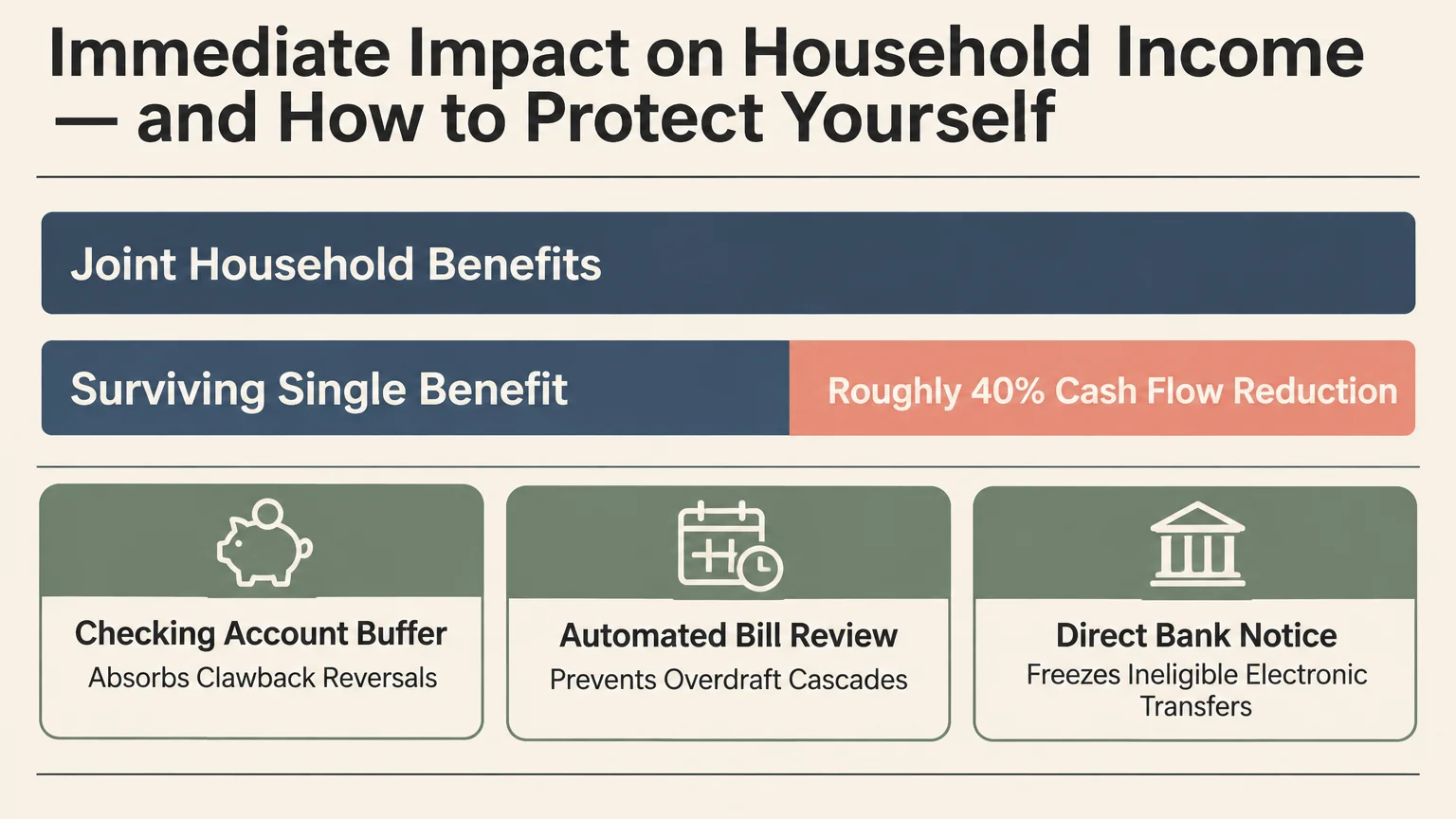
This timing trap surprises grieving families who have already paid funeral bills or automatic utilities from a joint checking account. Worse, losing one monthly benefit can slash household cash flow by roughly forty percent overnight.
Understanding these repayment rules, survivor benefit elections, and tax shifts protects your retirement lifestyle. You can guard your checking account against sudden reversals and claim every dollar your family earned.
The Rule Families Don’t Expect: Month-of-Death Clawbacks
Most families assume that if a retiree lives for three weeks of a given month, their estate keeps a full or prorated check. The Social Security Administration enforces an all-or-nothing rule instead.
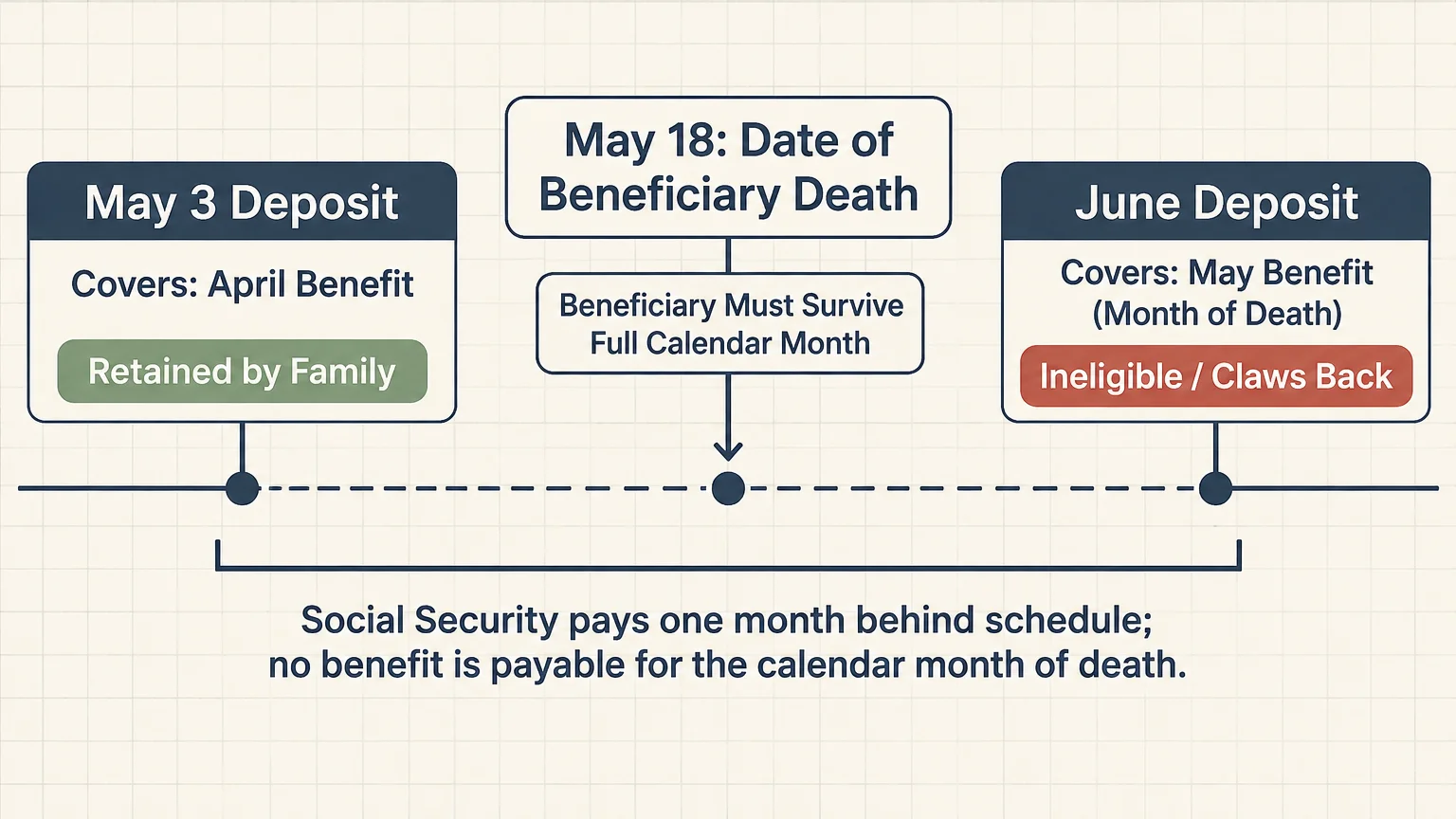
No retirement, survivor, auxiliary, or disability benefit is payable for the month in which a beneficiary dies. Even if your loved one passes away on the very last day of the month, that month’s benefit is forfeited.
Why Payments Arrive After Death
This rule causes confusion because Social Security pays benefits one month behind schedule. Deposits delivered on the third of the month—or on the second, third, or fourth Wednesday based on birth date—always cover the prior calendar month.
Consider a concrete example to see how the calendar works in practice. Suppose your spouse passes away on May 18 while receiving standard retirement benefits.
The deposit that arrived in May actually paid for April, so your family keeps that money. However, the payment scheduled to arrive in June covers May—and because your spouse did not survive all of May, June’s deposit must go back.
If death happens near the end of the month, the administrative notice often lags behind automated bank transfers. Your bank account may receive that ineligible payment in June before the agency freezes future deposits.
How to Return Ineligible Payments Without Panic
Never spend a deposit arriving in the month after death until you confirm which benefit period it covers. Keeping a dedicated cash buffer in your joint checking account prevents accidental overdrafts when a reversal occurs.
If your loved one still received paper checks, do not endorse or deposit any check covering the month of death or later. Return uncashed checks to the Social Security Administration as soon as possible.
When benefits arrive by direct deposit, contact your bank or credit union immediately to notify them of the death. Financial institutions handle electronic returns directly with the Treasury once you alert them.
One major program follows a different calendar standard that you should recognize. Supplemental Security Income payments are payable for the month of death, meaning families only return SSI deposits received for months after death.
Claiming Unpaid Benefits Owed Before Death
While the government reclaims payments for the month of death, it may still owe your family money from earlier months. Underpayments or Medicare premium refunds due prior to the month of death remain payable to eligible survivors.
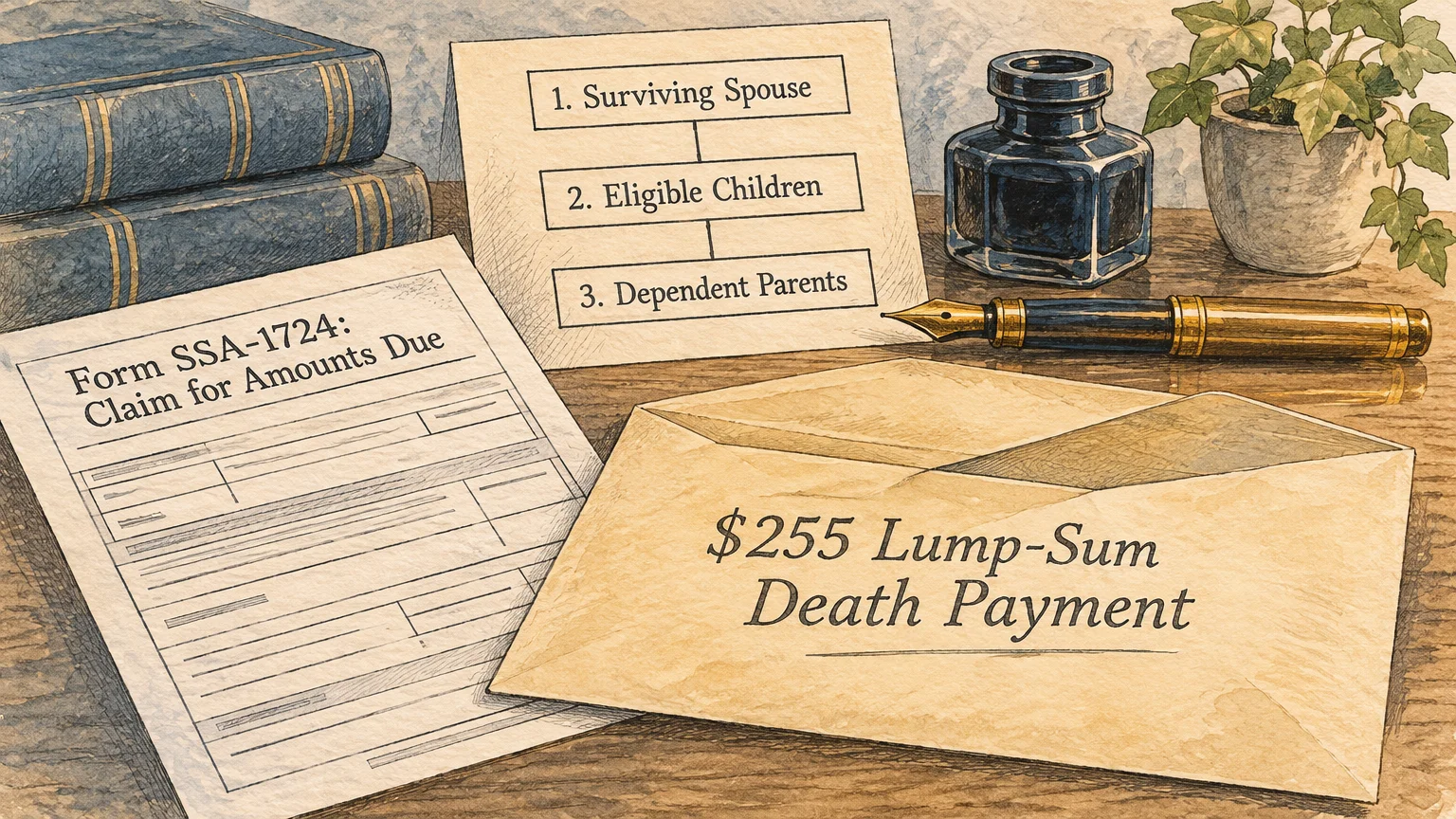
You can claim those unpaid amounts by filing Form SSA-1724 with the agency. Federal law distributes any approved underpayment in a strict statutory priority order.
A qualifying surviving spouse stands first in line, followed by eligible children and then dependent parents. If no qualifying family member exists, the estate’s legal representative receives the balance.
Immediate Reporting Steps and the $255 Death Payment
Reporting a death promptly stops improper deposits before they complicate your estate settlement. Acting within the first few days also starts the clock on converting spousal benefits smoothly.
Notifying the Agency and Checking Your Benefit Status
In most cases, your funeral director handles the initial notification if you provide the deceased’s Social Security number. Funeral homes submit reports through the Electronic Death Registration system or Form SSA-721.
If a funeral home is not involved—or cannot confirm the filing—you must call the Social Security Administration directly at 1-800-772-1213. Representatives answer Monday through Friday from 8 a.m. to 7 p.m. local time.
Hearing-impaired callers can reach TTY support at 1-800-325-0778, while family members outside the United States can dial +1-855-522-6936. Keep the deceased’s full name, Social Security number, birth date, and date of death nearby when calling.
Do not look for an online application button if you need to apply for monthly survivor income. Survivors cannot file for monthly survivor benefits online and must call to schedule a phone or local office appointment.
Your existing benefit setup determines what happens next. If you already receive spousal or child benefits on the deceased worker’s record, the agency automatically converts your check to a survivor benefit once notified.
If you collect retirement benefits on your own work history, nothing switches automatically. You must contact a representative to calculate whether moving to a survivor benefit increases your monthly check.
Understanding the $255 Lump-Sum Death Payment
Many families expect a substantial burial stipend from Social Security after decades of payroll taxes. In reality, the one-time Lump-Sum Death Payment has been capped at $255 for deaths occurring after August 1981.
Strict eligibility rules govern who receives this modest check under Section 202(i) of the Social Security Act. It goes first to a surviving spouse who lived in the same household at the time of death.
A spouse living apart qualifies only if they were eligible for benefits on the deceased’s record during the month of death. Without an eligible spouse, the payment splits equally among qualifying children entitled on that record.
You generally must file Form SSA-8 within two years of the date of death to claim the $255 payment. Surviving spouses already drawing benefits on the deceased’s record the prior month—or anyone establishing good cause—may bypass that window.
Income Alignment: Navigating Survivor Benefits and Portfolio Gaps
Replacing the sudden loss of one check requires coordinating Social Security rules with your pensions, annuities, and investment accounts. You can review the official survivor benefits guide before locking in any irrevocable claiming choices.
The Single-Check Rule and the Household Income Drop
When both spouses collect Social Security, the surviving partner does not keep both monthly deposits. You receive only the higher of your own benefit or the deceased spouse’s benefit.
Average benefit figures illustrate just how steep this household income drop can feel. In 2026, an aged couple both receiving benefits averages $3,238 per month, rising to $3,355 in 2027 after the 3.6% cost-of-living adjustment.
By comparison, an aged widow or widower living alone averages $1,936 per month in 2026 and $2,005 in 2027. That drop removes more than $1,300 from monthly cash flow while property taxes, insurance, and utilities barely budge.
This gap explains why higher-earning spouses often delay claiming their own retirement benefits until age 70. Maximizing the larger earner’s check builds a bigger permanent survivor benefit for whichever partner lives longer.
Timing Rules, Percentages, and Family Eligibility
To unlock survivor coverage, no worker needs more than 10 years of covered employment credits—and younger workers need even fewer. Under a special rule, children and a caregiving spouse qualify if the deceased worked 1.5 years during the three years before death.
A surviving spouse generally qualifies at age 60 or older if the marriage lasted at least nine months. Disabled widows and widowers can claim as early as age 50 through 59.
You can also claim at any age if you care for the deceased’s child who is under age 16 or became disabled before age 22. Unmarried eligible children generally receive 75% of the deceased parent’s benefit up to age 18, or 19 if still in high school full time.
Adult children disabled before age 22 remain eligible indefinitely, and dependent parents age 62 or older who relied on the deceased for at least half their support may also qualify. A widowed mother caring for two children averages $3,932 monthly in 2026 and $4,074 in 2027.
Claiming early reduces your monthly survivor percentage permanently unless you plan a strategic switch later. Starting at age 60 pays 71.5% of your late spouse’s benefit, rising above 75% at 61, over 80% at 63, and over 90% at 65.
Waiting until your survivor Full Retirement Age delivers 100% of your deceased spouse’s benefit. Survivor Full Retirement Age sits between 66 and 67, climbing gradually for survivors born between 1957 and 1962.
Unlike standard retirement claims, you can still separate your two benefit clocks after a spouse passes away. For example, you might take a reduced survivor benefit at age 60 while letting your own retirement benefit grow until age 70.
If your own benefit grows larger than the survivor check by age 70, you simply switch to your higher record. Conversely, a higher-earning widow could take her own reduced benefit at 62 and switch to 100% of her late husband’s benefit at her survivor Full Retirement Age.
Divorced surviving spouses qualify under identical age thresholds if their prior marriage lasted at least 10 years. An ex-spouse’s claim does not reduce benefits paid to a current spouse or family maximum limits.
Remarriage rules also contain a clear age cutoff that catches some retirees off guard. Remarrying before age 60—or before age 50 if disabled—ends survivor eligibility unless that later marriage ends, while remarrying at 60 or older leaves your survivor benefits untouched.
Public Pension Repeal, Annuities, and Portfolio Withdrawals
Millions of public-sector retirees recently gained back lost survivor income thanks to federal legislation. On January 5, 2025, the Social Security Fairness Act repealed the Government Pension Offset for benefits payable in January 2024 and later.
Previously, the Government Pension Offset reduced or completely erased Social Security survivor checks for teachers, police officers, firefighters, and certain federal workers with non-covered pensions. By July 2025, the agency had already processed over 3.1 million adjustments totaling $17 billion.
If you hold a public pension, verify that your survivor projection reflects this repeal before tightening your budget. Pair that update with a careful review of any private pensions and annuity contracts you own.
Private defined-benefit pensions require choosing between single-life payouts and joint-and-survivor elections before retirement starts. Choosing a higher single-life check leaves your spouse with zero pension income after your death unless life insurance or savings backstop the loss.
Similarly, single-premium immediate annuities stop paying at death unless you selected a joint-life or period-certain guarantee. Review your contract schedules now so your survivor knows exactly which streams continue.
When one Social Security check disappears, most households lean harder on investment portfolios to cover living expenses. Consider an illustrative math example using the 2026 average couple drop of $1,302 per month, or roughly $15,624 per year.
Suppose a couple holds a $500,000 investment portfolio and withdraws 4%, or $20,000 annually, to supplement two Social Security checks. If the survivor keeps the portfolio at $500,000 and withdraws an extra $15,624 to replace the lost check, annual draws jump to $35,624.
That single change pushes the portfolio withdrawal rate above 7.1%, dramatically increasing the risk of running out of money during a market downturn. Consult a licensed fiduciary planner to stress-test your withdrawal rate, adjust spending, or reposition assets before making big portfolio shifts.
Tax and Healthcare Strategy for Surviving Spouses
Losing a spouse creates a double financial squeeze that goes well beyond your gross monthly deposits. Within a year or two of death, your tax filing status shifts, pushing the same investment income into steeper tax and Medicare brackets.
Avoiding the Single-Filer Tax Squeeze on RMDs
For the calendar year of death, a surviving spouse can generally still file a joint tax return. If you support a qualifying dependent child, you may access qualifying surviving spouse rates for two additional years.
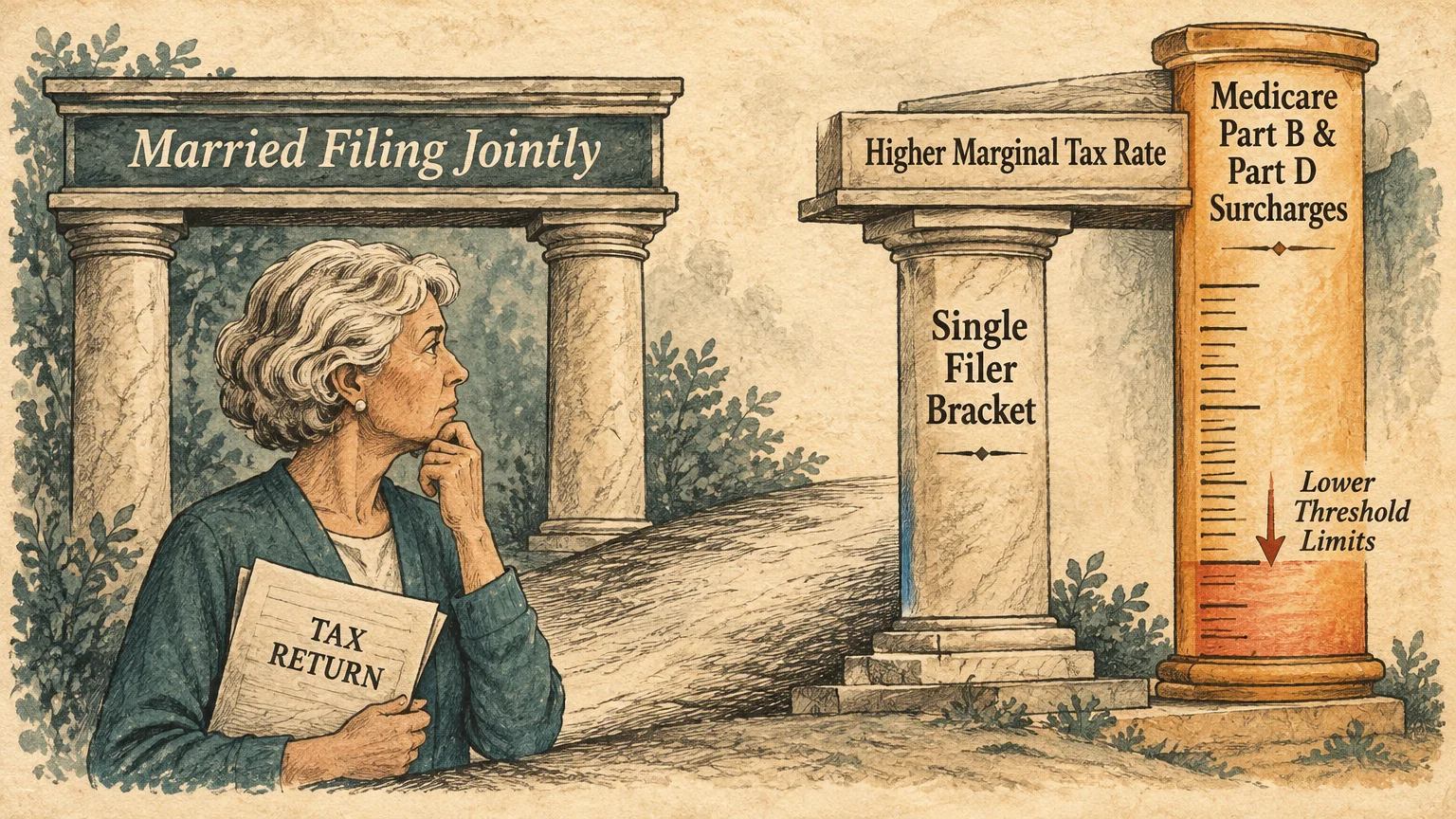
Once you transition to single-filer tax brackets, income thresholds shrink roughly in half while deductions drop sharply. Even though your household lost one Social Security check, your remaining pension and retirement account distributions face higher marginal tax rates.
Lower provisional income thresholds for single filers can also make up to 85% of your remaining Social Security benefit taxable. Meanwhile, Required Minimum Distributions from a deceased spouse’s traditional IRA often roll into your own IRA, compounding taxable withdrawals as you age.
You can inspect federal required minimum distribution guidelines to see how spousal rollover rules affect your distribution timeline. Planning ahead during the final joint filing year often saves thousands in lifetime taxes.
For instance, executing partial Roth IRA conversions while you still enjoy wider married-filing-jointly brackets moves future growth into tax-free territory. Balancing withdrawals across taxable brokerage accounts, traditional IRAs, and Roth balances helps keep your adjusted gross income predictable.
Because tax rules vary based on age, account balances, and state laws, work with a certified public accountant before executing large conversions. A few hours of tax modeling during the year of death prevents irreversible bracket spikes later.
Managing Medicare IRMAA and Health Savings Accounts
That same shift to single tax brackets frequently triggers unexpected Medicare Part B and Part D surcharges. Known as the Income-Related Monthly Adjustment Amount, these surcharges look back at your modified adjusted gross income from two years prior.
Because the look-back relies on an older joint return—or applies single brackets to your current distributions—you can get hit with higher premiums right when your cash flow drops. Fortunately, the death of a spouse qualifies as an official life-changing event.
You can appeal the surcharge by submitting Form SSA-44 along with a death certificate and updated income estimates. Review the life-changing event appeal instructions promptly so Medicare lowers your monthly deductions right away.
Health Savings Accounts also carry unique spousal survival rules worth confirming now. If you name your spouse as the beneficiary of your Health Savings Account, the account becomes theirs upon death with all tax-free medical withdrawal privileges intact.
Naming a child or estate instead forces the full account balance to become taxable income in the year of death. Check every medical savings account beneficiary designation annually to keep those tax advantages inside the household.

Protection, Fraud Prevention, and Legacy Readiness
Grieving families face heightened administrative and security risks right after a loss. Taking practical protective steps shields both your surviving spouse’s privacy and your estate’s liquidity.
Stopping Post-Death Fraud and Scams
Identity thieves routinely scan public obituaries and death notices to target grieving spouses within days of a funeral. Fraudsters often call pretending to be federal agents demanding immediate repayment for the month-of-death Social Security check.
Scammers demand wire transfers, cryptocurrency, or prepaid gift cards while threatening arrest or frozen bank accounts. Never comply with urgent phone demands for money, regardless of how accurate the caller’s personal details sound.
Legitimate Social Security overpayments are never settled via gift cards, wire transfers, or peer-to-peer payment apps. Official recoveries happen strictly through your financial institution or formal written correspondence offering clear appeal rights.
Beyond screening phone calls, send copies of the death certificate to all three major credit bureaus to place a deceased alert on your spouse’s credit file. Cancel unused credit cards and remove your late partner’s name from joint utility profiles only after consulting your banker about account continuity.
Keep joint bank accounts open temporarily for several months after death. Closing an account too early can bounce legitimate tax refunds, insurance payouts, or Form SSA-1724 underpayment reimbursements payable to your spouse.
Updating Beneficiaries, Estates, and Long-Term Care Buffers
After your spouse passes, your own estate documents and account beneficiaries immediately need fresh eyes. If your late spouse served as your primary beneficiary, power of attorney, and healthcare proxy, those backups are now empty.
Remember that beneficiary forms on 401(k) plans, IRAs, life insurance policies, and annuity contracts override whatever your will states. Update both primary and contingent designations across every retirement and brokerage platform.
Adding payable-on-death or transfer-on-death designations to bank and non-retirement investment accounts helps your heirs bypass lengthy probate delays. Keeping a master binder of account logins, pension contacts, and policy numbers saves your children months of guesswork.
Do not overlook long-term care risk once one spouse is gone. A single retiree often needs paid home care or assisted living sooner than a couple who could assist each other with daily routines.
Keep an accessible emergency cash reserve to cover at least six months of essential expenses alongside any potential month-of-death clawbacks. Reviewing long-term care insurance or setting aside dedicated liquidity protects your remaining assets without forcing premature home sales.
Frequently Asked Questions About Social Security After Death
Real-world survivor decisions rarely fit neat templates. These four answers address the most common planning questions retirees raise when preparing their households.
Can I Work Part-Time While Collecting Survivor Benefits?
Yes, you can work while receiving survivor benefits, though earnings above annual limits temporarily reduce payments if you have not reached Full Retirement Age. In 2026, the agency withholds $1 for every $2 you earn above $24,480 per year, or $2,040 monthly.
That threshold increases to $25,560 per year, or $2,130 monthly, in 2027. During the calendar year you reach Full Retirement Age, a much higher limit applies before your birthday month.
In 2026, only $1 is withheld for every $3 earned above $65,160, or $5,430 monthly, rising to $67,920—or $5,660 monthly—in 2027. Once you reach the month of Full Retirement Age, earnings limits vanish completely, and withheld benefits are gradually credited back.
How Can I Hedge Against Inflation After Losing a Check?
Social Security survivor benefits carry built-in inflation protection through annual adjustments, including the 3.6% increase taking effect for January 2027 payments. Delaying your own retirement benefit to age 70—if it exceeds your survivor check—compounds future cost-of-living raises on a bigger base.
Outside Social Security, holding a diversified mix of equities alongside Treasury Inflation-Protected Securities helps your portfolio keep pace with rising healthcare and housing bills. Avoid locking every spare dollar into fixed nominal annuities or low-yield certificates of deposit that lose purchasing power over twenty years.
Should I Pay an Advisor to Model My Survivor Claiming Strategy?
Coordinating survivor switching strategies, pension elections, and single-filer Roth conversions involves interlocking tax and benefit rules. Paying a flat-fee or hourly fiduciary planner for a targeted retirement income review often costs far less than a single claiming mistake.
Look for advisors legally bound to act in your best interest rather than earning commissions by selling proprietary insurance products. You can verify advisor credentials and fee structures through this federal investment adviser guide before signing any agreement.
What Is the Single Most Important Step for Surviving Spouse Planning?
Before filing for anything, compare your own work-record projection against your survivor benefit across ages 60 through 70. Locking in the wrong check prematurely—or leaving a higher benefit untapped—can cost tens of thousands of dollars over a long retirement.
At the same time, keep enough liquid cash in your checking account to absorb the month-of-death reversal without stress. Planning those two details together turns a vulnerable transition into a stable financial reset.
Protecting Your Household Cash Flow Before a Crisis
You do not need to wait for a medical emergency to organize your household’s Social Security paperwork. Log into your online Social Security account this week to download current benefit statements for both spouses.
Write down each partner’s estimated survivor payout, pension election, and primary bank contact on a single summary sheet. Confirm that your checking account holds an adequate buffer to absorb a final-month clawback if a deposit arrives after death.
Finally, schedule an annual check-in with a trusted fiduciary financial planner and tax professional to review your beneficiary forms and withdrawal assumptions. Preparing those steps while both partners are healthy gives your family clarity, security, and financial breathing room when it matters most.