
A major federal tax change is reshaping retirement cash flow for older Americans. You can now claim up to $6,000 per qualifying person—or $12,000 for eligible married couples—under the new senior tax deduction 2026 rules.
This deduction stacks right on top of your regular standard deduction and existing age-based tax breaks. However, strict income phase-outs mean poorly timed IRA withdrawals or capital gains could quietly erase your savings.
Coordinating your Social Security, pensions, and portfolio distributions now helps you keep more of every retirement dollar. Understanding these rules before year-end puts you firmly in control.
How the $6,000 Senior Tax Deduction Works in 2026
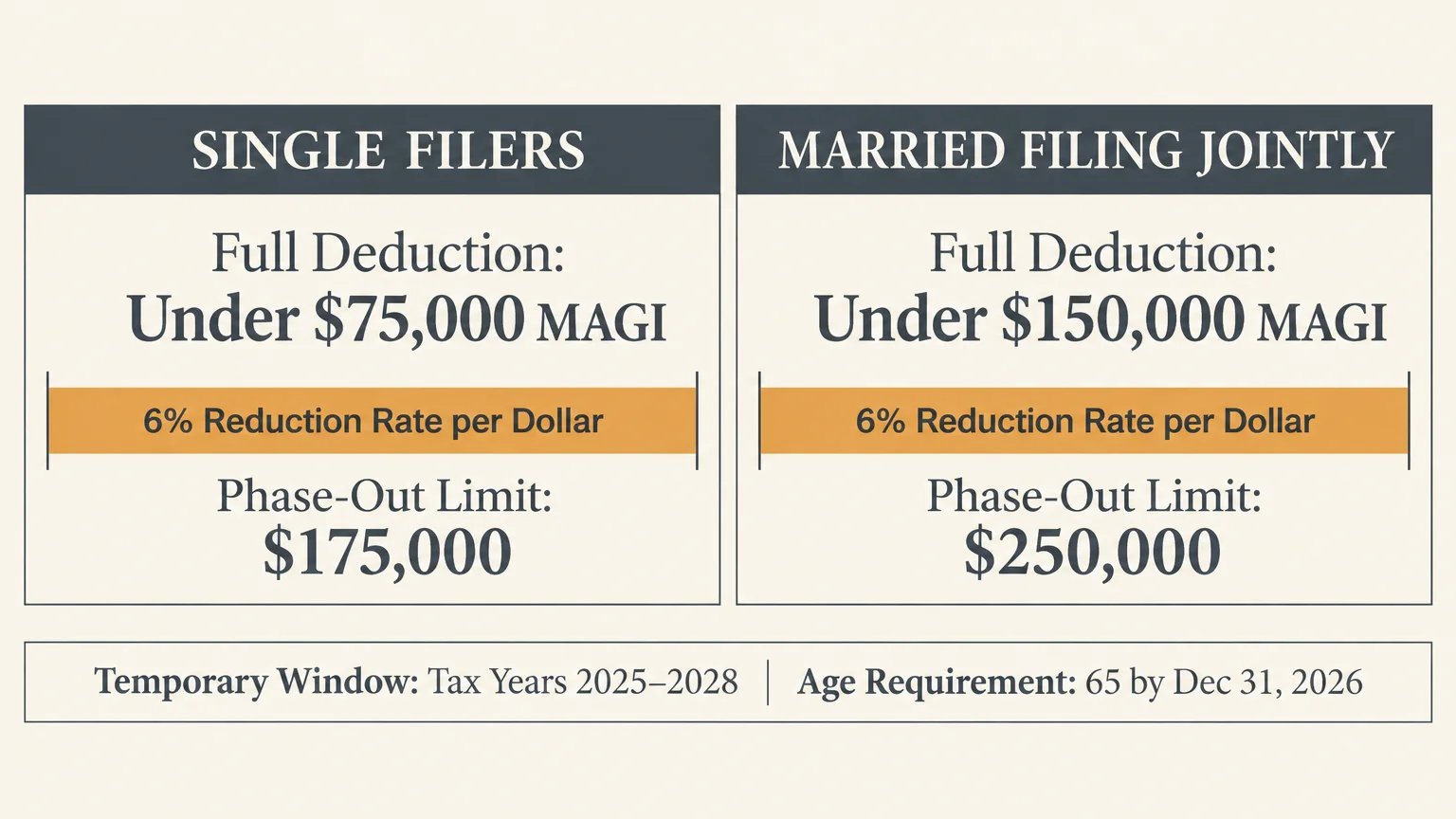
Congress created this enhanced deduction under the One Big Beautiful Bill Act, which the IRS administers as part of the Working Families Tax Cuts. It provides temporary relief strictly for tax years 2025 through 2028.
Unless lawmakers vote to extend the provision, the benefit expires for tax years beginning on or after January 1, 2029. That four-year window makes proactive income planning especially valuable right now.
To qualify for the 2026 tax year, you must reach age 65 on or before December 31, 2026. Under IRS rules, you legally turn 65 on the day before your actual birthday.
Each qualifying taxpayer must include a valid Social Security number on the return. If you are married, you must file a joint return to claim this break; married couples filing separately are ineligible.
Stacking With Your 2026 Standard Deduction
Unlike many deductions, the 6000 senior deduction works whether you claim the standard deduction or itemize expenses. It also layers directly onto the traditional additional standard deduction for seniors.
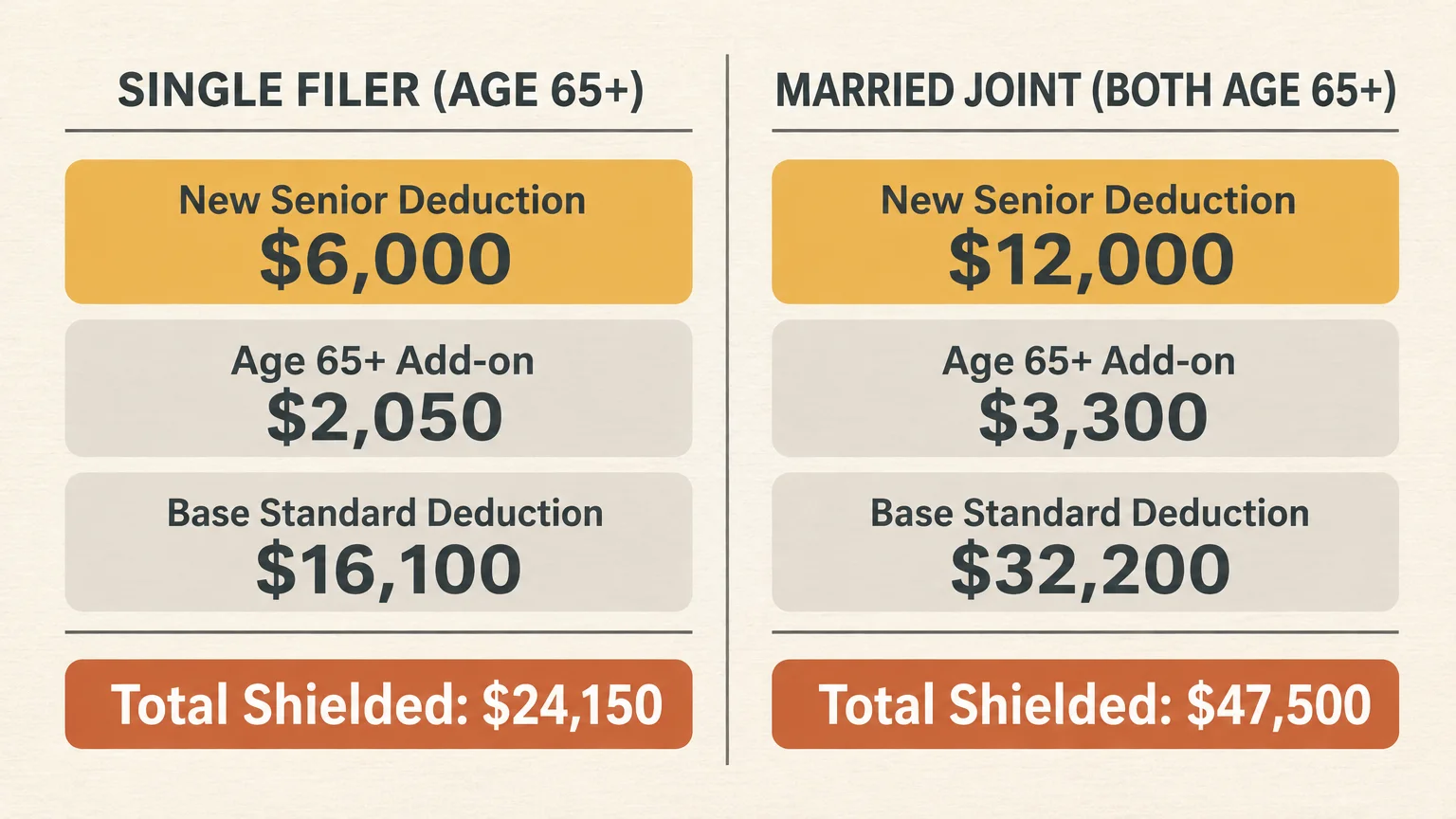
For 2026, the IRS raised the base standard deduction to $16,100 for single filers and $32,200 for married couples filing jointly. Heads of household receive a $24,150 base standard deduction.
On top of that base, taxpayers age 65 or older receive an existing additional standard deduction of $2,050 for single or head-of-household returns. Qualifying married joint filers receive $1,650 per spouse age 65 or older.
Those existing add-ons double if you are both age 65 or older and legally blind. That brings the additional amount to $4,100 for single filers or $3,300 per qualifying spouse on joint returns.
Consider a single retiree age 66 with $60,000 in modified adjusted gross income. Combining the $16,100 base, the $2,050 age add-on, and the $6,000 senior deduction shields $24,150 from federal income tax.
Now picture a married couple, both age 67, with $130,000 in modified adjusted gross income. Together, they stack $32,200, plus $3,300 in existing senior add-ons, plus $12,000 from the new break—totaling $47,500 in deductions.
Higher deductions also affect whether you even owe a return. For 2026, the gross-income filing threshold generally equals your combined regular and age-65 standard deductions, starting at $18,150 for single seniors.
Phase-Out Thresholds and Filing Forms
Your ability to claim the full deduction depends on your modified adjusted gross income, known as MAGI. Once your MAGI crosses specific thresholds, the IRS begins trimming your benefit.
Single and head-of-household filers face a phase-out starting at $75,000 MAGI. Married couples filing jointly face the phase-out once combined MAGI exceeds $150,000.
Above those limits, your deduction drops by 6%—or six cents for every extra dollar of MAGI. The benefit disappears completely once MAGI reaches $175,000 for single filers or $250,000 for joint filers when both spouses qualify.
Suppose you are single, age 68, and report $100,000 in MAGI. Your income sits $25,000 above the $75,000 threshold, which reduces your deduction by $1,500 and leaves you with $4,500.
When preparing your 2026 tax return seniors must attach Schedule 1-A, Part V, to Form 1040. That figure then flows directly onto line 13b of Form 1040 or Form 1040-SR.
Every household tax profile carries unique adjustments, state rules, and carryover items. Always confirm these calculations with a licensed CPA or enrolled agent before locking in major financial moves.
Aligning Social Security, Pensions, and Portfolio Withdrawals
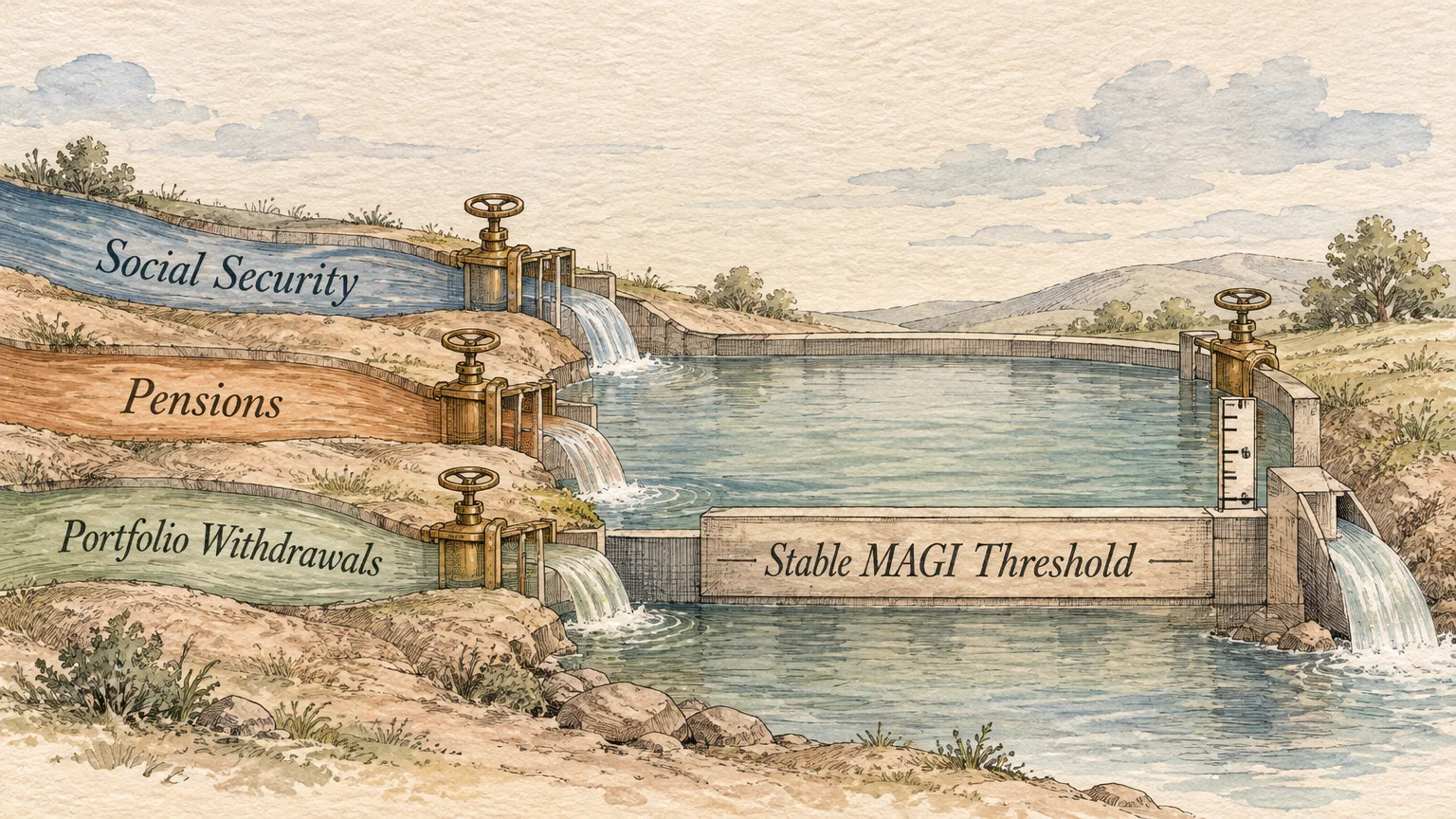
Managing taxes over 65 requires looking at all your income streams together rather than in isolation. Because your deductions and benefit taxes share the same income base, pulling from the wrong account triggers cascading costs.
Why Social Security Benefit Taxes Still Apply
Despite informal rumors calling this policy tax-free Social Security, your benefit taxation rules have not changed. The new deduction reduces your overall taxable income, yet it does not exempt Social Security benefits from federal calculations.
The IRS still uses provisional income—your adjusted gross income, tax-exempt interest, and half of your Social Security benefits—to determine how much of your check is taxable. Those statutory thresholds remain frozen without inflation indexing.
For single filers, up to 50% of benefits become taxable once provisional income exceeds $25,000, jumping to 85% above $34,000. For joint filers, those limits sit at $32,000 and $44,000.
Reviewing federal Social Security benefit tax rules helps you map out how extra retirement income interacts with your monthly checks. Once benefits become taxable, that taxable portion flows straight into your MAGI.
That double effect catches many retirees off guard. An unexpected IRA withdrawal can simultaneously make more Social Security taxable and push your MAGI into the 6% senior deduction phase-out zone.
Delaying Social Security while drawing down pre-tax IRAs in your early sixties can ease this pressure. Smaller future IRA balances mean lower mandatory withdrawals later, helping keep your MAGI below the phase-out cliffs.
Navigating 2026 Tax Brackets and the Phase-Out Zone
The federal tax brackets themselves were made permanent by the recent legislation, with 2026 income thresholds adjusted roughly 2% for inflation. Knowing where your income lands helps you spot hidden marginal rate spikes.
For 2026, the 10% bracket covers up to $12,400 for single filers and $24,800 for joint filers. The 12% bracket spans $12,401 to $50,400 for singles and $24,801 to $100,800 for couples.
The 22% rate applies from $50,401 to $105,700 for singles and $100,801 to $211,400 for joint filers. Next, the 24% bracket reaches $201,775 for singles and $403,550 for married couples.
Higher earners face the 32% bracket up to $256,225 single or $512,450 joint, followed by 35% up to $640,600 single or $768,700 joint. Income above those ceilings hits the top 37% rate.
Look closely at what happens when you withdraw money inside the phase-out range. Suppose you are single in the 22% bracket with $85,000 in MAGI and pull an extra $1,000 from your traditional IRA.
That $1,000 increases your income by $1,000 and shrinks your senior deduction by $60, raising your taxable income by $1,060. Instead of paying $220 in federal tax, you owe $233.20—an effective 23.32% bracket before state taxes.
Blending withdrawals from taxable brokerage accounts, Roth IRAs, and pre-tax IRAs lets you cap MAGI right below $75,000 or $150,000. Roth distributions do not count toward MAGI, making them your best tool for topping up spending.
Coordinating Pensions, Annuities, and Capital Gains
Traditional corporate and government pensions flow directly into adjusted gross income dollar for dollar. If a monthly pension already fills your lower tax brackets, additional pre-tax withdrawals require extra caution.
Before selecting a pension payout option, model how a lump-sum rollover compares to a steady lifetime annuity. Taking a lump sum directly into cash in one tax year would obliterate the $6,000 deduction and spike your bracket.
Non-qualified annuities purchased with after-tax savings follow an exclusion ratio, meaning only the earnings portion increases MAGI. Qualified annuities inside IRAs, however, are fully taxable upon withdrawal and count completely toward phase-out limits.
Realized capital gains in taxable brokerage accounts also count toward MAGI, even when taxed at preferential long-term capital gains rates. Selling appreciated stock to buy a vehicle or fund travel could unintentionally erode your senior tax break.
Harvesting tax losses in down markets helps offset realized gains and preserves your deduction. Remember that consulting a fiduciary planner or tax professional before executing large trades prevents expensive surprises.
Coordinating RMDs, Healthcare Costs, and New 2026 Tax Breaks
Smart retirement planning blends tax reduction with healthcare budgeting. Several new rules taking effect in 2026 give retirees fresh tools to control MAGI and capture meaningful tax breaks for retirees.
Using Qualified Charitable Distributions to Shield MAGI
Under federal retirement rules, required minimum distributions—known as RMDs—begin at age 73, affecting anyone born in 1953 during 2026. You can estimate your mandatory payout using the official federal RMD calculator before taking distributions.
Large RMDs often push retirees past the $75,000 or $150,000 MAGI thresholds automatically. Fortunately, if you are age 70½ or older, Qualified Charitable Distributions offer a direct escape valve.
In 2026, you can transfer up to $111,000 directly from your IRA to eligible charities through a Qualified Charitable Distribution. That transfer satisfies your RMD requirement while bypassing your adjusted gross income entirely.
Keeping that charitable gift out of MAGI protects your $6,000 senior deduction and avoids pushing more Social Security into taxation. You also preserve the standard deduction because you do not need to itemize to benefit.
Timing matters when executing Roth conversions during these years as well. Converting pre-tax IRA balances up to the top of the 12% or 22% bracket before 2029 locks in low rates, even if it temporarily trims the senior deduction.
Protecting Medicare IRMAA and Maximizing HSAs
Your MAGI does more than determine your income tax bill; it also dictates your Medicare premiums. Higher income triggers Income-Related Monthly Adjustment Amounts, increasing monthly Part B and Part D surcharges two years later.
Because 2026 tax returns set your Medicare premium adjustments in 2028, controlling MAGI delivers a double payoff. Checking current Medicare cost structures reminds you how tightly health premiums track your tax return.
Health Savings Accounts provide another powerful buffer against rising medical bills in retirement. Once you enroll in Medicare, you can no longer make new HSA contributions, yet you can still spend existing balances freely.
Qualified withdrawals from an HSA for Medicare premiums, deductibles, dental work, or prescriptions are completely tax-free. Better yet, those distributions never appear in your MAGI, letting you cover major medical costs without endangering your $6,000 deduction.
If you are still working at age 65 and covered by a qualifying high-deductible employer plan, delay enrolling in Medicare Part A if you wish to keep funding an HSA. Confirm coverage rules with your benefits administrator first.
Weighing the Expanded SALT Cap and Charitable Rules
Two additional 2026 tax changes reshape whether you should itemize or take the standard deduction. First, the State and Local Tax deduction cap rises to $40,400 for 2026, or $20,200 if married filing separately.
That higher cap phases down by 30% of MAGI above $505,000 down to a $10,000 floor, before reverting to $10,000 in 2030. Retirees in high-property-tax states may find itemizing attractive again, especially since the $6,000 senior deduction still applies.
Second, starting in 2026, non-itemizers gain a permanent charitable deduction. Single filers taking the standard deduction can write off up to $1,000 in cash gifts to qualifying public charities, while joint filers can deduct up to $2,000.
Note that donor-advised funds, supporting organizations, and non-cash property donations do not qualify for this non-itemizer break. Meanwhile, taxpayers who itemize face a new 0.5% of AGI floor before deducting charitable gifts.
Furthermore, top-bracket filers in the 37% bracket now have itemized tax benefits capped at 35 cents per dollar. A licensed tax professional can run a side-by-side comparison showing whether itemizing or taking the standard deduction wins for you.

Protecting Your Retirement Income and Legacy
Minimizing taxes achieves little if unexpected healthcare expenses, scams, or outdated estate paperwork erode your nest egg. Smart retirement planning pairs annual tax efficiency with long-term risk management.
Long-Term Care Expenses and Tax Planning
Assisted living, home health aides, and nursing care represent some of the largest financial risks in late retirement. Planning ahead determines how much of those costs can eventually serve as tax deductions.
Because the $6,000 senior deduction remains available to itemizers, heavy out-of-pocket medical expenses still pair smoothly with this new break. Unreimbursed medical and qualified long-term care expenses exceeding IRS thresholds can justify itemizing during high-care years.
If you own a tax-qualified long-term care insurance policy, benefit payouts generally arrive tax-free up to federal daily limits. Alternatively, tapping an HSA for eligible long-term care premiums or services preserves your MAGI and protects your senior deduction.
When tapping investment accounts to pay care bills, draw from high-basis taxable accounts or Roth savings before emptying pre-tax IRAs. Keeping taxable income steady helps ensure care costs do not create an unnecessary tax spike.
Preventing Tax Fraud and Identity Theft
New tax breaks always attract scammers looking to exploit confusion around 2026 tax return seniors rules. Fraudsters frequently impersonate IRS agents via phone calls, text messages, or spoofed emails promising instant senior rebates.
Remember that the IRS initiates contact through official postal mail rather than demanding urgent payments over the phone or requesting gift cards. Never click unsolicited links claiming you must verify eligibility for the $6,000 deduction.
Because claiming Schedule 1-A requires valid Social Security numbers for every qualifying filer, protecting your personal data is vital. Identity thieves who steal your Social Security number can file fraudulent returns and freeze your genuine refund for months.
Consider requesting an Identity Protection PIN directly from the IRS before filing season opens. Avoid unverified pop-up tax preparers who promise inflated refunds or refuse to sign your return as a paid preparer.
Estate Basics and Beneficiary Reviews
Tax laws evolve quickly, and the 2029 expiration of the $6,000 senior deduction makes reviewing your estate plan timely. Every asset with a named beneficiary bypasses your will, so outdated forms override even the finest legal drafting.
Review primary and contingent beneficiaries on all IRAs, 401(k) plans, annuities, and life insurance policies at least once a year. Confirm that your designations reflect marriages, divorces, births, or family losses accurately.
Under modern inherited IRA rules, most non-spouse beneficiaries must empty inherited retirement accounts within ten years of the original owner passing away. Leaving a large pre-tax IRA to children in their peak earning years can create heavy tax burdens.
Gradually shifting pre-tax dollars into Roth accounts during your lower-bracket retirement years leaves heirs with tax-free inheritances. Coordinate these legacy steps with an estate attorney and fiduciary planner so your documents and tax strategy align.
Common Questions About 2026 Senior Taxes
Even with clear statutory rules, real-life retirement scenarios raise nuanced questions. Below are practical answers to four frequent planning challenges retirees face in 2026.
How Does Part-Time Work Affect My Senior Deduction?
Working part-time in retirement brings welcome social connection and cash flow, yet wages add directly to your MAGI. Earning enough to cross $75,000 single or $150,000 joint triggers the 6% deduction phase-out.
Fortunately, earned income allows you to fund retirement accounts that actively lower your MAGI. In 2026, workers can defer up to $24,500 into a 401(k), 403(b), 457, or Thrift Savings Plan, plus an $8,000 catch-up contribution at age 50 or older.
If you are between ages 60 and 63, a special super catch-up increases your additional limit to $11,250, bringing total deferrals to $35,750. However, if your prior-year FICA wages exceeded $150,000, workplace catch-up contributions starting in 2026 must go into Roth accounts.
Traditional IRA contributions also remain open at any age if you have earned income, up to $7,500 base plus a $1,100 catch-up for age 50 and older. Deductible traditional contributions reduce MAGI dollar for dollar, helping you stay below phase-out thresholds.
Which Inflation Hedges Protect Purchasing Power Without Tax Spikes?
Rising living costs tempt many retirees to chase high-yield dividend stocks or rebalance aggressively, yet frequent trading triggers taxable events. Every short-term gain or ordinary dividend pushes MAGI higher and chips away at your senior tax break.
Treasury Inflation-Protected Securities held inside tax-deferred IRAs shelter your purchasing power without creating annual phantom-income tax bills. When held in taxable brokerage accounts, inflation adjustments on those bonds become taxable every year even before maturity.
Broad, low-turnover equity index funds held in taxable accounts generate minimal capital gains distributions while delivering long-term inflation growth. Matching your asset location—placing tax-inefficient income assets inside IRAs and tax-efficient growth outside—keeps MAGI predictable.
Are Fiduciary Financial Advisor Fees Worth the Cost?
Evaluating an advisor requires comparing their annual fee against measurable tax, investment, and behavioral value. A transparent, fee-only fiduciary planner does not earn commissions from selling annuities or loaded funds.
Ask prospective advisors specifically how they coordinate Roth conversions, Social Security timing, RMD planning, and MAGI thresholds like the $6,000 senior deduction. Preventing just one avoidable Medicare surcharge or deduction phase-out can offset a meaningful share of advisory fees.
Always request a written breakdown of all advisory charges, underlying fund expense ratios, and fiduciary standards before signing an agreement. Confirming incentives upfront ensures advice stays centered on your retirement security.
How Should Married Couples Plan for a Surviving Spouse?
Losing a spouse creates an emotional transition alongside a sudden tax shock known as the widow penalty. While you can file as a Qualifying Surviving Spouse under specific rules with dependents, most retirees transition to single tax brackets the year after a spouse dies.
As a single filer, your base standard deduction drops from $32,200 to $16,100, and your 22% bracket ceiling shrinks in half. Simultaneously, your $12,000 combined senior deduction drops to $6,000, and your phase-out threshold drops from $150,000 to $75,000.
Yet the surviving spouse often continues receiving the higher Social Security check and full pension or RMD income. Modeling single-filer projections early helps couples complete strategic Roth conversions while still enjoying wider joint brackets.

Reviewing Your 2026 Tax Plan and Filing Deadlines
The temporary window for this enhanced senior deduction runs through 2028, giving you a clear runway to refine your retirement income mix. Gather your year-end Social Security statements, pension summaries, and brokerage 1099 forms before making annual withdrawal decisions.
Mark April 15, 2027, on your calendar as the federal filing deadline for 2026 returns. You may request a six-month extension until October 15, 2027, though any taxes owed remain due on April 15 to avoid penalties and interest.
You do not have to navigate these forms alone if your budget is tight. Retirees age 60 and older can access free IRS senior tax counseling through the Tax Counseling for the Elderly and VITA programs by calling 800-906-9887.
AARP Foundation Tax-Aide also provides free nationwide tax preparation assistance at 888-227-7669. Additionally, taxpayers with an AGI of $95,000 or less can prepare returns electronically through the official IRS Free File program.
Whether you file through free community programs or partner with a trusted CPA and fiduciary planner, schedule a mid-year income review soon. Checking your MAGI early gives you time to adjust withdrawals, direct charitable gifts, and capture every dollar of your 2026 tax relief.