
Filing for Social Security as a married couple in 2027 carries higher stakes than most retirees realize. A 3.6% cost-of-living adjustment lifts average couple checks, yet small timing mistakes can permanently erase thousands in lifetime household income.
People born in 1960 also reach a historic Full Retirement Age of 67 during 2027, changing how early-claiming penalties apply. Meanwhile, recent pension-offset repeals and strict filing rules reward couples who plan ahead.
Before you submit an application, you need to understand three governing rules that determine what you actually keep after taxes and Medicare deductions.
The 2027 Social Security Landscape for Married Couples
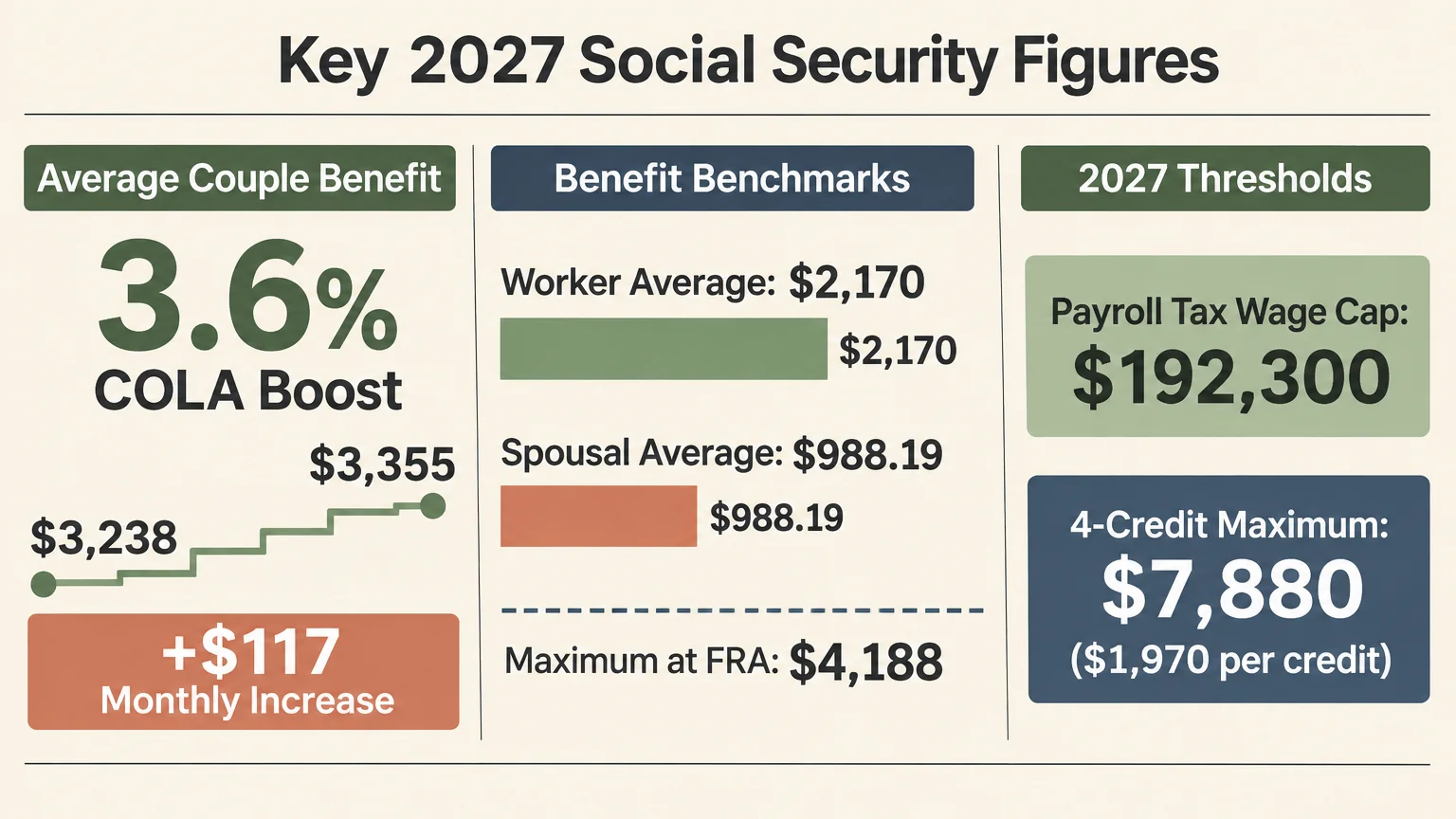
Social Security and Supplemental Security Income benefits rise by 3.6% for 2027, starting with January 2027 Social Security payments. According to the Social Security Administration, that adjustment raises the average monthly payment for an aged couple from $3,238 to $3,355.
That $117 monthly boost offers welcome breathing room, while the average individual retired worker benefit climbs by $75 to $2,170 per month. Still, spousal checks remain significantly smaller than primary worker checks for most households.
As of October 2026, roughly 2.1 million spouses of retired workers received an average monthly benefit of $988.19 prior to the 2027 increase. Maximizing every dollar of that secondary income stream starts with understanding how the broader program shifts in 2027.
For higher earners retiring at Full Retirement Age in 2027, the maximum monthly benefit reaches $4,188, up from $4,152 in 2026. If either spouse still works, payroll taxes apply on earnings up to $192,300 in 2027.
Workers also need $1,970 in earnings to earn a single credit in 2027, or $7,880 for the annual maximum of four credits toward the 40-credit threshold. You can review your personal earnings history anytime through the my Social Security portal.
Long-term program solvency adds another planning layer for couples mapping out a thirty-year retirement. The 2026 Social Security Trustees’ Report projects that retirement trust fund reserves will be depleted in late 2032.
Even if Congress delays legislative fixes until that deadline approaches, ongoing payroll taxes will still fund a substantial share of scheduled benefits. Building resilient non-Social Security income streams remains essential—yet optimizing your spousal claim right now delivers guaranteed returns.
Rule 1: Master Eligibility, the 50% Cap, and the Age-67 Milestone
The first rule governs who qualifies for a spousal check, when the benefit stops growing, and how deeply early filing cuts your income. Many couples assume spousal benefits mirror worker benefits, which leads to costly delays or premature claims.
Eligibility Rules for Current and Divorced Spouses
To claim on a current spouse’s record, you generally must be at least age 62 and married for at least one continuous year. That one-year marriage rule is waived in limited situations, such as parenting a mutual child.
You can also qualify at any age if you care for the working spouse’s child under age 16 or a child with a disability entitled on that record. Critically, your working spouse must already be receiving Social Security retirement or disability benefits.
Divorced spouses follow different rules that protect your independence after a split. You may claim on an ex-spouse’s record if your marriage lasted at least 10 consecutive years, you are at least age 62, and you remain currently unmarried.
If your former spouse has not yet filed, you can still claim independently once your ex turns 62 and your divorce has been final for at least two continuous years. Paying a spousal or divorced-spouse benefit never reduces the worker’s own monthly check.
Why Waiting Past 67 Adds Zero to Spousal Checks
The maximum spousal benefit equals 50% of the working spouse’s Primary Insurance Amount, known as the PIA. Your spouse’s PIA is the exact benefit they earn at their own Full Retirement Age.
Unlike standard retirement benefits, spousal benefits do not earn delayed retirement credits past your own Full Retirement Age. Waiting until age 70 to claim a spousal benefit leaves three years of checks on the table for zero extra monthly gain.
Spousal benefits also exclude any delayed retirement credits your working spouse earns between Full Retirement Age and age 70. While your partner grows their own check by 8% per year up to age 70, your 50% spousal cap stays locked to their PIA.
The Steep Cost of Claiming Early at Age 62
During 2027, individuals born in 1960 become the first cohort with a Full Retirement Age of 67 to reach that milestone. Everyone born in 1960 or later shares an FRA of 67, completing the schedule enacted under the 1983 Social Security Amendments.
Note one technical calendar quirk from SSA rules: people born on January 1 fall under the prior year’s schedule. For anyone with an FRA of 67, claiming before that birthday triggers steep permanent reductions.
SSA reduces early spousal benefits by 25/36 of 1% per month for the first 36 months before Full Retirement Age. Each additional month beyond 36 reduces the check by another 5/12 of 1%.
If you claim at age 62 with an FRA of 67—exactly 60 months early—your spousal rate drops permanently to 32.5% of your spouse’s PIA. That represents a 35% cut compared to waiting until age 67 for the full 50% maximum.
Consider a hypothetical couple where the higher earner has a PIA of $2,400 per month. Waiting until age 67 delivers a $1,200 monthly spousal check, whereas claiming at age 62 locks in just $780 per month.
That $420 monthly gap equals $5,040 per year before annual cost-of-living adjustments. You should test different claiming ages using the Social Security Administration benefit calculators and review the numbers with a licensed financial advisor.
Rule 2: Navigate Deemed Filing Before You Submit an Application
The second rule catches couples who remember old retirement strategies from a decade ago. Under the Bipartisan Budget Act of 2015, anyone who turned 62 on or after January 2, 2016 faces mandatory deemed filing rules.
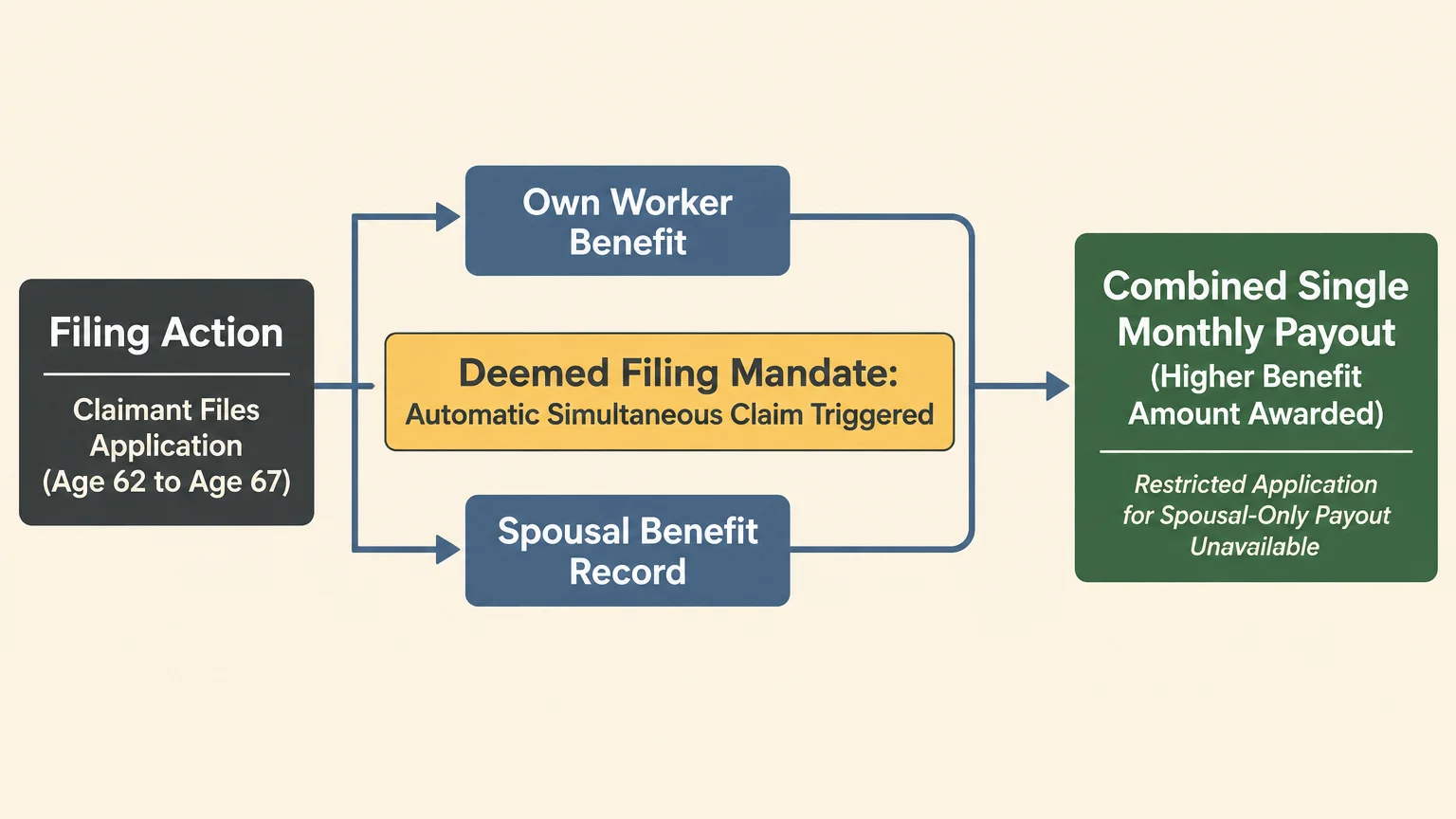
Deemed filing means you cannot choose to take only a spousal benefit while letting your own retirement record grow untouched. Applying for either your own retirement benefit or a spousal benefit automatically files you for both if you are eligible.
How SSA Combines Your Record and Spousal Excess
Deemed filing applies at age 62, at Full Retirement Age, and at every age beyond. When you submit an application, SSA always pays your own earned retirement benefit first.
If 50% of your spouse’s PIA exceeds your own PIA, SSA adds an excess spousal amount—essentially a top-up—to bring your total toward the higher threshold. If your own benefit is reduced for early filing, that reduction stays baked into your combined check.
Suppose your own PIA at age 67 is $900, and your spouse’s PIA is $2,600. Because 50% of your spouse’s PIA equals $1,300, you qualify for an excess spousal top-up of $400 on top of your $900 retirement benefit.
Under older rules, you could have claimed a restricted spousal benefit at Full Retirement Age and delayed your own benefit until age 70 to earn 8% annual credits. Deemed filing eliminates that strategy entirely for modern retirees.
Only narrow exceptions bypass deemed filing today. You remain exempt if you receive disability benefits or if you qualify for spousal benefits because you care for a child under age 16 or a child with a disability.
Coordinating Claiming Dates Across Your Household
Because deemed filing links both records, you must coordinate your claiming date with your spouse’s timeline. Remember that you cannot collect a current-spouse top-up until your working partner actively claims their own retirement or disability benefit.
If you earned a smaller work history and want to start cash flow at 62, you can file on your own record first. Later, when your higher-earning spouse claims at age 67 or 70, SSA automatically adds your excess spousal benefit.
Wait until your own Full Retirement Age to apply for that spousal top-up, however, or early-claiming penalties will still shrink the excess portion. Balancing immediate cash flow against higher survivor protection takes careful modeling with a fiduciary planner.
Rule 3: Factor In the 2027 Earnings Test and the GPO Repeal
The third rule addresses two major income adjustments that alter how much cash actually reaches your bank account in 2027. One temporarily trims checks if you keep working; the other permanently restores benefits for many public-sector households.
Working While Claiming Before Full Retirement Age
Many retirees transition gradually out of the workforce through consulting, seasonal jobs, or part-time roles. If you claim spousal benefits before reaching Full Retirement Age, the 2027 Retirement Earnings Test limits how much wage income you can earn without withholdings.
If you remain under Full Retirement Age for all of 2027, you can earn up to $25,560 per year—or $2,130 per month—before penalties kick in. That threshold rises from $24,480 in 2026.
SSA withholds $1 in benefits for every $2 you earn above $25,560. Note that passive income from pensions, annuities, portfolio dividends, and retirement account withdrawals does not count toward this earnings limit.
A higher limit applies if you reach Full Retirement Age during 2027. In the months before your FRA birthday month, you can earn up to $67,920—or $5,660 per month—with $1 withheld for every $3 earned above the cap.
Beginning in the exact month you reach Full Retirement Age, the earnings test vanishes completely. You can earn unlimited wages without losing a single dollar of your monthly spousal or retirement check.
Consider a hypothetical spouse under FRA all year who claims benefits and earns $31,560 from part-time work. Those earnings exceed the $25,560 limit by $6,000, prompting SSA to withhold $3,000 in benefits during the year.
Withheld checks are not lost forever, though they disrupt short-term cash flow. Once you reach Full Retirement Age, SSA recalculates your monthly payment upward to credit back the months withheld.
New Opportunities for Public-Sector Spouses After GPO Repeal
For decades, the Government Pension Offset slashed spousal and survivor checks by two-thirds of any pension earned from non-Social Security-covered government employment. Public school teachers, firefighters, police officers, and federal retirees under older civil service systems often saw their spousal benefits wiped out completely.
Everything changed when the Social Security Fairness Act became law on January 5, 2025. That legislation repealed both the Government Pension Offset and the Windfall Elimination Provision retroactively for benefits payable in January 2024 and later.
December 2023 marked the final month those reductions applied. If you receive a non-covered government pension, your public pension no longer reduces your 2027 spousal Social Security benefit by a single dollar.
If you already had a claim on file, SSA adjusted benefits and processed retroactive payments under the repeal. However, countless eligible spouses never bothered applying in past years because the two-thirds offset reduced their projected benefit to zero.
If you never filed an application due to the old offset, you must submit a fresh claim with SSA to begin receiving checks. Retroactive pay on a newly filed claim is generally capped at six months, so delaying your application costs real money.

Aligning Spousal Benefits With Pensions, Annuities, and Portfolio Withdrawals
Claiming Social Security in a vacuum undermines your broader retirement paycheck. Your spousal benefit works best when coordinated alongside workplace pensions, annuity contracts, and investment portfolio withdrawals.
Start by examining your pension payout elections if either spouse holds a traditional defined-benefit plan. Selecting a joint-and-survivor pension option lowers your initial monthly pension slightly, yet protects the surviving spouse if the pensioner dies first.
Pair that decision with your Social Security timing strategy. Often, the higher-earning spouse delays Social Security until age 70 to maximize both their own check and future survivor benefits, while the lower-earning spouse claims earlier or draws moderately from retirement accounts.
Using portfolio withdrawals to bridge the gap between retirement and age 70 can dramatically reduce sequence-of-returns risk. Instead of forcing your nest egg to fund 100% of living expenses through your seventies and eighties, you lock in inflation-adjusted lifetime income.
If you lack a traditional pension and worry about market downturns draining your accounts, an immediate or deferred fixed income annuity can help cover fixed monthly bills. Before buying any annuity contract, scrutinize surrender charges, insurer credit ratings, and inflation riders.
You can verify how retirement products and advisors are regulated through the SEC Investor.gov portal. Always remember that a bridge withdrawal plan requires personalized stress-testing by a qualified fiduciary planner before you lock in irreversible elections.
Coordinating 2027 Tax Strategy and Medicare Costs
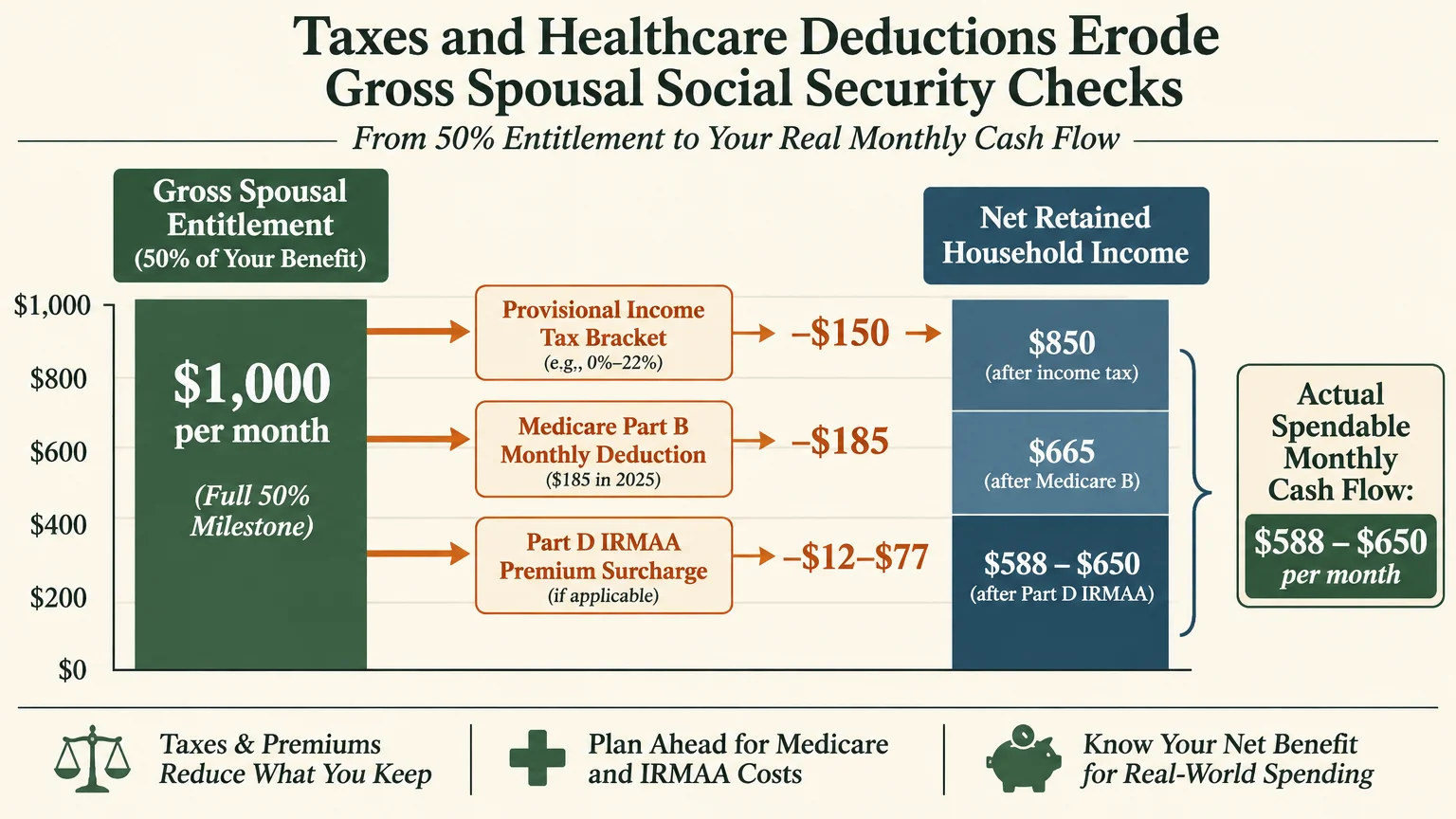
Gross Social Security figures tell only half the story because federal income taxes and Medicare deductions chip away at your net deposit. Proactive tax planning in 2027 helps couples keep more of every spousal dollar.
Managing Social Security Taxation and 2027 Senior Deductions
The IRS taxes Social Security benefits using a formula called combined income, which adds adjusted gross income, nontaxable interest, and half of your annual Social Security benefits. Married couples filing jointly face taxes on up to 50% of benefits once combined income lands between $32,000 and $44,000.
Above $44,000 in combined income, up to 85% of your Social Security benefits become subject to federal income tax. Because those thresholds are not indexed to inflation, even modest IRA withdrawals frequently push middle-income couples into the 85% tier.
Fortunately, tax year 2027 brings generous deductions that cushion older households. According to IRS Revenue Procedure 2026-35, the standard deduction for married couples filing jointly rises to $33,200 in 2027.
Better yet, for tax years 2025 through 2028, taxpayers age 65 or older can claim an enhanced $6,000 senior deduction per eligible spouse, or $12,000 for a qualifying couple. You can claim this bonus whether you take the standard deduction or itemize, though it phases out above $150,000 in modified adjusted gross income for joint filers.
That higher deduction window creates a golden opportunity for smart withdrawal sequencing. Drawing selectively from taxable brokerage accounts, Roth IRAs, or Health Savings Accounts can keep your combined income lower and preserve eligibility for the senior deduction.
Look closely at Required Minimum Distributions from traditional IRAs and workplace 401(k) plans before they begin. Executing partial Roth conversions during lower-income gap years—after leaving work and before claiming Social Security—shrinks future forced distributions that otherwise trigger higher benefit taxes.
Consult a certified public accountant and review official IRS guidance for seniors and retirees before executing multi-year Roth conversions.
Accounting for 2027 Medicare Part B Premiums and IRMAA
Most retirees have Medicare Part B premiums deducted straight out of their monthly Social Security deposits. According to the Centers for Medicare & Medicaid Services, the standard monthly Part B premium rises 3.2% in 2027 to $209.40, up $6.50 from $202.90 in 2026.
The annual Medicare Part B deductible also climbs to $292 in 2027, up from $283 in 2026. For a couple both enrolled in Part B, standard monthly deductions alone subtract $418.80 from your combined Social Security deposits.
Higher-income couples must also watch out for the Income-Related Monthly Adjustment Amount, known as IRMAA. If your modified adjusted gross income from two years prior exceeds statutory tiers, Medicare adds surcharges onto both your Part B and Part D premiums.
Large capital gains from selling a home, big one-time IRA withdrawals, or aggressive Roth conversions in 2025 can inflate your 2027 Medicare premiums. Keeping an eye on the official Medicare cost overview helps you anticipate net cash flow accurately.
If either spouse still works and retains eligibility for a Health Savings Account before enrolling in Medicare, maximize those tax-advantaged contributions. HSA dollars grow tax-free and pay for qualified medical costs, Medicare premiums, and long-term care expenses without raising your combined income.
Protecting Your Spouse, Long-Term Care, and Legacy
A strong claiming strategy protects your household not just this year, but when one partner eventually faces serious health challenges or passes away. Overlooking protection and legacy details can leave a surviving spouse financially exposed.
First, understand what happens to Social Security when one spouse dies. The household loses the smaller monthly check, while the surviving spouse steps up to 100% of the higher check—which is why maximizing the higher earner’s benefit up to age 70 serves as built-in survivor insurance.
Second, integrate long-term care funding into your cash-flow plan early. Medicare covers limited short-term rehabilitation, leaving families to cover prolonged assisted living or memory care out of pocket unless they carry dedicated insurance or substantial liquid reserves.
Third, stay vigilant against Social Security impersonation scams targeting older adults. Scammers routinely call, text, or email claiming your benefits are suspended or demand gift cards, wire transfers, or cryptocurrency to restore a record.
SSA never threatens arrest, never demands immediate payment, and never asks for sensitive banking details over unsolicited calls. Hang up immediately and verify your status directly inside your secure online account.
Finally, audit your estate basics alongside your claiming paperwork. Confirm that your wills, durable powers of attorney, healthcare proxies, and primary plus contingent beneficiary designations on every IRA, 401(k), annuity, and bank account match your current wishes.
Beneficiary forms override what you write in a will, so outdated designations after a marriage, divorce, or birth can accidentally disinherit a spouse. Reviewing those records annually keeps your family’s transition seamless.
Frequently Asked Questions About Spousal Benefits in 2027
Can I work part time after claiming spousal benefits in 2027?
Yes, you can work part time, though your earnings face limits if you claim before Full Retirement Age. In 2027, SSA withholds $1 for every $2 earned above $25,560 if you remain under FRA all year.
If you reach FRA during 2027, the higher $67,920 cap applies to months prior to your FRA birthday, with $1 withheld per $3 over. Once you hit Full Retirement Age, no earnings cap applies.
Is the 3.6% Social Security COLA enough to protect my purchasing power?
The 3.6% increase helps offset everyday price inflation, yet healthcare and housing costs frequently outpace general consumer indexes. Because 2027 Medicare Part B premiums rise to $209.40 per month, medical deductions absorb a slice of your raise.
Protect your lifestyle by pairing Social Security with inflation hedges inside your portfolio, such as Treasury Inflation-Protected Securities, diversified dividend-growing equities, and a two-year cash reserve. A diversified asset mix prevents you from selling depressed stocks to cover rising bills.
How should we evaluate financial advisor fees when building a claiming strategy?
Seek a fiduciary advisor legally obligated to put your household’s interests first, and ask for a clear written breakdown of every fee before signing. Advisors generally charge flat project fees, hourly rates, or ongoing percentages of assets under management.
If you only want a customized Social Security, tax, and withdrawal roadmap rather than ongoing investment management, an hourly or flat-fee fiduciary plan often costs far less over time. Always verify an advisor’s background, licenses, and disciplinary history before sharing financial statements.
How do spousal benefits differ from surviving spouse benefits?
Spousal benefits while both partners are alive cap at 50% of the working spouse’s PIA and never include the worker’s delayed retirement credits. By contrast, survivor benefits for a widow or widower can reach up to 100% of what the deceased spouse received or earned.
Crucially, survivor benefits do include any delayed retirement credits the working spouse accumulated up to age 70. Surviving spouses can also claim survivor benefits separately from their own retirement record, switching between the two to maximize lifetime income.
Your Pre-Filing Checklist for 2027
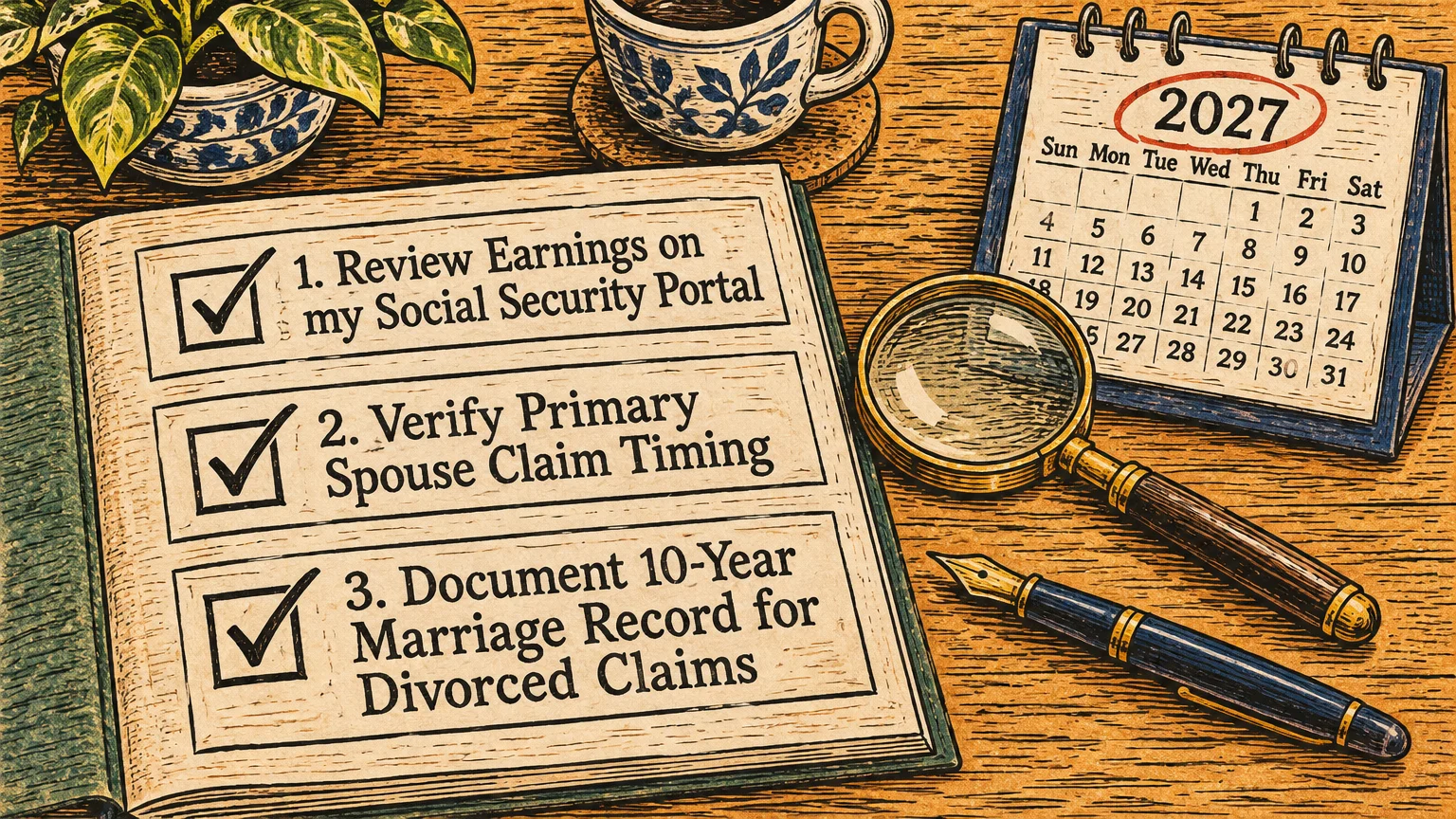
Timing your spousal Social Security claim in 2027 rewards deliberate preparation over guesswork. Start by downloading updated benefit statements for both spouses so you know your exact Primary Insurance Amounts and full retirement dates.
Verify whether either partner holds a non-covered government pension now eligible for full benefits after the GPO repeal, and double-check your projected 2027 wage earnings against the retirement earnings test limits. Next, map how your combined benefits interact with the $33,200 joint standard deduction, the enhanced senior deduction, and Medicare Part B thresholds.
Before you click submit on any Social Security application, schedule a coordinated check-in with a licensed fiduciary planner, a qualified tax professional, and an estate attorney. A few hours of coordinated planning now can secure thousands in extra net income and lasting peace of mind for both of you.